3281 E. Guasti Rd, STE 700, Ontario, CA 91761
1712 9th Ave SW, Watertown, SD 57201

Author: Lance Reichenberger, Ph.D.
Less than 1,000 defense contractors have secured a final certification status as of early 2026. This tiny group represents a fraction of the 80,000 firms that must meet CMMC level 2 requirements to keep their revenue alive. You feel the pressure. The Department of Defense moved past the suggestion phase on November 10, 2025. Now, the phased rollout is active. You know that missing the mark on your SPRS score is not just a technical error. It is a business threat that could end your participation in the Defense Industrial Base.
Lance Reichenberger, Ph.D. breaks through the noise to show you how to handle the 110 NIST 800-171 controls. We focus on the technical reality of your network. Paperwork alone won't save you. This guide provides the checklist you need to manage Controlled Unclassified Information with absolute certainty. You will see the specific steps to move from a conditional status to a final certification. We look at the 180 day limits on POA&Ms. Protect your contracts before the November 10, 2026 expansion.
Contact Trinity Networx, LLC to secure your compliance at https://www.trinitynetworx.com/contact-us. Share this guide on LinkedIn, X, or via email to help your partners stay ready.
• Stop relying on paperwork alone. Learn how to generate the technical evidence required for all 110 NIST 800-171 controls.
• Identify the CMMC level 2 requirements that dictate how your network handles Controlled Unclassified Information.
• Master the scoping process to isolate CUI. This prevents expensive compliance errors.
• Execute a gap analysis that prepares your Southern California shop for a rigorous third-party audit.
• Understand why your SPRS score is the ultimate metric for your business health in the defense market.
Level 2 is the line in the sand for the modern defense contractor. It represents the "Advanced" tier of the DoD cybersecurity framework. If your business handles Controlled Unclassified Information (CUI), these rules are your new reality. The Department of Defense no longer accepts "best efforts" or vague promises of future security. You either prove you can protect the data, or you lose the contract. The CMMC level 2 requirements center on 110 specific security controls. These are pulled directly from NIST SP 800-171 Revision 2. While a third revision exists, the DoD currently demands adherence to Revision 2 for all certification activities.
The stakes are absolute. Failure to meet these standards results in immediate exclusion from the Defense Industrial Base. This is not a slow phase-out. It is a hard stop. The Cybersecurity Maturity Model Certification (CMMC) ensures that every link in the supply chain is hardened against foreign threats. You must show evidence for every control. This includes technical logs, active monitoring, and written policies that govern your daily operations. If you can't produce the proof, you can't win the work.
Level 1 was about basic cyber hygiene. It involved 15 simple controls that most businesses already had in place. Level 2 is a massive leap forward. You move from 15 controls to the full set of 110. This transition demands active management rather than passive observation. You must track how data moves through your shop. If your contract specifies "Advanced" data protection, basic hygiene is no longer enough. You need a system that identifies, protects, and responds to threats in real time. This is about moving from a static posture to a dynamic defense of CUI.
The clock started on November 10, 2025. This marked the beginning of Phase 1. Many contractors are now required to execute annual self-assessments. You must calculate your score and upload it to the Supplier Performance Risk System (SPRS). This is not a task for a junior IT person. A senior official in your organization must sign off on the accuracy of these scores. They are personally affirming that the company meets the CMMC level 2 requirements. False affirmations carry severe legal risks. You need a clear, evidence-based score before you hit that submit button.
Contact Trinity Networx to secure your compliance at https://www.trinitynetworx.com/contact-us. Share this guide on LinkedIn, X, or via email to help your partners stay ready.
Author: Lance Reichenberger, Ph.D.
The 110 controls are not just a list. They are a map of your entire operation. These requirements are categorized into 14 distinct security families. Think of these as domains. Access Control, Incident Response, and Media Protection are just a few. Each domain demands a specific outcome. You must prove how you restrict system access. You must show how you handle a breach. It isn't enough to say you do it. You have to prove it through technical evidence and written policy. This is the heart of CMMC level 2 requirements. You cannot skip a single domain and expect to pass.
Meeting these standards means looking beyond your digital firewall. Physical protection is just as vital. Locked server rooms and visitor logs are part of the framework. If a bad actor can walk up to your server, your encryption doesn't matter. The Department of Defense expects a complete shield around your data. For those looking for the source, the official CMMC program information provides the regulatory context for these 14 families. Every control is a piece of a larger puzzle. If one piece is missing, the whole picture fails.
Controls fall into two buckets. Technical controls are the software and hardware settings you change. Multi-factor authentication (MFA) is a classic example. Encryption of data at rest is another. Administrative controls are the human side. These involve employee training and keeping detailed access logs. You need both to pass. A secure firewall is useless if an untrained employee gives away their password. You must verify that your staff knows how to handle CUI. This is where many companies stumble. They focus on the hardware but forget the people.
Auditors don't take your word for it. They look for "artifacts." These are the physical or digital footprints of your security. System logs and configuration files serve as proof. You also need a System Security Plan (SSP). This document describes how you meet every single control. If you have gaps, you use a Plan of Action and Milestones (POAM). Under current rules, you have 180 days to fix POAM items. Waiting until the last minute is a recipe for failure. If you need help mapping your current controls, reach out to an expert who understands the manufacturing floor.
Contact Trinity Networx to secure your compliance at https://www.trinitynetworx.com/contact-us. Share this guide on LinkedIn, X, or via email to help your partners stay ready.
Author: Lance Reichenberger, Ph.D.
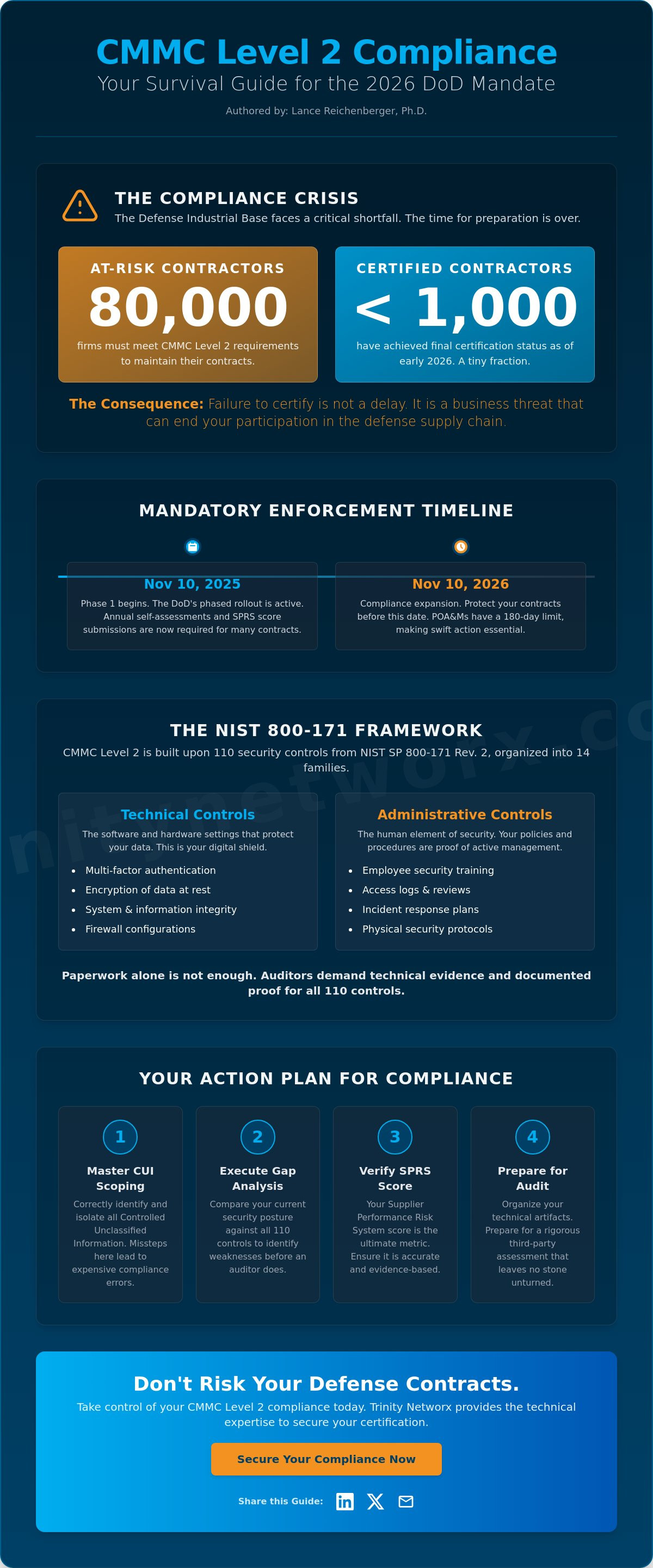
Your SPRS score is a live reflection of your business health. It is not a static number you file once and forget. The calculation is brutal but clear. You start with a perfect 110. For every control you haven't mastered, points vanish. Some failures carry a heavy 5-point penalty. Others cost 1 or 3 points. If you finish with a negative number, you're effectively invisible to DoD contract officers. Achieving CMMC level 2 requirements means fighting for every single point until you hit that 110 mark. This score lives in the Supplier Performance Risk System. The DoD uses it to decide if you are a liability or an asset.
Scoping is the second hurdle where contractors trip. It defines the fence around your data. If you don't know exactly where Controlled Unclassified Information (CUI) travels, you can't protect it. Many small machine shops make the mistake of over-scoping. They try to make their entire building compliant. This makes the project too expensive and slow. Conversely, under-scoping is a legal landmine. If an auditor finds CUI on an unmanaged device, your certification dies on the spot. You must draw a hard line between your business operations and your defense work.
Honesty is your only protection. The DoD is cracking down on False Claims Act violations. If you submit a score of 110 but don't have the logs to prove it, the consequences are severe. Focus on the high-weight controls first. These are the basic requirements that carry 5-point penalties. They are the low-hanging fruit that can save your score from a nose-dive.
• Identify every 5-point penalty control you currently miss.
• Document your plan to fix these gaps within 180 days.
• Submit your score truthfully to maintain your standing in the DIB.
Update your score as you fix your network. It shows the government that you are proactive and reliable.
Isolation is the key to a manageable budget. You must map exactly where defense data enters, stays, and leaves your facility. Don't let CUI bleed into your guest Wi-Fi or payroll systems. You can apply it-infrastructure strategies to isolate sensitive data into a secure enclave. Segmenting your network reduces the number of devices you have to manage. This keeps your costs down while ensuring you meet CMMC level 2 requirements. A smaller boundary is easier to defend and cheaper to audit.
Contact Trinity Networx, LLC to secure your compliance at https://www.trinitynetworx.com/contact-us. Share this guide on LinkedIn, X, or via email to help your partners stay ready.
Author: Lance Reichenberger, Ph.D.
Southern California manufacturers face a hard deadline. You cannot afford a wait and see approach. Start with a gap analysis against the 14 NIST domains immediately. This isn't a suggestion. It is the foundation of your defense. You must deploy Multi-Factor Authentication (MFA) across every system that touches CUI. This includes shop floor workstations and office laptops. If a user can see sensitive data, they must prove their identity twice. These are the non-negotiable CMMC level 2 requirements for 2026. Do not let a single unmanaged device put your contracts at risk.
Your business needs an Incident Response Plan that actually works. Don't let a breach be the first time you test your recovery steps. Establish clear protocols for reporting and containment. You also need continuous monitoring to stay ahead of threats. Your it-management strategy should include real-time alerts. Finally, check your backups. They must be encrypted and stored off-site. If your local server fails, your business shouldn't fail with it. Secure your data now to avoid a total operational halt. Proactive security is the only way to maintain your momentum in the defense industry.
Access Control is the first gate. Limit system entry to people who need it for their specific jobs. Identification and Authentication comes next. Verify every user and device on your network before they touch data. Media Protection is often ignored in manufacturing environments. You must sanitize or destroy old drives that held sensitive data. Don't leave old CAD workstations in the corner of the shop with CUI still on the disk. Also, pay attention to Configuration Management. You must control how your systems are set up and prevent unauthorized software from entering your environment. Physical Protection is equally vital. Lock your server rooms and monitor who enters your facility.
Review your System Security Plan with an expert. This document is your primary defense during an audit. Follow the detailed how to become CMMC compliant steps to ensure no control is left behind. Schedule a mock audit. It is better to find a hole in your security now than during an official assessment. This proactive step saves your contracts and your reputation. Reach out to schedule your readiness review today to ensure your SPRS score is accurate and defensible.
Contact Trinity Networx to secure your compliance at https://www.trinitynetworx.com/contact-us. Share this guide on LinkedIn, X, or via email to help your partners stay ready.
Author: Lance Reichenberger, Ph.D.
Generic IT providers don't understand the weight of defense regulations. They might keep your email running, but they often lack the depth needed for a federal audit. Trinity Networx builds security for Southern California machine shops with a focus on active defense. We know the Inland Empire manufacturing floor. We understand how data moves from a CAD workstation to a CNC machine. Our team bridges the gap between technical settings and the strict evidence auditors demand. Meeting CMMC level 2 requirements is about more than just checking boxes. It is about building a wall around your business health.
We don't just react to problems. We drive progress. You need a partner who acts as a strategic driver for your growth. Waiting for a contract to require certification is a dangerous gamble. We help you stay ahead of the phased rollout that began in late 2025. Your network must match your SPRS score every single day. We provide the stability your business needs to win and keep DoD contracts. Our approach is direct and results oriented.
You must know who does what. An MSP prepares your network. They maintain the 110 controls and gather the evidence. A C3PAO is the auditor. They perform the final check and issue your certification. They cannot grade their own work, so you need a separate partner for readiness. If you already have an IT team, you can use co-managed IT support to give them the tools they need. This adds expert layers to your existing staff without forcing you to start over. It ensures your CMMC level 2 requirements are met with precision and reliability.
The deadline of November 10, 2026, is approaching fast. Start your gap analysis today. If you wait, you risk losing your status in the Defense Industrial Base. Contact Lance Reichenberger, Ph.D. for a readiness review that looks at your specific network state. We move fast because your business moves fast. Contact Trinity Networx for CMMC Support and secure your future in the defense market. Don't let compliance be the reason you lose your best contracts.
Contact Trinity Networx to secure your compliance at https://www.trinitynetworx.com/contact-us. Share this guide on LinkedIn, X, or via email to help your partners stay ready.
The clock is ticking on your next contract award. You've seen how the 110 NIST controls create a hard boundary for your business. Meeting CMMC level 2 requirements isn't just about passing an audit. It is about proving your reliability to the Department of Defense. You must align your technical reality with your SPRS score before the November 10, 2026 expansion hits. Precise scoping is the only way to keep your costs under control while staying in the game.
Don't let technical confusion stall your growth. Trinity Networx brings deep expertise in Southern California manufacturing IT to your shop floor. Led by Lance Reichenberger, Ph.D., we provide the assertive reliability you need to stay compliant. We back our service with a 20-minute response time guarantee. Stop guessing about your readiness and start acting. Secure Your DoD Contracts: Contact Trinity Networx Today. Your team has the skill to build the best defense products; we have the skill to protect them.
Author: Lance Reichenberger, Ph.D.
CMMC Level 2 is only mandatory for contractors who handle Controlled Unclassified Information (CUI). If your work only involves Federal Contract Information (FCI), you only need Level 1. Check your contract for the DFARS 252.204-7021 clause to be sure. Most defense manufacturers will need to meet CMMC level 2 requirements because technical drawings and specs are almost always CUI. This requirement applies even if you are not the prime contractor.
You can perform a self-assessment for Phase 1 contracts. This phase started on November 10, 2025. You must upload your score to the SPRS database. However, once Phase 2 starts on November 10, 2026, many contracts will demand a third-party assessment from a C3PAO. Don't assume a self-assessment is a permanent fix for your business. You must prepare for a professional auditor to visit your facility.
Compliance costs depend on the complexity of your network and the data you handle. Small businesses must account for hardware upgrades, software licenses, and physical security. You should also budget for annual maintenance, which often runs between 20% and 30% of the initial setup cost. Don't wait for a quote to start fixing basic gaps in your network hardware. Proactive spending now prevents a rush as the 2026 deadline approaches.
A score below 110 indicates gaps in your network security. You can still reach a "Conditional" status if you score at least 88 points. This requires that you meet all high-weight controls. You have exactly 180 days to fix the remaining items after your assessment. Failing to reach the 88 mark means you lose eligibility for many DoD contracts. Your score must be an honest reflection of your actual network state.
Most manufacturers spend 6 to 18 months preparing for an audit. Your timeline depends on your current security state and available resources. If you haven't started your gap analysis, you are already behind the 2026 deadlines. Meeting CMMC level 2 requirements takes time because you must gather evidence for every control. You cannot rush the documentation process without risking an audit failure. Start mapping your data flow today to save time later.
Level 1 has 15 basic controls for protecting FCI. Level 2 jumps to 110 controls designed to protect CUI. Level 1 is a self-assessment for basic hygiene. Level 2 is a rigorous standard that often requires third-party verification. The jump from 15 to 110 controls is the hardest hurdle for growing defense contractors. It requires a move from simple passwords to advanced identity management.
Subcontractors must meet the same requirements as primes if they handle the same level of data. Requirements flow down through the supply chain. If a prime contractor sends you CUI, you must prove you can protect it. Many prime contractors now audit their own vendors to protect their own certifications. You don't want to be the weak link that costs your partner a major contract.
You can only use a Plan of Action and Milestones (POAM) for specific, low-weight controls. High-weight controls must be fully met before the assessment begins. Any POAM you use must be closed within 180 days of the assessment date. If you don't close the items in that window, your certification will be revoked. This rule is strict and leaves no room for procrastination.
Contact Trinity Networx to secure your compliance at https://www.trinitynetworx.com/contact-us. Share this guide on LinkedIn, X, or via email to help your partners stay ready.

Article by
Lance Reichenberger, Ph.D.
Dr. Lance Reichenberger is the founder of Trinity Networx, a Southern California technology firm specializing in managed IT services, cybersecurity, network infrastructure, and business technology strategy. With nearly four decades of experience in the IT industry, he works with businesses to improve operational efficiency, strengthen security, and align technology with long-term growth objectives.
Lance focuses on proactive IT management, enterprise wireless infrastructure, cybersecurity integration, and scalable technology solutions for growing organizations throughout Southern California.
The content published on this website is provided for general informational and educational purposes only. Articles may be created, edited, or enhanced with the assistance of artificial intelligence and automation tools under the direction and review of Trinity Networx. While every effort is made to ensure accuracy and relevance, the information provided should not be considered professional, legal, financial, cybersecurity, or technical advice specific to your organization. Businesses should consult directly with a qualified professional regarding their unique environment, compliance requirements, and operational needs. Trinity Networx makes no warranties regarding completeness, reliability, or applicability of the information contained within these articles.
Schedule a brief conversation with Trinity Networx to discuss your business technology needs.
Get a practical roadmap built around your business, your users, your systems, and the technology issues that need attention first.
Put the right technology, support, security, and infrastructure in place so your business can grow, adapt, and move forward with confidence.