3281 E. Guasti Rd, STE 700, Ontario, CA 91761
1712 9th Ave SW, Watertown, SD 57201

By: Lance Reichenberger, Ph.D.
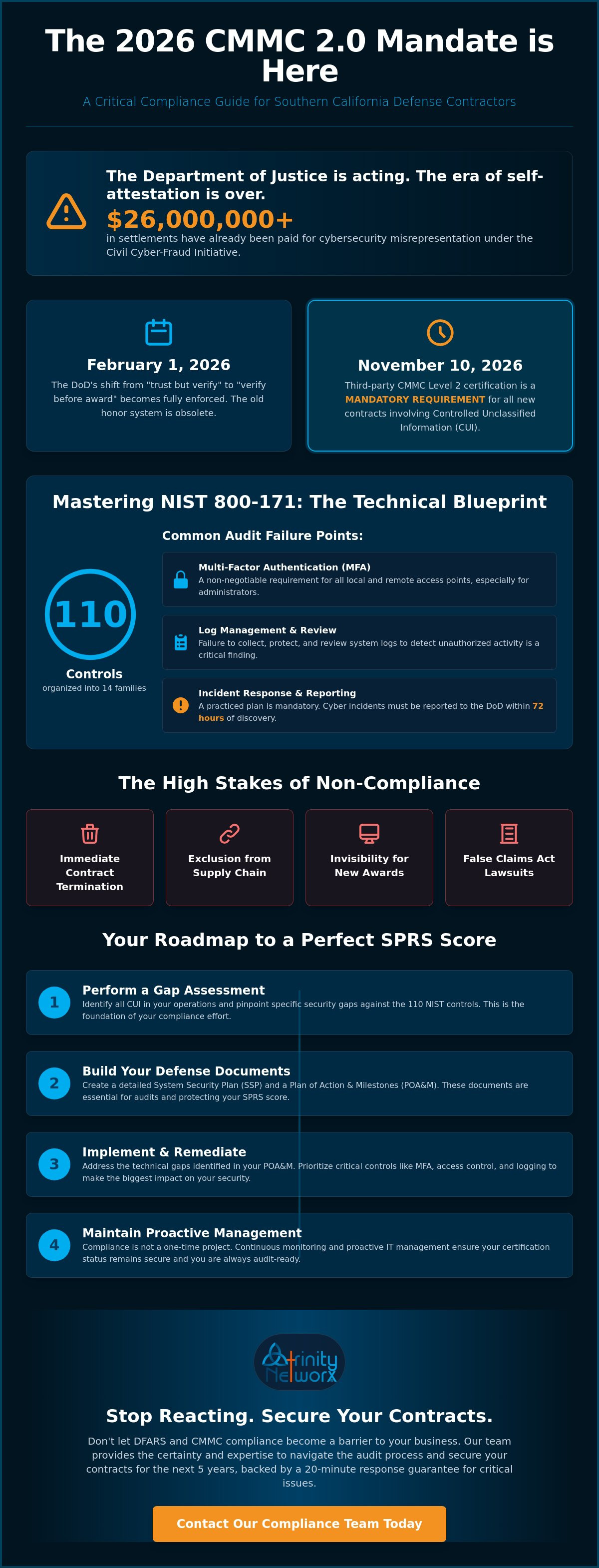
The Department of Justice isn't just watching. They're acting. Since the launch of the Civil Cyber-Fraud Initiative, settlements for cybersecurity misrepresentation have topped $26 million. For those managing DFARS compliance for defense contractors in Southern California, the era of checking boxes and hoping for the best ended on February 1, 2026. You likely feel the weight of the November 10, 2026, deadline. This is when third party CMMC Level 2 certification becomes a hard requirement for new contracts involving CUI. It's a technical barrier to entry. We're here to help you clear it.
Compliance feels like a moving target that drains your budget and distracts your team. It's frustrating to watch technical debt pile up while the 2026 CMMC rollout nears. You need certainty. This guide provides a clear roadmap to a high SPRS score and long term contract security for the next 5 years. We will break down NIST 800-171 Revision 2 requirements and the specific steps needed to survive a C3PAO audit in the SoCal aerospace hub. Stop reacting. Start securing your future.
• Verification is the new standard. DFARS 252.204-7012 requires proof, not just promises, to keep your contracts active in 2026.
• Master the 110 NIST 800-171 controls. We identify the specific security gaps that cause most audit failures for small defense firms.
• Prepare for the CMMC transition. DFARS compliance for defense contractors in Southern California is the mandatory baseline for Level 2 certification.
• Build your defense with an SSP and POA&M. These documents fix technical gaps and protect your SPRS score from point deductions.
• Don't settle for reactive support. Proactive IT management keeps your certification status secure with a 20-minute response guarantee for critical issues.
DFARS 252.204-7012 isn't a suggestion. It's a mandate. For years, contractors treated it as a minor bureaucratic hurdle. That posture ended on February 1, 2026. The Department of Defense (DoD) shifted from a "trust but verify" model to "verify before award." This clause governs how you safeguard Controlled Unclassified Information (CUI). It's a critical supplement to the Federal Acquisition Regulation (FAR). If you handle sensitive data, you must implement the 110 controls of NIST 800-171 Revision 2. Failure doesn't just mean a slap on the wrist. It means immediate contract termination and potential exclusion from the defense supply chain.
Southern California is the heart of the aerospace industry. Procurement officers here are now monitoring Supplier Performance Risk System (SPRS) scores in real time. They won't wait for your annual review. If your score drops or your self-assessment expires, you're invisible for new awards. Subcontractors face even tighter pressure. Primes are shedding risky partners to protect their own standing. Waiting for a formal audit is a high risk strategy that usually ends in lost revenue. The DoD is using automated tools to flag anomalies in compliance reporting across the Inland Empire and Orange County hubs. You're either ready or you're out.
The old days of self-attestation are dead. You can't just say you're compliant. You need documented proof. Every one of the 110 controls requires evidence of implementation. Stated intent carries zero weight in a 2026 audit. The Department of Justice is actively pursuing cases under the False Claims Act. Settlements already exceed $26 million for cybersecurity misrepresentation. Your SPRS score is now the primary metric that determines your eligibility for every DoD contract award. It's a binary choice. You either meet the standard or you lose the business. We've seen local firms lose primary contracts in 72 hours due to failed incident reporting under the -7012 clause.
The financial risks are massive. Beyond the loss of current work, the cost of technical remediation after a failed audit is often triple the price of proactive management. The February 1, 2026, regulatory update renumbered several assessment obligations, but the core requirement remains. You must post an accurate score in SPRS. This score starts at 110 and drops for every unimplemented control. For DFARS compliance for defense contractors in Southern California, a perfect score is the only way to guarantee contractual security for the next five years.
Controlled Unclassified Information (CUI) is the lifeblood of your Department of Defense (DoD) contract. It isn't classified, yet its loss compromises national security. The NIST 800-171 standards provide the technical blueprint for protecting this data. These 110 controls are organized into 14 functional families, ranging from access control to incident response. For many firms, the sheer volume of requirements feels overwhelming. We simplify this by focusing on the high impact areas that directly protect your SPRS score. Modern it-infrastructure must account for both digital and physical access points. A secure server room is worthless if your shop floor workstations are left logged in and unattended.
Multi-Factor Authentication (MFA) is no longer a luxury. It's a hard requirement for every local and remote access point. If you aren't using MFA for system administrators and remote workers, you're failing a primary control. Log management is another frequent pitfall. You must collect, protect, and review system logs to detect unauthorized activity. Logs tell stories. Most firms don't read them until it's too late. Remember the 72-hour rule. You must report cyber incidents to the DoD within three days of discovery. This requires a practiced incident response plan, not a reactive panic. If your current setup feels like a liability, talk to our compliance team about a gap assessment.
CUI isn't always labeled clearly. In a machine shop, it often takes the form of digital blueprints, CAD models, or specific technical tolerances. If a document contains instructions on how to build a part for a military platform, it's likely CUI. Handling this data safely requires strict protocols. Digital files should live in encrypted environments with restricted access. Physical documents need more than a desk drawer. They require locked cabinets and a clear marking system. DFARS compliance for defense contractors in Southern California depends on your ability to track this data from the moment it enters your building until it's securely destroyed. Use this checklist for daily operations:
• Encrypt all CUI at rest and during transmission.
• Mark every physical page with the appropriate CUI header and footer.
• Limit data access to only those employees with a specific "need to know."
• Wipe CAD data from shop floor terminals immediately after a job is completed.
Small defense firms often fail because they treat cybersecurity as a separate department. It isn't. It's an operational reality. Technical controls must integrate with your physical facility security to create a unified defense. This proactive approach ensures your DFARS compliance for defense contractors in Southern California remains ironclad through 2026 and beyond. We don't just install software. We build the resilience required to keep your contracts secure.
By: Lance Reichenberger, Ph.D.
Ontario and Rancho Cucamonga manufacturers are in the crosshairs. If you run a shop floor in the Inland Empire, you already know that DFARS 252.204-7012 is the bedrock. It isn't just about data anymore. It is the technical precursor to CMMC Level 2. In 2026, the Department of Defense is moving with speed. They've stopped asking for promises. Now, they want proof. For DFARS compliance for defense contractors in Southern California, this means your self-assessment in SPRS must align perfectly with the looming C3PAO audits. You can't afford a gap between what you claim and what you've actually built.
Phase 1 began on November 10, 2025. It required Level 1 or Level 2 self-assessments for many new contracts. We're now approaching the critical November 10, 2026, deadline for Phase 2. This is where the game changes. New contracts involving CUI will mandate a verified CMMC Level 2 certification from a third party assessor. Level 1 remains a self-assessment for Basic Safeguarding. Level 2 is the gauntlet. Because Southern California holds the highest density of aerospace suppliers in the nation, local firms are seeing these requirements appear in RFPs earlier than their peers in other states. You can't hide in the noise. The DoD is prioritizing high-density hubs for early enforcement.
Shop floors present unique risks. Your legacy CNC machines likely run on outdated operating systems that can't be patched. These are massive security holes. You don't have to replace every machine. The smart move is network segmentation. By isolating your production hardware from the rest of your digital environment, you shrink the scope of your audit. This reduces the technical burden and lowers implementation costs. Beyond just checking a box, this approach drives it-optimization by improving overall network reliability and speed. It turns a compliance requirement into a performance gain.
Compliance isn't a one-time event. It is a continuous operational state. Manufacturers often struggle with the "flow down" requirements to their own vendors. If you're confused about the 2026 timeline, our CMMC compliance consultants guide offers a deeper look at the audit process. DFARS compliance for defense contractors in Southern California is about protecting your revenue. Don't let a legacy machine or a missed deadline end your DoD partnership. Get ahead of the Phase 2 rollout now. Secure your standing before the audit window closes.
Execution beats intention. Every single time. For DFARS compliance for defense contractors in Southern California, the margin for error has vanished. You need a tactical plan that procurement officers can't ignore. Start with a brutal gap assessment against all 110 NIST controls. Don't gloss over the hard parts. If your current encryption is weak or your logging is non-existent, face it now. Once you've mapped your failures, build your documentation and upload your score to the Supplier Performance Risk System (SPRS) immediately. An empty entry is an automatic disqualification. Finally, secure a local partner for 24/7 monitoring. Cyber threats don't wait for business hours. Neither should your defense.
Your System Security Plan (SSP) is the anchor of your entire compliance posture. It isn't a static PDF you file away and forget. It is a living record of how you protect CUI across your it-management stack. The SSP details every technical and administrative safeguard you have in place. Auditors look here first. If your SSP doesn't match your actual shop floor practices, you've already failed. Update this document whenever you add a new server or change a vendor. It must grow as your business grows. This document proves to the DoD that you have a deliberate strategy for data protection rather than a collection of random tools.
The Plan of Action and Milestones (POAM) is your roadmap to a perfect score. It identifies exactly what's broken and when you'll fix it. Under current DFARS rules, a POAM allows you to keep working while you remediate gaps. However, CMMC Level 2 is far more restrictive. You won't be able to stay in a "remediation phase" indefinitely. Focus on closing critical security gaps in 30 days or less. This shows the DoD you take their data seriously. It also protects you from False Claims Act risks. If you're struggling to bridge the gap between your current tech and these mandates, request a professional gap analysis today.
A high SPRS score is a competitive advantage in the 2026 market. It signals stability to prime contractors and the DoD alike. Use these steps to lock down DFARS compliance for defense contractors in Southern California for the next five years. Proactive firms in Orange County and the Inland Empire are already moving. Don't let your competitors take your seat at the table because of a documentation error or a delayed score upload. Your business health depends on your ability to prove your security posture in real time. We handle the technical burden so you can focus on production.
By: Lance Reichenberger, Ph.D.
Compliance shouldn't be your full time job. You build aircraft components and defense systems. We build the digital fortifications that keep your contracts secure. Trinity Networx, LLC acts as your proactive partner, moving beyond the reactive "break-fix" model that leaves firms vulnerable to audit failures. When a technical crisis hits, every second counts. That's why we offer a 20 minute response guarantee for critical issues. For DFARS compliance for defense contractors in Southern California, having a local team on the ground is a strategic necessity. We walk your shop floor, assess your physical facility, and ensure your hardware matches your System Security Plan. A remote help desk in a different time zone can't verify the physical locks on your server room. We can.
Proactive management is the only way to survive the 2026 enforcement wave. Reactive IT is a liability you can't afford. When a cyber incident occurs, you have 72 hours to report it to the Department of Defense. Our 20 minute response guarantee ensures you meet that window with accurate data and a clear recovery plan. Trinity Networx, LLC acts as an empowering force for your business, removing the friction of compliance so you can expand your operations without fear. The Department of Justice isn't slowing down. They've already recovered millions from contractors who misrepresented their security posture. We ensure your SPRS score is backed by reality. This isn't just about avoiding fines. It's about maintaining your reputation as a reliable partner in the defense industrial base.
The Southern California aerospace corridor is a high stakes environment. We understand the specific pressures of manufacturing and the complexities of the defense supply chain. Our team handles the heavy technical burden so you can focus on production and growth. Lance Reichenberger, Ph.D., brings decades of authoritative experience to the IT space, ensuring your strategy is both technically sound and business-centric. We don't just manage servers. We protect your ability to win new awards. Our deep roots in managed IT services Ontario CA give us a unique perspective on the Inland Empire industrial base. We see what the software misses.
The November 10, 2026, deadline is approaching fast. Don't wait until your primary contractor demands a certification you don't have. Schedule a readiness assessment today to identify your gaps before an auditor does. Our managed cybersecurity services provide the continuous monitoring and incident response required by DFARS 252.204-7012. We take the guesswork out of the SPRS scoring system. Your contractual security for the next five years starts with a single proactive choice. We deliver results that keep your production lines moving and your contracts active. Stop reacting to regulations and start leading your industry.
Contact the team at Trinity Networx, LLC to secure your defense contracts today.
Share this article: Facebook | LinkedIn | X (Twitter)
The November 10, 2026, deadline is a hard stop for the defense industrial base. We've detailed the shift from self-attestation to third party audits and the technical nuances of NIST 800-171. For DFARS compliance for defense contractors in Southern California, the path to a secure future requires more than just intent. It requires a partner who has navigated the aerospace corridor since 2001. We understand that your production schedule doesn't stop for IT hurdles. Our goal is to ensure your certification status acts as a catalyst for growth rather than a bottleneck.
Don't let a documentation gap or a missed log review end your DoD partnership. Our team provides the steady competence needed to clear the CMMC Level 2 hurdle while maintaining your operational speed. Contact the experts at Trinity Networx, LLC to secure your standing today. With our 20-minute response guarantee, you get the assurance that your defense systems are always protected. It's time to stop reacting to the mandates and start leading your industry. You've built a strong business. We're here to keep it that way.
Share this strategy: LinkedIn | Facebook | X
By: Lance Reichenberger, Ph.D.
DFARS 252.204-7012 is the contract clause that mandates the implementation of NIST 800-171 security controls. CMMC 2.0 is the verification program that forces you to prove those controls are active. Starting November 10, 2026, Phase 2 of the CMMC rollout will require many contractors to pass a third party audit to win new work involving CUI. You can't have one without the other.
Yes. If your contract contains the -7012 clause and you handle Controlled Unclassified Information, you must comply regardless of your company size. CUI often includes technical drawings, CAD models, or performance specifications for defense parts. Failing to meet DFARS compliance for defense contractors in Southern California puts your current revenue and future eligibility at immediate risk.
Costs are determined by the complexity of your network and your current level of security maturity. A facility with five shop floor terminals requires a different scope than a multi-site manufacturer with hundreds of users. We focus on identifying specific gaps first. This prevents waste on hardware that doesn't actually improve your SPRS score.
Standard commercial versions of Microsoft 365 don't meet the strict data residency requirements for CUI. You must use Microsoft 365 Government (GCC or GCC High) to ensure your data stays within the United States and meets federal sovereignty rules. We help you select and configure the right environment so you don't get flagged during a C3PAO assessment.
You must update your score in the Supplier Performance Risk System at least every three years. However, you should post a new score immediately after fixing any items on your Plan of Action and Milestones. Procurement officers check these numbers in real time. An empty entry or an outdated score suggests your security posture is a low priority.
You're required to report the cyber incident to the DoD within 72 hours of discovery. This isn't optional. You must also preserve any affected images or logs to assist the government in their investigation. Having a practiced incident response plan is the only way to meet this tight window without losing your contract.
Yes. The SSP is a foundational requirement of NIST 800-171. It serves as the primary evidence of your security strategy. If you don't have an SSP that accurately describes your technical and administrative controls, you'll fail an audit. It's a living document that must change as your business grows.
Yes. We handle technical implementation like MFA and log management while drafting your SSP and POAM. Our team provides a complete path to DFARS compliance for defense contractors in Southern California. We ensure your technology and your paperwork both meet the standards required to keep your contracts secure.
Contact the team at Trinity Networx, LLC to secure your defense contracts today.
Share this FAQ: Facebook | LinkedIn | X (Twitter)

Article by
Lance Reichenberger, Ph.D.
Dr. Lance Reichenberger is the founder of Trinity Networx, a Southern California technology firm specializing in managed IT services, cybersecurity, network infrastructure, and business technology strategy. With nearly four decades of experience in the IT industry, he works with businesses to improve operational efficiency, strengthen security, and align technology with long-term growth objectives.
Lance focuses on proactive IT management, enterprise wireless infrastructure, cybersecurity integration, and scalable technology solutions for growing organizations throughout Southern California.
The content published on this website is provided for general informational and educational purposes only. Articles may be created, edited, or enhanced with the assistance of artificial intelligence and automation tools under the direction and review of Trinity Networx. While every effort is made to ensure accuracy and relevance, the information provided should not be considered professional, legal, financial, cybersecurity, or technical advice specific to your organization. Businesses should consult directly with a qualified professional regarding their unique environment, compliance requirements, and operational needs. Trinity Networx makes no warranties regarding completeness, reliability, or applicability of the information contained within these articles.
Schedule a brief conversation with Trinity Networx to discuss your business technology needs.
Get a practical roadmap built around your business, your users, your systems, and the technology issues that need attention first.
Put the right technology, support, security, and infrastructure in place so your business can grow, adapt, and move forward with confidence.