3281 E. Guasti Rd, STE 700, Ontario, CA 91761
1712 9th Ave SW, Watertown, SD 57201

A local backup is a static record of what you used to own. It isn't a plan for what you need to do next. When a regional emergency hits Southern California, waiting days for a data restore isn't just an inconvenience; it's a business death sentence. You've likely felt the frustration of slow, unreliable tape drives or the constant fear that a single ransomware attack could wipe out decades of work. Adopting disaster recovery as a service ensures that your business doesn't become another statistic in the next CISA CI Fortify report.
The pressure to meet CMMC or HIPAA compliance shouldn't keep you up at night. You deserve better than a reactive mentality. This guide explains how to protect your operations from total shutdowns. We'll show you how to move past the status quo of fragile infrastructure. You'll discover how to secure near-instant recovery and achieve predictable monthly IT costs. We're going to look at the NIST Cybersecurity Framework 2.0 standards and the specific steps required to keep your business running while competitors are still waiting for their servers to reboot.
• Stop relying on slow, local backups that fail when you need them most. Adopting disaster recovery as a service provides a cloud-hosted failover that keeps your Southern California business operational.
• Master RTO and RPO metrics. These numbers define exactly how fast your team returns to work after a system failure.
• Evaluate managed versus self-service strategies. You need a plan that matches your actual technical capabilities and staff bandwidth.
• Build a clear Business Continuity Plan. Assigning specific roles prevents confusion and panic during a regional emergency.
• Protect your revenue. A sub-20-minute response time for critical issues is the only way to survive unexpected downtime.
Silence during a disaster is expensive. Every minute your servers stay dark, your revenue evaporates. For small and mid-sized businesses in Southern California, downtime isn't a minor technical glitch; it's a fiscal catastrophe. You don't need a secondary, physical data center that sits idle and drains your budget. Instead, Disaster Recovery as a Service (DRaaS) acts as a cloud-hosted failover solution. It keeps your critical business workloads alive when your local hardware dies. This isn't passive protection. It's assertive reliability. Proactive recovery is your only real defense against modern ransomware that targets and encrypts standard backups first.
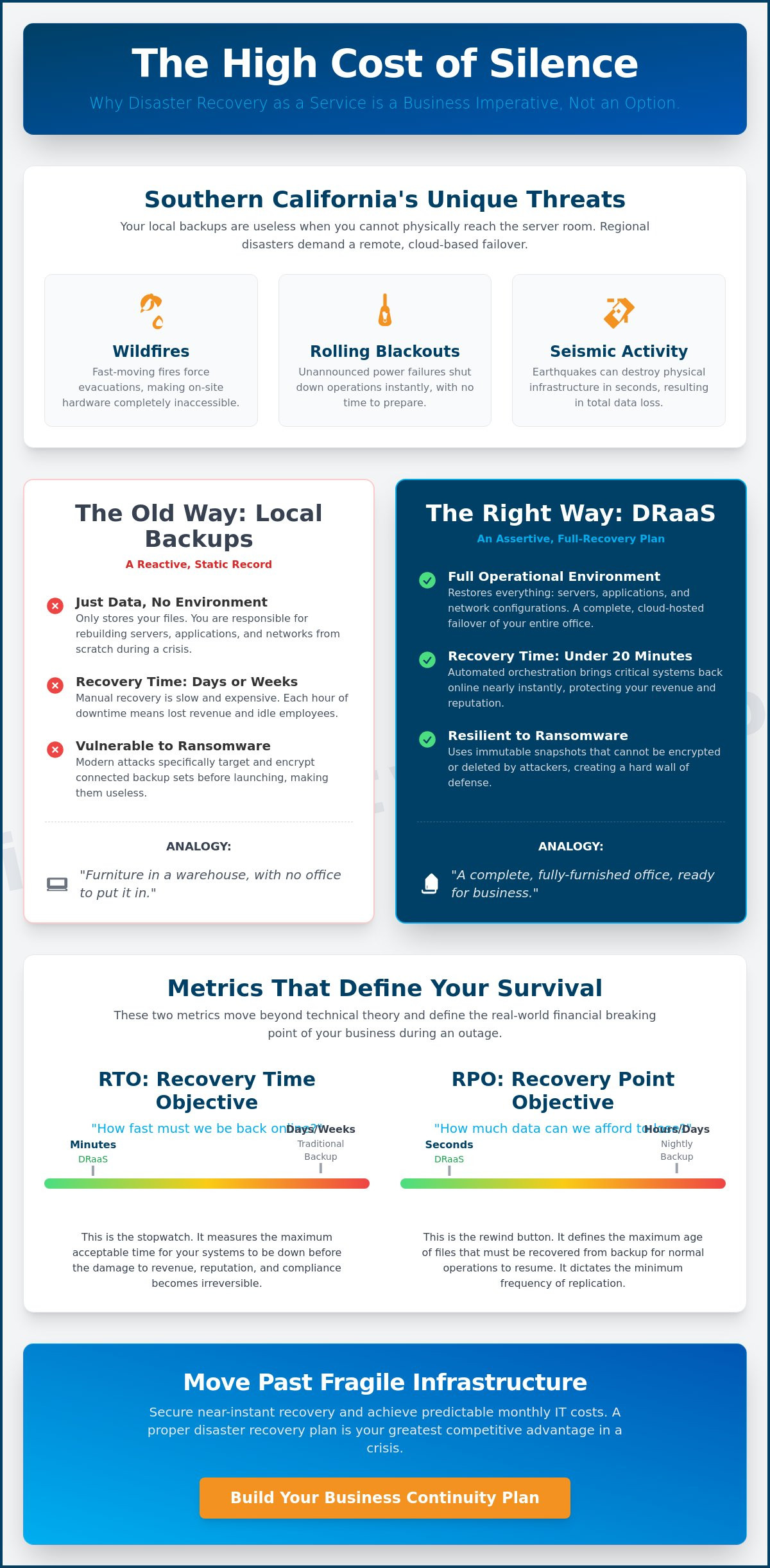
Our region faces unique threats. Wildfires move fast. Rolling blackouts happen without warning. Seismic activity can shatter infrastructure in seconds. If your building is inaccessible or the power grid fails, your local backups are useless. You can't restore data if you can't reach the server room. Beyond the immediate loss of sales, your brand reputation takes a hit. Clients expect availability. When they can't reach you, they find someone else. Reliability is a competitive advantage.
Traditional backups are like a warehouse full of office furniture; you have the desks, but no office to put them in. Disaster recovery as a service is different. It provides the entire building. While standard backups only store data, DRaaS restores your entire operational environment. You aren't just getting files back. You're getting your servers, applications, and network configurations. Modern virtualization allows for a full recovery in minutes. Legacy systems take days or weeks.
The financial impact of a shutdown is often underestimated. You have to account for idle employees who are still on the clock. You have to factor in the cost of emergency IT labor to fix the mess. Most importantly, you have to look at the lifetime value of the clients who leave because they lost confidence in your stability. Modern ransomware is smarter than it used to be. It sleeps in your network for weeks, finding your backup sets and corrupting them before the first ransom note appears. A true disaster recovery as a service plan uses immutable snapshots. This means your recovery points can't be changed or deleted by hackers. It's a hard wall between your business and total operational failure.
Manual recovery is a gamble. You're paying for high-priced engineers to rebuild your environment from scratch while your staff sits idle. This reactive approach drains your cash reserves. A professional disaster recovery as a service model removes the guesswork. It replaces manual labor with automated orchestration. This ensures your recovery is consistent and repeatable. You get peace of mind knowing that your business can survive a regional crisis without bankrupting itself in the process. We focus on technical efficiency so you can focus on your overall business health.
Technical specifications often hide the real business risks. You need to know exactly when your operations will stop hemorrhaging money. Disaster recovery as a service isn't just about software; it's about defining the point where your business breaks. We don't look at recovery as a technical goal. We look at it as a revenue protection strategy. If your recovery metrics are based on guesswork, you are gambling with your company's future. You must align your technical capabilities with the actual financial requirements of your business.
Recovery Time Objective (RTO) is the stopwatch that starts the moment your systems fail. It measures how fast you need to be back online before the damage becomes irreversible. You have to separate your applications into tiers. "Mission Critical" tools like your primary database or order processing system need an RTO measured in minutes. "Important" but non-essential files might have a longer window. To set an accurate RTO, you must calculate the high costs of unplanned IT downtime based on your team's hourly wages and lost sales opportunities. If your staff is sitting idle, your cash is burning. Legal and compliance obligations like HIPAA or CMMC also dictate these timelines. Failing to meet them can result in heavy fines or lost contracts.
Recovery Point Objective (RPO) determines how much data you are willing to lose in a crash. It's about the age of the data you restore. For a manufacturing plant, losing four hours of sensor data might be a manageable setback. For a professional services firm, losing four hours of billable work or client communications is a disaster. Recovery Point Objective is the maximum tolerable age of unrecovered data. The frequency of your data replication determines this gap. If you only sync your data once a day, you are accepting a 24-hour RPO. This means an entire day of work could vanish forever. Frequent, automated replication is the only way to keep this number low. High-frequency syncing ensures that when you fail over, you are working with the most current information possible.
Choosing "good enough" metrics is a recipe for financial disaster. Many business owners assume their current backups are sufficient until they actually try to use them. They discover the hard way that their RTO is measured in days, not hours. Disaster recovery as a service removes this uncertainty by providing a predictable, tested path to restoration. You get a clear view of your survival window. This transparency allows you to make informed decisions about your IT spend. Balancing these metrics requires a strategic IT partner who understands your specific revenue drivers and operational needs. We don't just provide a service; we provide a guarantee that your business stays in motion. Stop guessing about your recovery and start measuring it with precision.
Buying the right software is only half the battle. You have to decide who sits in the captain's chair when your primary site goes dark. Self-service models provide the infrastructure but leave the execution entirely to your internal team. This might seem cost-effective until you realize your IT staff is already overextended. Disaster recovery as a service is most effective when it includes expert oversight. Managed DRaaS ensures that when every second counts, a seasoned professional is already initiating the failover. You aren't just buying a cloud subscription; you're securing a guarantee of operational continuity.
Internal teams often fall victim to configuration drift. Your production environment changes daily, but recovery scripts rarely keep pace. This creates a dangerous gap known as backup rot. You might have a plan on paper, but if it hasn't been updated for your latest software patch, it will fail during a crisis. DIY recovery also lacks the 24/7 monitoring required to catch silent failures. If a replication job stalls at 2:00 AM on a Saturday, who is there to fix it? Without immediate response capability, your recovery window stays open far longer than your business can afford.
A managed partnership turns your technical defense into a proactive shield. You get 24/7 expert monitoring and immediate threat detection that stops issues before they escalate. This level of support is vital for maintaining a Resilient Business Continuity Plan (BCP) that actually works. Instead of hoping your team remembers the recovery steps, you rely on regular, automated testing. This ensures your systems are always ready for a live failover. You also swap unpredictable emergency consulting fees for stable, monthly costs. It's a strategic move that protects your cash flow while increasing your resilience.
Failback is the hidden trap of disaster recovery. Moving your operations back to your primary systems is often more complex than the initial move to the cloud. It requires precise data synchronization to ensure no new information is lost during the transition. Most SMBs simply don't have the internal bandwidth or specialized knowledge to handle this delicate process alone. Managed providers handle the heavy lifting of disaster recovery as a service transitions, including both failover and failback. This allows your team to focus on serving your customers while we handle the technical restoration. We don't just wait for things to break. We actively manage the health of your recovery environment to ensure it's always ready for action.
A disaster recovery as a service solution is a powerful engine, but it needs a driver. Your Business Continuity Plan (BCP) acts as the roadmap for your entire organization when local infrastructure fails. It isn't just a technical document. It's a strategic guide that dictates how your people, processes, and technology function during a crisis. If you haven't defined who makes the final call to initiate a failover, you'll lose precious minutes in a committee meeting while your revenue vanishes. This plan must be integrated into your broader CMMC or HIPAA compliance framework to ensure you meet legal obligations under pressure. The CISA CI Fortify initiative, announced in May 2026, expects critical infrastructure operators to sustain operations in isolation for weeks. Your BCP must reflect this level of endurance.
Business doesn't stop just because your office is inaccessible due to a wildfire or a regional power outage. Your staff needs to stay connected. Relying on personal cell phones is a security risk and looks unprofessional to clients. Reliable Business VoIP systems allow your team to maintain their office identity from any location. Secure remote access through Virtual Desktop Infrastructure (VDI) ensures that your data stays protected even when employees work from home. In Southern California, seismic activity can disrupt local supply chains. Your BCP should include pre-arranged coordination plans for your vendors and logistics partners to keep your commitments on track.
An untested plan is a liability. There is a massive difference between a simple ping test and a full environment spin-up. A ping test only tells you a server is awake. A full spin-up proves your applications actually work and your data is accessible. You should conduct full-scale drills at least annually, though quarterly testing is the gold standard for high-availability environments. These drills expose configuration gaps before they become fatal errors. As your business grows and your IT infrastructure evolves, your BCP must change with it. Static plans lead to failure. We recommend that you schedule a technical assessment to verify that your current recovery strategy matches your actual business needs.
Communication is the lifeblood of recovery. You need a clear strategy for notifying both your internal team and your external clients during a disruption. Silence breeds panic. Your BCP should include templates for emergency notifications so you aren't writing them from scratch during an emergency. Transparency builds trust. When you can tell your clients that you are operating via a failover site and that their data is safe, you turn a potential PR disaster into a demonstration of professional competence. Disaster recovery as a service provides the technical foundation, but your BCP provides the human leadership required to survive.
Expertise isn't just about having the right tools. It's about knowing exactly how to use them when the stakes are highest. We provide disaster recovery as a service built for the specific environmental and digital risks of Southern California. You don't have time for a vendor that waits for your call. We offer an under 20-minute response guarantee for critical technical issues. This is assertive reliability. We act as a strategic driver of your progress. Our team ensures that technical efficiency supports your overall business health. You need a partner who values your growth as much as you do. We refuse to accept the reactive standard of the IT industry.
We understand the local landscape because we live here. Our deep experience in the manufacturing, legal, and supply chain sectors allows us to build strategies that work for your specific workflow. We know how regional infrastructure challenges like power grid instability or seismic events impact your bottom line. You aren't getting a faceless vendor. You're gaining local experts who are committed to a more efficient way of operating. Our vCIO services go beyond basic troubleshooting. We look at your five-year plan and build an IT roadmap that supports it. In the legal sector, this means ensuring your document management systems are always available for court deadlines. For manufacturing, it means protecting the data that keeps your production lines moving.
We treat your uptime as a non-negotiable requirement. This commitment to steady competence is what sets us apart from distant, faceless vendors. We are a protective and empowering force for your team. This no-nonsense approach to cybersecurity and operational uptime keeps you moving forward while competitors are stuck in recovery mode. We prioritize your time above all else. Our focus remains on the relationship between your technical stability and your overall commercial success.
Anxiety about permanent data loss shouldn't be part of your daily routine. You can eliminate the fear of "what if" scenarios with a proven disaster recovery as a service strategy. It starts with a comprehensive assessment of your current environment. We identify the gaps in your defense before they become financial liabilities. You deserve a clear path to zero downtime. Stop settling for reactive support that leaves your revenue at risk. Take control of your operational continuity. To get started, schedule your 20-minute discovery call today. We'll show you how to turn your IT into a strategic driver of momentum. Our goal is your peace of mind and your business's stability. Don't wait for the next regional emergency to find out if your plan works.
Resilience isn't a passive state. It's an active choice to protect your growth. You now understand that defining your RTO and RPO metrics is the difference between a minor pause and a total shutdown. Managed disaster recovery as a service provides the expert oversight required to execute a failover when every second counts. Trinity Networx has been serving Southern California since 2001. We provide proactive 24/7 monitoring and an under 20-minute response guarantee for critical technical issues. Reliability is a standard, not a goal.
You don't have to face regional emergencies or cybersecurity threats alone. Our team is ready to align your IT infrastructure with your long-term business goals. Stop settling for reactive support that leaves your revenue at risk. Take control of your operational continuity and keep your team productive. Secure Your Operations with a DRaaS Strategy Session. Your business deserves a future without downtime.
Cloud backup is a copy of your files; disaster recovery as a service is a copy of your entire business environment. If your server dies, a backup requires you to buy new hardware and wait for a long download. DRaaS allows you to spin up virtual versions of your servers in the cloud immediately. You stay operational while you fix the physical issues. It's the difference between having a spare tire and having a second car ready to drive.
Restoration happens in minutes when you have a properly configured plan. Your specific timeline depends on the Recovery Time Objective (RTO) we set during the planning phase. High-priority applications return to service almost instantly. Less critical systems follow in a staged sequence to manage network traffic. We prioritize your revenue generating tools first to minimize the financial impact of the outage.
Modern cloud models make these tools accessible to businesses of any size. You don't need to build a secondary data center or buy duplicate hardware. Replacing unpredictable emergency repair bills with a steady monthly cost protects your cash flow. It's a strategic investment in your business's survival. Smaller teams benefit from the automated nature of these services because they don't have large internal IT departments to manage manual recoveries.
Compliance requires more than just having a backup; you must prove you can recover. Disaster recovery as a service satisfies the "Recover" function of the NIST CSF 2.0 framework. It also ensures the availability of Protected Health Information (PHI) under HIPAA. For CMMC, it provides the required resiliency to keep federal contract data safe during a regional disruption. We ensure your recovery plan meets these strict regulatory standards.
Your data remains secure because it is replicated to a geographically distant location. If a wildfire or earthquake makes your Southern California office inaccessible, your team simply connects to the cloud environment from a safe location. Business continues without interruption. Physical damage to your building won't result in permanent data loss or an operational shutdown. You keep working while the local situation is resolved.
Rapid restoration from immutable snapshots is your best defense against encryption. Ransomware often targets local backups first to force a payment. Our solution uses offsite, read only copies that hackers can't modify or delete. You simply fail over to a clean version of your environment from minutes before the attack. You keep your data and your money while avoiding the status quo of paying criminals.
You should perform a full scale test at least once per year. High availability environments or businesses with strict compliance needs should move to a quarterly testing schedule. Testing isn't just a box to check; it's how you identify configuration drift. Regular drills ensure that your recovery plan evolves alongside your actual IT infrastructure. This practice makes your eventual recovery permanent and predictable.
Failover is the process of switching your operations to the cloud when your primary systems fail. It keeps you online during a crisis. Failback is the return to your local hardware once the disaster is over. This second step is often more complex. It requires precise data synchronization to ensure no new information is lost during the move back home. We handle both processes to ensure a smooth transition.
Schedule a brief conversation with Trinity Networx to discuss your business technology needs.
Get a practical roadmap built around your business, your users, your systems, and the technology issues that need attention first.
Put the right technology, support, security, and infrastructure in place so your business can grow, adapt, and move forward with confidence.