3281 E. Guasti Rd, STE 700, Ontario, CA 91761
1712 9th Ave SW, Watertown, SD 57201

Lance Reichenberger, Ph.D.
Contact the Trinity Networx team at https://www.trinitynetworx.com/contact-us. Share this guide: [Facebook] [LinkedIn] [Twitter]
If a sudden power surge or a seismic shift along the San Andreas fault kills your servers tonight, your business doesn't just pause; it bleeds. You face massive financial penalties for every missed delivery deadline. A basic backup won't save you when the hardware is fried. Implementing a specific disaster recovery plan for manufacturers in the Inland Empire is the only way to ensure your production lines stay active during local emergencies. It’s the difference between a temporary glitch and a permanent shutdown.
You likely feel the weight of protecting proprietary CAD files and sensitive ERP data while navigating the unique risks of Riverside and San Bernardino counties. We agree that simple data copies aren't enough for a high-stakes factory environment. This guide provides a clear roadmap for IT resilience, helping you move past technical confusion and into a state of total operational readiness. You’ll learn how to protect your production lines from local geographic risks and technical failures with a proactive recovery strategy. We will cover the 2026 legislative landscape, the gap between backups and recovery, and the steps to keep your machines turning.
• Calculate your Recovery Time Objective (RTO) to determine the exact moment downtime penalties start eating your profits.
• Discover why a disaster recovery plan for manufacturers in the Inland Empire requires more than just off-site backups to keep ERP systems and shop floor software running.
• Rank application criticality through a business impact analysis. Your recovery team must focus on the systems that drive revenue first.
• Ditch reactive fixes for proactive IT support. Spotting hardware issues early prevents technical failures that lead to massive production delays.
• Prepare for regional threats like power outages and seismic activity. Establish clear roles for your local recovery team to maintain momentum during a crisis.
Disaster recovery isn't a vague insurance policy. It is a precise set of technical procedures designed to regain access to your data and hardware after a total disruption. For a factory in Ontario or a warehouse in Riverside, this isn't just about email. It centers on your ERP systems and the shop floor control software that keeps your machines moving. If those systems stay dark, your production floor is a graveyard of expensive, idle equipment. Implementing a disaster recovery plan for manufacturers in the Inland Empire ensures that when the hardware fails, the business doesn't. A high-performance Business continuity planning strategy ensures your business survives the initial shock, but recovery is what actually gets the lights back on.
Manufacturers here face specific threats that businesses in other regions don't. We deal with the San Andreas fault and seasonal Public Safety Power Shutoffs during high fire risk periods. These aren't "what if" scenarios; they are inevitable operational hurdles. Success is measured by one metric: how fast you return to full production capacity. If your recovery takes days, you lose your slot in the supply chain. You need a partner who understands that every minute of downtime equals thousands in lost revenue.
Backups are static. They are merely copies of data sitting on a drive or in a cloud. If your server dies, a backup is just a pile of bricks without a mason. Orchestration is the automated sequence that brings your systems back to life in the right order. Your database must be up before your ERP can talk to it. Without this sequence, you're left with manual errors and hours of troubleshooting. You can read more about these distinctions in our executive guide to business data backup.
Geography dictates survival. It’s that simple. If your backup server sits in the same zip code as your primary facility, one seismic event wipes out your entire operation. You need distance. You also need a stable power strategy. Ontario and Fontana often see grid strain during heatwaves or high-demand cycles. This makes local IT infrastructure resilience non-negotiable.
Power grid stability issues require specific hardware redundancies like high-capacity UPS systems and local failover nodes. A solid disaster recovery plan for manufacturers in the Inland Empire also accounts for logistics. When the I-15 or the 91 freeway shuts down during a fire, your remote IT support won't help if you need hands on hardware. Local support teams must be able to reach your facility when regional transport is disrupted. If your IT provider is stuck in Orange County while your servers are smoking in San Bernardino, you've already lost.
Downtime is a silent profit killer. Most executives look at the payroll clock and see idle workers, but that is only the surface. The real damage happens in the fine print of your contracts. A disaster recovery plan for manufacturers in the Inland Empire must account for the weight of supply chain penalties and the long term erosion of client trust. If you can't ship, your customers will find someone who can. Inventory counts become guesses. Production schedules collapse.
Your Recovery Time Objective (RTO) defines the maximum duration your systems can stay dark before the business fails. Conversely, the Recovery Point Objective (RPO) dictates how much data loss you can survive. For a precision machine shop, losing four hours of CAD updates might be manageable. Losing four days is a catastrophe. Proactive cybersecurity is no longer a separate IT project; it is a core component of this financial equation. Ransomware doesn't just steal data; it holds your production capacity hostage. Applying resources like the Ready.gov business preparedness toolkit helps frame these risks, but it won't fix a broken ERP server. You need technical execution.
If you operate in the Chino or Ontario corridors and serve the Department of Defense, CMMC compliance is your ticket to play. These standards demand strict data availability and integrity. Local contractors have to prove they can recover Controlled Unclassified Information (CUI) immediately after a breach. Failure to recover data isn't just a technical glitch; it is a compliance violation. You can align your recovery goals with our managed cybersecurity services to ensure you don't lose your eligibility for federal contracts.
Just In Time (JIT) manufacturing leaves zero room for technical friction. Modern manufacturing relies on rigid delivery windows. A four hour outage often triggers immediate contractual penalties from Tier 1 partners that wipe out the margin on an entire production run. When your ERP system goes offline, shipping and receiving stop. You cannot track materials or verify quality benchmarks. If you want to quantify your specific downtime risks, our team can help map your infrastructure against these financial threats. We focus on getting you back to full capacity before the penalties kick in.
Many shop owners mistake a data copy for a safety net. It isn't. A backup is a tactical component; it is the digital insurance card you hope you never have to use. Business continuity is the strategic framework that ensures your entire organization remains functional during a crisis. If your facility in San Bernardino is inaccessible, your backup won't help your office staff manage orders. You need a strategy that keeps the business moving even when the shop floor is silent. Your disaster recovery plan for manufacturers in the Inland Empire should bridge the gap between having data and actually using it under pressure.
Resources like the Ready Business preparedness toolkits provide a baseline for these strategies, but manufacturers need more technical depth. You have to decide how much of your operation can move to the cloud. If a fire or earthquake shuts down your main site, cloud based recovery allows for immediate remote operations. This keeps your administrative and sales teams active while you work on physical repairs. It prevents a total blackout of your customer service and logistics departments.
Geography is your biggest risk factor. Offsite storage should be located outside of the immediate Southern California seismic zone to avoid simultaneous failure during a major event. Virtual desktop infrastructure allows office staff to work from any location during a facility closure, maintaining customer communication and billing. Hybrid cloud recovery serves as the balance between local speed for immediate access and offsite safety for total data protection. This ensures that a local power surge doesn't wipe out your entire history.
You can't build a plan on a crumbling foundation. A disaster recovery plan for manufacturers in the Inland Empire is only as strong as the physical equipment it relies on. Identify single points of failure in your server room, such as a single aging switch or a non-redundant power supply. Assess the age and reliability of your hardware assets before they fail. You can learn more about it infrastructure management to identify these hidden gaps in your current setup. A proactive audit prevents a small hardware glitch from turning into a week long production halt. Don't wait for a crash to find out your server was five years past its prime. Fix it now.
Building a disaster recovery plan for manufacturers in the Inland Empire requires moving beyond generic templates. You need a granular view of your specific shop floor. Start with a business impact analysis. This isn't a simple survey. It is a hierarchy of survival. Rank every application by how fast its failure stops the revenue. If the ERP goes down, everything stops. If the breakroom Wi-Fi fails, production continues. Prioritize accordingly. You must identify exactly which systems are the engines of your profit and which are merely accessories.
Designate your recovery team today. Every primary contact needs a secondary. If your IT manager is stuck behind a rockslide on the 138, who has the encryption keys? Communication must bypass local landlines and office email. Use out-of-band tools like encrypted messaging apps or dedicated emergency notification platforms. Document the restoration process for your specific ERP down to the last keystroke. If the person who installed the system is unreachable, the manual must become the expert. This level of detail is a core part of effective it management for high volume facilities.
Quarterly testing is the only way to prove your plan isn't a work of fiction. A plan that isn't tested is merely a suggestion. Simulate a total network failure once every ninety days. This exercise reveals hidden dependencies in your software that you didn't know existed. Your database might rely on a legacy service you forgot was even running. Update your documentation every time you add a new CNC machine or a robotic arm. Your environment changes. Your plan must keep up or it will fail you when the stakes are highest.
Speed is your only defense against a total loss. Ensure your IT provider offers a 20 minute response guarantee for critical infrastructure failures. Maintain hard copies of your recovery plan in secure offsite locations. Digital access is great until the power grid dies. Establish redundant internet connections through different providers to mitigate local ISP outages. If the fiber line gets cut during roadwork in Jurupa Valley, your cellular failover keeps the data flowing. You can't afford to wait for a technician to drive in from Los Angeles. You need local execution and immediate results.
If you're ready to build a tested recovery framework, our team is ready to audit your current readiness and close the gaps in your defense.
Lance Reichenberger, Ph.D.
Contact the Trinity Networx team at https://www.trinitynetworx.com/contact-us. Share this guide: [Facebook] [LinkedIn] [Twitter]
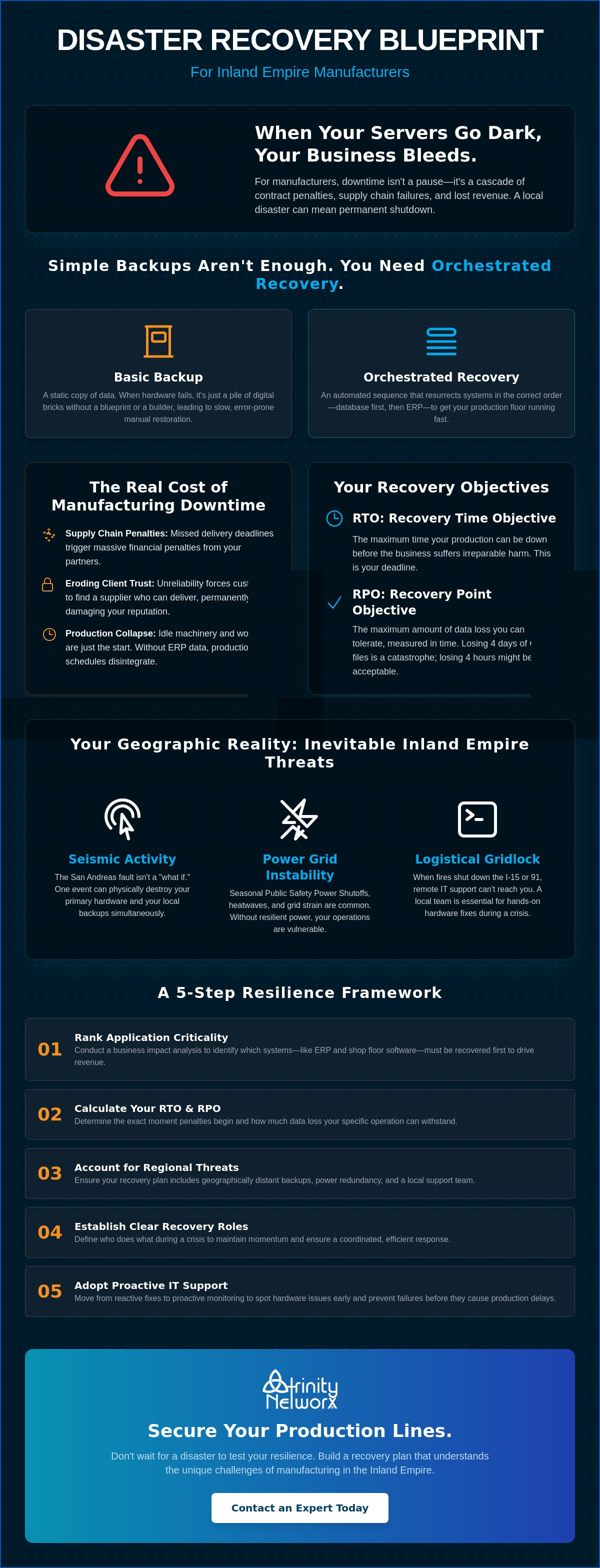
Reactive IT support is a liability. It is a gamble you will eventually lose. In the high volume manufacturing environments of Southern California, waiting for hardware to smoke before calling for help is a recipe for financial ruin. You need constant eyes on your hardware. Proactive monitoring catches disk failures, memory leaks, and thermal issues before they trigger a site wide disaster. A disaster recovery plan for manufacturers in the Inland Empire is only as effective as the monitoring that supports it. We don't just fix what's broken. We prevent the break from happening by identifying technical friction before it stops the machines.
Strategic technology planning ensures your recovery capabilities grow with your business. As you add new production lines or expand your floor space in San Bernardino, your IT must keep pace. A dedicated partner understands the specific nuances of Inland Empire logistics, including power grid quirks and local transport hurdles. The power grid in Ontario often fluctuates during peak summer months, creating invisible wear on your server power supplies. If your IT provider doesn't understand these local patterns, they won't know to check your hardware health before the summer heat hits. We look for these patterns because we are part of this community. We know the streets, the grid, and the stakes.
We focus on operational health rather than just patching software or fixing broken keyboards. Our team provides 24/7 helpdesk support with a rapid response mandate. We know that a midnight server crash in Ontario can halt an entire morning shift in Riverside. You can explore how our managed it services drive efficiency and security by keeping your systems in peak condition. We act as a protective force for your data, ensuring that your proprietary CAD files and ERP data remain accessible even during regional emergencies. Our goal is to instill a sense of security and momentum in your daily operations.
Protecting your production floor starts with a hard reality check. Schedule a professional assessment of your current data risks today. Don't assume your systems are safe just because the lights are currently on. Review your existing backup logs for consistency and completion. Many manufacturers find that their automated backups haven't actually finished a full cycle in weeks. This is a dangerous gap that only a thorough audit can reveal. Contact our team for a no nonsense evaluation of your manufacturing resilience. We provide the technical assurance you need to focus on your business growth. Stop reacting to disasters. Start preventing them.
Lance Reichenberger, Ph.D.
Contact the Trinity Networx team at https://www.trinitynetworx.com/contact-us. Share this guide: [Facebook] [LinkedIn] [Twitter]
Waiting for a crisis to test your hardware is a strategy for failure. You now understand that a true disaster recovery plan for manufacturers in the Inland Empire requires precise RTO calculations and a clear distinction between simple backups and orchestrated business continuity. Protecting your shop floor means moving beyond reactive fixes. It requires a technical partner who understands the specific power grid and seismic risks of San Bernardino and Riverside counties. You've seen how CMMC compliance and JIT supply chain demands make data availability a non-negotiable requirement for your growth.
Trinity Networx specializes in manufacturing environments. We provide a 20 minute response time guarantee and 24/7 helpdesk support to ensure your machines never sit idle. Our expertise in CMMC compliance ensures your data stays secure and your federal contracts remain valid. Don't leave your production capacity to chance. Contact the Trinity Networx team for a proactive resilience assessment. Your facility deserves a partner that values uptime as much as you do. Let's get to work.
Hardware failure and power grid instability lead the list. San Bernardino and Riverside counties face significant grid strain during summer peaks, which causes cooling failures and fried components. A disaster recovery plan for manufacturers in the Inland Empire must prioritize hardware redundancy to survive these local conditions. Aging servers often fail under the heat before a natural disaster ever strikes. You need active monitoring to catch these failures before they stop your production line.
You should test your recovery procedures at least four times a year. Yearly testing is a dangerous gamble that ignores how fast your technical environment changes. Your network updates every time you add a new piece of shop floor equipment or update your ERP software. Quarterly drills ensure that your recovery sequence actually works under current conditions. Testing reveals hidden software dependencies that would otherwise cause your restoration to fail during a real emergency.
No, simple storage isn't enough for federal standards. CMMC requires strict evidence of data availability and integrity for all defense contracts. You have to prove that Controlled Unclassified Information is protected and recoverable under specific, documented timelines. A compliant strategy involves managed encryption and detailed access logs that standard cloud backups often lack. You need a partner who understands the technical requirements of NIST 800-171 to stay eligible for Department of Defense work.
RTO is your recovery deadline; RPO is your data loss limit. If your Recovery Time Objective is four hours, you must be back in production by then to avoid contractual penalties. If your Recovery Point Objective is thirty minutes, you can't afford to lose more than thirty minutes of production data. These metrics define the speed and frequency of your backup systems. They are the financial guardrails that keep your business from bleeding out during a technical failure.
Documented recovery plans frequently lead to lower insurance costs for local facilities. Carriers reward manufacturers who actively mitigate risk with lower cyber and business interruption premiums. By proving you can survive a server crash or a regional disaster, you decrease the likelihood of a massive payout. This makes your factory a more predictable and less expensive risk for the provider. Proactive planning turns a technical necessity into a direct financial benefit for your bottom line.
Cloud failover ensures your business continues even if your site is physically cut off. If a fire or earthquake blocks access to your facility, your critical applications should launch in a secure remote environment. This allows your office staff to manage orders and communicate with customers from any location with an internet connection. Physical access shouldn't be a requirement for data access. Your disaster recovery plan for manufacturers in the Inland Empire must include remote orchestration to handle these scenarios.
Ransomware protection is a core part of any modern recovery strategy. Cyber attacks now trigger more recovery events than natural disasters or hardware failures combined. Your plan should include immutable backups that remain out of reach for hackers. This ensures that even if your primary servers are encrypted, you can restore your entire operation without ever considering a ransom payment. We focus on getting you back to work with clean data while the authorities handle the breach.
Acceptable downtime depends entirely on your delivery contracts and supply chain obligations. Most mid sized plants face heavy penalties if they stay dark for more than four hours. If you support a Just-In-Time supply chain, even two hours of idleness can be a catastrophe for your reputation. You have to set your recovery goals based on the financial cost of every missed shipment. Our team helps you calculate these costs to build a plan that matches your specific business realities.

Article by
Lance Reichenberger, Ph.D.
Dr. Lance Reichenberger is the founder of Trinity Networx, a Southern California technology firm specializing in managed IT services, cybersecurity, network infrastructure, and business technology strategy. With nearly four decades of experience in the IT industry, he works with businesses to improve operational efficiency, strengthen security, and align technology with long-term growth objectives.
Lance focuses on proactive IT management, enterprise wireless infrastructure, cybersecurity integration, and scalable technology solutions for growing organizations throughout Southern California.
The content published on this website is provided for general informational and educational purposes only. Articles may be created, edited, or enhanced with the assistance of artificial intelligence and automation tools under the direction and review of Trinity Networx. While every effort is made to ensure accuracy and relevance, the information provided should not be considered professional, legal, financial, cybersecurity, or technical advice specific to your organization. Businesses should consult directly with a qualified professional regarding their unique environment, compliance requirements, and operational needs. Trinity Networx makes no warranties regarding completeness, reliability, or applicability of the information contained within these articles.
Schedule a brief conversation with Trinity Networx to discuss your business technology needs.
Get a practical roadmap built around your business, your users, your systems, and the technology issues that need attention first.
Put the right technology, support, security, and infrastructure in place so your business can grow, adapt, and move forward with confidence.