3281 E. Guasti Rd, STE 700, Ontario, CA 91761
1712 9th Ave SW, Watertown, SD 57201

Lance Reichenberger, Ph.D.
Mitigation saves four dollars for every dollar spent. In the Inland Empire, with 110 million square feet of industrial space, the risk is real. Effective disaster recovery planning for manufacturing businesses in Ontario CA prevents a local utility failure from turning into a week of expensive supply chain penalties. You know the pressure. Specialized software and tight shipping windows leave zero room for idle machines. It is a harsh reality of the sector. As Phase II of The HUB @ Ontario International Airport expands the region through 2026, technical complexity increases. We provide a no-nonsense framework to secure your shop floor against seismic and utility threats. This guide explains how to align your technical redundancy with the City of Ontario’s Local Hazard Mitigation Plan. Focus on hard metrics. Protect your production hours. Outrun the next disruption.
Contact the team at contact us. Share this guide: [Facebook] [X] [LinkedIn]
Lance Reichenberger, Ph.D.
Map local hazards like Santa Ana winds to your specific grid stability. Real stability starts with local context. Quantify the financial bleeding from idle machines. Every hour of production loss hits the bottom line through wasted labor and delivery penalties. Sync your technical protocols with the City of Ontario Local Hazard Mitigation Plan. Using city-level data strengthens your technical redundancy. Effective disaster recovery planning for manufacturing businesses in Ontario CA requires a 3-2-1 backup strategy and hardened shop floor endpoints. Stop disasters before they stop your lines. Partner with experts who promise a 20 minute response time. We don't just react. We drive your operational continuity forward.
Contact the team at contact us. Share this guide: [Facebook] [X] [LinkedIn]
Lance Reichenberger, Ph.D.
Ontario manufacturers operate in a high-stakes environment. Survival requires moving beyond reactive fixes. Effective disaster recovery planning for manufacturing businesses in Ontario CA demands a hard look at the local geography. We aren't just talking about general outages. We're talking about specific regional stressors. These threats target your shop floor every season. Proactive planning is the only way to stay operational when the environment turns hostile. It is a survival strategy for the Inland Empire industrial sector.
Ontario manufacturers face wind and fire risks that coastal facilities never see. Santa Ana winds create a dangerous wind tunnel effect through our local industrial corridors. These gusts aren't just a nuisance. They are operational hazards that down power lines and spark brush fires. While beach cities enjoy a marine layer, Ontario deals with extreme thermal stress. This heat strains utility infrastructure until it snaps. Low-lying warehouse districts also face flash flooding during sudden Inland Empire downpours. Water on a CNC floor or in a server room ends production. It happens fast. Structural integrity is the first line of defense. High-wind events can displace external cooling units or damage roof-mounted sensors. You need a plan that accounts for the physical environment of the Inland Empire.
Rolling blackouts are a reality of the local summer. A sudden power loss during a high-precision CNC cycle ruins the part. It often ruins the tool as well. Standard surge protection fails in high-voltage industrial settings. When the grid drops, your ERP system is the next victim. Databases that don't close properly lead to massive data corruption. You lose the digital record of your operation. Following Business Continuity Planning Principles ensures your hardware stays functional when the ground moves or the lights go out.
Heavy machinery needs anchoring. Your facility sits between the San Jacinto and San Andreas fault lines. A significant quake turns an assembly line into scrap metal. This risk extends to your IT infrastructure as well. Unsecured server racks are a liability in a seismic zone. A single seismic event can trigger a massive regional shutdown. Supply chain logistics in Ontario are also a prime target for human-caused hazards. Ransomware doesn't just lock files. It halts the movement of trucks through our logistical hubs. Protecting your network against these targeted strikes is as critical as fire suppression. You cannot afford a weak link in the chain. Trinity Networx, LLC provides the technical oversight to prevent these digital strikes from halting your floor.
Contact the team at contact us. Share this guide: [Facebook] [X] [LinkedIn]
Lance Reichenberger, Ph.D.
Idle machines don't just sit; they drain capital. For an Ontario manufacturer, one hour of downtime isn't a minor glitch. It's a cascade of financial failure. You're paying skilled operators to watch a dark screen while your overhead remains fixed. You're missing critical shipping windows at the Ontario International Airport logistics hubs. Contractual penalties for late deliveries hit hard and fast. This is the financial reality that drives disaster recovery planning for manufacturing businesses in Ontario CA. We must look at the convergence of Operational Technology (OT) and Information Technology (IT). If the PLC (Programmable Logic Controller) can't communicate with the ERP, the line stops. Time is a predator. When your assembly line halts because a server in the back room lost its connection to the shop floor controllers, the clock starts ticking against your quarterly profits. Beyond the immediate labor loss, you face the long-term erosion of client trust. Recovering that reputation costs far more than any backup system. Using resources like the FEMA Ready Business Toolkits can help you frame these risks, but the math remains local and immediate.
RTO is the maximum duration your facility can stay offline before the damage becomes permanent. It isn't a one-size-fits-all metric. Your shipping department might handle a four-hour delay, but your main assembly line could trigger massive penalties after just sixty minutes. For a machine shop with 24/7 operations, the RTO is effectively zero because every second of silence is a direct loss of billable production. You need to rank your departments by their survival limit. This hierarchy dictates where your technical resources go first during a crisis.
RPO defines the maximum amount of data loss your business can tolerate. Think of it as the gap between your last backup and the moment of failure. If you rely on daily backups, you could lose twenty-four hours of inventory data and custom job settings. Real-time replication is the standard for modern manufacturing. Losing a day of production data means losing a day of traceability, which is a nightmare for compliance and quality control. If you need help refining your system performance to meet these tight windows, we can help you map out the requirements. Accurately setting your RPO ensures your supply chain records remain intact even if the local grid fails.
Contact the team at contact us to protect your shop floor. Share this resilience guide: [Facebook] [X] [LinkedIn]
Lance Reichenberger, Ph.D.
Ontario’s Local Hazard Mitigation Plan (LHMP) is more than just a government report. It is a data source for your survival. The city adopted the current version in November 2023 to map out natural and human-caused hazards. Successful disaster recovery planning for manufacturing businesses in Ontario CA means applying this city-level research to your own digital architecture. If the city identifies your specific block as a high-risk zone for thermal stress or seismic instability, your hardware protection must be twice as aggressive. FEMA-aligned city plans provide the context your private protocols currently lack. Drawing on this public data allows you to anticipate regional failures before the grid drops.
Physical site safety is the foundation of digital health. Proper IT infrastructure management requires a deep understanding of local utility density. Redundant internet circuits are a requirement, not a luxury. When high winds down poles along major industrial corridors, a single fiber connection is a liability. You need diverse paths that enter your facility from different points. Stay current with LHMP updates as we approach the 2028 revision. Your long-term technical planning should mirror the city's infrastructure hardening efforts. Geography is destiny. Plan for it.
Communication is the first thing to break. Cell towers get overwhelmed during regional emergencies. You need a communication tree that functions when the primary grid fails. Resilient VoIP for small business systems allow for automatic cloud-based routing. If your physical site goes dark, calls move to mobile devices or remote locations instantly. This prevents the silence that leads to supply chain penalties. Collaborative assessments with local public safety officers add a final layer of protection. These experts see fire risks and structural gaps that internal teams often miss. Their insights turn a generic document into a localized defense strategy.
Contact the team at Trinity Networx, LLC at contact us to align your resilience plan. Share this guide: [Facebook] [X] [LinkedIn]
Lance Reichenberger, Ph.D.
Strategy is only as good as its execution. You cannot rely on a single solution to protect your production line. Effective disaster recovery planning for manufacturing businesses in Ontario CA requires a stacked approach. If one layer fails, the next must hold the line. This starts with the 3-2-1 backup rule. Keep three copies of your data. Store them on two different media types. Keep one copy off-site. For industrial sites, we add a fourth "1": an air-gapped copy. This is your insurance against ransomware that crawls through your network to encrypt backups. It is a hard stop for digital threats that bypass standard firewalls.
Off-site storage is mandatory, but air-gapped copies provide the ultimate security. When a cyber strike hits, an air-gapped drive is the only resource that remains uninfected. For deep technical insights into these protocols, look at our guide on business data backup. Large CAD files present a unique challenge for local shops. Cloud storage offers geographic redundancy, but it can be slow when you need to pull massive files back to the shop floor. Local storage is fast but vulnerable to physical theft or fire. A hybrid model is the answer. You get the speed of local access with the long-term security of the cloud. Do both. Don't choose.
Shop floor workstations are often the weakest link in your defense. These machines run specialized software but often lack the protection of office PCs. You need endpoint protection on every terminal. This prevents a single infected workstation from taking down the entire assembly line. Documentation is your manual for survival. Every step of the recovery process must be written down clearly. Keep a physical copy in a fireproof safe and a digital copy in a secure cloud location. Memory fails during a crisis. Paper does not. Assign specific roles to your team members now. Who calls the utility company? Who initiates the server restore? Clear roles prevent the chaos that leads to extended downtime.
A plan that isn't tested is just a wish. It is not a plan. Mandate quarterly disaster simulations to find your blind spots. Turn off a server. See how long it takes to get back online. These drills identify the weak points before a real disaster does. Continuous IT optimization keeps your protocols current as your hardware evolves. Technology changes. Your recovery speed should improve over time, not degrade. If your last test took six hours, find out why. Fix the bottleneck. Aim for that four-hour window mentioned earlier. Speed is the only metric that matters when production is idle.
Ready to harden your facility against the next disruption? We can build a defense that actually works. Contact our technical team today to schedule a recovery audit.
Contact the team at contact us. Share this guide: [Facebook] [X] [LinkedIn]
Lance Reichenberger, Ph.D.
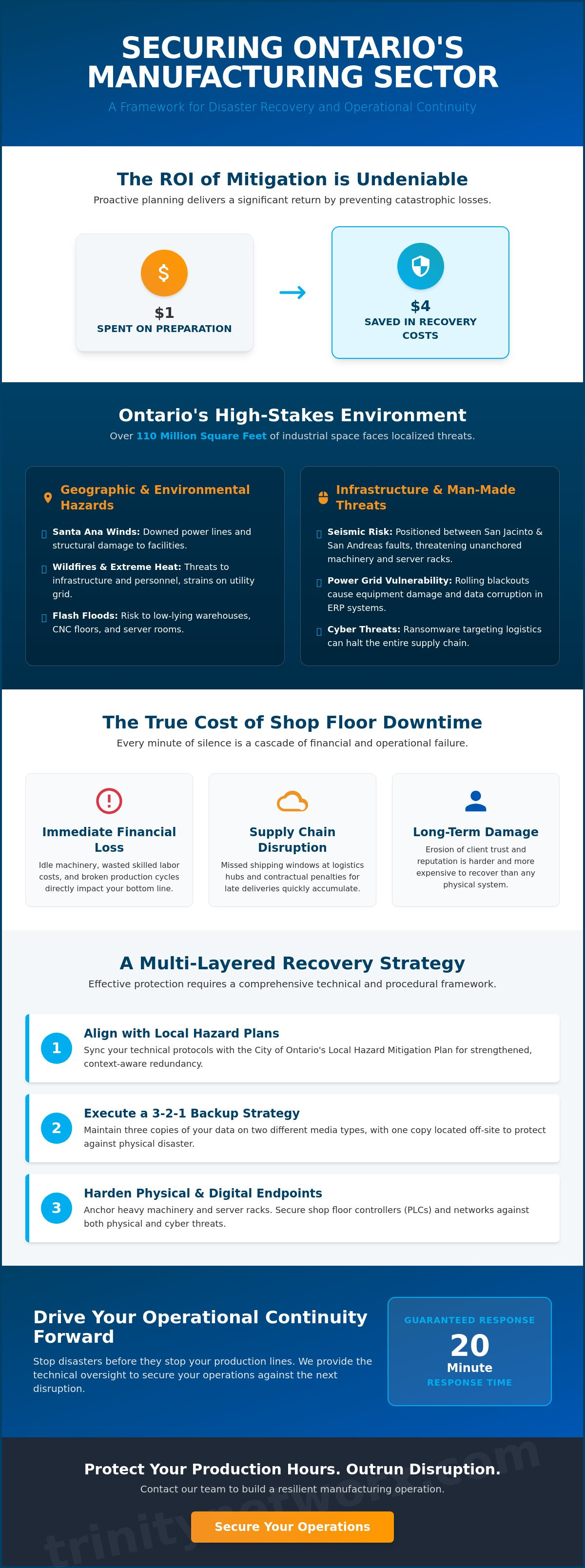
Stop reacting. Start operating. Most IT vendors wait for your phone call; we ensure the call never needs to happen. Disaster recovery planning for manufacturing businesses in Ontario CA is not a passive document. It is an active defense. We specialize in the intersection of shop floor hardware and supply chain logistics. Our team guarantees a 20 minute response time for critical issues. We know that when the CNC stops, the profit stops. A vCIO from our team acts as your strategic architect. We look at the next five years, not just the next five minutes. Our focus is on your business health and operational continuity.
We bridge the gap between technical jargon and executive priorities. If your recovery plan does not align with your financial goals, it is a liability. We focus on movement and stability. We are a protective force. Our partners are tired of the status quo. They want efficiency. They want momentum. We deliver both through professional assurance and steady competence. We handle the heavy lifting of IT management so you can focus on the shop floor. Our specialized focus on manufacturing means we understand the specific software that runs your lines. We don't just fix PCs. We protect your ability to deliver.
A vCIO is your secret weapon for long-term growth. They don't just talk about backups. They talk about business health. They help you navigate complex requirements like CMMC compliance or supply chain security. This is about more than just surviving a disaster. It is about thriving in a competitive market. We provide the technical leadership you need without the overhead of a full-time executive. It is a strategic driver of progress. We refine your systems to ensure they support your expansion rather than hindering it.
Ontario is unique. The power grid behaves differently here. The wind patterns are specific to our corridors. Having a partner who breathes the same SoCal air is a distinct advantage. We understand the local business landscape and the pressures of the Inland Empire. You can read more about our approach to managed IT services Ontario CA to see how we support regional growth. We aren't a distant, faceless vendor. We are your neighbors. We are on the ground when the grid fails. This local proximity allows us to respond with precision and speed.
Don't wait for the next Santa Ana wind event to test your resilience. The cost of a single hour of downtime is too high to ignore. Assess your current facility vulnerabilities today. A professional IT audit identifies the cracks in your armor before they become catastrophic failures. We provide the clarity you need to make informed decisions. Secure your shop floor. Protect your workforce. Drive your business forward with confidence. The time for a hardened defense is now.
Lance Reichenberger, Ph.D.
Contact the team at contact us. Share this guide: [Facebook] [X] [LinkedIn]
Production stops for no one. You've seen the data. Santa Ana winds and seismic shifts are local realities, not just theories. Effective disaster recovery planning for manufacturing businesses in Ontario CA requires more than a digital safety net. It demands a physical and procedural fortress. By aligning your shop floor with the 2023 Local Hazard Mitigation Plan and enforcing the 3-2-1-1 backup rule, you strip away the uncertainty of Inland Empire utility failures. You gain control over your recovery time. You secure your supply chain reputation. It's about stability. It's about momentum.
Don't leave your recovery to chance. Trinity Networx provides the specialized manufacturing IT expertise you need to hit sub-four-hour recovery targets. We back our work with a 20 minute response time guarantee and a 24/7 helpdesk that understands your machines. Contact our team for a proactive disaster recovery assessment. Build a facility that stays operational while others wait for the grid. Your next production cycle depends on the choices you make today. Let's get to work.
Contact the team at contact us. Share this guide: [Facebook] [X] [LinkedIn]
Lance Reichenberger, Ph.D.
Power grid instability caused by Santa Ana winds remains the primary threat to local shop floors. These high-wind events often trigger rolling blackouts or equipment damage across the 110 million square feet of industrial space in the region. Cyberattacks targeting supply chain logistics are a close second. Both require specific disaster recovery planning for manufacturing businesses in Ontario CA to prevent total production stops.
You should run full-scale disaster simulations every quarter. Annual testing is a recipe for failure because your network and production software change too fast. Frequent drills identify bottlenecks in your recovery time before a real crisis hits. We use these tests to ensure your team knows their specific roles without hesitation.
Cloud backup is only one part of a professional strategy. Large CAD files and ERP databases take too long to download from the cloud during a total site failure. You need a hybrid approach that includes a local, fast-access copy and an air-gapped off-site version. This 3-2-1-1 method ensures you can resume production in hours, not days.
Costs vary based on the complexity of your shop floor and the volume of data you must protect. Instead of looking at the price tag, consider the mitigation ratio. Every dollar you spend on preparation saves an average of four dollars in response and recovery costs. We focus on the business impact of your technical efficiency rather than generic pricing models.
Business continuity is your broad strategy for keeping the entire company operational during a crisis. Disaster recovery is the specific technical subset focused on restoring your IT systems and data. You need both to survive. While DR gets your servers back online, business continuity ensures your staff has a place to work and a way to communicate.
Yes, we integrate CMMC compliance requirements directly into our data protection frameworks. For manufacturers in the defense supply chain, disaster recovery is a mandatory part of meeting federal security standards. We ensure your backups and technical redundancies satisfy these audits while protecting your intellectual property from local hazards.
Your operations should switch to a redundant circuit automatically. We implement diverse internet paths to ensure that a single cut line or downed utility pole doesn't isolate your facility. Your VoIP systems will route calls to mobile devices or remote offices instantly. This keeps your logistics moving even when your physical site is offline.
Industrial-grade uninterruptible power supplies (UPS) and specialized surge protection are mandatory for high-voltage environments. These systems provide the minutes needed for a controlled shutdown of sensitive machinery. Without this layer, a sudden surge can corrupt the PLC firmware or destroy expensive tooling. We help you map these physical protections to your digital recovery plan.
Contact the team at contact us. Share this guide: [Facebook] [X] [LinkedIn]

Article by
Lance Reichenberger, Ph.D.
Dr. Lance Reichenberger is the founder of Trinity Networx, a Southern California technology firm specializing in managed IT services, cybersecurity, network infrastructure, and business technology strategy. With nearly four decades of experience in the IT industry, he works with businesses to improve operational efficiency, strengthen security, and align technology with long-term growth objectives.
Lance focuses on proactive IT management, enterprise wireless infrastructure, cybersecurity integration, and scalable technology solutions for growing organizations throughout Southern California.
The content published on this website is provided for general informational and educational purposes only. Articles may be created, edited, or enhanced with the assistance of artificial intelligence and automation tools under the direction and review of Trinity Networx. While every effort is made to ensure accuracy and relevance, the information provided should not be considered professional, legal, financial, cybersecurity, or technical advice specific to your organization. Businesses should consult directly with a qualified professional regarding their unique environment, compliance requirements, and operational needs. Trinity Networx makes no warranties regarding completeness, reliability, or applicability of the information contained within these articles.
Schedule a brief conversation with Trinity Networx to discuss your business technology needs.
Get a practical roadmap built around your business, your users, your systems, and the technology issues that need attention first.
Put the right technology, support, security, and infrastructure in place so your business can grow, adapt, and move forward with confidence.