3281 E. Guasti Rd, STE 700, Ontario, CA 91761
1712 9th Ave SW, Watertown, SD 57201
Lance Reichenberger, Ph.D.
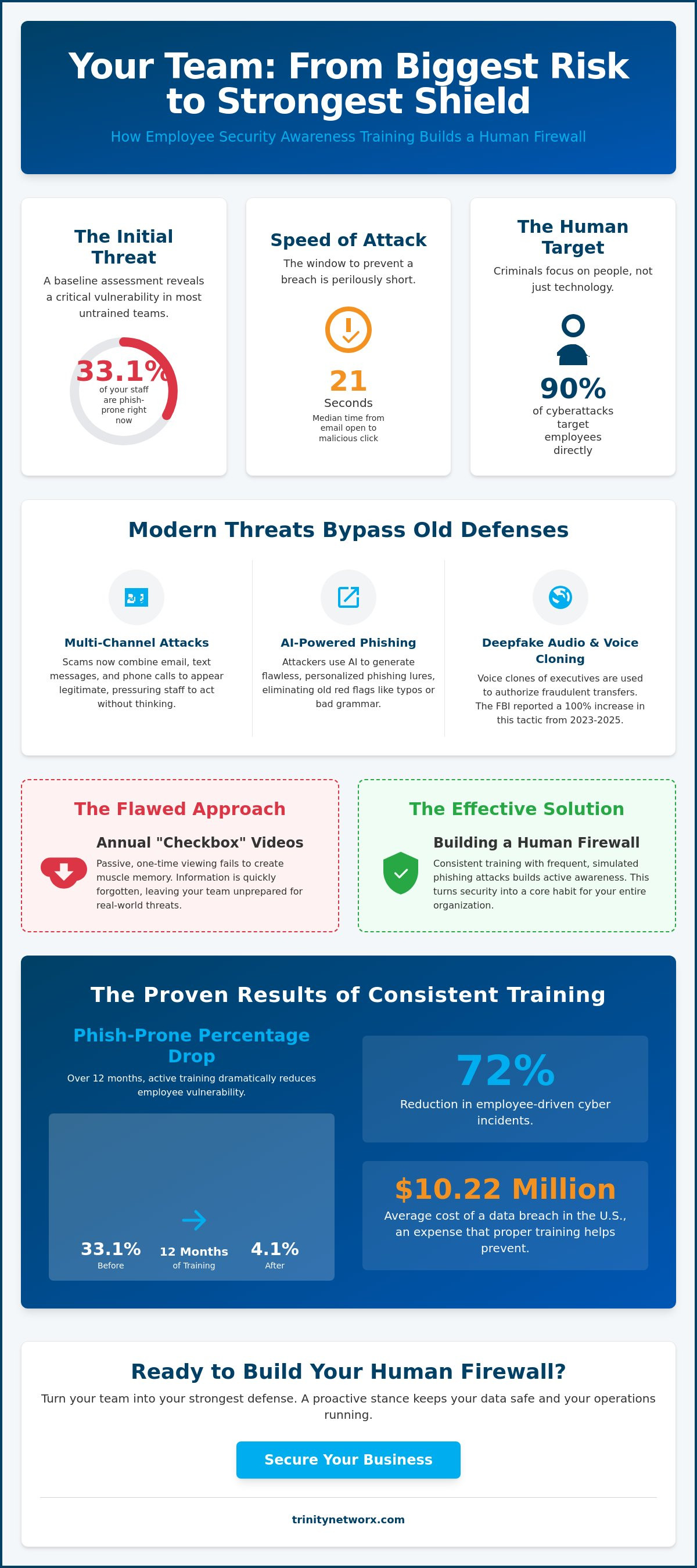
Did you know that 33.1% of your workforce is likely to fall for a phishing scam right now? This isn't a theory. It's a verified fact from 2025 data that haunts Southern California business owners. You probably feel the constant pressure of a potential ransomware attack. It's frustrating when IT policies gather dust while staff members struggle with technical jargon. Your team shouldn't be your biggest vulnerability. With the right employee security awareness training, they become your most reliable shield against digital threats. The median time between a phishing email being opened and a malicious link being clicked is just 21 seconds. You can't afford to wait for a disaster to act.
We'll show you how to change your company culture from reactive to proactive. You'll learn how to build a human firewall that identifies red flags in seconds. This shift helps secure your network and can help lower your insurance premiums. We explore how consistent training reduces your phish-prone percentage to just 4.1% over twelve months. It's a massive drop from the 33.1% starting point. We're talking about a 72% reduction in employee-driven cyber incidents. It's time to trade your anxiety for a secure, high-performance operation that protects your bottom line.
• Stop viewing your team as a liability. Start seeing them as the primary defense against the 90 percent of cyberattacks aimed at humans.
• Recognize how current social engineering schemes use multi-channel tactics like phone calls and text messages to trick your staff.
• Abandon the waste of annual checkbox videos. Active, repeated learning actually changes how your employees handle suspicious links.
• Build a program that sticks by using frequent phishing simulations to make employee security awareness training a core habit for your entire Southern California business.
• Combine your team's vigilance with proactive IT management. This ensures active threats meet a 20-minute response time every time.
Lance Reichenberger, Ph.D.
Cybercriminals don't always look for a back door in your software. They walk through the front door by tricking your staff. Recent data shows that 90 percent of modern cyberattacks target employees directly. This makes your team the primary target for every threat actor. Your technical shields are essential, but they cannot stop a determined social engineer who knows how to manipulate human emotion. This is where a human firewall changes everything. It is a culture of alertness where every staff member acts as an active sensor for the business. They stop the threats that your filters miss.
Building this defense requires consistent employee security awareness training. You aren't just teaching people to spot bad links. You are protecting your profit margins and long-term business continuity. One wrong click can stop your operations for weeks. A human firewall ensures that your last line of defense is actually your strongest. It turns passive observers into a vigilant force that protects your Southern California business from the inside out. This proactive stance keeps your data safe while your competitors struggle with reactive fixes. It is about building Security awareness into the daily rhythm of your office.
Hackers are efficient. Why spend months trying to crack an encrypted server when a single phone call can get them a password? They use psychological triggers like urgency and fear to bypass technical controls. If an employee thinks their boss is demanding an immediate wire transfer, they might ignore standard protocols. The shift to remote work has only made this easier for attackers. Your team is often working in less secure home environments. This makes them prime targets for sophisticated scams that appear legitimate. Without regular employee security awareness training, your staff remains the path of least resistance for any criminal.
The numbers are staggering. In 2025, IBM reported the average cost of a data breach in the US reached $10.22 million. For a small or medium business, this isn't just a setback. It's often a company-ending event. You have to consider more than just the immediate ransom or recovery fees. There is the weight of lost client trust and long-term reputation damage. Proper training helps you avoid these hidden costs. It prevents the weeks of operational downtime that follow a successful breach. Protecting your network is a direct investment in your company's survival and future growth.
Secure your business today. Contact Trinity Networx at contact us to start your defense plan.
Share this article: LinkedIn | Twitter | Facebook
Lance Reichenberger, Ph.D.
The days of spotting a scam by looking for broken English or obvious typos are over. Attackers have abandoned the amateur approach. In 2026, social engineering is a multi-channel operation that hits your staff from every angle. Your employees might receive a perfectly worded email, followed by a text message and a phone call, all appearing to come from your internal departments. This coordinated pressure creates a false sense of legitimacy that technical filters often miss. It makes your current employee security awareness training more vital than ever before. Threats emerge at a pace that leaves traditional IT defenses scrambling to keep up.
Criminals now use high-speed automation to research your company hierarchy. They know who reports to whom. They understand your internal jargon. This precision allows them to craft lures that feel like standard business requests. To understand how these human-targeted threats fit into your broader defense, you should review our guide on managed cybersecurity services. Relying on outdated methods leaves your Southern California business exposed to sophisticated psychological manipulation. You need a team that recognizes the subtle signs of a modern breach.
Artificial intelligence has stripped away the old red flags. Attackers use AI to generate flawless, personalized phishing lures in seconds. The FBI reported a 100% increase in deepfake-related fraud reports between 2023 and 2025. This includes voice clones that mimic a CEO's voice during a phone call to authorize a wire transfer. If your staff is still looking for spelling mistakes, they are already behind. 62% of organizations expect employees to face more attacks due to the malicious use of AI by threat actors. Modern employee security awareness training must focus on verifying identity through out-of-band communication rather than trusting what they see or hear on the first attempt.
Hackers have moved to personal devices. Malicious text messages, known as smishing, target employees when their guard is down. These messages often mimic shipping alerts or IT support notifications. Vishing, or voice phishing, targets administrative assistants who handle sensitive data. Even physical security is at risk. Attackers may attempt to "tailgate" into your office by following an employee through a secure door. You can find more guidance on staying safe by visiting CISA cybersecurity resources. A vigilant staff is the only way to catch these diverse, non-technical entry points. You can strengthen your team's readiness by partnering with experts who understand the 2026 threat landscape.
Protect your business from the next generation of threats. Contact Trinity Networx at contact us.
Share this article: LinkedIn | Twitter | Facebook
Lance Reichenberger, Ph.D.
Sitting your staff in front of a 60-minute video once a year is not a security strategy. It is a waste of your time and money. Many Southern California businesses treat employee security awareness training as a chore to satisfy insurance requirements. This checkbox mentality creates a false sense of security. Just because your team finished a slide deck doesn't mean they can stop a real-world attack. Passive learning rarely leads to active defense. While you might check a box for compliance, your network remains wide open to the psychological tactics we discussed earlier. Insurance companies want to see a certificate, but a certificate won't stop a ransomware deployment. You need a team that feels the weight of their responsibility every time they check an inbox.
Real readiness comes from changing habits, not just accumulating certificates. You need a program that focuses on behavior. If your training is boring, your employees will tune out. This creates massive gaps in your armor. While technical tools like managed firewall services provide a necessary safety net, they cannot compensate for a workforce that has forgotten everything they learned six months ago. Effective security requires a constant rhythm of education that keeps threats top of mind. This proactive approach ensures your staff stays sharp and ready for the next move by cybercriminals. It is about building a culture of defense that operates every single day.
The human brain is wired to forget information it doesn't use. Research on the forgetting curve shows that people forget about 70 percent of new information within just a few days if it isn't reinforced. Static slides from an annual presentation fail to change long-term digital habits. You don't need a marathon session. You need bite-sized, frequent updates that reflect the curriculum found in CISA security awareness training. Constant reinforcement ensures that security becomes a subconscious reflex for your staff. Short, impactful lessons are far more effective than a single day of boring lectures that no one remembers by the following week.
Dry, repetitive content is a security risk. When employees view employee security awareness training as a nuisance, they stop paying attention. They click through the slides as fast as possible just to get back to work. This low engagement leaves your business vulnerable. Training must be relevant to their daily tasks to be effective. It needs to show them how a threat affects their specific role. If the material doesn't feel real, they won't treat the threats as real. A team that is bored is a team that is prone to making the $10 million mistakes we mentioned previously. You can't afford a workforce that is mentally checked out when the stakes for your business are this high.
Stop settling for checkbox security. Contact Trinity Networx at contact us to build a resilient team.
Share this article: LinkedIn | Twitter | Facebook
Lance Reichenberger, Ph.D.
You cannot fix what you haven't measured. Effective employee security awareness training starts with a clear baseline of your current risk. Don't guess how vulnerable your team is. Test them. Send out a baseline phishing simulation to see who clicks. This data gives you a starting point and proves the need for a stronger defense. Once you have your numbers, you can deploy a program that moves beyond simple lectures. You need a system that tracks progress with clear metrics. This allows you to show your board exactly how you are reducing risk over time. If your phish-prone percentage drops from 33.1% to under 5%, you have tangible proof that your investment is working.
A strong program requires more than just testing. It needs a plan for when things go wrong. Even the best-trained teams might have a slip-up. You should have a clear cybersecurity incident response plan template ready to go. This ensures that a single mistake doesn't turn into a total network collapse. By combining active training with a solid response strategy, you protect your Southern California business from every angle. It is about creating a loop of testing, learning, and improving that never stops. This proactive approach keeps your defense sharp while others remain stagnant.
Simulations must be unpredictable. If your staff knows a test is coming every third Tuesday, they will spot it easily. That isn't real learning. You need to use varied lures that mirror the actual threats hitting your industry today. When an employee clicks a test link, don't punish them. Use it as a teachable moment. Provide immediate micro-learning that explains exactly what they missed. This instant feedback is far more effective than a lecture three months later. Your goal is to encourage a report-it culture. You want employees to feel proud of spotting a scam and reporting it to IT immediately. This turns every staff member into an active sensor for your network.
Generic training fails because it doesn't feel real to your staff. If you run a manufacturing plant near the Port of Long Beach, your threats look different than a retail store. Attackers target SoCal manufacturers with fake shipping manifests or urgent supply chain updates. Construction firms often face lures involving fake change orders or permit approvals that bypass standard filters. We've seen these tactics firsthand in our cybersecurity for manufacturing case study. Your training must address these specific scenarios to be effective. When the lures look like their actual daily emails, your team learns to stay vigilant during their most busy hours.
Ready to build a vigilant workforce? Contact Trinity Networx today to set up a custom training program for your team.
Share this article: LinkedIn | Twitter | Facebook
Lance Reichenberger, Ph.D.
Your security is only as strong as its weakest point. Many owners treat employee security awareness training as an isolated task. This is a mistake. Education must work in lockstep with proactive IT management to be effective. When your staff flags a suspicious email, they need an expert to verify it instantly. A 20-minute helpdesk response time is the difference between a caught threat and a network-wide infection. This combination of human vigilance and rapid technical support creates a shield that software alone cannot provide. Your team identifies the smoke, and our support team puts out the fire before it spreads.
Data from your training sessions should drive your technical policies. If a specific department consistently fails phishing tests, your security settings need to tighten for those users. A secure IT infrastructure serves as the necessary foundation for these human defenses. We use the results of your simulations to adjust your filters and access controls. This ensures your technology evolves as your team learns. It is a feedback loop that strengthens your entire Southern California business. You aren't just checking boxes; you are building a resilient operation that values technical health.
A proactive partner does more than just wait for tickets. We monitor your network for signs of compromised accounts that might have slipped through. When your staff receives employee security awareness training, they become better at using our helpdesk as a resource. They stop guessing and start asking. This expert vetting process keeps malicious links out of your environment. As your team grows more capable, your security stack must adapt to handle more complex threats. We ensure your technical tools stay ahead of the criminals while your staff remains alert.
Forget about 100% completion rates. They don't tell the whole story. You need to track the "time to report" a phishing attempt. A successful defense relies on how fast your team alerts IT. We also look for a steady reduction in successful clicks during our simulations. These behavioral metrics prove your team is actually learning. A resilient business doesn't just survive an attack; it thrives by making security a subconscious habit. This high level of readiness protects your data and your reputation.
Your staff is your strongest defense. Ensure they have the right support. Contact Trinity Networx for a security review and start building your human firewall today.
Share this article: LinkedIn | Twitter | Facebook
Lance Reichenberger, Ph.D.
Your business cannot survive on technical filters alone. You've seen how deepfakes and multi-channel scams bypass the best software. A checkbox approach to security is a liability you don't need. You need a team that acts as a vigilant sensor for your network. Real-world simulations and micro-learning change habits far better than a yearly video ever could. It's about building a culture where reporting a threat is second nature. You turn your staff from a risk into a shield. This is the way to protect your bottom line in 2026.
Effective employee security awareness training works best when backed by a proactive partner. We provide 24/7 proactive monitoring and an under 20-minute response time guarantee. Our cybersecurity experts focus on the specific needs of SoCal SMBs. We bridge the gap between human readiness and technical stability. Don't wait for a $10 million breach to realize your team was unprepared. Your network deserves a defense that stays active every hour of the day. We are ready to help you move forward.
Secure your Southern California business by contacting Trinity Networx today.
Share this article: LinkedIn | Twitter | Facebook
Lance Reichenberger, Ph.D.
The most effective method involves continuous, bite-sized lessons paired with unannounced simulations. You don't want a long, boring lecture that people forget by Friday. Real learning happens when staff must identify a fake threat in their actual inbox. This active participation builds the mental muscle needed to spot a real attack before it causes damage. It turns theory into a daily habit for every person on your team.
You should conduct training at least once a month to keep your defense sharp. Annual sessions are a waste because the forgetting curve wipes out 70 percent of the information within days. Frequent, short updates keep new threats like deepfakes top of mind. This consistent rhythm ensures that employee security awareness training remains a vital reflex rather than a yearly chore. Constant repetition is the only way to stay safe.
Yes, many insurance carriers offer lower premiums or better coverage terms for businesses with documented training programs. Carriers view a trained workforce as a lower risk. Without proof of regular simulations, you might face higher costs or even a denial of coverage. It's a direct way to protect your bottom line while improving your safety. Insurance companies want to see evidence of active defense, not just a policy on paper.
The curriculum focuses on phishing, social engineering, and password security. Modern programs also include lessons on deepfake voice clones and smishing, which are malicious texts. You need to cover physical risks like office tailgating too. Every entry point for a criminal must be addressed to keep your Southern California business secure. Teaching staff to verify identity through a second channel is a major part of the process.
They work exceptionally well for businesses of all sizes. Data from 2025 shows that consistent simulations can drop a company's phish-prone percentage from 33.1% to just 4.1% over a year. That is an 86% improvement in your team's ability to catch scams. Simulations turn theoretical knowledge into a practical skill that saves your network from ransomware. They provide the real-world practice your staff needs to stay alert.
Most businesses see a 40% drop in their risk rating within the first 90 days. While immediate awareness happens after the first test, true behavior change takes a few months of repetition. By the end of the first year, your staff functions as a reliable human firewall. The speed of your results depends on how often you test and train. Consistency is the key to moving the needle on your security posture.
Yes, both CMMC and HIPAA mandate documented training for all staff members who handle sensitive data. Compliance isn't just about technical settings; it requires proof that your people understand the risks. Failing to provide this training can lead to heavy fines or the loss of government contracts. It is a non-negotiable part of modern regulatory standards. You must prove your team is ready to defend the data they handle.
Use these failures as a chance for targeted coaching rather than punishment. Provide immediate micro-learning modules that explain the specific red flags they missed during the simulation. If the pattern continues, you might need to review their access levels to limit potential damage. The goal is to help them improve so they don't become the weak link in your defense. A supportive approach builds a stronger culture of security.
Ready to build a vigilant workforce? Contact Trinity Networx today to set up a custom training program for your team.
Share this article: LinkedIn | Twitter | Facebook

Article by
Lance Reichenberger, Ph.D.
Dr. Lance Reichenberger is the founder of Trinity Networx, a Southern California technology firm specializing in managed IT services, cybersecurity, network infrastructure, and business technology strategy. With nearly four decades of experience in the IT industry, he works with businesses to improve operational efficiency, strengthen security, and align technology with long-term growth objectives.
Lance focuses on proactive IT management, enterprise wireless infrastructure, cybersecurity integration, and scalable technology solutions for growing organizations throughout Southern California.
The content published on this website is provided for general informational and educational purposes only. Articles may be created, edited, or enhanced with the assistance of artificial intelligence and automation tools under the direction and review of Trinity Networx. While every effort is made to ensure accuracy and relevance, the information provided should not be considered professional, legal, financial, cybersecurity, or technical advice specific to your organization. Businesses should consult directly with a qualified professional regarding their unique environment, compliance requirements, and operational needs. Trinity Networx makes no warranties regarding completeness, reliability, or applicability of the information contained within these articles.
Schedule a brief conversation with Trinity Networx to discuss your business technology needs.
Get a practical roadmap built around your business, your users, your systems, and the technology issues that need attention first.
Put the right technology, support, security, and infrastructure in place so your business can grow, adapt, and move forward with confidence.