3281 E. Guasti Rd, STE 700, Ontario, CA 91761
1712 9th Ave SW, Watertown, SD 57201
Lance Reichenberger, Ph.D.
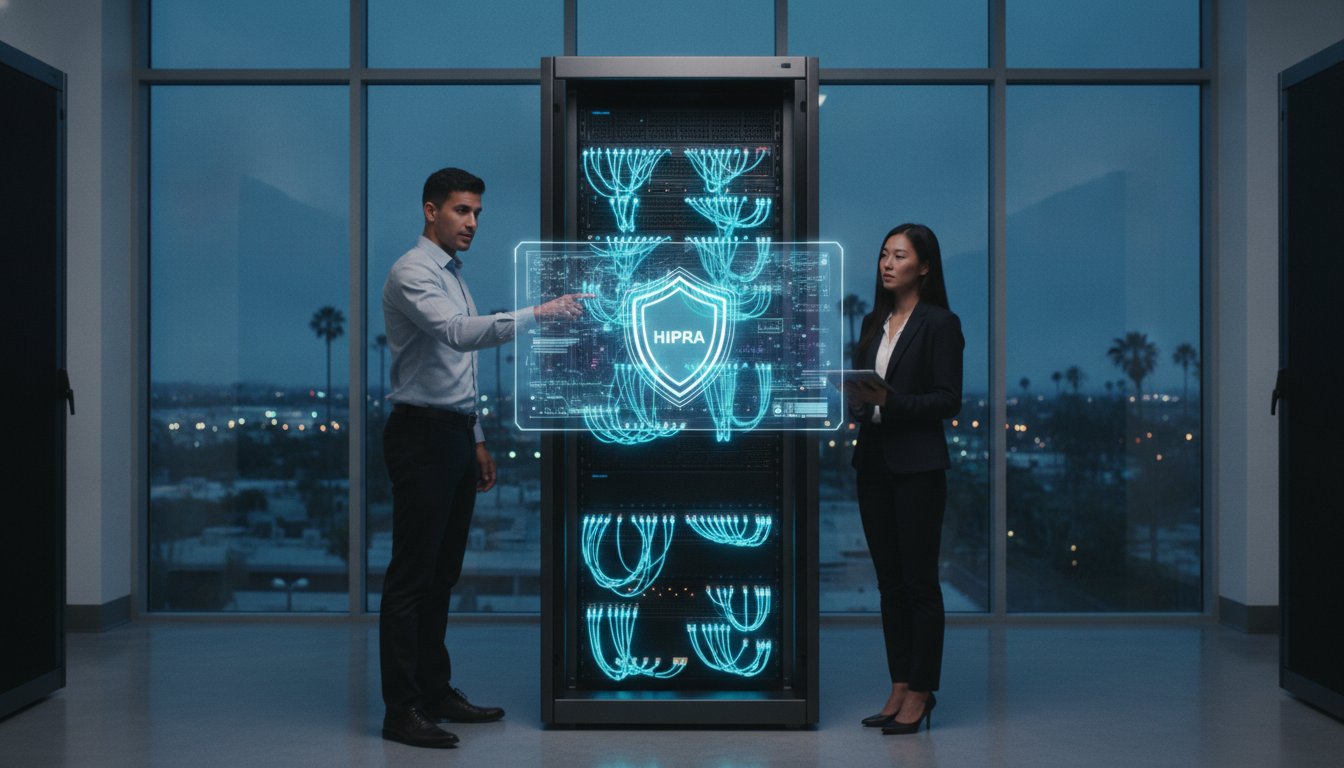
If a hardware failure wiped your patient records this morning, could you resume appointments by noon, or would you be staring at a $50,000 HIPAA penalty before the end of the day? You know that clinical excellence means nothing if your digital infrastructure collapses. Slow IT support is a liability. Uncertainty about cloud security is a distraction you cannot afford. Establishing a HIPAA compliant data backup for medical practices in Los Angeles is an active defense, not a passive utility. We provide a clear roadmap to secure your data and maintain total regulatory assurance. This article explores the 2026 mandatory encryption updates and the 72-hour recovery mandate that now dictates how you must handle ePHI. You will discover how to align with California's CMIA 15-day access rules and protect your practice from the 60% failure rate that haunts businesses after a major data loss event.
• Stop using standard storage folders that lack a signed Business Associate Agreement. Discover why a BAA is the only document standing between you and massive federal fines.
• New 2026 standards require mandatory AES-256 encryption and multi-factor authentication for all patient data. Learn the exact technical steps to secure your portal without causing daily friction for your staff.
• Discover why a HIPAA compliant data backup for medical practices in Los Angeles must include a mix of onsite speed for imaging and cloud resilience for disaster recovery.
• Your backup is useless if the restore process takes days. Calculate your Recovery Time Objective to guarantee your office stays operational even during a total server failure.
• Move beyond reactive IT with a strategy that handles both technical protection and the required compliance documentation.
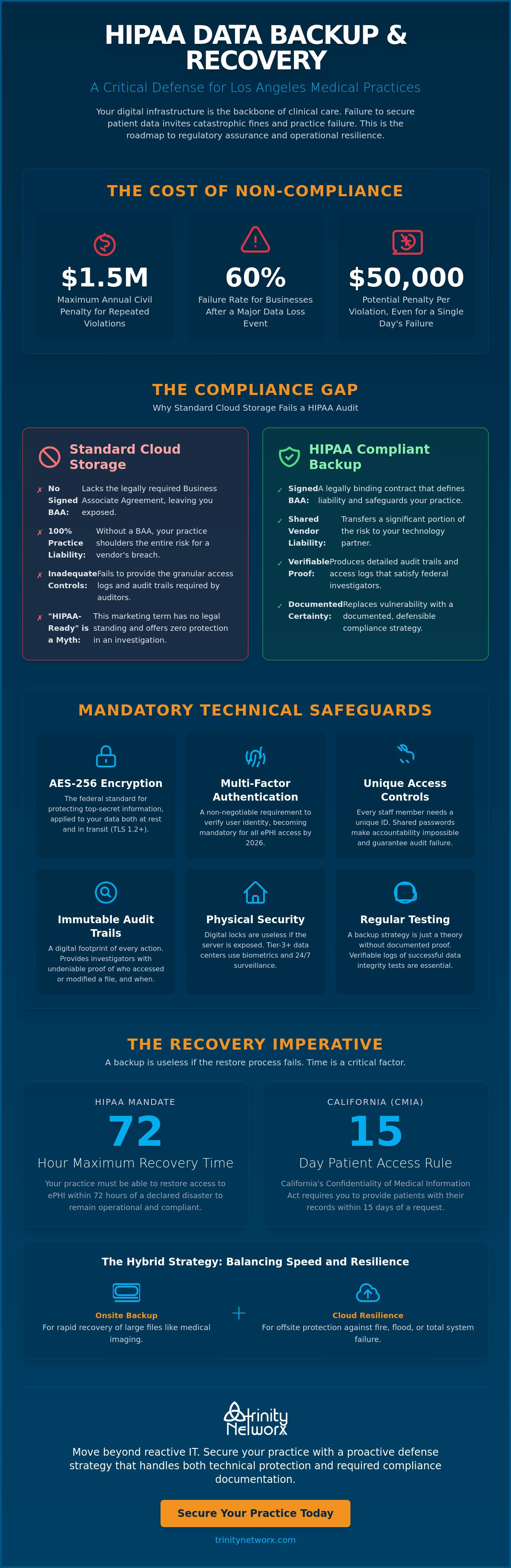
Consumer cloud storage is a trap for healthcare providers. Dropbox or Google Drive might feel convenient, but they are compliance disasters waiting to happen. Most standard drives lack the specific legal protections required for medical data. They don't offer the granular control needed to satisfy federal investigators. Choosing a dedicated HIPAA compliant data backup for medical practices in Los Angeles is a business decision that prevents financial ruin. Fines for non-compliance are not just expensive; they often surpass the cost of professional IT management for several years combined. Civil penalties can reach $1.5 million per year. These aren't just numbers on a page; they are practice-ending events. Data must remain secure while it sits on a server and every millisecond it spends moving across the web.
Auditors look for proof of control. If you can't produce detailed access logs showing exactly who touched a patient file and when, you've already lost. Many practices forget that encryption keys must remain under the clinic's control, not the vendor's. A regular testing schedule is another frequent point of failure. You must document that your backups actually work. Without a verifiable log of successful data integrity tests, your backup strategy is just a theory. The HIPAA Security Rule demands these administrative safeguards to prevent unauthorized access. When you implement a HIPAA compliant data backup for medical practices in Los Angeles, you replace these vulnerabilities with documented certainty.
A Business Associate Agreement (BAA) is your primary legal shield. It defines how liability shifts if a breach occurs. Without a signed BAA, your practice carries 100% of the risk for a vendor's mistake. Don't be fooled by 'HIPAA-ready' marketing labels. That term has no legal standing in a courtroom or an audit. It's a hollow promise. Real protection requires a vendor willing to sign a medical-specific contract. Many massive tech companies refuse to sign these agreements for their basic tiers. This refusal is a red flag. Using a vendor that won't commit to a BAA is an admission of negligence. It shows you aren't serious about patient privacy or the survival of your clinic. Liability is not a concept to ignore; it is a weight you must share with a professional partner.
Technical protection is the wall between your clinical reputation and a public data breach. It's not enough to just have a backup anymore. You need a HIPAA compliant data backup for medical practices in Los Angeles that uses AES-256 bit encryption as the absolute floor. This standard is what the federal government uses for top-secret information. It ensures that even if a drive is physically stolen, the patient records remain unreadable. You must also align with data management and backup best practices to ensure your internal protocols match federal expectations. Security is about layers. If one fails, the next must hold. Do not settle for weak links in your digital chain.
Data is most vulnerable when it's moving. Whether you're sending a file to the cloud or an offsite server, it must be shielded by TLS 1.2 or higher. Encryption at rest is the lock on the vault; encryption in transit is the armored truck. Digital locks are useless if the physical server is in an unlocked closet. High-tier data centers use biometric scanners and 24/7 surveillance to prevent physical tampering. End-to-end encryption ensures that patient records are encrypted on your local device and only decrypted once they reach the secure backup destination.
Audit trails are your best friend during a HIPAA investigation. They provide an immutable digital footprint of every person who accessed or modified a file. This level of accountability is impossible if your staff shares a single admin password. Every employee needs a unique ID. Multi-factor authentication (MFA) is now a requirement, not an option. It forces a second form of verification, usually a code on a mobile device, before granting access. In a fast-paced clinic, people forget to lock their screens. Automatic log-offs solve this by closing sessions after a few minutes of inactivity.
Ransomware is the biggest threat to your uptime. To fight it, you need immutable version history. This allows you to restore data to a point in time before the infection hit, bypassing the hacker's ransom demand entirely. Automation makes this happen. Relying on a staff member to swap tapes or click start every night is a recipe for disaster. Your it-infrastructure should handle these tasks in the background. If you are unsure if your current setup meets these marks, reach out for a technical review. We can help you identify the gaps before they become liabilities.
Los Angeles medical providers face a geography problem. Local speed is vital. You cannot wait for a download while a patient is on the table. But distance is your only defense against a tremor. A HIPAA compliant data backup for medical practices in Los Angeles bridges this gap. You need the velocity of onsite storage and the resilience of a distant cloud. This dual approach ensures your clinic never stops moving, regardless of local hardware failures or regional disasters. It turns a reactive tech hurdle into a proactive business strength.
Southern California is a unique environment for data safety. Seismic activity is a constant threat that makes offsite storage a mandatory requirement for any HIPAA Contingency Plan requirements checklist. If a quake damages your office, a local hard drive is just as broken as your medical equipment. Physical destruction of hardware is a permanent loss if you haven't mirrored that data elsewhere. Power grid instability in the LA basin also creates technical risks. Rolling blackouts or sudden surge events can corrupt databases during a backup cycle, rendering the local copy useless. This is why we advocate for geographic redundancy. Your patient records should exist in at least two safe zones, with one located far outside the immediate Los Angeles area. This ensures that a regional disaster doesn't result in total data loss or a massive breach of availability.
The hybrid model is the gold standard for modern clinics. It uses a local appliance to handle minor server glitches or accidental deletions. These restores take minutes, not hours. Simultaneously, the system pushes encrypted copies to a secure cloud for long-term archiving. This setup balances cost and speed. You keep active patient files on the fast local tier and move historical records to the more affordable cloud tier. It ensures your technical performance strategy supports both daily workflows and long-term compliance. By separating your backups across different physical locations, you ensure your practice survives even if the office is temporarily inaccessible. It's about maintaining operational continuity when your competitors are still trying to find their backup tapes. This proactive stance is what separates a strategic partner from a mere vendor. It prevents the panic of a site-down event from becoming a permanent business failure.
Storage is not recovery. Many providers assume a green checkmark on a backup dashboard means their data is safe. It doesn't. HIPAA mandates the availability of patient records, which means your HIPAA compliant data backup for medical practices in Los Angeles must be fast enough to keep your clinic operational. A backup is just a pile of encrypted bits until you successfully pull it back into your system. If that process takes three days, your practice is effectively dead for those three days. You need to prove your recovery speed before a crisis forces your hand. Establishing a HIPAA compliant data backup for medical practices in Los Angeles requires more than just buying storage space; it requires a verified path back to productivity.
Your Recovery Time Objective (RTO) is the clock ticking against your revenue. Calculate the cost of every idle doctor in your building. If your internet connection cannot handle a multi-terabyte cloud restore in under four hours, your cloud-only strategy is a failure. RTO is the most critical metric for any medical facility because it dictates when you can resume patient care. Your Recovery Point Objective (RPO) is equally vital. It defines how much data you can lose before the gaps in patient history become dangerous. If you only backup once a day, you risk losing eight hours of new charts and vitals. Fire drills aren't just for school children. They are a technical necessity. We simulate total server failures to time the restoration process from start to finish. This identifies bottlenecks in your local network or internet bandwidth. It removes the guesswork.
IT support that takes hours to call back is a liability. In a medical environment, technical glitches are emergencies. We believe in proactive IT support that answers in minutes. A 20-minute response factor should be your baseline. Waiting days for a technician to look at a failed backup server is unacceptable. Regular testing ensures the recovery process is second nature for your team and your IT partner. You should know exactly how long it takes to get your EMR system back online. If your current provider hasn't run a full-scale restoration test in the last six months, you don't have a backup. You have a hope. Hope is not a strategy for a professional medical practice. Schedule a recovery speed test with our team today to see where your current plan falls short.
Trinity Networx is not a faceless tech support vendor. We are a strategic partner for medical professionals who refuse to settle for the status quo. Our Ph.D.-led strategy focuses on the relationship between technical efficiency and the overall health of your business. We don't just install software; we implement a HIPAA compliant data backup for medical practices in Los Angeles that is built for resilience. Our team manages the Business Associate Agreements and all required compliance documentation for you. This allows your staff to stop obsessing over technical audits and return their full attention to patient care.
A Ph.D.-led approach means we apply rigorous analysis to your specific needs. We don't use cookie-cutter solutions. Every practice has different imaging requirements and different staff workflows. We tailor the backup strategy to fit those movements. Handling the BAA is just the start. We also provide the evidence-based justifications you need if a regulator ever knocks on your door. This is about total peace of mind. It is about knowing that your data is protected by an authoritative expert who values your time as much as you do.
Waiting for an IT guy to call back is a cost you shouldn't have to bear. We guarantee a response in under 20 minutes for critical issues. This level of professional assurance is what separates us from the local computer repair shops. We treat your data as the lifeblood of your practice. If your system falters, we are already moving before you even pick up the phone. The Trinity Networx compliance advantage comes from our intimate knowledge of the local medical landscape. We understand the interplay between federal HIPAA rules and California's specific privacy mandates. Our proactive monitoring identifies and neutralizes threats before they have a chance to encrypt your patient records. A stable it-infrastructure is the foundation of a successful clinic. We ensure that foundation is unbreakable.
Your medical team works hard. Your technical systems should do the same. Don't let uncertainty about cloud security or frustration with slow support hold your practice back. We provide the momentum you need to grow without the fear of a regulatory disaster. Reach out to us to review your current security posture. We will identify the gaps and build a defense that protects your reputation and your revenue. This is the end of reactive IT. It is the start of a more efficient, forward-thinking way of operating. Contact our team today to secure your practice with a partner that understands the stakes.
Contact the Trinity Networx team at contact us to protect your patient data today. Share this article on: [Facebook] [LinkedIn] [Twitter]
Patient care is your priority. Protecting the data that fuels that care is ours. Relying on consumer-grade folders is a gamble that eventually ends in federal fines or practice-ending data loss. True security requires a hybrid approach that survives both local hardware glitches and regional seismic events. We've shown that a HIPAA compliant data backup for medical practices in Los Angeles is a live strategy, not a static product. It demands AES-256 encryption, multi-factor authentication, and a verified Recovery Time Objective. You need an IT partner that speaks the language of compliance and responds in minutes, not days. Trinity Networx provides a Ph.D.-led strategy backed by a 20-minute response guarantee. We handle the technical heavy lifting and the BAA documentation so you can focus on clinical outcomes. Your practice deserves a foundation built on professional assurance and local Southern California expertise. Contact Trinity Networx for a HIPAA-compliant data assessment. Let's build a resilient future for your clinic today.
Yes, federal updates for 2026 have moved encryption from an addressable measure to a mandatory requirement for all electronic Protected Health Information. You must use AES-256 bit encryption for data at rest and TLS 1.2 or higher for data in transit. Failing to encrypt your backups is now a direct violation of the HIPAA Security Rule. It leaves your practice vulnerable to both malicious actors and federal investigators.
You should perform technical restoration tests at least every six months to ensure data integrity and system availability. A backup that hasn't been verified is just a liability waiting to surface during a crisis. We recommend monthly checks for critical patient files and annual full scale disaster simulations. This frequency ensures your team knows exactly how to respond when a real server crash occurs.
No, a basic consumer hard drive lacks the access logs and mandatory encryption controls required by federal law. These devices are easily stolen and offer zero protection against local disasters like fires or floods. A professional HIPAA compliant data backup for medical practices in Los Angeles requires a managed solution with immutable versioning and offsite redundancy. Relying on a cheap drive to protect a professional practice is a massive risk.
If your only backup is physical and located in your office, an earthquake could destroy both your primary data and your recovery files simultaneously. HIPAA requires a formal contingency plan that includes offsite storage. We use geographic redundancy to store your encrypted records in multiple safe zones outside the LA basin. This ensures your practice stays operational even if your physical building is temporarily inaccessible or damaged.
Yes, a Business Associate Agreement is a non-negotiable legal requirement under federal law for any vendor touching patient data. It defines the liability of the backup provider and ensures they are contractually obligated to protect your records. Without a signed BAA, you are 100% responsible for any breach that occurs on the vendor's servers. Most consumer cloud services refuse to sign these documents, making them illegal for medical use.
Recovery time depends entirely on your local internet bandwidth and the total volume of your data. A full EHR restore from the cloud can take anywhere from a few hours to several days if you don't have a local recovery appliance. The 2026 HIPAA updates propose a 72-hour mandate for restoring critical systems. We use hybrid solutions to hit this window and keep your clinic running without interruption.
Data backup is the act of making a copy of your files, while disaster recovery is the strategic plan to get your systems back online. Think of the backup as the spare tire and disaster recovery as the jack and tools needed to change it. A backup alone won't help you if you don't have the hardware or protocols to restore it. You need both to maintain true operational continuity.
Yes, fines for failing to maintain an accessible backup range from $100 to $50,000 per violation. In 2026, the annual maximum for non-compliance categories is $1.5 million. Regulators view the lack of a backup as willful neglect, which triggers the highest tier of penalties. Investing in a HIPAA compliant data backup for medical practices in Los Angeles is significantly cheaper than paying a single federal fine.

Article by
Lance Reichenberger, Ph.D.
Dr. Lance Reichenberger is the founder of Trinity Networx, a Southern California technology firm specializing in managed IT services, cybersecurity, network infrastructure, and business technology strategy. With nearly four decades of experience in the IT industry, he works with businesses to improve operational efficiency, strengthen security, and align technology with long-term growth objectives.
Lance focuses on proactive IT management, enterprise wireless infrastructure, cybersecurity integration, and scalable technology solutions for growing organizations throughout Southern California.
The content published on this website is provided for general informational and educational purposes only. Articles may be created, edited, or enhanced with the assistance of artificial intelligence and automation tools under the direction and review of Trinity Networx. While every effort is made to ensure accuracy and relevance, the information provided should not be considered professional, legal, financial, cybersecurity, or technical advice specific to your organization. Businesses should consult directly with a qualified professional regarding their unique environment, compliance requirements, and operational needs. Trinity Networx makes no warranties regarding completeness, reliability, or applicability of the information contained within these articles.
Schedule a brief conversation with Trinity Networx to discuss your business technology needs.
Get a practical roadmap built around your business, your users, your systems, and the technology issues that need attention first.
Put the right technology, support, security, and infrastructure in place so your business can grow, adapt, and move forward with confidence.