3281 E. Guasti Rd, STE 700, Ontario, CA 91761
1712 9th Ave SW, Watertown, SD 57201

Your SPRS score is no longer a suggestion; it is a hard requirement for survival in the defense industrial base. With Phase 2 of the CMMC 2.0 rollout beginning on November 10, 2026, the era of simple self-attestation has ended. You likely feel the weight of these 110 NIST controls and worry that the price of staying eligible will gut your profit margins. It's a valid concern for any Southern California contractor trying to understand how to become CMMC compliant while keeping their daily operations running smoothly.
We cut through the noise to build a no-nonsense roadmap that protects your contracts without causing operational gridlock. You'll learn exactly how to move from technical gaps to a successful C3PAO assessment. This guide covers the essential steps for SPRS submission and the specific evidence required to maintain your DoD eligibility throughout 2026 and beyond. We focus on results, not abstract theory. Efficiency drives this process. Let's get to work.
• The 2026 Phase 1 window is open. Act now to meet Level 1 and Level 2 self-assessment demands before the Phase 2 deadline triggers mandatory third-party audits.
• Identify your specific data handling requirements. Learn why the presence of CUI mandates the advanced 110 security controls of CMMC Level 2.
• Master the 5-step roadmap explaining how to become CMMC compliant while protecting your operational uptime and contract eligibility.
• Stop guessing about your security posture. Use a formal gap assessment to map technical holes against the NIST 800-171 standard.
• Compliance is a continuous culture, not a one-time fix. Proactive IT management ensures you stay ready for annual affirmations and DoD scrutiny.
The Department of Defense (DoD) changed the rules. The Cybersecurity Maturity Model Certification (CMMC) is no longer a distant threat. It's the law. As of November 10, 2025, the final rule is active. We are currently in Phase 1. This window runs until November 9, 2026. During this time, every contractor must understand how to become CMMC compliant to stay in the game. If you don't have a score in the Supplier Performance Risk System (SPRS), you're invisible to contracting officers.
Disqualification is immediate. You won't just lose new bids; you'll lose the ability to extend existing contracts. This isn't about checking boxes anymore. It's about a documented culture of security. The DoD is weeding out contractors who treat cybersecurity as an afterthought. If your IT isn't proactive, your business is a liability.
Your data has a target on it. Federal Contract Information (FCI) is basic data provided by the government that isn't intended for public release. Controlled Unclassified Information (CUI) is more sensitive; it's information that requires safeguarding or dissemination controls. The DoD views CUI protection as a vital pillar of national security because stolen data costs lives on the battlefield. Adversaries target small contractors to find backdoors into larger systems. For machine shops and parts manufacturers, CUI includes the specific technical drawings, CAD files, and material specifications required to produce defense components. Protecting these assets is non-negotiable.
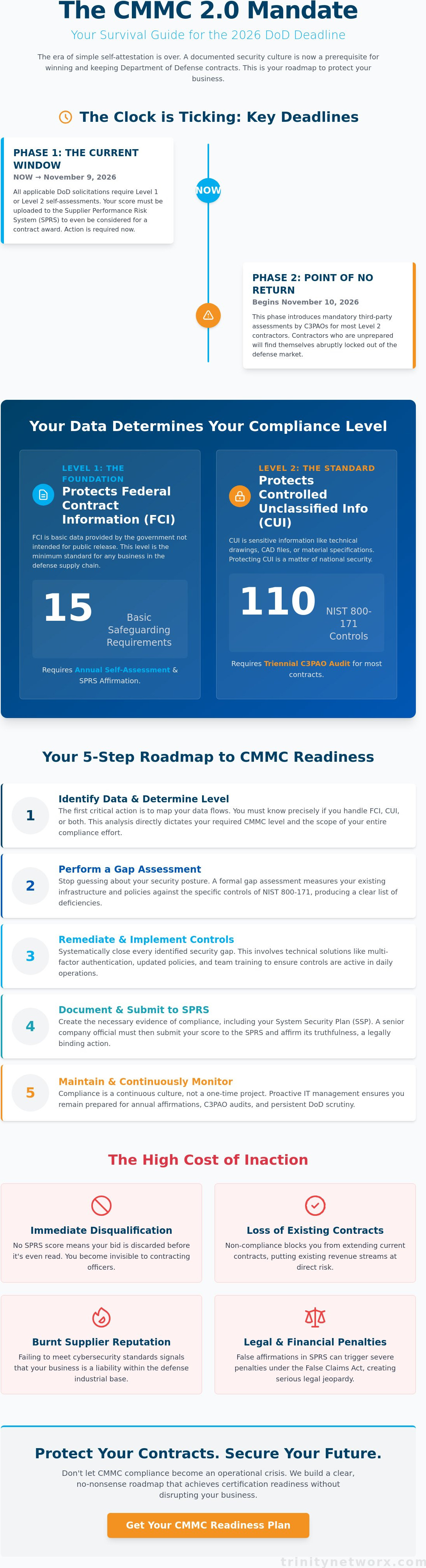
Phase 1 mandates Level 1 or Level 2 self-assessments in all applicable solicitations. You must upload your results to the SPRS. This isn't a suggestion. It's a prerequisite for award. By November 10, 2026, Phase 2 begins. This introduces mandatory third-party assessments for Level 2. The transition is fast. Contractors who fail to prepare now will find themselves locked out of the market when the third-party auditors arrive.
The legal weight here is heavy. When you submit your score, a senior company official must sign an affirmation of truthfulness. False claims aren't just IT errors; they're potential False Claims Act violations. The DoD uses the SPRS to verify your status before they even look at your bid. If the score isn't there, or if the affirmation is missing, your proposal goes in the trash. You can't afford to wait until the deadline to fix your infrastructure. Real security takes time to build.
Miscalculating your compliance level is a fast track to wasted capital or lost bids. You must know exactly what data you handle before starting the process of how to become CMMC compliant. The DoD CMMC Program creates a clear distinction based on data sensitivity. Most Southern California contractors won't stop at Level 1. If you touch technical drawings or proprietary military specs, Level 2 is your baseline. Precision here is a requirement for survival.
Level 1 is the floor. It covers Federal Contract Information (FCI). If you only provide commercial off-the-shelf items or generic services, this might be your stop. You'll focus on 15 basic controls across domains like Access Control and Identification. It's a self-assessment, but don't get complacent. You must submit an annual affirmation in the SPRS system. Think of it as your basic ticket to play. Without it, you aren't even on the field. It is the minimum standard for any business in the defense supply chain.
The jump from 15 to 110 controls is steep. Level 2 aligns with NIST SP 800-171 Rev 2. This level protects Controlled Unclassified Information (CUI). If your shop handles sensitive blueprints or specific performance requirements, you're here. For most, this requires a third-party assessment from a C3PAO every three years. Some "non-prioritized" contracts allow self-assessment, but those are becoming rare. Readiness means proving you can protect the intellectual property of the United States. It requires a documented history of compliance, not just a promise to fix things later. You must demonstrate that these controls are active in your daily operations.
Complexity scales fast. Moving to Level 2 isn't just about adding more software. It's about managing 110 distinct security requirements. This includes everything from multi-factor authentication to physical security and incident response. If you handle CUI, a C3PAO will eventually walk through your doors. They want to see evidence. They want to see that your team follows these rules every single day. If you can't produce that evidence, your eligibility vanishes. This is the reality of the defense industry in 2026. You either meet the standard or you find a new line of work. Getting an expert IT consulting perspective helps clarify which bucket you fall into before you spend a dime on the wrong hardware.
Contract requirements flow down. If a prime contractor handles CUI, they will likely require you to meet Level 2 standards even if your specific task seems minor. The triennial assessment cycle means you'll face a deep dive every three years for Level 2 and Level 3. However, the annual affirmation keeps the pressure on between those audits. You can't let your guard down. One weak link in the supply chain can compromise an entire program. Consistency is the only way to maintain your status.
You cannot fix what you haven't measured. Guesswork is the fastest way to fail an audit and lose your DoD eligibility. A formal gap assessment is the first move in learning how to become CMMC compliant because it provides a brutal, honest baseline. You must map your current IT practices against the 110 NIST 800-171 controls to see exactly where your defenses crumble. This isn't a casual checklist. It is a technical deep dive into your network architecture, physical security, and employee behavior.
The heart of this process is your System Security Plan (SSP). This is the living document of your compliance. It describes the boundary of your network, how data flows, and which controls are in place. If the SSP doesn't exist, you aren't compliant. Many small shops struggle here. They often lack multi-factor authentication (MFA) on internal systems or fail to perform consistent log monitoring. If you aren't watching who enters your network and what they do, you are a liability to the defense supply chain. We see these gaps daily. They are fixable, but only if you identify them early.
Once the gaps are visible, you need a roadmap to close them. The Plan of Action and Milestones (POA&M) is your remediation to-do list. Under the 2026 rules, the DoD is much stricter about these plans. You can no longer put critical security controls on a POA&M and expect a passing score. High-priority requirements must be active and verified before you submit your SPRS score. Use this document to set hard deadlines for hardware replacements or software upgrades. It keeps your team accountable and ensures your budget goes where it matters most.
Doing the work is only half the job. You must prove it. CMMC assessors live by the "Show Me" rule. If a security practice isn't backed by logs, policies, and screenshots, it doesn't exist in the eyes of the government. This is the culture of evidence. You need a paper trail for every one of those 110 controls. Documentation is 50% of the compliance battle. Policies must be written, approved, and followed by every staff member. Assessors will interview your team to ensure your written rules match your daily actions. If there is a disconnect, you fail. Consistency is the only path to a successful certification.
Stop relying on reactive fixes. Proactive cybersecurity solutions build the evidence you need automatically. When the auditor asks for six months of logs, you should be able to produce them in seconds. That level of readiness only comes from a disciplined approach to IT management. Start documenting today so you aren't scrambling when the contract is on the line.
Success in the Southern California defense sector requires more than just high-quality parts. It requires a secure digital environment. If you want to know how to become CMMC compliant without bankrupting your shop, follow this direct, five-step roadmap. This process ensures you meet the strict DoD requirements while maintaining the speed your customers expect.
Identify every location where CUI lives on your network. Isolate these segments to reduce the cost of your audit. If you don't need CUI on every machine, don't put it there.
Fix the technical gaps found in your assessment. This means active multi-factor authentication, full-disk encryption, and advanced endpoint protection on every device.
Formalize your internal rules. Document how you handle password changes, manage guest access, and dispose of sensitive digital and physical data.
Your team is your biggest risk. Ensure every employee understands how to handle sensitive data and can spot a phishing attempt before it compromises a contract.
Run a mock audit. This finds "automatic fail" items before the official assessor arrives. It's your last chance to verify your evidence.
Legacy hardware is often the biggest hurdle for Orange County and San Diego manufacturers. Old servers and unpatched workstations cannot meet Level 2 standards. You must move to CMMC-compliant cloud environments or modern local stacks. Real security also requires 24/7 monitoring. A Security Operations Center (SOC) must watch your network for threats at all times. This is where response time matters. At Trinity Networx, our 20-minute response time isn't just a goal; it's a critical security metric that keeps your operations running and your data safe. If your current IT provider takes hours to respond, you are already behind.
Finding an authorized Certified Third-Party Assessment Organization (C3PAO) is your next move. There are currently only around 80 authorized C3PAOs available to conduct these deep dives for the 80,000 contractors needing certification. Demand is high. On audit day, the assessor will interview your staff and inspect your logs. They want to see that your policies are active habits, not just dusty documents. Once they verify your 110 controls, they submit your certification directly to the DoD. Don't wait for a contract deadline to start this search. Secure your spot now with our CMMC compliance expertise to ensure your shop is ready for the call.
CMMC is a full-time commitment. Managing 110 controls alone is a recipe for failure. A single internal IT staffer or a reactive technician who only shows up when things break cannot keep pace with DoD requirements. You need a team that never blinks. Security isn't a one-time project. It's a constant state of readiness that requires active monitoring every hour of every day.
This is where our Compliance-as-a-Service model changes the game. We don't just install software and walk away. We provide continuous oversight to ensure your score stays high and your evidence is always ready for inspection. When you're learning how to become CMMC compliant, you soon discover that maintenance is harder than the initial setup. Proactive management stops threats before they trigger an audit failure. It keeps your business eligible for the contracts you've worked hard to win.
Being a secure supplier is a badge of honor. It separates the top-tier shops from the ones who will be disqualified by the 2028 full implementation deadline. Your compliance is a growth engine. It makes you the safe choice for prime contractors who can't risk their own eligibility by hiring a weak link. High-level security attracts high-level opportunities.
We live here. Our team understands the Inland Empire manufacturing scene. We know how machine shops operate. We've seen the dusty shop floors and the high-precision CNC areas. Our security stack aligns directly with the NIST 800-171 requirements you face. If you need Managed IT Services Ontario CA, you need a partner who speaks your language and knows exactly what the DoD expects from local contractors. We bridge the gap between technical requirements and business reality.
The 2026 deadlines are moving closer. Don't wait until a major contract is on the line to find out your IT is failing. We provide a proactive stance that keeps you ahead of the auditors and the hackers. Our 20-minute response guarantee means your problems get solved fast. No waiting around. No excuses. Just results.
Get CMMC Compliant with Trinity Networx. Schedule your CMMC Readiness Assessment today. Protect your business. Protect your future. Let's get your shop ready for the next decade of defense work.
The 2026 implementation window is your chance to act before mandatory Phase 2 audits begin. You now understand the gap assessment process and the weight of the System Security Plan. Waiting for a contract deadline to figure out how to become CMMC compliant is a gamble you will lose. Real security requires a culture of evidence that is built over months, not days. It's a strategic move that protects your revenue and your reputation.
Trinity Networx has spent 20 years serving Southern California manufacturers with assertive reliability. We don't just fix computers. We drive your business forward by aligning your IT with the strict NIST 800-171 controls required by the DoD. With a guaranteed response time of under 20 minutes, we ensure your operations never stall while you pursue new opportunities. Our expertise in CMMC compliance means we handle the technical burden so you can focus on production.
Don't let technical requirements stand between you and your next award. Schedule Your CMMC Readiness Assessment today to lock in your eligibility. Your business is too valuable to leave to chance. Let's build a secure foundation for your growth.
Total costs depend on your current security gaps and the level of data you handle. Industry estimates suggest total implementation and certification for Level 2 can range from $50,000 to $200,000. These figures include the C3PAO assessment fee, which often sits between $30,000 and $100,000. Your specific hardware needs and policy development time will dictate the final investment required to secure your network.
Yes, but only for a limited time and specific contracts. Phase 1 of the rollout allows Level 2 self-assessments until November 9, 2026. After Phase 2 begins on November 10, 2026, most Level 2 contracts will require a third-party assessment from a C3PAO. You must check your specific solicitation to see if self-attestation is still permitted for that award or if an independent audit is mandatory.
You might still be eligible for an award if your Plan of Action and Milestones (POA&M) is accepted by the DoD. However, you cannot delay every requirement. High-priority security controls must be met before you can submit a passing score. A low score signals high risk to contracting officers. This often leads to disqualification in a competitive bidding environment where other contractors have already reached the full 110 mark.
Expect the process to take six to eighteen months. This timeline depends on the maturity of your existing IT infrastructure and how quickly you can document your policies. Preparing for how to become CMMC compliant involves more than just technical fixes. You must show months of logs and evidence to an auditor to prove your security practices are consistent habits rather than temporary adjustments made for the audit.
They are closely linked but not identical. CMMC Level 2 incorporates all 110 security requirements from NIST SP 800-171 Rev 2. The main difference is the verification method. While NIST 800-171 previously relied on self-reporting, CMMC adds a mandatory certification layer. You must now prove you follow the NIST standards through an independent audit or a formal annual affirmation that carries legal weight.
Compliance requirements flow down the entire supply chain. If your subcontractors handle Federal Contract Information (FCI), they need Level 1. If they touch Controlled Unclassified Information (CUI), they must meet Level 2 standards. As a prime contractor, it is your responsibility to verify that every partner on the project meets the security level specified in the contract. Failure to verify your subs can put your own contract at risk.
A C3PAO is an independent organization authorized by the DoD to conduct Level 2 audits. They act as the jury. Their job is to verify your evidence and ensure your 110 controls are fully implemented. They will interview your staff and inspect your network to confirm your System Security Plan is accurate. Once they finish, they submit their findings to the DoD to finalize your certification status.
You must undergo a full assessment every three years for Level 2 and Level 3. In addition to this triennial audit, a senior company official must provide an annual affirmation of compliance in the SPRS. This ensures that your security posture doesn't slip between formal assessments. Level 1 contractors must also perform a self-assessment and submit an affirmation every single year to maintain their eligibility for defense contracts.

Article by
Lance Reichenberger, Ph.D.., J.D. (Candidate)
Dr. Lance Reichenberger is the founder of Trinity Networx, a Southern California technology firm specializing in managed IT services, cybersecurity, network infrastructure, and business technology strategy. With nearly four decades of experience in the IT industry, he works with businesses to improve operational efficiency, strengthen security, and align technology with long-term growth objectives.
Lance focuses on proactive IT management, enterprise wireless infrastructure, cybersecurity integration, and scalable technology solutions for growing organizations throughout Southern California.
The content published on this website is provided for general informational and educational purposes only. Articles may be created, edited, or enhanced with the assistance of artificial intelligence and automation tools under the direction and review of Trinity Networx. While every effort is made to ensure accuracy and relevance, the information provided should not be considered professional, legal, financial, cybersecurity, or technical advice specific to your organization. Businesses should consult directly with a qualified professional regarding their unique environment, compliance requirements, and operational needs. Trinity Networx makes no warranties regarding completeness, reliability, or applicability of the information contained within these articles.
Schedule a brief conversation with Trinity Networx to discuss your business technology needs.
Get a practical roadmap built around your business, your users, your systems, and the technology issues that need attention first.
Put the right technology, support, security, and infrastructure in place so your business can grow, adapt, and move forward with confidence.