3281 E. Guasti Rd, STE 700, Ontario, CA 91761
1712 9th Ave SW, Watertown, SD 57201

Lance Reichenberger, Ph.D.
Mastering the framework for how to choose a managed service provider puts the power back in your hands. You don't have to accept silent profit leaks or reactive vendors who profit from your downtime. A true partner aligns their success with your uptime. We have explored the necessity of a non-negotiable security baseline and the hard questions required to vet helpdesk performance. While a local Southern California presence is key for regional firms, businesses in the UK can find similar high-standard support from Protozoon, which provides all-inclusive IT and security managed services.
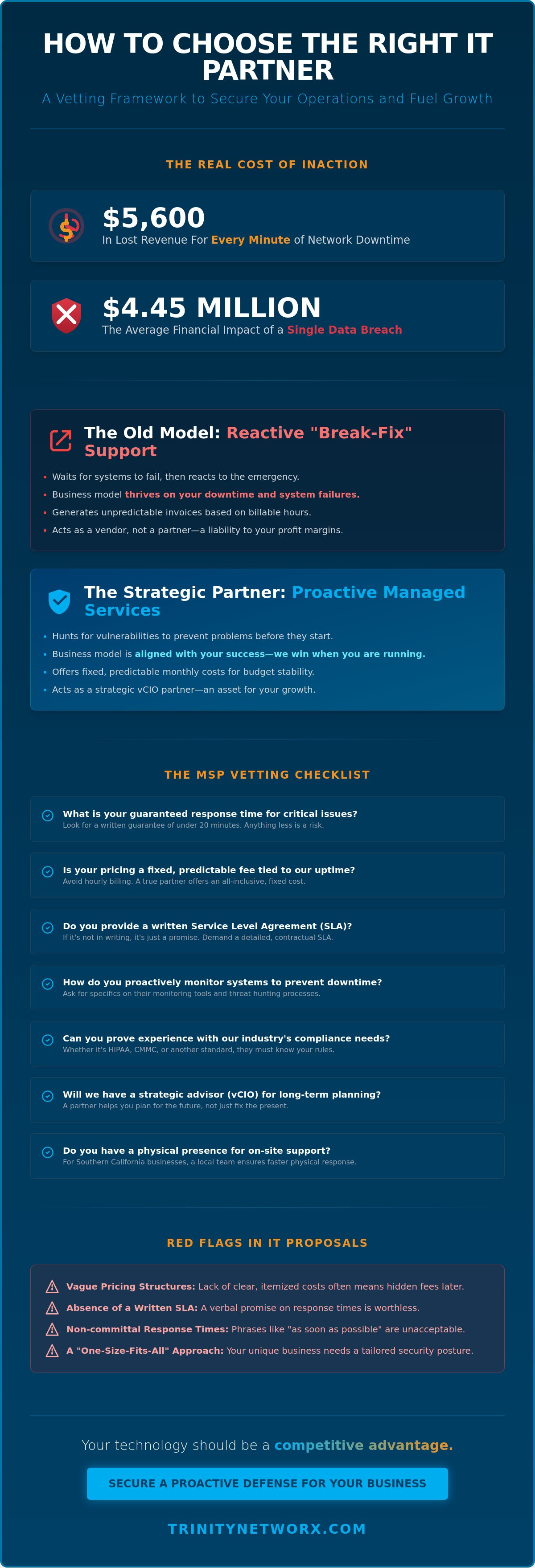
Every sixty seconds your network stays dark, your business bleeds $5,600. That is the reality of downtime in 2026 according to research from Gartner. You likely feel the sting of slow helpdesk tickets. You face the anxiety of unpredictable monthly invoices that never reflect actual performance. It's exhausting to wonder if your current team truly understands your manufacturing floor or legal filing deadlines. Learning how to choose a managed service provider is no longer about finding a technician. It's about securing a partner who views your uptime as their only metric of success.
I will show you how to master the selection process using a rigorous vetting framework designed to protect your profit margins. You will gain a clear checklist to identify proactive defense forces that offer sub-20-minute response times and fixed, predictable costs. We will look at why a non-negotiable security baseline is the new standard. We will verify how a partner handles the specific demands of your industry, ensuring your operations stay resilient against the $4.45 million average cost of a data breach. Peace of mind regarding your cybersecurity is not a luxury; it's a requirement for growth.
Secure your operations today by reaching out at contact us
• Identify why reactive IT models drain your budget and how to find a partner whose success matches your own uptime.
• Master how to choose a managed service provider by using a vetting framework that exposes hidden technical weaknesses and defense gaps.
• Learn the specific questions that reveal if a vendor can truly handle the demands of CMMC or HIPAA compliance.
• Detect red flags in IT proposals like vague pricing structures or the absence of a written Service Level Agreement.
• Prioritize a Southern California provider with a physical presence to ensure your business remains resilient and ready for growth.
Profit leaks rarely happen all at once. They drip. For many Southern California companies, these leaks take the form of micro-downtime, those five minute stretches where the server lags or an application hangs. If your IT guy only shows up when things are already broken, your business goals are fundamentally misaligned with his bank account. A reactive provider thrives on your failure because system crashes generate billable hours. This antiquated break-fix model is a liability in 2026. Learning how to choose a managed service provider means finding a team that wins only when you are up and running. You want your technology to protect your profit margins, not erode them through neglect. If your IT support feels like a recurring tax on your operations, you are in the wrong contract.
A true Managed Service Provider (MSP) acts as a shield. They hunt for vulnerabilities before a hacker or a hardware failure can exploit them. This proactive stance ensures your staff stays productive instead of waiting for a return phone call. You need a partner who views your network as a strategic asset, not just a collection of cables and screens. Efficient managed IT services focus on stability and operational continuity. This ensures technical efficiency becomes a strategic driver of progress rather than a persistent headache. We focus on the health of your entire business ecosystem to ensure your momentum never stalls.
Idle employees are expensive. If twenty people at your firm sit around for two hours waiting for a helpdesk response, you aren't just losing time; you're losing thousands in payroll and missed opportunities. A four hour response window is a relic of the past. It's unacceptable. Demand a guarantee of under 20 minutes for critical technical issues. Speed is a metric of professional assurance that directly impacts your bottom line. If a provider can't commit to that pace, they aren't equipped to handle your growth. Momentum requires immediate action, not a ticket number in a queue.
A vendor sells you a box and a bill. A strategic partner manages your digital health. You need more than hardware; you need a vCIO to map out your long-term planning and security posture. This is especially true for businesses looking for managed IT services Ontario CA, where local expertise meets high-level strategy. When you evaluate how to choose a managed service provider, look for those who participate in your business meetings, not just your server room. They should understand your workflow as well as you do. They must protect your data while empowering your team to work faster.
Stop settling for reactive support. Contact Trinity Networx, LLC today to build a proactive defense for your business: contact us
Share this article: Facebook | LinkedIn | X
Lance Reichenberger, Ph.D.
Technical depth is more than a list of software licenses. It is the human intelligence behind the dashboard. When you research how to choose a managed service provider, you must look for an organization that operates with an active defensive posture. This means catching a failing server drive or an overheating switch weeks before it halts your production line. Proactive monitoring isn't a buzzword. It's a technical requirement for survival in 2026. You need a team that understands why a manufacturing workflow cannot stop for a software update. They must know why a commercial construction site needs reliable wireless networking immediately. If they don't understand your specific industry pressure, they will fail you when minutes matter most.
CISA provides a specific framework for evaluating security posture, which offers invaluable guidance for organizations researching how to choose a managed service provider and assessing their defensive capabilities.
You've identified the risks of reactive IT and evaluated technical stacks. Now, you must sit across from a potential partner and ask the hard questions. Knowing how to choose a managed service provider depends on their ability to provide concrete answers instead of vague promises. Don't accept "we're fast" as a metric. Demand data. If they can't show you their performance history, they won't perform for you. You need a partner that treats your network like a strategic asset, not a burden.
Use these seven questions to separate the professional defense forces from the basic vendors:
(Look for under 20 minutes).
Efficiency dies when support is outsourced to a different time zone. You need local experts who understand the Southern California pace. Verify if they offer unlimited support. A per-ticket model creates a barrier between your team and their technology. It discourages employees from reporting small glitches. Those glitches eventually grow into major outages. Proactive managed IT services should encourage communication, not penalize it with extra fees. Demand 24/7 availability if your operations run after hours. Your business doesn't stop at 5:00 PM; your IT shouldn't either.
Generalists are a danger to specialized firms. If you work in defense, you need CMMC compliance consultants who know the 2026 requirements. They must understand the specific data privacy laws in California. Ask for examples of how they manage workflows for legal or manufacturing clients. A partner who understands your industry will anticipate your needs. They will protect your data while keeping your supply chain moving. Understanding how to choose a managed service provider involves verifying their grasp on your specific regulatory environment. This ensures your compliance isn't just a checkbox; it's a competitive advantage.
Ready to see our answers to these questions? Contact us at contact us to start a real conversation about your growth.
Share this vetting guide: Facebook | LinkedIn | X
Lance Reichenberger, Ph.D.
The proposal on your desk is a window into the provider's priorities. It shows where their loyalty lies. If it's filled with technical jargon but lacks clear accountability, you're looking at a vendor, not a partner. Learning how to choose a managed service provider involves reading between the lines of these documents. Vague pricing is the first warning. If the quote doesn't define what is included, expect a flood of "out of scope" invoices for every minor change. This "nickel and diming" approach drains your budget and distracts your team. A professional proposal should also feature a written Service Level Agreement (SLA) with clear penalties. Without a financial consequence for missing response times, the provider has no skin in the game. They win even when you lose.
Watch for a rigid push toward specific hardware brands. If a provider insists on one manufacturer without explaining how it fits your unique needs, they might be chasing sales incentives rather than your operational success. Your IT stack should serve your workflows, not their vendor quotas. If the document fails to address the signs you need a new IT provider, they are likely hiding their own deficiencies. You want a partner who is transparent about performance standards from day one. In Southern California, this transparency must extend to local regulations. A proposal that ignores the specifics of CMMC for defense contractors or HIPAA for medical groups is a liability. It shows they don't understand the legal landscape of your industry.
Locking your business into a three year deal without a performance out-clause is a mistake. If the service fails to meet the agreed standards, you must have a way to leave. A reputable provider will outline a clear off-boarding process. They shouldn't hold your data or passwords hostage. Look for total transparency in the average cost of managed IT services. Hidden fees for onboarding or emergency visits should be clearly stated upfront, not buried in the fine print. You need a predictable budget to maintain your momentum.
Listen to the verbs they use during the presentation. If they focus on how fast they "fix" things, they are admitting they expect things to break. You need a partner who talks about "prevention" and "stability." A proactive IT management strategy aims for zero downtime. If they don't ask about your business goals or your 2026 growth plans, they are just selling you a utility. You deserve a strategic driver of progress. Knowing how to choose a managed service provider means demanding a partner who cares about your profit margins as much as you do.
Don't sign a contract that leaves your business exposed. Contact Trinity Networx for a transparent, proactive proposal that aligns with your growth: contact us
Share this guide: Facebook | LinkedIn | X
Lance Reichenberger, Ph.D.
Choosing an IT partner is a strategic investment. Don't treat it like buying office supplies. When you decide how to choose a managed service provider, you are selecting the engine for your 2026 expansion. A low bid often masks a lack of technical depth or a reactive mindset that will cost you more in downtime than you save in monthly fees. Focus on risk reduction. Prioritize a team that understands the local Southern California market. A physical presence in SoCal is mandatory. If your server room floods or a switch dies, you can't wait for a technician to fly in from another state. You need boots on the ground within the hour. Remote support is a tool, but it is not a replacement for a local expert who can walk through your warehouse or office.
Culture matters just as much as code. Your IT team will interact with your staff daily. If their communication style is cold or overly academic, your team won't use the tools they provide. Efficiency stalls when people are afraid to call support. Ensure their values align with yours. They should act as a protective force that empowers your staff, not a distant vendor that hides behind a ticketing portal. You want a partner who speaks your language and understands your specific business pressures. Reliability is built on these relationships.
Value is found in the absence of problems. If your network stays silent and your costs stay flat, the provider is doing their job. Don't chase the cheapest contract only to pay for it later with lost data or angry customers. A true partner treats your profit margins as their primary performance metric.
The first 30 days are a sprint. Your new partner must document every corner of your network. This creates a blueprint that ensures no single point of failure exists. You should receive a clear vCIO schedule for the first year immediately. This ensures your IT performance strategy remains a priority, not an afterthought. Expect a deep dive into your current security gaps and a roadmap to close them. We look at everything from aging hardware to weak passwords to ensure your momentum never slows.
Stop settling for technology that holds your business back. You deserve a partner that treats your uptime as their primary metric. We guarantee a response time of under 20 minutes because we know your profit margins depend on it. It is time to move beyond the status quo. Get a custom IT assessment from Trinity Networx today. Let's build a network that drives your progress. Our team is ready to protect your growth and ensure your operational continuity.
Contact us: contact us
Share this article: Facebook | LinkedIn | X
Lance Reichenberger, Ph.D.
Mastering the framework for how to choose a managed service provider puts the power back in your hands. You don't have to accept silent profit leaks or reactive vendors who profit from your downtime. A true partner aligns their success with your uptime. We have explored the necessity of a non-negotiable security baseline and the hard questions required to vet helpdesk performance. Remember that a local Southern California presence ensures your business stays resilient when emergencies strike.
Trinity Networx brings a 20 year track record to your network. We specialize in CMMC and HIPAA compliance to keep your firm ahead of regulatory shifts. We don't just promise speed; we guarantee a response time under 20 minutes. Contact Lance Reichenberger and the Trinity Networx team today for a no-nonsense IT consultation. It's time to build a network that drives your progress. Your growth is waiting.
Contact us: contact us
Share this article: Facebook | LinkedIn | X
Lance Reichenberger, Ph.D.
An MSP provides a full team of specialists for less than the cost of one senior executive salary. While an in-house employee offers physical proximity, they rarely possess the breadth of knowledge required to handle cybersecurity, cloud migrations, and compliance simultaneously. Choosing an external partner gives your business a proactive defense force that never takes a vacation or a sick day. It's about buying a result, not just a person.
National averages for managed IT services in 2026 range between $110 and $400 per user each month. Costs in the Los Angeles market often sit between $100 and $200 per user for standard support packages. These rates vary based on your specific security needs and regulatory requirements. When you research how to choose a managed service provider, look for fixed pricing that prevents surprise invoices and aligns with your budget.
Specialized providers offer dedicated consulting to help you meet CMMC or HIPAA standards. They manage the technical evidence collection and continuous monitoring required by federal and state auditors. This proactive stance ensures your manufacturing or medical firm remains eligible for contracts. Don't assume every IT shop understands these complex frameworks; verify their specific track record before signing any long term agreement.
Managed IT focuses on prevention while break-fix shops only respond after a failure occurs. A break-fix model creates a conflict of interest because the vendor makes more money when your network crashes. In contrast, a managed partner works to keep your systems stable and efficient. This alignment of goals ensures your profit margins stay protected from the high cost of emergency hourly repairs and staff downtime.
A professional transition usually takes between 30 and 60 days to finish properly. This period involves documenting your infrastructure, auditing security permissions, and deploying monitoring tools. A rushed onboarding leads to gaps in your defense. A methodical approach ensures your team experiences zero disruption while your new partner assumes full accountability for your digital health and operational continuity.
Your contract should include a clear off-boarding clause that mandates the return of all passwords and network documentation. You must own your data and administrative credentials at all times. A reputable partner will facilitate a smooth handoff to your next provider without holding your infrastructure hostage. This transparency is a hallmark of professional assurance and a sign of a healthy strategic partnership.
Most modern providers manage Azure or AWS environments to ensure your cloud costs don't spiral out of control. They handle security patching, identity management, and data backups within these platforms. This expertise is vital for businesses running hybrid models or full cloud migrations. Knowing how to choose a managed service provider involves verifying their ability to secure and improve these specific virtual environments for your growth.
Contact Lance Reichenberger, Ph.D. and the Trinity Networx, LLC team for a no-nonsense IT consultation: contact us
Share this FAQ: Facebook | LinkedIn | X

Article by
Lance Reichenberger, Ph.D.
Dr. Lance Reichenberger is the founder of Trinity Networx, a Southern California technology firm specializing in managed IT services, cybersecurity, network infrastructure, and business technology strategy. With nearly four decades of experience in the IT industry, he works with businesses to improve operational efficiency, strengthen security, and align technology with long-term growth objectives.
Lance focuses on proactive IT management, enterprise wireless infrastructure, cybersecurity integration, and scalable technology solutions for growing organizations throughout Southern California.
The content published on this website is provided for general informational and educational purposes only. Articles may be created, edited, or enhanced with the assistance of artificial intelligence and automation tools under the direction and review of Trinity Networx. While every effort is made to ensure accuracy and relevance, the information provided should not be considered professional, legal, financial, cybersecurity, or technical advice specific to your organization. Businesses should consult directly with a qualified professional regarding their unique environment, compliance requirements, and operational needs. Trinity Networx makes no warranties regarding completeness, reliability, or applicability of the information contained within these articles.
Schedule a brief conversation with Trinity Networx to discuss your business technology needs.
Get a practical roadmap built around your business, your users, your systems, and the technology issues that need attention first.
Put the right technology, support, security, and infrastructure in place so your business can grow, adapt, and move forward with confidence.