3281 E. Guasti Rd, STE 700, Ontario, CA 91761
1712 9th Ave SW, Watertown, SD 57201

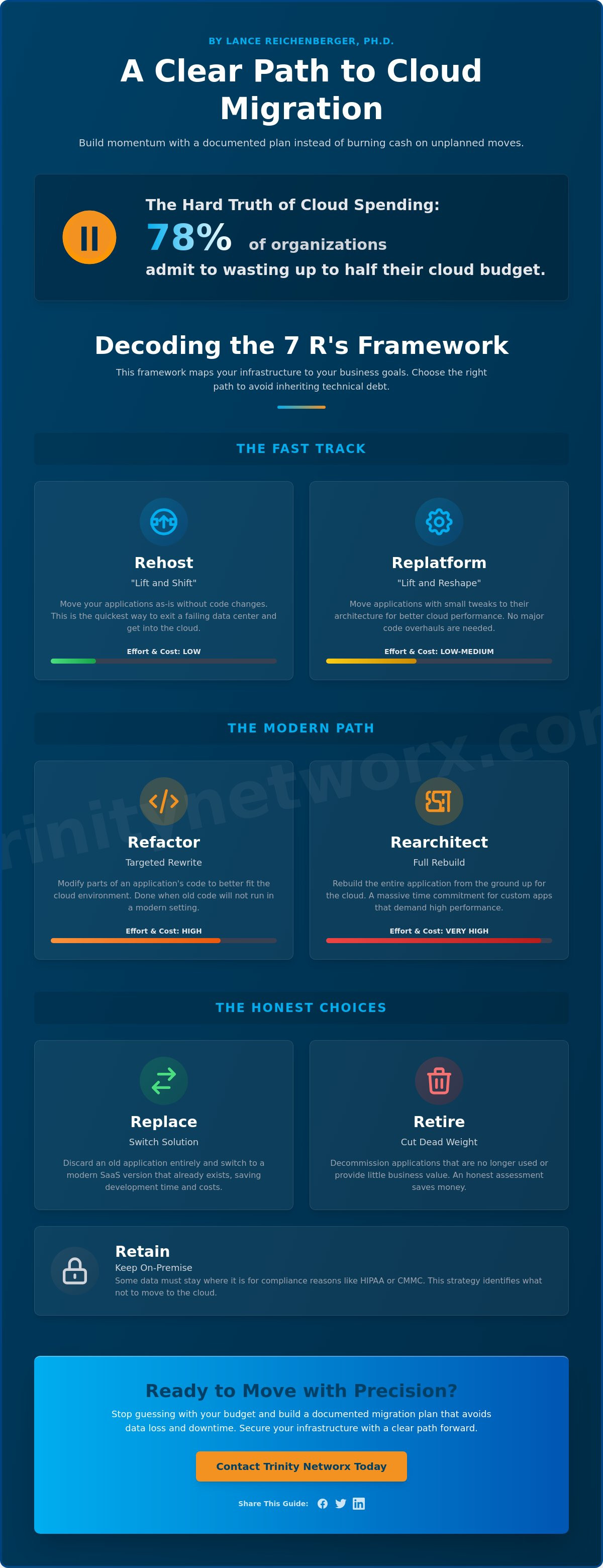
78% of organizations admit they waste up to half their cloud budget on resources they don't need. It’s a mess. Most projects stall because leaders treat them like minor tech upgrades rather than business survival. You’ve likely felt the sting of unexpected bills or the fear of a move that kills your daily operations. It’s frustrating. You need a cloud migration strategy that builds momentum instead of burning cash.
This guide shows you how to move your data without the traps that drain your bank account. I will map out a clear path to lower risk, fixed monthly IT costs, and faster performance for your remote staff. We cover the 7 Rs and the hard truths of cloud spending in 2026. Stop guessing. Start moving with precision. Your business growth depends on a stable foundation that does not break when you grow.
Contact us at https://www.trinitynetworx.com/contact-us to secure your infrastructure. Share this guide: [Facebook] [Twitter] [LinkedIn]
• Stop guessing with your budget and build a documented plan to avoid the data loss that kills momentum.
• Master the 7 Rs framework to decide if you should move, rebuild, or retire legacy hardware based on your business goals.
• Find every hidden data set with automated tools and assign a specific cloud migration strategy to every application you own.
• Eliminate downtime with a proactive support model that guarantees a response in under 20 minutes for any migration issues.
• Audit your technical debt now to ensure your current gear isn't holding your future growth hostage.
Author: Lance Reichenberger, Ph.D.
Moving your business to the cloud without a map is a recipe for disaster. You wouldn't build a new warehouse without a foundation. You shouldn't move your data without a documented cloud migration strategy. A real strategy is a blueprint. It maps every byte of data and every application to a specific destination in a secure cloud computing environment. It isn't a suggestion. It's a plan for survival.
Many leaders confuse a simple file upload with a full infrastructure shift. One is a digital closet; the other is a complete rebuild of how your business breathes. When you shift an entire server stack, you change the plumbing of your organization. Doing this on the fly leads to budget bleed. Industry data from 2025 shows that 78% of organizations waste up to 50% of their cloud budget because they didn't size their resources correctly from the start. That's capital your business cannot afford to lose.
Planning failures create ghosts in the machine. You get broken application links. You find security holes that hackers love. Worst of all, you end up with a messy hybrid environment that nobody knows how to manage. Business continuity must be the primary
Author: Lance Reichenberger, Ph.D.
Choice paralysis kills projects. When building a cloud migration strategy, you face seven distinct paths. These are Rehost, Replatform, Refactor, Rearchitect, Rebuild, Replace, and Retire. They range from simple moves to total rebuilds. Most small businesses don't need a total code rewrite. They need stability. We use thorough IT infrastructure management to evaluate these paths against your actual business goals. Don't over-complicate the move. Pick the path that offers the fastest way to reach uptime.
A winning cloud migration strategy balances speed with long-term cost. It ignores the hype and focuses on what keeps your team working. If you choose the wrong path, you inherit technical debt that follows you for years. We look at your current stack to see which apps are assets and which are anchors. This honest assessment saves money before the first file moves.
Rehosting is often called Lift and Shift. It is the quickest way to exit a failing data center. You move your apps as they are. No changes. No fuss. Replatforming goes one step further. You make small tweaks to improve performance without a total overhaul. For local businesses, these two options are the most cost-effective. They get you out of the hardware game fast. Following a step-by-step migration guide helps you identify which apps are ready for this quick transition without breaking links.
Sometimes, old code won't run in a modern environment. Refactoring means writing parts of the application to fit the cloud. Rearchitecting goes deeper. You rebuild the entire application from the ground up. These paths require a massive time commitment. They are expensive. Don't choose these unless your business relies on a custom app that must perform at a high level. For most, the simpler paths offer better value. If you aren't sure which R fits your business, speak with our team to find the right fit.
Be honest about your apps. Some are dead weight. If an app isn't used, Retire it. If a modern SaaS version exists, Replace it. Some data should stay exactly where it is. We call this Retaining. Compliance rules like HIPAA or CMMC often dictate that certain data stays on-premise. An expert vCIO helps you spot these requirements before you make a mistake. It is about keeping what works and cutting what doesn't.
Contact us via https://www.trinitynetworx.com/contact-us. Share this guide: [Facebook] [Twitter] [LinkedIn]
Author: Lance Reichenberger, Ph.D.
Clean house before you move. Dragging useless data into a new environment is a fast way to blow your budget. You need an audit that counts every file and every app currently in your stack. Most businesses carry too much weight. They store files from 2012 that nobody has opened in a decade. Delete them. A lean cloud migration strategy starts with a clear view of what actually makes you money. You have to balance the cost of the move against the speed your team gains. If an app doesn't help your remote team work faster, why move it at all? You want a setup that drives progress, not one that just replicates your old office's problems in a new place.
Identify the vital apps that drive your revenue. Your ERP or CRM is the heart of your business. These get priority. If these go down, your business stops. We focus on it-optimization to ensure these tools perform better after the move than they did on your local server. Performance gains aren't just about raw speed; they're about predictable monthly IT costs. You want to know what you'll pay before the bill arrives. This prevents the cost spikes that often haunt unmanaged migrations.
Moving a broken server to the cloud just gives you a broken cloud server. It's a waste of time and cash. Check your hardware age. Is your gear over five years old? Is your software reaching its end-of-life? If the answer is yes, don't move it; replace it. Use this checklist to evaluate your readiness:
• Hardware age and warranty status
• Software compatibility with modern operating systems
• Redundant data and duplicate backups
• Current bandwidth limits for remote access
Data shows that up to 50% of cloud budgets are wasted on oversized resources. Cut the fat now to stay lean later.Inland Empire defense firms have zero room for error. CMMC requirements are strict. You need to know exactly where your data sits and who can see it. For medical teams, HIPAA compliance is a moving target. Moving records to a cloud environment requires specific encryption and access controls. We bake these rules into the cloud migration strategy from day one. We don't add them as an afterthought. It's about protecting your data and your ability to operate in highly regulated sectors. Security is the foundation of the move, not a coat of paint you slap on at the end.
Contact us at https://www.trinitynetworx.com/contact-us to secure your business future. Share this guide: [Facebook] [Twitter] [LinkedIn]
Author: Lance Reichenberger, Ph.D.
Theory is dead. Execution is where most businesses face their biggest hurdles because they treat the move like a simple software update instead of a logistical overhaul. A solid cloud migration strategy demands a cold, hard look at your physical reality. You cannot just flip a switch and hope for the best. You need a methodical, aggressive approach to ensure your team stays productive while the data moves. Most failures happen because of poor timing or ignored dependencies. Don't let that be your story. Follow these five steps to keep your business running while you shift your infrastructure.
Use automated tools to find every hidden piece of data. Manual lists are usually wrong.
Assign one of the 7 Rs to every item in your inventory. We covered these in section two. Stick to the plan.
Move a small, non-vital workload first. Test the connection. Break things in a safe environment before you move the big stuff.
Move data in stages. This prevents a total business shutdown and lets you fix issues in small bites.
Confirm everything works. Your cloud migration strategy isn't finished until your team knows how to use the new tools.
Manual inventories are a trap. They usually miss 20 percent of a business's data because of shadow IT and forgotten local drives. You must map app dependencies before you pull any plugs. If you move a database but forget the app that talks to it, your operations will grind to a halt. We use it-management tools to see these links clearly. Before you start, check our guide on business data backup to ensure you have a safety net if a transfer fails. Data safety is not optional.
A 'big bang' migration is a recipe for disaster for SMBs. Moving everything at once creates too many points of failure. Instead, group your apps into waves based on how much they matter to your daily revenue. Start with the low-risk items. This builds confidence and proves the pipes are working. You need 'go/no-go' checkpoints at every stage. If a wave hits a snag, you stop and fix it before moving the next group. This staged approach keeps your staff working and your customers happy. It’s about steady progress, not reckless speed.
Ready to move without the mess? Contact our expert team to build your execution plan. Share this guide: [Facebook] [Twitter] [LinkedIn]
Author: Lance Reichenberger, Ph.D.
Trinity Networx, LLC does not act as a distant, faceless vendor. We function as a strategic driver for your business progress. Most tech firms wait for a server to crash before they pick up the phone. They react to disasters. We don't. Our proactive model stops trouble before it begins. When you execute a cloud migration strategy with us, you gain a partner committed to your total operational continuity. We focus on the health of your entire technical ecosystem. This isn't just about moving data; it's about building a foundation that supports your next five years of growth. We want your business to move with security and momentum. If your network lags, your profit lags. We eliminate the friction that keeps your remote staff from performing at their peak.
We monitor your cloud environment every second of every day. If a glitch appears, we see it before your staff does. Our response time guarantee is under 20 minutes for any migration hiccups. That is a hard metric, not a vague promise. Most vendors are slow. They hide behind ticketing systems and automated replies. Trinity Networx, LLC projects assertive reliability. Being local to Southern California gives us a major advantage. We understand the local landscape, from the Inland Empire to Orange County. If you need someone on-site for it-infrastructure needs, we are there. We ensure your it-management stays sharp and your downtime stays at zero.
The cloud should drive efficiency in your manufacturing or supply chain operations. It isn't a digital closet. Our vCIO services help you look past the next five days. We build a roadmap for the next five years. We want your business to be agile and fast. We help you shed the weight of old hardware and high energy bills. You deserve a partner who values your time and your profit margins above all else. Stop settling for the status quo and the slow pace of legacy IT. Trinity Networx, LLC acts as a protective and empowering force for your team. Take the next step toward a better way of operating today. Your growth depends on a system that works as hard as you do. We provide the assurance you need to focus on your clients, not your cables.
Contact us at https://www.trinitynetworx.com/contact-us to start your move. Share this guide: [Facebook] [Twitter] [LinkedIn]
Author: Lance Reichenberger, Ph.D.
Waiting for hardware to fail is a losing game. A documented cloud migration strategy acts as a shield for your business health. It moves you past the guessing games that drain budgets and stall teams. We've decoded the 7 Rs and mapped the path from discovery to execution. Don't let technical debt or compliance gaps hold your progress hostage. You need a partner who moves as fast as you do. We provide 24/7 proactive monitoring and an under 20-minute response time guarantee. Our team holds deep expertise in CMMC and HIPAA compliance to keep your data locked down. Your business deserves a foundation built for speed and stability. We focus on the practical business impact of every technical choice. Let's build a more efficient way of operating together. We are ready when you are. Your secure move starts with a single decision to stop the status quo.
Contact Trinity Networx, LLC to start your secure move
Share this guide: [Facebook] [Twitter] [LinkedIn]
Author: Lance Reichenberger, Ph.D.
A cloud migration strategy is the formal blueprint that dictates how your business shifts its digital assets into a secure cloud environment. It isn't a casual suggestion. It is a firm plan that prevents the data loss and budget spikes that occur when tech teams wing it. This document ensures every application has a designated home and a clear path to get there.
Most small business migrations take between thirty and ninety days to complete. The timeline shifts based on your data volume and the complexity of your current infrastructure. We prioritize a methodical pace to ensure your staff stays productive. Rushing a move leads to broken links and security gaps that cost more to fix later.
The 7 Rs include Rehost, Replatform, Refactor, Rearchitect, Rebuild, Replace, and Retire. There is no single best option for every firm. Many Southern California businesses choose Rehosting or Replatforming because they offer the fastest path to stability without a massive price tag. We help you pick the path that matches your five-year growth plan.
Cloud environments are highly secure for legal and medical records when you use a cloud migration strategy built on compliance. We use specific encryption and access controls to meet HIPAA and CMMC standards. Your data is often safer in a managed cloud than on a local server sitting in an unlocked closet. It is about building a wall around your digital assets.
Costs for a mid-sized company vary based on user count and the specific applications you need to move. You should focus on achieving predictable monthly IT costs rather than just the initial migration bill. A managed move eliminates the surprise expenses that occur when you don't size your resources correctly. It is a strategic investment in your operational continuity.
You can move to the cloud with near-zero downtime by using migration waves and pilot testing. We shift your data in small bites rather than one giant leap. This staged approach allows your team to keep working on vital tasks while we handle the background infrastructure. If a snag occurs in one wave, we fix it before moving the next group.
We perform a thorough audit of your current upload and download speeds to ensure they can support a cloud-first workforce. Bandwidth is the fuel for your new system. If your connection is too slow, your team will face lag that kills productivity. We check your pipes before the move so you don't face a bottleneck on day one.
Old servers and hardware can be securely wiped, recycled, or repurposed for local backup storage. Once your apps are live in the cloud, those hot, loud machines in the office are no longer needed. We help you decide which gear still has value and which should be retired. It is the final step in shedding your technical debt.
Contact Trinity Networx, LLC to start your secure move
Share this guide: [Facebook] [Twitter] [LinkedIn]

Article by
Lance Reichenberger, Ph.D.
Dr. Lance Reichenberger is the founder of Trinity Networx, a Southern California technology firm specializing in managed IT services, cybersecurity, network infrastructure, and business technology strategy. With nearly four decades of experience in the IT industry, he works with businesses to improve operational efficiency, strengthen security, and align technology with long-term growth objectives.
Lance focuses on proactive IT management, enterprise wireless infrastructure, cybersecurity integration, and scalable technology solutions for growing organizations throughout Southern California.
The content published on this website is provided for general informational and educational purposes only. Articles may be created, edited, or enhanced with the assistance of artificial intelligence and automation tools under the direction and review of Trinity Networx. While every effort is made to ensure accuracy and relevance, the information provided should not be considered professional, legal, financial, cybersecurity, or technical advice specific to your organization. Businesses should consult directly with a qualified professional regarding their unique environment, compliance requirements, and operational needs. Trinity Networx makes no warranties regarding completeness, reliability, or applicability of the information contained within these articles.
Schedule a brief conversation with Trinity Networx to discuss your business technology needs.
Get a practical roadmap built around your business, your users, your systems, and the technology issues that need attention first.
Put the right technology, support, security, and infrastructure in place so your business can grow, adapt, and move forward with confidence.