3281 E. Guasti Rd, STE 700, Ontario, CA 91761
1712 9th Ave SW, Watertown, SD 57201

Author: Lance Reichenberger, Ph.D.
Contact Trinity Networx, LLC for immediate assistance | Share this article: Facebook, LinkedIn, X
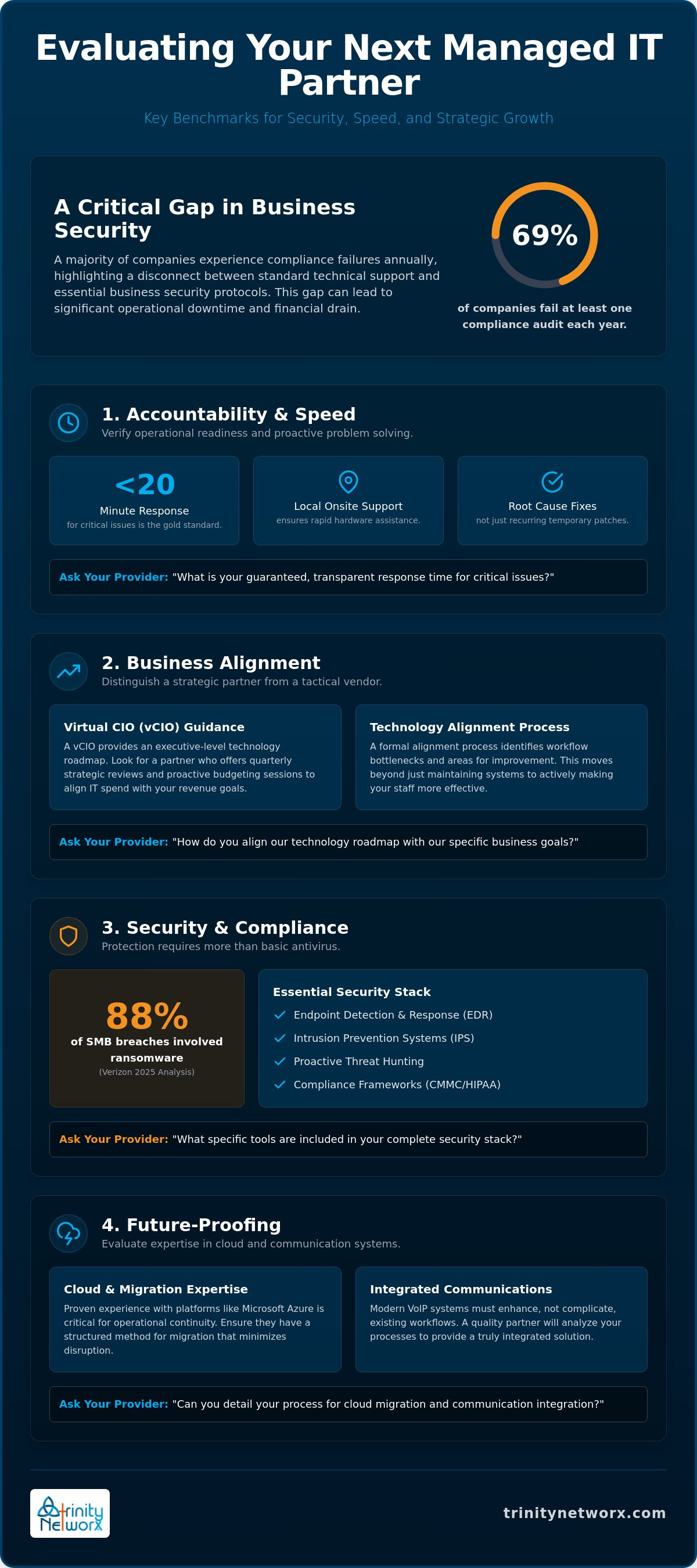
69 percent of companies fail at least one compliance audit every year. This failure highlights a massive gap between standard technical support and business security. You might be accustomed to waiting hours for a callback while your team sits idle. That stagnation kills momentum. It drains profit. Finding the right partner requires moving past basic surface level inquiries. You need specific questions to ask a potential managed IT service provider to expose their true level of accountability and strategic worth.
You deserve an IT partner who acts as a strategic driver of progress rather than a distant vendor. It's frustrating to deal with hidden fees for projects that should be included in your agreement. We understand you want predictable costs and a network that supports growth. This article identifies the exact benchmarks you must demand in 2026. We'll cover fifteen essential points that separate reactive troubleshooters from proactive experts who keep your data secure. Stop settling for excuses. Start demanding results.
• Demand accountability through specific response time guarantees. Local Southern California support ensures your team stays productive and focused.
• Identify strategic value by probing the vCIO process. Move beyond tactical fixes toward technology that drives business momentum and long term growth.
• Assess security depth by vetting their full stack of tools. These specific questions to ask a potential managed IT service provider expose their ability to meet CMMC or HIPAA standards.
• Ensure operational continuity with proven Microsoft Azure migration methods. Integrated VoIP systems must enhance your existing workflows to be effective.
Operational speed isn't a luxury. It's a survival requirement. When your server fails, every minute of downtime erodes your bottom line. You need to verify if a Managed Service Provider (MSP) actually has the capacity to support your specific workload. This is why specific questions to ask a potential managed IT service provider must focus on staffing levels. Ask about the ratio of technicians to total managed users. A high ratio means your tickets sit in a queue while your employees wait. Don't accept vague promises. Demand data on how they resolve recurring glitches. If the same printer error happens every Tuesday, your provider isn't fixing the root cause. They're just billing you for a temporary patch.
Wait times define your productivity. The industry gold standard for critical issues is a response in under 20 minutes. This should be one of your primary questions to ask a potential managed IT service provider. Ask how they track these metrics. Real accountability comes from transparent reporting. If they can't show you a dashboard of their monthly performance, they aren't managing their own operations. You need a partner who values your time as much as you do.
Remote help is effective until hardware physically breaks. Some problems require boots on the ground. Check if their helpdesk is staffed by local employees in Southern California. Sending a technician from three states away isn't a solution. Verify if emergency onsite visits trigger hidden fees. You need a partner who can physically arrive at your office quickly. Our IT helpdesk and support model prioritizes this local presence. It ensures that when hardware fails, help is minutes away. Speed saves money. Proximity builds trust.
IT is a profit catalyst. It's not just a monthly expense. Tactical vendors react to tickets. Strategic partners anticipate your next fiscal quarter. Your list of questions to ask a potential managed IT service provider must focus on how they integrate with your executive vision. Demand to see a sample of their technology alignment report. This document reveals if they actually understand your operational health or if they're just watching server lights. If they lack experience with your specific industry software, you'll pay for their learning curve. That's a risk your budget can't afford. Specific software requires more than basic installation. It requires an understanding of your daily user experience. A partner who knows your tools can suggest improvements that save hours of manual data entry.
Executive guidance changes everything. A Virtual CIO provides the roadmap for your digital spending. Ask how often they meet for budgeting sessions. Quarterly reviews are the minimum standard for staying ahead of growth. You need a partner who talks about your business goals, not just your hard drives. This forward-thinking approach ensures your technology spend matches your revenue targets. It prevents the sudden, expensive surprises that derail annual budgets.
Work slows down when software doesn't talk. Ask how they identify bottlenecks in your current digital processes. A formal Technology Alignment identifies exactly where your team loses time. It simplifies complex tasks. It makes your staff more effective. If you want to see how we build these roadmaps, reach out to our strategy experts for a direct conversation. Stop managing tech. Start driving progress.
A 2025 Verizon analysis found that ransomware was involved in 88 percent of breaches affecting small and midsize businesses. Basic antivirus is a relic of the past. It cannot stop modern threats. Your list of questions to ask a potential managed IT service provider must start with their security stack. Demand a detailed list of every tool they deploy. If they cannot name their endpoint detection or intrusion prevention systems, they aren't protecting you. They're just hoping for the best. You need a partner who conducts regular security awareness training for your staff. Employee error remains a primary entry point for attackers. Continuous education is the only way to build a human firewall that actually works, and you can also explore managed ICT services and cybersecurity solutions options from Flux Group SARL to ensure a robust, multi-layered defense.
Regulatory scrutiny is increasing. HIPAA violations can now cost up to $50,000 per incident. If you handle defense contracts, you need a partner who understands the strict requirements of CMMC Compliance Consultants. Ask how they document every action for your annual audits. 69 percent of companies fail at least one compliance audit each year. Don't be part of that statistic. You need verifiable proof of adherence to these frameworks to protect your contracts and your reputation.
Backups are useless if they don't restore. Most providers claim they back up your data, but few actually test the restoration process. Demand to see a recent success report from a monthly restoration test. This is one of the most critical questions to ask a potential managed IT service provider. Our approach to Data Backups and Disaster Recovery Ontario focuses on verified availability. We ensure your data is ready when disaster strikes. If you want a security audit that exposes your true vulnerabilities, contact our compliance team today to secure your network.
Static technology is dead. Your business needs a partner who plans for three years out, not just next week. The global managed services market is projected to reach $493.09 billion in 2026. This growth is driven by businesses moving away from physical hardware toward flexible environments. Your list of questions to ask a potential managed IT service provider should focus on their specific migration path for Microsoft Azure. Moving data isn't enough. You need to know how they maintain security during the transition. Ask how they handle hardware refresh cycles. Running old servers is a liability. It invites failure. A proactive partner replaces equipment before it breaks. They ensure your IT capacity expands alongside your headcount without causing friction or sudden budget spikes.
Public cloud environments offer immense power. We focus on Cloud Solutions in Ontario that prioritize local business needs. Ask if your provider manages private or public environments like Azure. You need a strategy that matches your specific compliance requirements. Don't let a vendor force you into a one-size-fits-all box. Demand a plan that accounts for your unique data volume and access needs. This prevents overpaying for storage you never use.
Communication is the lifeblood of your sales team. Call quality must be perfect. One of the vital questions to ask a potential managed IT service provider involves their experience with VoIP systems. Ask how they ensure 99.999 percent uptime. Verify their ability to manage structured cabling for new office build outs. Physical infrastructure matters as much as the software. If the wiring is wrong, the cloud won't matter. You need a partner who handles the entire stack from the ground up to ensure operational continuity. Stop settling for reactive support. Demand a strategy that secures your future.
IT isn't a utility. It's an engine. You've learned to probe for speed. You've seen how to verify compliance. Strategic alignment is no longer a guess. These specific questions to ask a potential managed IT service provider reveal if a vendor will actually protect your profit. Don't settle for hours of silence. Avoid hidden fees. Since 2001, we've focused on Southern California businesses that value their time. Our local helpdesk operates 24/7/365. We provide a 20 minute response time guarantee for critical issues. Downtime is expensive. You need a partner who sees your profit margin as their own responsibility. We move beyond basic fixes. We ensure your cloud strategy and communication tools actually work for your team. Your technology should drive progress. It shouldn't be a source of stress. Take control of your network today. Contact Trinity Networx, LLC today for a proactive IT assessment. Your growth is our priority.
Industry market data for 2026 shows a wide range based on service depth. Fully managed packages often fall between $100 and $350 per user per month. Southern California rates typically sit at the higher end of this spectrum due to local operational costs. Evaluate these costs against the price of downtime. A single hour of lost productivity for a 50 person team often exceeds the monthly service fee. Efficiency pays for itself.
Break-fix companies profit when your technology fails. They charge hourly rates to repair damage after it occurs. A Managed Service Provider (MSP) operates on a subscription model that aligns their success with your uptime. They prioritize proactive maintenance to prevent issues before they disrupt your workflow. This shift in accountability is one of the most important questions to ask a potential managed IT service provider during your search. Stability is the goal.
Technical failures don't follow a standard business schedule. If your team works late or accesses files on weekends, a lack of support stops their progress. 24/7 helpdesk availability ensures that critical issues are addressed immediately. It maintains your operational momentum. Constant access to local experts prevents small glitches from becoming Monday morning disasters. Support must be constant. Reliability builds confidence.
Specialized providers offer structured support for complex frameworks like CMMC and HIPAA. 69 percent of companies fail at least one compliance audit each year according to 2025 industry research. A qualified partner manages the documentation and security controls required to meet these legal standards. They protect you from HIPAA fines that can reach $50,000 per violation. Expertise reduces risk. Compliance is a competitive advantage.
Transitioning to a new partner should be a methodical and transparent process. A professional provider handles the offboarding of your old vendor by securing all administrative credentials and documentation. They conduct a thorough audit of your existing environment to identify immediate risks. This change doesn't cause downtime or data loss. Moving to a more proactive model restores your confidence. Demand a smooth transition. Your business deserves better.

Article by
Lance Reichenberger, Ph.D.., J.D. (Candidate)
Dr. Lance Reichenberger is the founder of Trinity Networx, a Southern California technology firm specializing in managed IT services, cybersecurity, network infrastructure, and business technology strategy. With nearly four decades of experience in the IT industry, he works with businesses to improve operational efficiency, strengthen security, and align technology with long-term growth objectives.
Lance focuses on proactive IT management, enterprise wireless infrastructure, cybersecurity integration, and scalable technology solutions for growing organizations throughout Southern California.
The content published on this website is provided for general informational and educational purposes only. Articles may be created, edited, or enhanced with the assistance of artificial intelligence and automation tools under the direction and review of Trinity Networx. While every effort is made to ensure accuracy and relevance, the information provided should not be considered professional, legal, financial, cybersecurity, or technical advice specific to your organization. Businesses should consult directly with a qualified professional regarding their unique environment, compliance requirements, and operational needs. Trinity Networx makes no warranties regarding completeness, reliability, or applicability of the information contained within these articles.
Schedule a brief conversation with Trinity Networx to discuss your business technology needs.
Get a practical roadmap built around your business, your users, your systems, and the technology issues that need attention first.
Put the right technology, support, security, and infrastructure in place so your business can grow, adapt, and move forward with confidence.