3281 E. Guasti Rd, STE 700, Ontario, CA 91761
1712 9th Ave SW, Watertown, SD 57201

How much margin did your firm lose last quarter because a field supervisor’s tablet failed or a job site lost connectivity during a critical concrete pour? Most construction executives accept these disruptions as an unavoidable cost of doing business. You shouldn't. Reactive spending on emergency hardware and rising cybersecurity insurance premiums can cripple a project before the foundation is even dry. Proper IT budgeting and forecasting for 2026 requires more than just looking at last year’s spreadsheets. It demands a strategy that treats technology as a tool for production, not a line item for repair.
We know you're tired of unpredictable invoices and tech that fails when the pressure is on. This guide provides a clear path to stabilize your monthly spend while securing your operations against modern threats. We will show you how to align your technology roadmap with your growth goals, ensuring every dollar spent supports field productivity and meets strict CMMC security standards. It's time to build a digital foundation that actually holds up under the weight of your projects.
• Identify field hardware nearing its end of life before it causes a site shutdown. Proper wireless infrastructure keeps project timelines moving.
• Master IT budgeting and forecasting for 2026 by linking your technology spend to specific project growth targets. This separates fixed operational costs from variable project spends.
• Use vCIO services to align your technical roadmap with long-term business objectives. This ensures technology investments protect margins rather than draining them.
• Transition to a flat-fee IT model to reduce support costs by 30 to 50 percent. Stop the surprise invoices and gain total cost certainty.
• Contact our team at https://www.trinitynetworx.com/contact-us to build a strategy that protects your 2026 project margins.
Your current tech stack is either an asset or a liability. There is no middle ground. Effective IT budgeting and forecasting for 2026 begins with a brutal audit of every device and connection you own. You can't build a reliable forecast on crumbling infrastructure. Applying standard corporate budgeting principles to a construction firm requires looking beyond the office walls and into the dirt. It means accounting for the rugged tablets in the field and the wireless bridges in the trailers. If you don't know what's about to break, you don't have a budget; you have a wish list.
Technical debt is the hidden tax on construction productivity. It grows every day you let a four year old server run or ignore a flickering job site router. List every workstation and server older than four years for immediate replacement. These are your primary failure points for 2026. If a major job site goes dark for just 20 minutes, the labor cost of dozens of idle workers far outweighs the price of a new access point. Calculate that downtime cost now. Use it to justify your hardware refresh before the hardware makes the decision for you.
Stop paying for ghost seats. Audit your BIM and project management software to see who actually logs in. You often find licenses for employees who left months ago or subscriptions that no one uses. Review your cybersecurity and antivirus stack to find gaps before a breach stops your payroll. Identify manual data entry tasks that kill hours of office time. These manual bottlenecks are the best candidates for automation in your 2026 plan. Modernize your workflow to keep your office as efficient as your field crews. Contact our team at https://www.trinitynetworx.com/contact-us to start your 2026 tech audit today.
Construction is volatile. An annual budget set in October is often useless by March. You need a model that moves at the speed of your project pipeline. Driver-Based IT Forecasting links your technology spend directly to business activities, such as new contract awards or headcount increases. This approach ensures your infrastructure expands when you win a big bid and tightens when the backlog thins. Effective IT budgeting and forecasting for 2026 means moving away from static guesses and toward data-driven reality.
Separate your costs. Fixed operational expenses like your managed service fee or core cloud hosting stay steady. Variable spends, such as field office setups and additional mobile devices, must fluctuate with your project load. If you land a defense contract, you must account for the rising costs of CMMC compliance immediately. These requirements aren't optional extras; they're prerequisites for doing business. Proper planning prevents these mandates from eating your profits.
Update your IT spend every 90 days. A quarterly review allows you to pivot before a small overage becomes a massive deficit. Use real-time data from your status monitoring to see which field assets are actually underperforming. This proactive visibility lets you predict hardware failures before they stop a crew. If you want to refine your forecasting process, talk to an expert who understands the construction cycle.
Security isn't a one-time purchase. It's a continuous operational cost. Allocate specific funds for ongoing employee security awareness training. Your field staff are your biggest risk. Include line items for mandatory vulnerability assessments and penetration testing. These aren't just boxes to check for insurance. They are the walls that protect your project margins from ransomware and data theft.
Most construction firms treat IT as a repair service. This reactive mindset is expensive. To truly master IT budgeting and forecasting for 2026, you need an executive seat at the technology table. Our Virtual CIO services provide this leadership without the six figure executive salary. We bridge the gap between your aggressive business goals and your technical spend. This ensures every dollar spent on infrastructure directly supports your five year growth plan rather than just keeping the lights on.
Expanding to new job sites shouldn't feel like a roll of the dice. Use project planning experts to handle technical relocations and site setups before the trailers even arrive. This proactive approach prevents the frantic, last minute calls for connectivity that plague most construction starts. When your technology roadmap aligns with your operational reality, your profit margins remain protected from technical friction.
Surprise invoices are the enemy of a predictable budget. Hourly billing models reward your IT provider for your downtime. We don't operate that way. A flat fee model aligns our interests with yours. We are incentivized to keep your systems running perfectly. This proactive stance prevents budget overruns and eliminates the "break fix" cycle that drains your cash flow. Firms that switch to this model often see IT support costs drop by 30 to 50 percent.
Reliability requires proximity. We maintain a 100 percent in-house Southern California staff to ensure we meet our 60 minute response guarantee. You don't have time to wait for an overseas call center while a project is stalled. You need experts who understand the local landscape and the specific demands of the construction industry. It's time to stop guessing about your technical future. You should contact Trinity Networx for a detailed 2026 budget review and secure your firm's operational stability today.
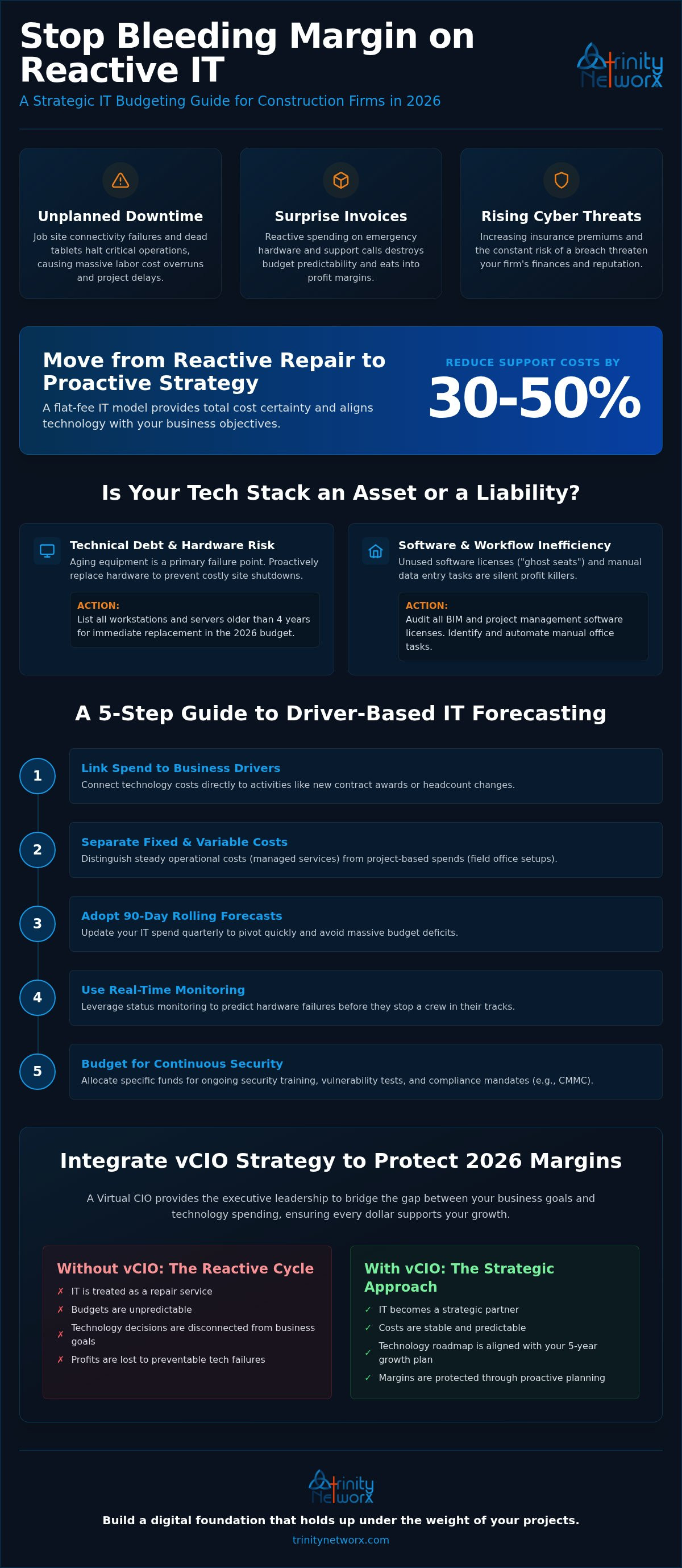
Stop reacting to technical failures that stall your field crews. You now have the blueprint to audit your stack and transition to driver-based planning. True IT budgeting and forecasting for 2026 requires a shift from viewing technology as a burden to treating it as a project engine. By aligning your hardware refresh cycles with project wins, you protect your margins from the high cost of job site downtime and connectivity issues. It's about moving with intent rather than operating in fear of the next breakdown.
Trinity Networx was recognized as one of CIO Review’s 20 Most Promising IT Services Companies because we solve these specific construction problems with assertive reliability. Our flat-fee pricing model can reduce your IT support costs by 30 to 50 percent while providing a 60-minute response guarantee on all support calls. We don't just fix computers; we build a stable foundation for your firm's growth. Take control of your 2026 IT budget by contacting our team today. Let's ensure your technology supports your project margins for years to come.
Stop treating security as a line item for emergencies. You must allocate funds for continuous protection, including mandatory vulnerability testing and employee awareness training. Rising premiums and CMMC compliance requirements are now standard costs of doing business. Proactive firms build these into their project bids to protect their margins from the start. This ensures you aren't hit with an unbudgeted expense when a general contractor demands proof of security.
A static budget is a yearly guess that fails the moment a project timeline shifts. Effective IT budgeting and forecasting for 2026 relies on adaptive models that you update every 90 days. This allows you to adjust your technical spend based on actual project wins and field headcount. You stay agile. You aren't locked into an outdated annual plan that doesn't reflect your current backlog or field requirements.
A vCIO identifies wasted technical spend by auditing your software licenses and eliminating seats you no longer need. They move your firm toward a flat fee model which can reduce support costs by 30 to 50 percent. This strategic oversight prevents expensive emergency repairs and ensures your technology investments actually drive profit. Contact our team at https://www.trinitynetworx.com/contact-us to learn how a vCIO can stabilize your 2026 spending.

Article by
Lance Reichenberger, Ph.D.., J.D. (Candidate)
Dr. Lance Reichenberger is the founder of Trinity Networx, a Southern California technology firm specializing in managed IT services, cybersecurity, network infrastructure, and business technology strategy. With nearly four decades of experience in the IT industry, he works with businesses to improve operational efficiency, strengthen security, and align technology with long-term growth objectives.
Lance focuses on proactive IT management, enterprise wireless infrastructure, cybersecurity integration, and scalable technology solutions for growing organizations throughout Southern California.
The content published on this website is provided for general informational and educational purposes only. Articles may be created, edited, or enhanced with the assistance of artificial intelligence and automation tools under the direction and review of Trinity Networx. While every effort is made to ensure accuracy and relevance, the information provided should not be considered professional, legal, financial, cybersecurity, or technical advice specific to your organization. Businesses should consult directly with a qualified professional regarding their unique environment, compliance requirements, and operational needs. Trinity Networx makes no warranties regarding completeness, reliability, or applicability of the information contained within these articles.
Schedule a brief conversation with Trinity Networx to discuss your business technology needs.
Get a practical roadmap built around your business, your users, your systems, and the technology issues that need attention first.
Put the right technology, support, security, and infrastructure in place so your business can grow, adapt, and move forward with confidence.