3281 E. Guasti Rd, STE 700, Ontario, CA 91761
1712 9th Ave SW, Watertown, SD 57201

Stolen credentials trigger 88% of basic web application attacks. For a construction firm, a single compromised password can lead to wire fraud or a complete project shutdown. A two-factor authentication implementation for business is no longer optional. You likely feel the pressure from insurance carriers to tighten up, but you also know the reality of the field. Rigid security often fails when a foreman has zero bars of service or a subcontractor needs immediate access to project software.
We understand that your technology must move as fast as your crews. This guide provides a clear path to balance high-level security with site-level reality. You will learn to deploy phishing-resistant methods that satisfy 2026 NIST standards and keep your job site data locked down. We will break down how to handle hardware keys, signal-independent codes, and the specific requirements needed to slash your cyber insurance premiums.
• Replace weak passwords with multi-layered defenses to protect sensitive blueprints and financial records from credential theft.
• Deploy hardware keys or offline codes so field crews maintain access in areas with poor cellular reception.
• Plan a phased two-factor authentication implementation for business to maintain productivity while securing project software.
• Meet 2026 NIST standards to reduce cyber insurance costs and stop payroll redirection fraud.
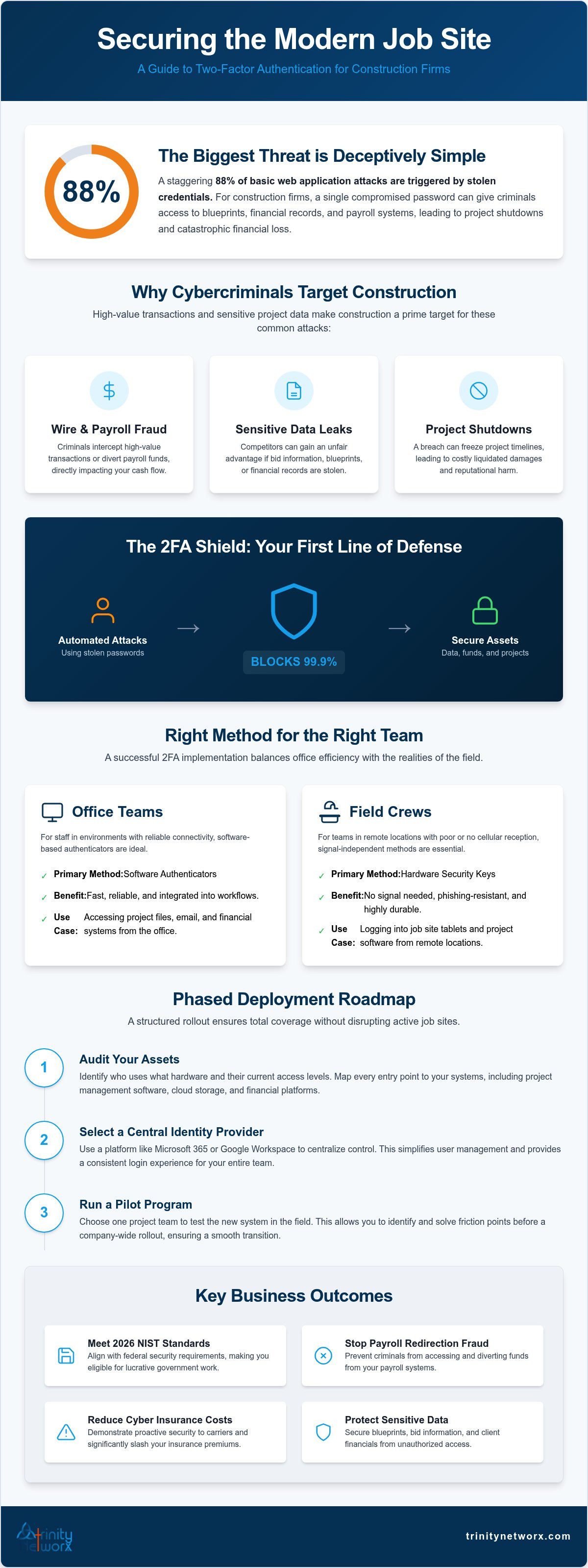
Traditional security models rely on a single wall. In construction, that wall is often built on vulnerable passwords that field crews reuse across personal and professional accounts. It's a massive liability. Stolen credentials cause 88% of basic web application attacks. For a general contractor, this means a leaked password for Procore or Autodesk can hand over sensitive blueprints to competitors. A professional two-factor authentication implementation for business stops this lateral movement immediately. It forces a secondary verification that blocks 99.9% of automated credential attacks, ensuring that only your authorized team touches your data.
Criminals don't just want your data. They want your cash flow. They target bid information to gain unfair advantages or intercept payroll to divert funds through wire fraud. The FBI's 2024 Internet Crime Report highlighted $16 billion in losses, and construction firms are prime targets due to high-value transactions. A single breach can freeze project timelines, causing liquidated damages that eat your margins. You can't afford the downtime. This is why a two-factor authentication implementation for business is now a requirement for modern insurance policies and lucrative government work. Meeting NIST or CMMC standards requires hardened identity verification. Without it, you aren't just at risk; you're uncompetitive. Proactive security positions IT as a strategic advantage that protects your reputation and your bottom line.
Construction sites demand tactical flexibility. You have project managers in regional offices and crews in remote locations with poor cellular reception. When Selecting Authentication Methods, you must account for these environmental extremes. A two-factor authentication implementation for business succeeds only when it doesn't block the work. Office teams thrive on software-based authenticators. They are fast, reliable, and integrated directly into desktop workflows for immediate access to project files.
Field teams need more options. SMS codes are common but fail in dead zones where signal is non-existent. Hardware security keys provide a superior alternative. They don't require a signal or a smartphone app. You just plug them in or tap them against the device. This physical layer offers the highest protection against phishing. It's the most reliable way to protect high-value project data when your team is off the grid.
Site supervisors face constant interruptions. Adding MFA fatigue to their day leads to security workarounds that leave you vulnerable. Push notifications are convenient but can become a nuisance on a busy site. We recommend risk-based policies. Require a physical key for financial transfers but allow longer session durations for trusted job site tablets. Managing subcontractors requires a similar approach. You can't always force them onto your corporate tenant. Instead, use guest access protocols that verify their identity without creating administrative friction. If you're struggling to find the right balance, our team can help you design a custom security roadmap that fits your specific workflow.
A successful two-factor authentication implementation for business isn't a five-minute task. It's a logistical project. You must avoid disrupting active job sites by flipping a switch and hoping for the best. Start by identifying every entry point. This includes your project management software, cloud storage, and financial systems. You need a rock-solid policy for when a field super drops their phone in a concrete pour. Emergency access shouldn't mean a security hole. It means a pre-planned recovery path that keeps the project moving. We ensure your team has backup codes or secondary hardware tokens ready before the first login prompt appears.
Follow a structured approach to ensure total coverage without the chaos. This methodical progression prevents the common tech failures that stall production.
Identify who uses what hardware and what their current access levels are. This prevents surprises when you go live. You need to know if a subcontractor is using a personal device that lacks modern security features.
Most firms use Microsoft 365 or Google Workspace. This centralizes control and simplifies the user experience.
Pick one project team. Test The Deployment Roadmap in the field. Solve the friction points there before rolling it out to the entire company.
Our Southern California help desk provides the high-touch support your crews need during enrollment. We don't just send a manual. We ensure every user is ready to work. This proactive stance is part of our cybersecurity solutions designed for the construction industry. We move fast so you can stay on schedule.
Protecting your firm requires more than a simple software toggle. It demands a strategy that respects the unique environment of a Southern California job site. You've learned that a successful two-factor authentication implementation for business balances high-level identity protection with the practical needs of field supervisors. By moving toward phishing-resistant hardware and phased rollouts, you secure your data while satisfying strict cyber insurance mandates. Security shouldn't be a bottleneck. It should be a competitive advantage that wins more contracts.
The team at Trinity Networx, LLC specializes in construction IT workflows and understands that downtime is not an option. We provide a 20 minute average response time and 100 percent US-based in-house support to keep your crews connected. Secure your construction firm by contacting Trinity Networx, LLC today. Let's build a more resilient operation together.
2FA stops the most common entry point for cybercriminals. Stolen credentials cause 88% of basic web application attacks according to the 2025 Verizon Data Breach Investigations Report. This prevents unauthorized access to bids and payroll systems. A two-factor authentication implementation for business is also a mandatory requirement for most cyber insurance policies and government contracts in 2026.
Security shouldn't be a bottleneck. We use risk-based authentication to minimize prompts on trusted job site devices. By using hardware keys, workers can authenticate even in areas with zero cellular reception. This approach ensures that your two-factor authentication implementation for business supports site productivity rather than hindering it. We focus on speed and reliability for every crew.
You don't need full accounts for every partner. Use secure guest access through your central identity provider to enforce security standards on their existing email addresses. This allows subcontractors to access project data while keeping your internal network isolated. It's a proactive way to maintain supply chain security without increasing your administrative overhead or licensing costs.
We establish a clear emergency access policy before deployment. Every supervisor receives a secondary backup method, such as a physical token or one-time recovery codes kept in a secure site office. If a device is lost, our in-house NOC provides a 60 minute response guarantee to reset credentials. This prevents project delays while maintaining a hardened security posture.

Article by
Lance Reichenberger, Ph.D.., J.D. (Candidate)
Dr. Lance Reichenberger is the founder of Trinity Networx, a Southern California technology firm specializing in managed IT services, cybersecurity, network infrastructure, and business technology strategy. With nearly four decades of experience in the IT industry, he works with businesses to improve operational efficiency, strengthen security, and align technology with long-term growth objectives.
Lance focuses on proactive IT management, enterprise wireless infrastructure, cybersecurity integration, and scalable technology solutions for growing organizations throughout Southern California.
The content published on this website is provided for general informational and educational purposes only. Articles may be created, edited, or enhanced with the assistance of artificial intelligence and automation tools under the direction and review of Trinity Networx. While every effort is made to ensure accuracy and relevance, the information provided should not be considered professional, legal, financial, cybersecurity, or technical advice specific to your organization. Businesses should consult directly with a qualified professional regarding their unique environment, compliance requirements, and operational needs. Trinity Networx makes no warranties regarding completeness, reliability, or applicability of the information contained within these articles.
Schedule a brief conversation with Trinity Networx to discuss your business technology needs.
Get a practical roadmap built around your business, your users, your systems, and the technology issues that need attention first.
Put the right technology, support, security, and infrastructure in place so your business can grow, adapt, and move forward with confidence.