3281 E. Guasti Rd, STE 700, Ontario, CA 91761
1712 9th Ave SW, Watertown, SD 57201
Author: Lance Reichenberger, Ph.D.
Drywall hides mistakes until they become expensive. If your cabling isn't right before the hangers arrive, you're already behind. Southern California developers face a moving target with the 2025 California Building Standards Code. Starting January 1, 2026, compliance isn't just about safety. It's about digital readiness. Your network cabling and infrastructure for new construction in SoCal requires a surgical approach to meet these new Title 24 mandates. It's the difference between a high-performing asset and a building that needs immediate, costly retrofits.
We understand the pressure of meeting tight deadlines while navigating ANSI/TIA-942-C standards. This article delivers a precise checklist to secure your technical foundation while the studs are still visible. You'll see exactly where to place dual Category 6A runs. We'll show you how to manage fiber backbones for maximum uptime. We're moving past the guesswork to get your project ready for inspection. No fluff. Just the technical requirements you need to keep your build on track and your future tenants connected.
• Avoid the massive expense of tearing out drywall by mapping every data drop before the construction crew arrives.
• Verify compliance with the 2025 California Building Standards Code to prevent inspection failures and costly project delays.
• Implement a strategic plan for network cabling and infrastructure for new construction in SoCal that specifies dual Cat6A runs for high-performance Wi-Fi 7 access points.
• Select OM4 or OM5 fiber optics for your backbone to support the 40Gbps speeds required for modern data center standards.
• Coordinate with local utilities early to establish secure fiber entry points and prevent connectivity bottlenecks at the move-in date.
Construction timelines are unforgiving. If you treat IT as an afterthought, you're building a liability. A professional structured cabling system serves as the nervous system of any modern commercial space. It's the foundation for every VoIP call, security camera, and cloud transaction. Skimping on network cabling and infrastructure for new construction in SoCal results in immediate operational bottlenecks that choke productivity. You wouldn't skip the plumbing, so don't ignore the data lines. This physical layer is the one part of your build that is nearly impossible to change once the project is finished.
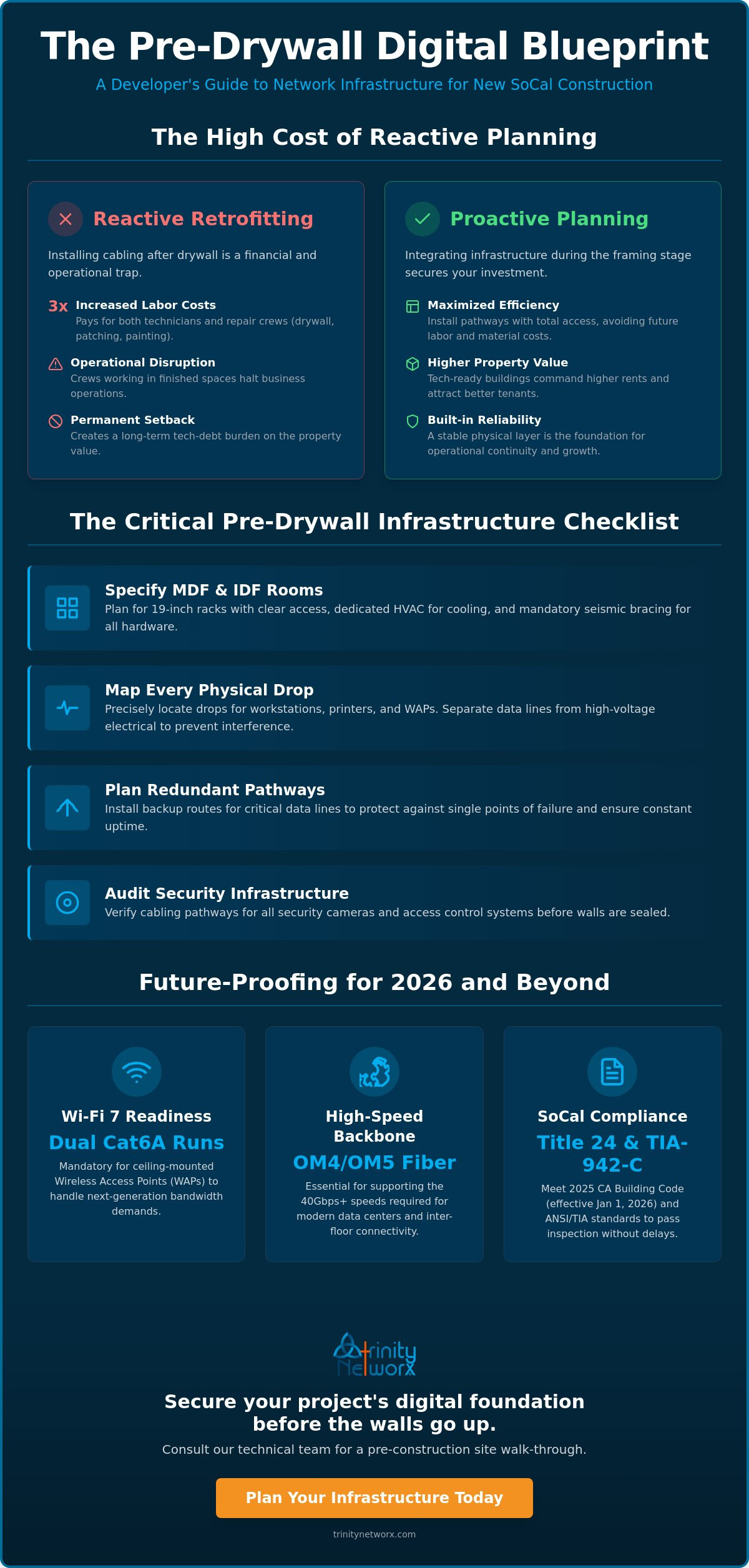
Retrofitting is a financial trap. When you install cables after the walls are closed, you pay for the technician's time and the repair crew's labor. Wall penetration involves drilling through studs and headers that are already sealed. This creates a mess of dust and debris in finished areas. You also face the cost of drywall patching, sanding, and repainting to match the original finish. These expenses are entirely avoidable. Beyond the hard costs, consider the operational friction. Operations grind to a halt when crews are active in the ceiling. Missing your infrastructure window during the framing stage is a permanent financial setback for the project.
Stability begins with the physical layer. We focus on IT infrastructure because it's the primary driver of business health. Electrical power keeps the lights on, but a high-speed data backbone is what allows a company to scale and adapt. In the Southern California market, tech-ready buildings command higher rents and see better tenant retention. A proactive layout is a competitive advantage that protects your investment. It also allows for the proactive monitoring we provide. We can't hit a 20-minute response time if the underlying wires are a tangled mess of poor choices. Secure your digital backbone now to ensure your building remains an asset rather than a tech-debt burden.
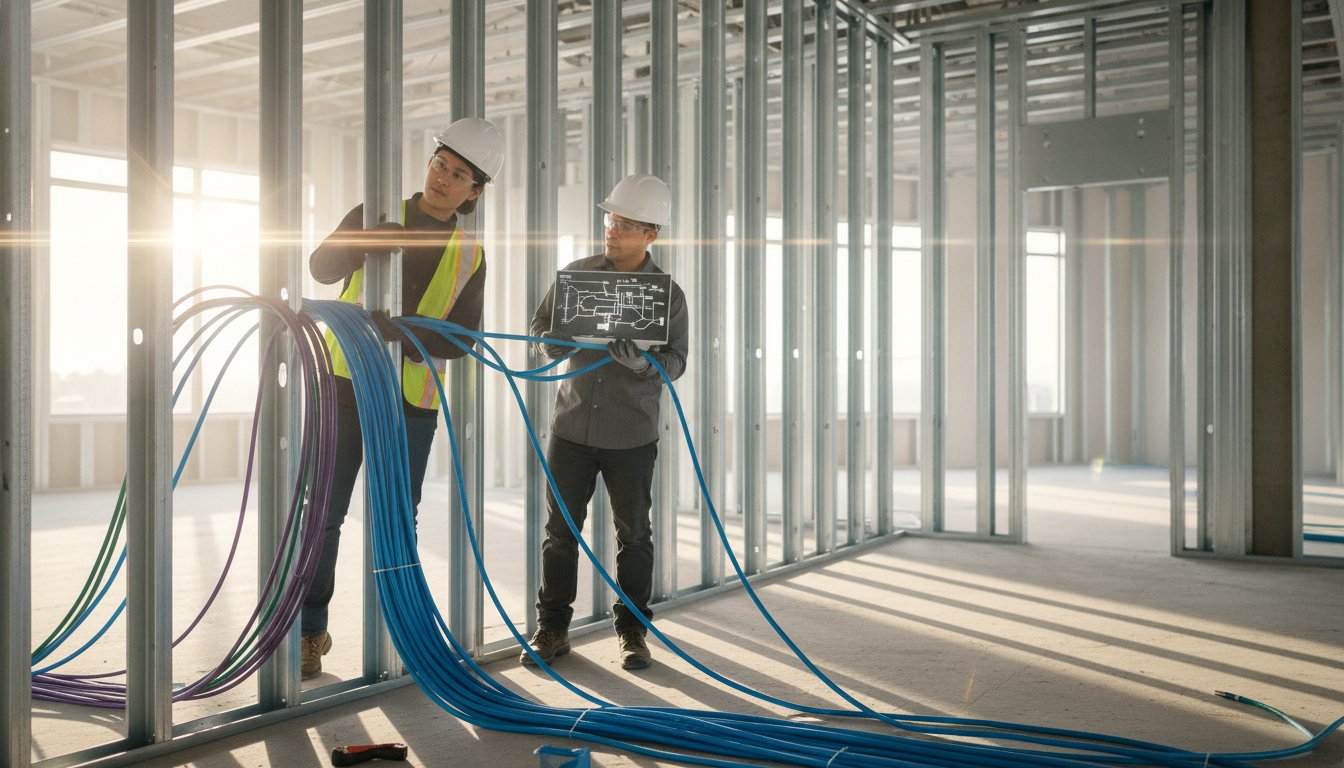
The skeletal frame of your building is the only time you have total access. Once the drywall goes up, your options vanish. Successful network cabling and infrastructure for new construction in SoCal depends on getting the physical layout right the first time. You need a checklist that accounts for both current speed and future growth. This is the window to install high-performance pathways without the friction of finished walls. If you miss this phase, you're looking at triple the labor costs later.
Your Main Distribution Frame (MDF) room isn't just a closet. It's the brain of your business. It requires enough space for standard 19 inch racks and clear access for cable management on all sides. Cooling is non-negotiable. High-density hardware generates heat that can trigger thermal shutdowns if not managed with dedicated HVAC. Because we're building in Southern California, seismic bracing is a legal and practical requirement. Every rack must be anchored to the slab to prevent collapse during a tremor. This ensures your data survives even when the ground moves.
Data drops must be precise. Map every workstation, printer, and specialized machine now. Redundant pathways for critical business data protect you from single points of failure. If one line is cut, the business stays online. We recommend IT infrastructure planning that separates data cables from high-voltage electrical lines. This prevents electromagnetic interference that ruins signal quality. Ceiling-mounted wireless access points (WAPs) now require dual Category 6A runs to handle the bandwidth of Wi-Fi 7, as per the latest ANSI/TIA-942-C standards. Don't forget the security layer. Audit your pathways for cameras and access control before the studs are covered.
Compliance is the final hurdle. Your project must align with the California Building Standards Code (Title 24) to pass inspection. The 2025 code update, effective January 1, 2026, adds stricter requirements for digital submittals and energy performance. We also suggest installing oversized conduit for future fiber optic expansions. It's a small investment today that prevents a massive headache in five years. If you want to ensure your site is ready for the next generation of tech, consult our technical team about a site walk-through before the hangers arrive.
Regulatory hurdles in Southern California can stall a project if you aren't prepared. Fire codes dictate specific material choices for any cable passing through air circulation spaces. You must use plenum-rated cabling to prevent toxic smoke in the event of a fire. This isn't just a recommendation. It's a legal requirement enforced during building inspections. Coordinating with local utilities for fiber entry points early prevents delays in getting your external connectivity live. We ensure your network cabling and infrastructure for new construction in SoCal meets every local ordinance before the final walk-through. If the physical layout doesn't pass the fire marshal's check, your occupancy permit stays on the desk.
Heat is a silent enemy of data transmission. In the Inland Empire and surrounding valleys, high ambient temperatures can degrade signal quality over long cable runs. We select insulation that withstands these conditions without melting or cracking. Grounding is another critical factor. Proper surge protection prevents electrical spikes from frying your server racks during seasonal storms. Our experience with Managed IT Services Ontario CA shows that local environmental factors dictate hardware longevity. We follow TIA industry standards to ensure every install handles the unique climate of the region. It's about building a system that lasts decades, not just until the first heatwave hits the coast.
Security starts at the physical layer. For industries like defense or healthcare, compliance with CMMC or HIPAA isn't optional. It's the price of doing business. Physical access control depends on the low-voltage wiring hidden in your walls. If your card readers or biometric scanners fail due to poor cabling, your entire security posture collapses. We integrate these physical components with broader Managed Cybersecurity Services to create a unified defense. This proactive approach ensures that your hardware and software work in tandem. Your infrastructure must support encrypted data paths and isolated networks for sensitive information. We map these requirements during the pre-drywall phase to avoid the cost of specialized retrofitting later. A secure building is a stable building. Don't leave your physical security to chance when the solution is as simple as correct wiring.
Building for 2026 means ignoring the cheap options of the last decade. If you're still considering Cat5E or standard Cat6 for your project, you're building a legacy system that will fail within years. Network cabling and infrastructure for new construction in SoCal must account for the massive bandwidth demands of Wi-Fi 7 and high-wattage Power over Ethernet (PoE). These aren't luxuries. They're the new baseline for commercial efficiency. We don't just install wires. We deploy a technical foundation that supports a decade of growth without needing a single wall opened for repairs.
Cat6A is the only viable choice for modern office environments. It supports 10Gbps speeds at a full 100 meters, whereas standard Cat6 falls short at these distances. This extra capacity is vital for high-wattage PoE, which powers everything from smart LED lighting to advanced security cameras. Shielding is another non-negotiable factor in dense Southern California markets. Shielded twisted pair (STP) prevents the electromagnetic interference common in urban centers like Los Angeles or Irvine. A professionally installed cabling plant should have a 15 to 20 year lifespan. If you choose inferior copper now, you'll be paying for a total replacement before your first lease is up.
Riser cabling requires more throughput than copper can provide. We've transitioned to OM4 and OM5 fiber for high-speed backbone connections to support the 40Gbps and 100Gbps speeds modern data centers demand. While multi-mode fiber works for most SoCal campuses, single-mode is the smart play for long-distance connectivity between multiple buildings or floors. This level of IT performance refinement ensures your infrastructure never becomes a bottleneck for business operations. The ANSI/TIA-942-C standard now requires two Category 6A runs for every wireless access point. We follow this strictly to handle the extreme throughput of Wi-Fi 7. Smart buildings also rely on hundreds of IoT sensors for HVAC and lighting control. These devices need a reliable physical path and consistent power. Designing for these power demands during the pre-drywall phase keeps your project ahead of the curve and your tenants happy.
Don't let your project fall behind. Contact our infrastructure specialists to review your blueprints before the walls are closed and the opportunity for easy installation vanishes.
Author: Lance Reichenberger, Ph.D.
Execution requires more than just pulling wire through studs. It demands a partner who understands how that wire functions on day 500. We coordinate directly with your general contractors to ensure network cabling and infrastructure for new construction in SoCal stays on the critical path. If the IT crew and the framing crew aren't speaking the same language, the schedule slips. Trinity Networx, LLC steps in to bridge that gap. This proactive stance ensures that your physical layer supports our standard 20-minute response times. We don't just walk away once the drywall is painted. We transition your site into a managed environment where every port is documented and every run is certified. This is the difference between a vendor and a strategic partner.
Construction is a game of inches and hours. If your cabling team shows up late, they block the plumbers. If they show up early, they get in the way of the framers. We manage that friction. Trinity Networx, LLC communicates with your general contractors to fit into the master schedule perfectly. This ensures your network cabling and infrastructure for new construction in SoCal is ready exactly when the building is ready for it. Transitioning from a construction site to a live office is a high-stakes moment. We handle the technical heavy lifting so your move-in is quiet and efficient. Our goal is to provide a technical foundation that supports our Managed IT Services from the moment you plug in your first workstation.
Certification isn't optional. Trinity Networx, LLC labels every run and provides a digital map of the entire facility. This prepares your site for day-one operations. You won't waste time hunting for dead ports or tracing unlabeled wires. Certification provides the data to prove every run meets TIA standards. We use high-end testers to verify that your 10Gbps runs actually hit those speeds. This level of detail is why we can offer a 20-minute response time. We don't search for wires. We know exactly where they are. This preparation sets the stage for our Managed IT Services, where we monitor your hardware around the clock to prevent downtime. You get a building that works from the first hour.
Strategy matters at the blueprint level. My Ph.D.-led approach focuses on the intersection of technical precision and business growth. Trinity Networx, LLC doesn't offer generic templates. We build a custom roadmap for your specific facility. Starting a consultation is simple. We review your plans, identify potential bottlenecks, and deploy a team that respects your timeline. Don't wait until the walls are closed to think about your digital backbone. Secure your technical future before the opportunity for easy installation vanishes. Contact our team to schedule your infrastructure walk-through. We'll ensure your project meets the highest standards of performance and compliance from the ground up.
Ready to secure your digital backbone? Contact the team at Trinity Networx, LLC to start your infrastructure consultation today.
Share this guide: [Facebook] [LinkedIn] [Twitter]
A building is only as capable as its hidden wiring. Missing the pre-drywall window is a mistake that haunts a developer for years. You've seen the risks of reactive planning and the specific requirements of the 2025 building code. Implementing correct network cabling and infrastructure for new construction in SoCal ensures your property remains competitive and compliant. It's about moving from a construction site to a high performance business environment without friction. Your tenants expect connectivity. You need reliability.
Trinity Networx brings 25 years of Southern California expertise to your project. Our Ph.D. led technical strategy removes the guesswork from complex deployments. We don't just install hardware. We build systems that support a 20 minute response time guarantee for your future operations. Don't let your digital backbone be an afterthought. Contact the Trinity Networx team to schedule your infrastructure consultation. Your project deserves a technical partner that values your timeline as much as you do. Let's build something that lasts.
Hire your specialist during the architectural design phase. You need technical requirements integrated into the blueprints before framing begins. Waiting until the studs are up creates scheduling conflicts with other trades. We coordinate with your general contractor to ensure the network cabling and infrastructure for new construction in SoCal aligns with the master build schedule. This prevents expensive changes once the walls are closed.
Electrical contractors focus on high voltage power, not high speed data. While they can pull wire, they often lack the specialized tools for Cat6A certification or fiber optic termination. Data cabling is sensitive to electromagnetic interference and tight bends. We specialize in the low voltage standards required to maintain signal integrity and ensure your network passes rigorous performance tests.
Cat6A is the modern standard for commercial builds. It supports 10Gbps data rates up to 100 meters, whereas standard Cat6 is restricted to shorter distances for high speed use. Cat6A also features superior heat dissipation for high wattage Power over Ethernet (PoE) devices like Wi-Fi 7 access points. Choosing Cat6 today is a gamble that leads to early obsolescence.
Most commercial buildings require a fiber optic backbone between the Main Distribution Frame (MDF) and any Independent Distribution Frames (IDFs). This ensures high speed data flow between floors or wings without the distance limitations of copper. We follow ANSI/TIA-942-C standards, which recommend at least two optical fibers for horizontal and backbone cabling to ensure redundancy and future capacity.
Southern California builds must follow the California Building Standards Code (Title 24). This includes using plenum rated cables in any air handling spaces to meet fire safety regulations. The 2025 update, effective January 1, 2026, also emphasizes digital documentation for all infrastructure. We ensure every install passes these specific regional inspections to prevent occupancy delays.
Cybersecurity begins at the physical layer. A secure structured cabling system allows for physical network segmentation, keeping sensitive data isolated from guest Wi-Fi or IoT devices. Wiring for biometric access control and IP security cameras must be integrated into your broader defense strategy. We ensure your network cabling and infrastructure for new construction in SoCal supports encrypted pathways and proactive hardware monitoring.
Missing the pre-drywall window triples your labor expenses. Once walls are sealed, technicians must drill through finished surfaces and pull cables through blind cavities. You'll also pay for drywall repair, sanding, and repainting. It's a messy process that causes significant delays to your move-in date. Proactive planning eliminates these avoidable costs.
Yes, seismic bracing is a non-negotiable requirement in Southern California. Every server rack and heavy equipment cabinet must be anchored to the concrete slab or structural steel. This prevents hardware from tipping or shifting during a tremor. It protects your expensive equipment and ensures business continuity when the ground moves.

Article by
Lance Reichenberger, Ph.D.., J.D. (Candidate)
Dr. Lance Reichenberger is the founder of Trinity Networx, a Southern California technology firm specializing in managed IT services, cybersecurity, network infrastructure, and business technology strategy. With nearly four decades of experience in the IT industry, he works with businesses to improve operational efficiency, strengthen security, and align technology with long-term growth objectives.
Lance focuses on proactive IT management, enterprise wireless infrastructure, cybersecurity integration, and scalable technology solutions for growing organizations throughout Southern California.
The content published on this website is provided for general informational and educational purposes only. Articles may be created, edited, or enhanced with the assistance of artificial intelligence and automation tools under the direction and review of Trinity Networx. While every effort is made to ensure accuracy and relevance, the information provided should not be considered professional, legal, financial, cybersecurity, or technical advice specific to your organization. Businesses should consult directly with a qualified professional regarding their unique environment, compliance requirements, and operational needs. Trinity Networx makes no warranties regarding completeness, reliability, or applicability of the information contained within these articles.
Schedule a brief conversation with Trinity Networx to discuss your business technology needs.
Get a practical roadmap built around your business, your users, your systems, and the technology issues that need attention first.
Put the right technology, support, security, and infrastructure in place so your business can grow, adapt, and move forward with confidence.