3281 E. Guasti Rd, STE 700, Ontario, CA 91761
1712 9th Ave SW, Watertown, SD 57201

Lance Reichenberger, Ph.D.
Why does your monthly IT invoice feel like a riddle you didn't ask to solve? Most business owners are fed up with opaque pricing structures and sudden bills for support that should've been covered from the start. It's frustrating to pay high fees only to wait hours for a response while your staff sits idle. You need a clear, no-nonsense breakdown of the average cost of managed IT services to protect your margins.
This guide cuts through the industry noise. We'll show you how to achieve predictable monthly spending and zero surprise bills. Our focus is fast technical support that keeps your team productive without the financial shocks. Secure your business health with a partner who acts as a driver of progress and values your growth.
Contact us at https://www.trinitynetworx.com/contact-us to secure your operations. Share this guide with your network on social media.
• Pick between per-user and per-device billing models to find the most cost-effective way to cover your team's technical needs.
• See how the average cost of managed IT services shifts when your business must meet strict CMMC or HIPAA standards.
• Plan for setup fees. These upfront investments fund the deep network discovery required to fix hidden risks before they stop your work.
• End the cycle of technical debt. A proactive model keeps your staff moving and makes your monthly expenses predictable.
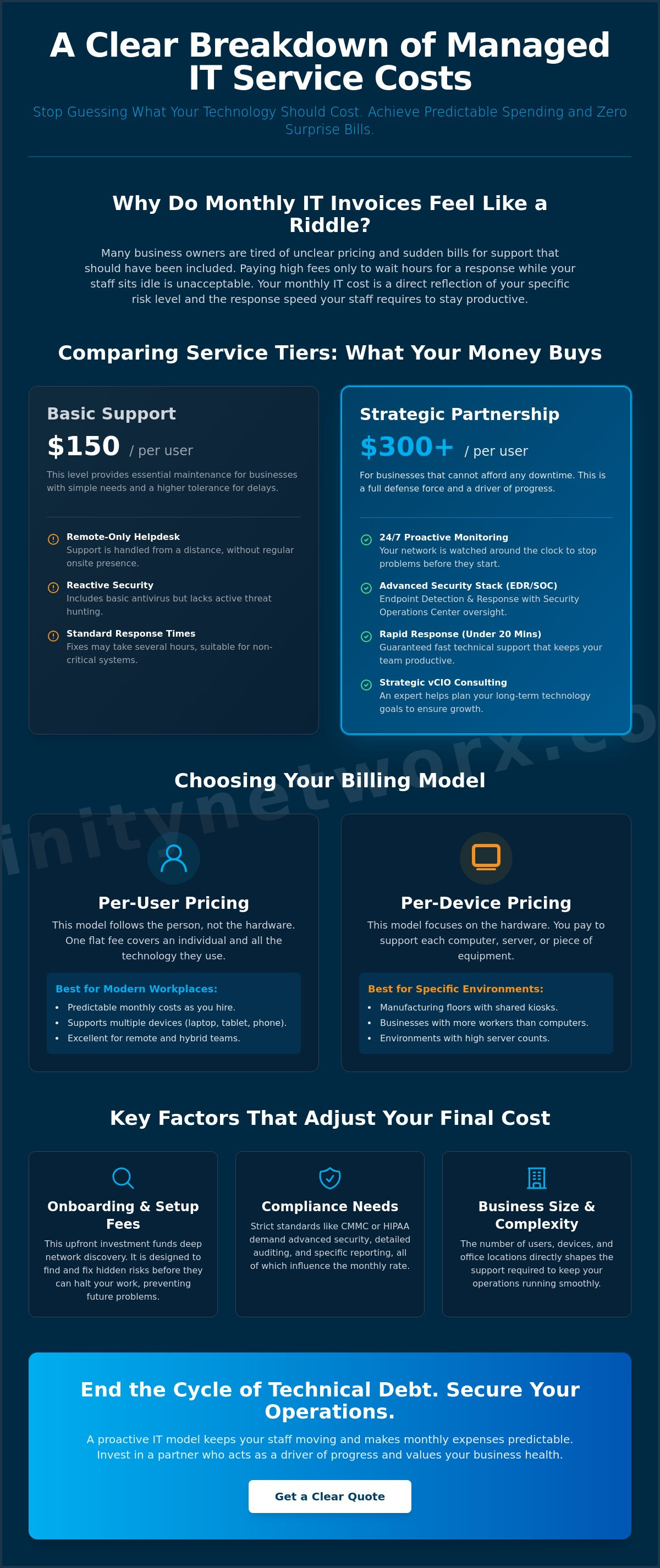
Stop guessing what your technology should cost. Pricing isn't a random number pulled from the air. It's a calculated investment in your operational speed and safety. Understanding the average cost of managed IT services requires looking past the monthly invoice total. You must look at what is actually being protected. Modern managed services models have moved far beyond the old break/fix days of waiting for a crash to call for help. Today, most businesses find their monthly rates landing between $150 and $350 per user. This range exists because no two companies share the same risk profile or performance demands. Managed IT costs are a direct reflection of your specific risk level and the response speed your staff requires to stay productive.
Entry-level pricing often starts around $150 per user. This price point serves businesses with very simple needs. You get a remote helpdesk and basic maintenance. Don't expect a technician at your door every week. Support is largely handled from a distance. Security at this level is often reactive. You might have basic antivirus software, but you lack active threat hunting or deep network analysis. Response times can lag. If your team can afford to wait a few hours for a fix, this might work. Common features include:
• Remote-only helpdesk access
• Basic antivirus software licenses
• Periodic software patching and updates
• Limited onsite support visits
When your business cannot afford a single minute of silence, you move into the $300 plus per user range. This is where managed IT services become a strategic engine. You aren't just buying support; you are buying a full defense force. This level includes 24/7 monitoring and response guarantees as fast as 20 minutes. You get a complete security stack featuring Endpoint Detection and Response (EDR) and Security Operations Center (SOC) oversight. These plans also provide vCIO services. A dedicated expert sits with your leadership to plan long-term technology goals. It ensures your hardware never becomes a bottleneck for your growth. You pay more to ensure your staff never stops moving. High-end plans turn IT from a utility into a driver of progress. They focus on the relationship between technical efficiency and overall business health. Premium packages offer:
• 24/7 proactive network monitoring
• Rapid response times, often under 20 minutes
• Advanced security including EDR and SOC monitoring
• Strategic vCIO consulting for long-term planning
Contact us at https://www.trinitynetworx.com/contact-us to lock in your business margins. Share this pricing guide with your colleagues on social media to help them avoid surprise invoices.
Lance Reichenberger, Ph.D.
Choosing between per-user and per-device billing isn't just about accounting. It's about how your team actually works. In 2026, the average cost of managed IT services often fluctuates based on which of these buckets your business falls into. Most Southern California firms have shifted toward per-user agreements because they mirror modern work habits. One person. Three devices. One flat fee. This approach removes the friction of tracking every piece of hardware your staff touches. It allows your technology to act as a strategic driver of progress rather than a line item you have to constantly audit.
This model follows the person, not the hardware. If an account manager uses a laptop at the office, a tablet in the field, and a phone for email, they are still just one human to support. Per-user pricing covers that individual across every piece of tech they use. It makes your monthly budgeting predictable. You know exactly what a new hire will cost your bottom line. It also stops the endless debates about which devices are "managed" or "unmanaged" in your environment. Benefits of this model include:
• Predictable monthly costs as you hire new staff.
• Support for multiple devices per person without extra fees.
• Easier management of remote and hybrid workforces.
Fixed workstations change the math. Think about a machine shop in Ontario or a warehouse in Rancho Cucamonga. You might have three shifts of workers sharing a single ruggedized computer on the floor. In this case, paying for three users would be a waste. Paying for one device is the smarter move. This model also suits server-heavy setups where you have massive infrastructure but very few people actually logging in. Be careful, though. Adding mobile hardware can trigger sudden, unexpected price jumps that disrupt your cash flow. This model is best for:
• Manufacturing floors with shared kiosks.
• Businesses with more employees than active computers.
• Environments with high server counts and low headcount.
Some specialized manufacturing environments require a hybrid mix. You might pay per user for your office staff and per device for the production floor. To determine if managed IT services are right for your specific workflow, you need to audit your actual hardware usage. Most local businesses value simplicity over granular device counting. If you are tired of counting every tablet and phone in your office, talk to us about a simpler approach. We focus on technical efficiency to ensure your business health remains the priority.
Contact us at https://www.trinitynetworx.com/contact-us to secure your operations. Share this guide with your network on social media.
Lance Reichenberger, Ph.D.
Monthly fees tell only half the story. If you want a clear picture of the average cost of managed IT services, you must account for the start. Most professional providers require an onboarding fee. This is not a hidden tax. It is a vital technical audit that secures your foundation. Expect to pay an amount equal to one full month of service before the first ticket is even opened. This upfront investment ensures your network is ready for high-speed performance. It pays for the labor needed to bring your systems up to a professional standard. Without this, your IT partner is merely guessing at your setup.
A reliable partner needs a map. Technicians spend the first few weeks cataloging every password and every network node. They find the lingering security holes left by previous, reactive support teams. This initial cleanup is what makes future stability possible. It sets a baseline. We document your environment so that when an issue arises, we solve it in minutes, not hours. This phase eliminates the legacy issues that frustrate your staff. You aren't just paying for a setup. You are paying for a secure, documented network that supports your business health. It is the first step in turning your technology into a strategic driver of progress.
Daily support keeps you running. Projects move you forward. Moving your data to the cloud involves one-time labor costs that fall outside your monthly agreement. Office relocations are another major expense. These often require specialized IT infrastructure services such as structured cabling or fiber optic installations. These tasks require physical labor and specific expertise that a remote helpdesk cannot provide. We treat these as standalone goals with fixed pricing to keep your spending predictable.
Strategic vCIO consulting often follows a similar path. While some premium plans include this, others bill it as a separate hourly rate for long-term technology planning. This ensures your hardware never becomes a bottleneck. We act as a protective force for your margins. Our goal is to ensure you never see a surprise bill for work you didn't approve. We value your time. We value your growth. This approach ensures your technical efficiency remains high without draining your cash flow on unexpected extras.
Contact us at contact us to plan your next technology move. Share this guide on social media to help other business leaders find clarity.
Lance Reichenberger, Ph.D.
Prices don't stay static. While we looked at base ranges earlier, your specific industry requirements act as the primary accelerator for the average cost of managed IT services. High stakes industries like defense or healthcare demand more than basic helpdesk support. You are paying for a shield against regulatory failure and expensive downtime. Advanced cybersecurity layers add per user licensing fees for tools like active threat hunting and SOC monitoring. These are not optional extras for firms that value stability. Your technology must act as a strategic driver of progress, not a weight on your budget.
Manufacturing and legal firms face higher audit risks than a standard retail office. Meeting HIPAA or CMMC standards requires specialized software and hardware configurations that go beyond standard business tech. Documentation for these standards adds labor hours to the bill every single month because every change must be logged. For example, working with CMMC compliance consultants is a major cost driver for defense contractors. These experts ensure you don't lose your government contracts due to a technical oversight. It is an investment in your ability to stay in business and grow without fear of a failed audit. We position our service as a protective force for your business health.
True round the clock support costs more than standard 8 to 5 coverage. It requires larger technician rotations to maintain performance during off hours. You are paying for a team that is awake when you are asleep. SLA guarantees for response times under 20 minutes require staff ready to jump at a moment's notice. This level of availability requires a higher headcount on our end to ensure your staff never sits idle. Proactive monitoring avoids the high cost of emergency repairs, but it demands constant vigilance. If your current provider is missing these marks, contact us for a compliance audit. We deliver professional assurance to ensure your momentum never stalls.
Contact us at https://www.trinitynetworx.com/contact-us to secure your operations. Share this guide with your network on social media.
Lance Reichenberger, Ph.D.
In the industrial hubs of Ontario and Rancho Cucamonga, silence is a financial disaster. When your network drops, your production stops. Every minute of downtime drains your bank account. Waiting for a technician to fix a broken server is a strategy from a decade ago. It's reactive. It's slow. It's expensive. Smart business owners in the Inland Empire look beyond the average cost of managed IT services to find a partner who prevents the crash before it starts. Trinity Networx, LLC focuses on keeping your staff working, not just fixing PCs after they fail. This assertive reliability ensures your business never loses its momentum. It positions technology as a strategic driver of progress rather than a utility burden.
Proactive care identifies risks before they turn into headlines. Reliability is not a luxury; it is a requirement for operational continuity. Firms in manufacturing and logistics require Managed IT Services in Ontario CA that understand the local pace. Trinity Networx, LLC acts as a protective force that values your time above all else.
A low price tag often hides a lack of vigilance. Budget vendors stay profitable by doing the bare minimum. They ignore slow burning security threats that eventually lead to catastrophic breaches. When you pay for the bottom tier, you often get slow response times that leave your employees idle. This lost productivity is a hidden tax on your business. You might save a few dollars on the monthly fee only to lose thousands in sales during a single afternoon of network failure. Watch for these 5 red flags your IT provider is killing growth to see if you are at risk. A distant, faceless vendor cannot provide the security your growth demands.
We don't believe in waiting. Our team provides a 20 minute response guarantee for technical issues. This is the professional assurance you need to maintain momentum. Trinity Networx, LLC delivers personalized care for the manufacturing and supply chain sectors that power our local economy. You deserve an authoritative expert who values your time and growth. Invest in IT management that prioritizes your business health. We act as a protective force for your margins. Our goal is steady competence and professional reliability every single day. We deliver the stability your staff needs to stay productive and profitable.
Contact us at https://www.trinitynetworx.com/contact-us to secure your operations. Share this guide with your network on social media.
Lance Reichenberger, Ph.D.
Operational silence kills profit. You now understand how the average cost of managed IT services shifts based on your risk profile and technical demands. Whether you handle defense contracts or manage a large logistics fleet, predictable spending is possible. You need a partner who treats your growth as an absolute priority. Trinity Networx, LLC has supported Southern California since 2001. Our Ph.D. led technical strategy ensures your network remains a strategic asset rather than a utility burden.
We guarantee a 20 minute response. No more waiting for reactive support. No more surprise invoices for work that should have been covered from the start. Trinity Networx, LLC acts as a protective force for your margins. Your business health relies on technical efficiency that moves as fast as you do. Stop guessing your IT budget. Contact Lance Reichenberger, Ph.D. and the Trinity Networx, LLC team today for a clear quote. Secure your operations and keep your momentum high. You deserve a partner who rejects the status quo and fights for your success.
Contact us at https://www.trinitynetworx.com/contact-us to secure your operations. Share this guide on social media to help other leaders find clarity.
Lance Reichenberger, Ph.D.
Outsourcing costs depend on your headcount and the level of protection your data requires. Most small firms pay a flat monthly fee that covers remote support and basic security. This model keeps your budget predictable and avoids the financial shocks of hourly billing. You pay for the stability of your network rather than the time it takes to fix a crash.
Per-user billing is the better choice for modern teams using multiple pieces of hardware. You pay one fee for an employee regardless of how many laptops or phones they use. Per-device models only make sense in environments with shared kiosks, such as a warehouse floor. Most Southern California offices prefer the simplicity of the per-user approach to avoid constant hardware audits.
A standard agreement covers remote helpdesk support, proactive monitoring, and software patching. These services focus on your overall business health and technical efficiency. You get a team that acts as a strategic driver of progress by identifying risks before they stop your work. It is a partnership designed to keep your staff productive every single day.
Hidden fees often appear as extra charges for onsite visits or support after five o'clock. Some vendors bill for travel time or "consulting" that should be part of your base plan. Professional partners provide clear invoices with zero surprise bills. Much like the transparent business and tax services provided by Apex Income Tax & Multiservice LLC, we believe in protecting your margins through transparent pricing and assertive reliability.
Strict mandates like HIPAA or CMMC compliance increase the average cost of managed IT services. These regulations require specialized software and constant logging to meet audit standards. You are paying for a higher level of professional assurance and a shield against regulatory fines. It is an essential investment for firms in the defense or healthcare sectors.
Onboarding fees cover the labor required to document your entire network and fix legacy security gaps. Technicians must create a map of your environment to ensure they can solve issues in minutes later on. This initial investment sets the baseline for future success. It ensures your IT partner isn't guessing when your team needs help the most.
Cheap support usually means reactive service that leaves your business vulnerable to downtime. Professional care requires a team of experts and high quality security tools that cost more to maintain. Paying too little often leads to slow response times and hidden risks. Quality IT support is a protective force that prevents expensive production stops.
Budget for major hardware refreshes and cloud migrations as separate capital expenses. These tasks involve one-time labor that falls outside your daily support agreement. Planning for these projects every few years ensures your technology never becomes a bottleneck for growth. We help you map out these costs in advance to keep your spending logical and steady.
Contact us at contact us to secure your operations. Share this guide with your network on social media to help other leaders find budget clarity.

Article by
Lance Reichenberger, Ph.D.., J.D. (Candidate)
Dr. Lance Reichenberger is the founder of Trinity Networx, a Southern California technology firm specializing in managed IT services, cybersecurity, network infrastructure, and business technology strategy. With nearly four decades of experience in the IT industry, he works with businesses to improve operational efficiency, strengthen security, and align technology with long-term growth objectives.
Lance focuses on proactive IT management, enterprise wireless infrastructure, cybersecurity integration, and scalable technology solutions for growing organizations throughout Southern California.
The content published on this website is provided for general informational and educational purposes only. Articles may be created, edited, or enhanced with the assistance of artificial intelligence and automation tools under the direction and review of Trinity Networx. While every effort is made to ensure accuracy and relevance, the information provided should not be considered professional, legal, financial, cybersecurity, or technical advice specific to your organization. Businesses should consult directly with a qualified professional regarding their unique environment, compliance requirements, and operational needs. Trinity Networx makes no warranties regarding completeness, reliability, or applicability of the information contained within these articles.
Schedule a brief conversation with Trinity Networx to discuss your business technology needs.
Get a practical roadmap built around your business, your users, your systems, and the technology issues that need attention first.
Put the right technology, support, security, and infrastructure in place so your business can grow, adapt, and move forward with confidence.