3281 E. Guasti Rd, STE 700, Ontario, CA 91761
1712 9th Ave SW, Watertown, SD 57201

Did you know that 94% of IT leaders are currently bracing for the impact of vendor lock-in? You likely feel this pressure every time you sign a new software agreement for your job site. That fear is justified. Moving massive amounts of field-to-office data should never feel like a hostage negotiation. Proprietary file formats that trap project information put your growth at the mercy of a third party. Prioritizing avoiding vendor lock-in with cloud providers is now a survival requirement, especially as global regulations like the EU Data Act mandate easier switching between services.
This guide provides a clear plan to protect your firm from restrictive contracts and keep your data under your control. You will learn how to build a tech stack that supports long-term growth without hidden traps. We will break down the essential checklist for data portability and risk reduction in 2026. This ensures your operational continuity remains intact regardless of which vendors you choose to partner with.
• Recognize how proprietary BIM file formats and massive egress fees create invisible barriers to your operational freedom.
• Secure your firm by avoiding vendor lock-in with cloud providers through strict data ownership clauses and clearly defined contract exit paths.
• Ensure your field and office tools communicate directly by choosing platforms that offer open APIs instead of closed ecosystems.
• Protect your project timelines with a Technology Alignment Process that identifies software traps before they lead to job site downtime.
Construction firms often find themselves anchored to a single platform because their data is stored in formats that other tools simply cannot read. BIM models and complex project management files frequently use closed architectures. This creates a situation where vendor lock-in prevents you from adopting better tools or negotiating fair prices. Within construction technology, this dependency represents a massive risk to long term project continuity. If your provider raises rates or changes terms, your data stays stuck. You lose the ability to pivot when project requirements shift.
High data egress fees add another layer of restriction. Moving large architectural files out of a cloud environment can become cost prohibitive for smaller firms. Many providers charge heavily for data transfers. This makes the act of leaving feel like a financial penalty rather than a business decision. Effective strategies for avoiding vendor lock-in with cloud providers must account for these hidden exit costs during the contract phase. You shouldn't have to pay a ransom to access your own historical project data. It is your intellectual property; you should own the path to move it.
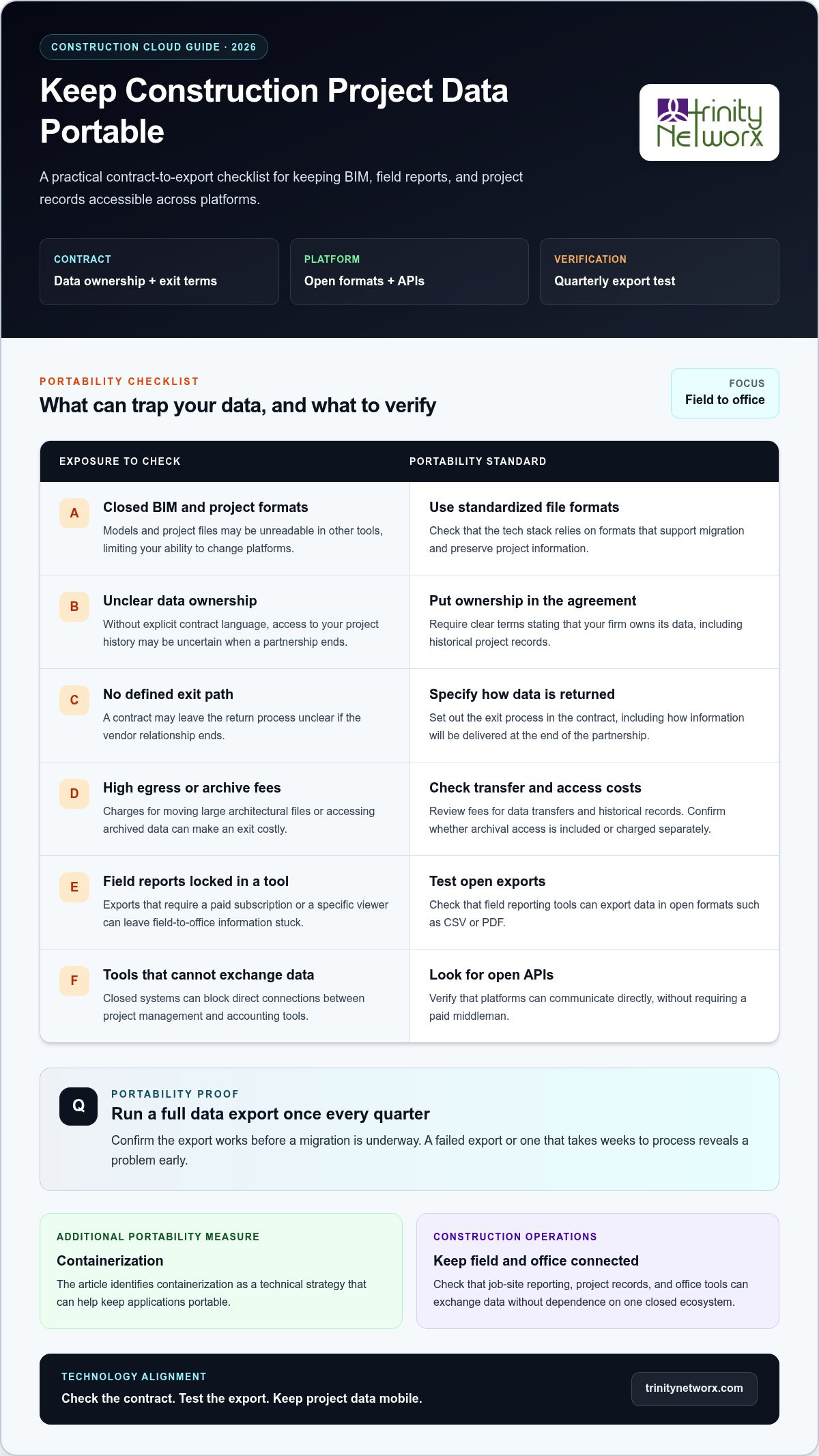
Start by auditing your field reporting tools. Do they allow for easy data export in open formats like CSV or PDF? If they require a specific viewer or a paid subscription to access exports, your field-to-office intelligence is trapped. Specialized IT services for commercial construction help identify these software gaps. We analyze how your current cloud provider handles office-to-field connectivity to ensure data remains accessible across different platforms. Reliable data movement is critical for managing job site progress. Don't let a vendor own your operational flow or dictate your tech future. Your field teams need tools that work for them, not tools that keep them caged.
Protecting your firm requires a proactive stance on contract language. Every agreement must explicitly state that you own the data. You need a defined exit path that outlines how information is returned if the partnership ends. Research suggests technical strategies like containerization can help to neutralize vendor lock-in by keeping applications portable. When avoiding vendor lock-in with cloud providers, verify that these clauses aren't buried in fine print. If a vendor refuses to guarantee your data ownership, walk away. Your project history is too valuable to leave in a black box.
Prioritize software offering open APIs. This ensures your project management tools can talk to your accounting software without needing a paid middleman. Don't just take a salesperson's word for it. Perform a full data export test once every quarter. This simple audit confirms that portability works before you actually need to move. If the export fails or takes weeks to process, you've identified a critical risk early. Finding these traps during a slow period is better than discovering them during a massive migration.
Check if your vendor provides full access to your historical project data without charging extra fees. Some providers hide these costs in archival access tiers. Ensure your tech stack relies on standardized file formats. This prevents losing intellectual property during a migration. For a deeper look at long term planning, see our cloud computing services for business guide. Keeping your data mobile is a strategic priority. If you need help auditing your current contracts, contact our construction IT experts to review your technology alignment.
Construction firms that react to tech problems after they occur are already behind. A proactive strategy uncovers software traps before they cause expensive downtime on your job site. Your data must stay mobile. Understanding the potential impact of vendor lock-in allows you to evaluate long term risks before signing a contract. By avoiding vendor lock-in with cloud providers, you maintain the agility to switch platforms without losing project momentum.
Local Southern California support ensures that your field teams never lose access to critical cloud data during a transition. When avoiding vendor lock-in with cloud providers, you need a partner who can arrive on site in the Inland Empire. A faceless ticket system won't fix a dead connection. Managed IT services provided at a flat fee help you manage the costs of maintaining a portable infrastructure without surprise billing. This predictable model allows you to invest in data portability without blowing your technology budget.
Partnering with a team that understands the specific needs of Inland Empire construction firms is vital. We use our Technology Alignment Process to keep your tech stack flexible and ready for change. This ensures your software choices reflect your business goals rather than a vendor's sales quota. For firms looking to build a secure foundation, our cloud solutions in Ontario provide the local expertise required for successful implementation. Don't let distance or complex contracts dictate how you run your job site.
Your firm's project data is its most valuable asset. Don't let restrictive contracts or proprietary BIM formats hold your operations hostage. We've discussed how a proactive checklist and open APIs are essential for avoiding vendor lock-in with cloud providers. Taking control now prevents expensive migration headaches and job site downtime later. You deserve a tech stack that supports your growth without creating invisible barriers. Trinity Networx offers over 30 years of IT expertise to ensure your infrastructure remains independent and mobile.
Our 100% in-house local staff provides a 60-minute response guarantee to keep your field teams moving. Stop worrying about software traps and start focusing on your next build. Solve your IT nightmares and secure your data by contacting Trinity Networx today. Your operational independence is just one strategic alignment away.
Signs include an inability to export data in standard formats like CSV or PDF and a lack of API access for third-party integrations. If your field data cannot be opened in any other application, you're already locked in. Another red flag is a vendor refusing to provide a clear technical path for data recovery. These restrictions prevent you from adopting better tools as your firm grows.
Data egress fees act as a financial barrier that makes moving large architectural files cost prohibitive. Providers charge these fees when you transfer data out of their environment. This creates unpredictable spikes in your IT budget. Successful strategies for avoiding vendor lock-in with cloud providers involve negotiating these fees early. You shouldn't face a penalty just to access your own project history.
Open BIM standards like IFC ensure your 3D models remain accessible regardless of the software vendor you choose. Relying on proprietary formats means your intellectual property is tied to a specific subscription. If that vendor raises prices, your historical data becomes a bargaining chip. Open standards protect your continuity. They allow for better collaboration between subcontractors using different specialized tools.
Prioritize software that uses open APIs and supports standard data formats for all field reporting. Regularly testing your data exports ensures your field-to-office intelligence isn't siloed within one ecosystem. Using a local partner for avoiding vendor lock-in with cloud providers helps build a network architecture that isn't dependent on one suite. This keeps your field teams productive during any transition.

Article by
Lance Reichenberger, Ph.D.., J.D. (Candidate)
Dr. Lance Reichenberger is the founder of Trinity Networx, a Southern California technology firm specializing in managed IT services, cybersecurity, network infrastructure, and business technology strategy. With nearly four decades of experience in the IT industry, he works with businesses to improve operational efficiency, strengthen security, and align technology with long-term growth objectives.
Lance focuses on proactive IT management, enterprise wireless infrastructure, cybersecurity integration, and scalable technology solutions for growing organizations throughout Southern California.
The content published on this website is provided for general informational and educational purposes only. Articles may be created, edited, or enhanced with the assistance of artificial intelligence and automation tools under the direction and review of Trinity Networx. While every effort is made to ensure accuracy and relevance, the information provided should not be considered professional, legal, financial, cybersecurity, or technical advice specific to your organization. Businesses should consult directly with a qualified professional regarding their unique environment, compliance requirements, and operational needs. Trinity Networx makes no warranties regarding completeness, reliability, or applicability of the information contained within these articles.
Schedule a brief conversation with Trinity Networx to discuss your business technology needs.
Get a practical roadmap built around your business, your users, your systems, and the technology issues that need attention first.
Put the right technology, support, security, and infrastructure in place so your business can grow, adapt, and move forward with confidence.