3281 E. Guasti Rd, STE 700, Ontario, CA 91761
1712 9th Ave SW, Watertown, SD 57201

Building a business case for a new firewall starts with the connections that keep construction work moving: office systems, field teams, project files, and jobsite technology. Executive support is easier to earn when the proposal explains how a firewall protects project continuity and supports the way your teams work, rather than relying on fear.
It is reasonable to question the cost and the risks of changing network protections during active projects. Make the case specific: show how office-to-field connectivity affects exposure, what a disruption could mean for schedules and access to project information, and how a planned transition can limit operational friction. The steps below help you compare options against construction workflows, document costs and assumptions, and present a practical plan to decision-makers. Security belongs in the business case, not in an isolated IT discussion.
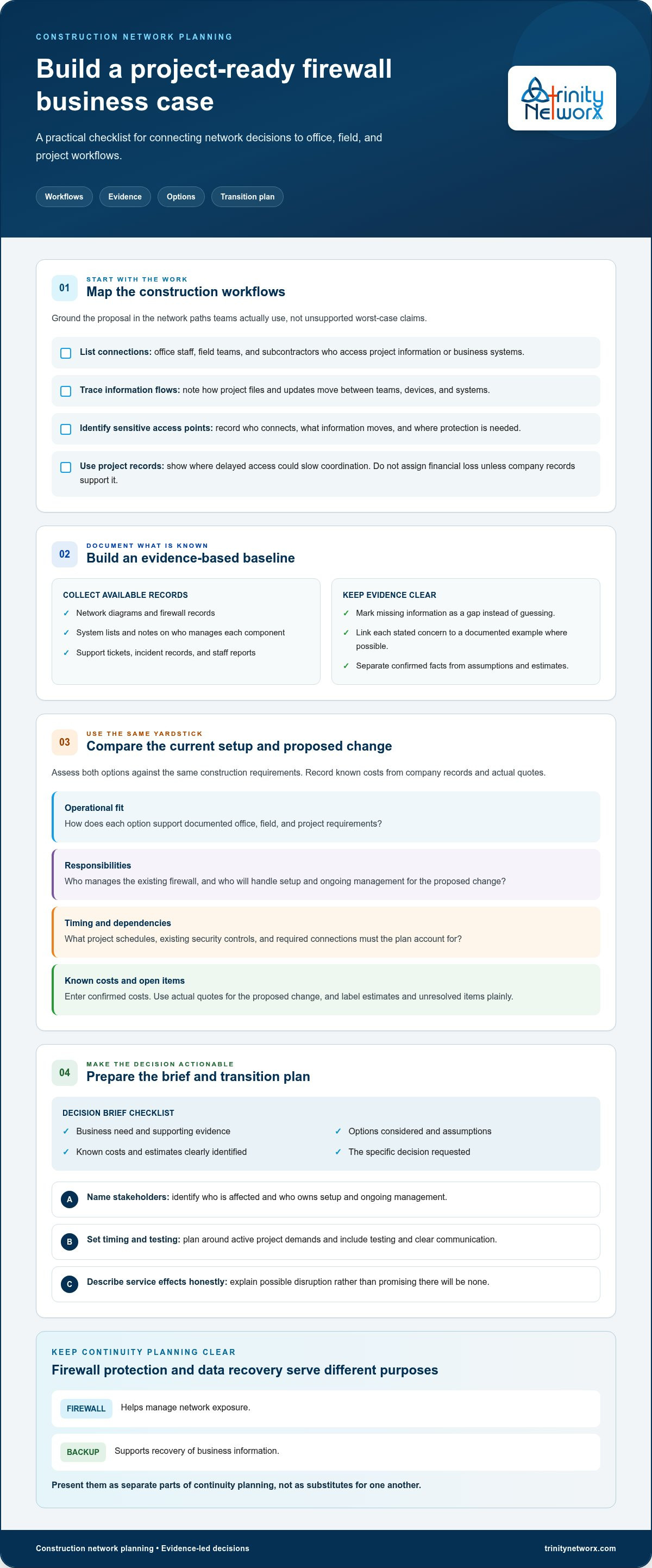
• Building a business case for a new firewall starts with documenting the current environment and the construction workflows it supports.
• Use actual quotes and internal records to separate known costs from estimates and make assumptions visible.
• Compare the current setup and proposed change by operational fit, responsibilities, and known costs.
• Plan a project-aware transition with named stakeholders, timing, testing, and clear communication.
Start with the construction workflows that depend on a reliable, protected network. A firewall proposal is strongest when it connects security decisions to the systems and information people need to keep projects moving, rather than to a worst-case scenario without evidence.
Map the paths your teams actually use. Consider office staff accessing project records, field teams sharing updates, subcontractors receiving information, and business systems supporting project coordination. The network design varies by company and project. Identify who connects, what information moves, and which access points need protection.
• List the office, field, and subcontractor connections used for your projects.
• Trace how project information moves between teams, devices, and systems.
• Use project records to identify where delayed access could slow coordination.
Ground the case in evidence your company can show: current workflows, observed access concerns, and the operational effects of an interruption. If a team cannot retrieve a current drawing or project update, coordination may slow while staff find another way to get the information. Describe that risk plainly. Do not assign a financial loss unless internal records support it.
A business case links a proposed decision to its purpose, effects, and supporting evidence. The What is a Business Case overview offers useful context, but the evidence should come from your own operations. Construction-focused technical expertise can connect firewall planning to office-to-field needs. Trinity Networx also provides business IT services relevant to network planning.
For construction-specific IT planning that accounts for your connectivity and security priorities, contact the Trinity Networx team.
Turn the operational picture into a decision record. Building a business case for a new firewall means documenting the current environment, the work it supports, and how each option fits construction operations. Keep evidence separate from assumptions.
Gather available network diagrams, firewall records, system lists, and notes about who manages each component. Mark gaps rather than filling them with guesses.
Record how office teams, field staff, and subcontractors access project files and business systems. Note the connections a proposed change must preserve.
Use support tickets, incident records, and staff reports to describe recurring access or security issues. Link each concern to a documented example where possible.
Assess the current arrangement and proposed changes using consistent criteria: required connectivity, management responsibilities, project timing, and fit with existing security controls.
List unknowns, dependencies, and estimates plainly so decision-makers can see what still needs validation.
Build a worksheet from actual quotes and internal records. Separate confirmed amounts from estimates, and describe operational impacts without assigning unsupported savings or avoided losses. Include project requirements, support patterns, and network documentation when available. Compare alternatives using the same criteria, including who manages firewall changes and how the work fits active project schedules. Managed cybersecurity can also put firewall management in context with other security measures.
A construction-focused review can help align these criteria with office-to-field connectivity and project demands. Discuss your firewall business case with Trinity Networx.
A decision brief should make the request clear. Building a business case for a new firewall means showing the operational need, the evidence behind it, the alternatives considered, and what approval will allow the company to do next.
| Comparison point | Current arrangement | Proposed change |
|---|---|---|
| Operational fit | Record how it supports documented office, field, and project requirements. | Describe how the proposed approach will address those same needs. |
| Responsibilities | Identify who manages the existing firewall and related work. | Name the people or teams responsible for setup and ongoing management. |
| Known costs | Enter confirmed costs from company records. | Use actual quotes; label estimates and open items clearly. |
Keep the recommendation concise. State the business need, supporting evidence, options considered, assumptions, known costs, and the specific decision requested. Tie the preferred option to documented office-to-field connectivity and project requirements, not general claims about risk or savings. Include proposed timing, affected stakeholders, testing, and communication. Schedule the work around active project demands, and describe possible service effects honestly rather than promising there will be no disruption.
Recovery planning supports security, but it serves a different purpose. A firewall helps manage network exposure; business data backup supports recovery of information. Present both as parts of continuity planning, not as substitutes for one another. Organizations coordinating enterprise infrastructure often look to integrated security for data centers to balance perimeter defenses with broader operational resilience in a similar way.
Construction-focused IT expertise can connect firewall management to the systems and field access your teams rely on. For a practical discussion of your proposal and transition priorities, contact Trinity Networx.
Turn documented requirements into a decision your leadership team can act on. Building a business case for a new firewall gives the discussion a clear focus: which project needs must be protected, who will manage the change, and how the transition fits the work underway. Assign ownership, identify what decision-makers still need to know, and set a review point before implementation begins.
Trinity Networx supports construction-focused IT planning for office-to-field connectivity, along with firewall management, intrusion prevention, and 24/7/365 remote network monitoring. This work can connect a firewall discussion to your company’s workflows instead of relying on generic assumptions about construction networks across California, Nevada, Arizona, and Utah.
Contact our team to discuss your construction firewall needs.
It can, but the right approach depends on your network paths, users, systems, and site connectivity. For construction teams working across California, Nevada, Arizona, and Utah, document how office staff, field personnel, and subcontractors connect before comparing options. Include the project tools they need to access. This keeps the decision tied to your operation rather than assumptions about every jobsite.
It may affect active work, depending on the existing environment and the change plan. Identify users, systems, and project activities that rely on affected connections before implementation. Choose a change window with project leads, schedule testing, and tell teams what to expect and where to report access problems. Planning can expose dependencies, but it cannot guarantee interruption-free work.
Yes. Retaining the current firewall may be reasonable if it meets documented business needs and responsibilities are clear. Assess support arrangements, available network documentation, and security ownership, then record any gaps. For example, uncertainty about who approves access changes is an operational issue worth resolving. Compare continued use, improved management, and replacement. For teams evaluating how external providers handle infrastructure oversight, managed service providers like itworks.co.nz demonstrate how ongoing support and technology management can be structured. Management alone may not address every technical or security limitation.
A working firewall may no longer fit changing teams, systems, or jobsite connections. Review current access patterns, assigned responsibilities, and known support issues against updated requirements. When building a business case for a new firewall, compare continued use, management changes, and replacement using the same criteria. Decision-makers can then weigh a specific case for action against a reasoned decision to defer.

Article by
Lance Reichenberger, Ph.D.., J.D. (Candidate)
Dr. Lance Reichenberger is the founder of Trinity Networx, a Southern California technology firm specializing in managed IT services, cybersecurity, network infrastructure, and business technology strategy. With nearly four decades of experience in the IT industry, he works with businesses to improve operational efficiency, strengthen security, and align technology with long-term growth objectives.
Lance focuses on proactive IT management, enterprise wireless infrastructure, cybersecurity integration, and scalable technology solutions for growing organizations throughout Southern California.
The content published on this website is provided for general informational and educational purposes only. Articles may be created, edited, or enhanced with the assistance of artificial intelligence and automation tools under the direction and review of Trinity Networx. While every effort is made to ensure accuracy and relevance, the information provided should not be considered professional, legal, financial, cybersecurity, or technical advice specific to your organization. Businesses should consult directly with a qualified professional regarding their unique environment, compliance requirements, and operational needs. Trinity Networx makes no warranties regarding completeness, reliability, or applicability of the information contained within these articles.
Schedule a brief conversation with Trinity Networx to discuss your business technology needs.
Get a practical roadmap built around your business, your users, your systems, and the technology issues that need attention first.
Put the right technology, support, security, and infrastructure in place so your business can grow, adapt, and move forward with confidence.