3281 E. Guasti Rd, STE 700, Ontario, CA 91761
1712 9th Ave SW, Watertown, SD 57201

What happens when your files are intact but your team can’t access the systems, people, or workspace needed to keep work moving? Business continuity planning in San Bernardino goes beyond backup software: it connects preparedness, staff training, incident response, and recovery so operations can continue through disruption.
Backups matter, but they do not assign responsibilities or guide decisions when a network outage, cyber incident, or facility disruption affects production. This article explains how continuity planning applies in San Bernardino and Riverside Counties, what a professional plan covers, and how training and recovery processes support daily operations, including in construction and manufacturing.
• A continuity plan connects staff roles, response steps, and recovery priorities, not just copies of business files.
• Local planning should account for how disruptions affect each worksite, team, and critical business process.
• A professional plan takes shape through an assessment of essential operations, dependencies, response responsibilities, and recovery needs.
• Business VoIP can support communication continuity, while IT, cybersecurity, and data recovery services address other parts of operational readiness.
A practical continuity plan connects emergency decisions with recovery actions. San Bernardino County’s emergency planning is one local example of coordinated response.
California State University Executive Order #1056 requires CSUSB to have a campus emergency management program. Its Emergency Operations Plan, identified as May 2022, describes emergency roles, responsibilities, policies, and response protocols. A business plan should likewise name who leads each department, who communicates updates, and who can authorize operational changes. Training should let staff practice those roles through realistic scenarios, such as a facility closure that interrupts production.
Backups preserve data; disaster recovery planning sets out how to restore systems and resume work. A recovery time objective, or RTO, defines how quickly a business needs a system restored after disruption. Set priorities by linking each system to the work it supports: a production scheduling platform may need to be restored before a rarely used archive. Document the recovery steps and assign responsibility for each one.
A disaster recovery plan should identify critical systems, dependencies, restoration order, and the people responsible for each action. San Bernardino County’s 2025 Emergency Operation Plan provides access to 21 Emergency Support Function documents; its annexes coordinate department and agency plans rather than replace them. Business documentation also needs updates when systems, sites, vendors, or staff responsibilities change. A new production line, for example, may add equipment and network dependencies that the recovery sequence must cover.
Include an emergency contact process, backup access and restoration steps, and remote-work roles, systems, and approval responsibilities. Specify who sends staff updates and how teams receive them if the usual channel fails. For disaster recovery, San Bernardino businesses may also consider insurance claims, loans, or grants; the applicable options depend on coverage, losses, and program eligibility. Connect those recovery tasks to operational priorities rather than leaving them as separate paperwork.
Plans must reflect how each location works, not just list general emergencies. In San Bernardino County, undocumented infrastructure and inconsistent support between locations are local IT priorities.
Software can organize plan documents, contacts, and review tasks. Consulting adds analysis of operations, dependencies, response roles, and recovery priorities. The right fit depends on the number of sites, the complexity of business processes, existing documentation, and the level of professional support needed. For San Bernardino businesses, software or consulting costs depend on the case and are provided after a quote request. Scope, system dependencies, and the work needed to document or coordinate locations shape the quote. Focus on whether the work produces a usable response plan, not simply another repository for files.
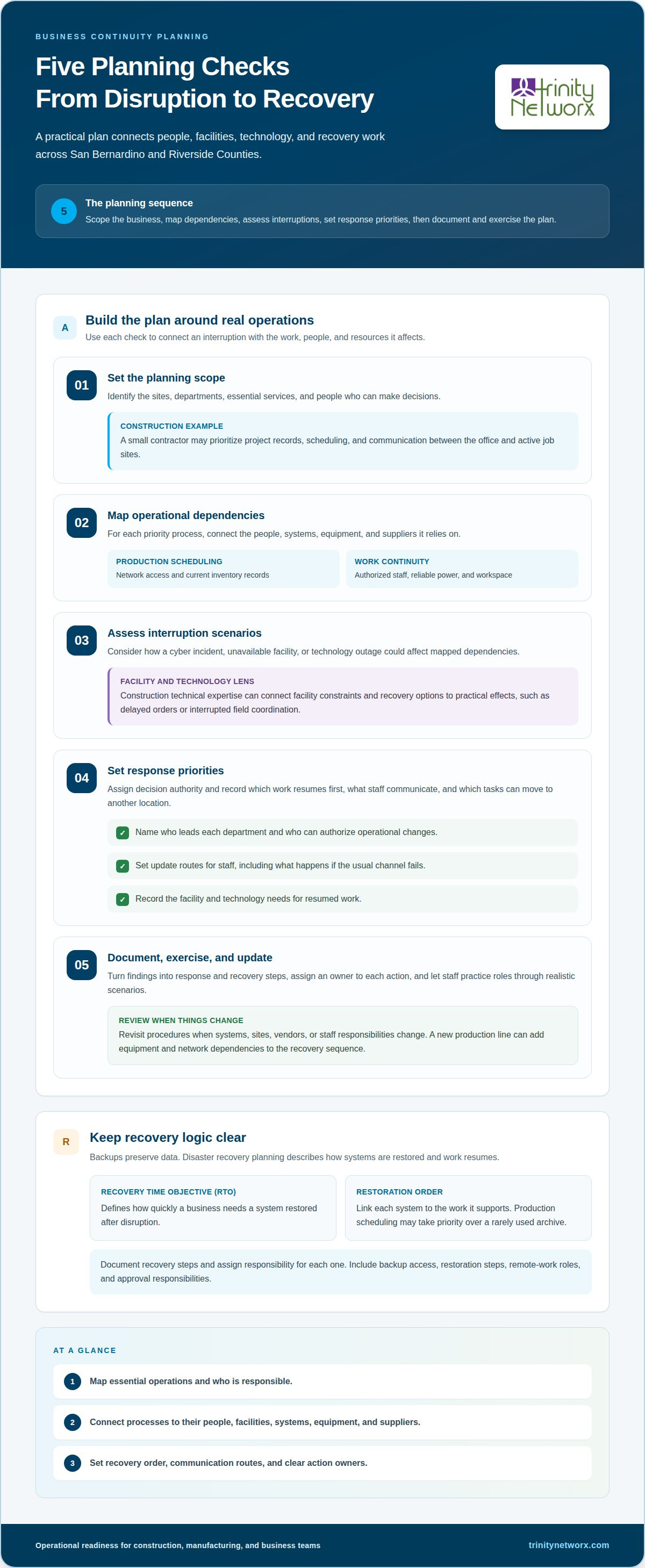
A professional begins by mapping essential operations, key staff, facilities, equipment, and technology dependencies. Next, they identify how an incident could interrupt each process and which activities take priority during response. The plan then assigns decision-making roles, communication routes, alternate work arrangements, and recovery actions. For a manufacturer, for example, this could mean mapping how a network outage affects production scheduling, inventory records, and supplier coordination. Document these connections and organize recovery priorities around business needs.
Review also matters. A change in location, staff responsibilities, or business systems can leave old procedures out of step with current operations. A professional can help connect planning decisions to day-to-day technology and documented responsibilities. If your continuity plan needs that operational review, discuss planning support.
A professional builds the plan around how the business operates, then links disruptions to practical recovery work. For a San Bernardino manufacturer or contractor, construction technical expertise can connect technology and facility issues to production, deliveries, and customer commitments.
The professional identifies sites, departments, essential services, and decision-makers. A small contractor might prioritize project records, scheduling, and communication between the office and active job sites, where site conditions and building systems can affect technology access.
The assessment connects each priority process to its people, systems, equipment, and suppliers. For example, production scheduling may depend on network access, current inventory records, staff who can authorize changes, and reliable power and workspace.
The professional considers how a cyber incident, unavailable facility, or technology outage could affect those dependencies. Construction technical expertise helps assess facility constraints and recovery options, tying each scenario to practical consequences such as delayed orders or interrupted field coordination.
The plan assigns decision authority and establishes which work resumes first. It also records what staff need to communicate, which tasks can shift to another location, and what information supports each decision, including the facility and technology needs for resumed work.
The professional turns findings into clear procedures, contact paths, and recovery actions. A discussion-based exercise can reveal missing contacts, unclear approvals, or instructions that don’t match current operations. Updates follow changes to sites, systems, staff, or suppliers.
This process gives owners a usable operating guide tied to daily work, technology dependencies, and facility recovery. Discuss continuity planning support for your business.
Trinity Networx, LLC helps businesses address communication gaps through Business VoIP, which can support continuity planning when teams need to coordinate during a disruption. If a site becomes unavailable, staff still need clear ways to reach colleagues, customers, and suppliers. Define who communicates, which teams need updates, and how calls are handled if normal work arrangements change.
Business VoIP can support those communication procedures, while Managed IT Services help manage the technology a business relies on. For organizations reviewing their communications setup, Business VoIP connects continuity planning to an operational need. Its role depends on how your teams work and communicate during an incident.
Contact Trinity Networx, LLC to discuss your business communication needs.
Business continuity planning in San Bernardino gives leadership a practical basis for deciding where to focus planning first. Start with a business priority that cannot stay idle, then identify the technology support it depends on. This keeps planning tied to real business needs.
Trinity Networx, LLC provides Managed IT Services, Cybersecurity Solutions, and Data Backup & Recovery. These services can support businesses as they align technology with continuity priorities.
Contact Trinity Networx, LLC to discuss planning and take the next step toward a plan suited to your business. Your continuity work can start with a clear priority.
Backup software can retain copies of selected files, but it cannot show whether staff can restore access, locate recovery credentials, or work around a missing application. A useful continuity exercise tests those details with the people responsible for them. For example, a team can confirm who has authorized access to restored files and how it will track pending customer orders during the test.
An RTO under 4 hours sets a target for restoring the particular system or service covered by that objective. It does not define when every business function returns to normal. Clarify the starting point, the system in scope, and what counts as restored access. For example, staff might be able to sign in before every connected workflow is available.
The plan can define incident categories and the conditions that activate each response. A brief network interruption may call for internal troubleshooting, while a suspected account compromise may require restricting access and escalating to security support. Include decision triggers, approval authority, and records to preserve. These details help staff choose an appropriate response instead of treating every disruption the same way.
Business continuity planning prepares a company to manage disruption while protecting its ability to serve customers and meet commitments. In San Bernardino, a firm with local customers or suppliers can use its plan to prioritize orders, invoices, and time-sensitive communication. Those decisions help leadership balance operational needs with technology recovery.
Wildfire, earthquakes, floods, and power outages are useful scenarios to consider for a San Bernardino County site. Their relevance varies by location and facility. A planning review can assess access restrictions, equipment exposure, utility loss, and staff availability for each scenario. The plan should distinguish actions for a threatened site from procedures for an incident that has already interrupted work.

Article by
Lance Reichenberger, Ph.D.., J.D. (Candidate)
Dr. Lance Reichenberger is the founder of Trinity Networx, a Southern California technology firm specializing in managed IT services, cybersecurity, network infrastructure, and business technology strategy. With nearly four decades of experience in the IT industry, he works with businesses to improve operational efficiency, strengthen security, and align technology with long-term growth objectives.
Lance focuses on proactive IT management, enterprise wireless infrastructure, cybersecurity integration, and scalable technology solutions for growing organizations throughout Southern California.
The content published on this website is provided for general informational and educational purposes only. Articles may be created, edited, or enhanced with the assistance of artificial intelligence and automation tools under the direction and review of Trinity Networx. While every effort is made to ensure accuracy and relevance, the information provided should not be considered professional, legal, financial, cybersecurity, or technical advice specific to your organization. Businesses should consult directly with a qualified professional regarding their unique environment, compliance requirements, and operational needs. Trinity Networx makes no warranties regarding completeness, reliability, or applicability of the information contained within these articles.
Schedule a brief conversation with Trinity Networx to discuss your business technology needs.
Get a practical roadmap built around your business, your users, your systems, and the technology issues that need attention first.
Put the right technology, support, security, and infrastructure in place so your business can grow, adapt, and move forward with confidence.