3281 E. Guasti Rd, STE 700, Ontario, CA 91761
1712 9th Ave SW, Watertown, SD 57201

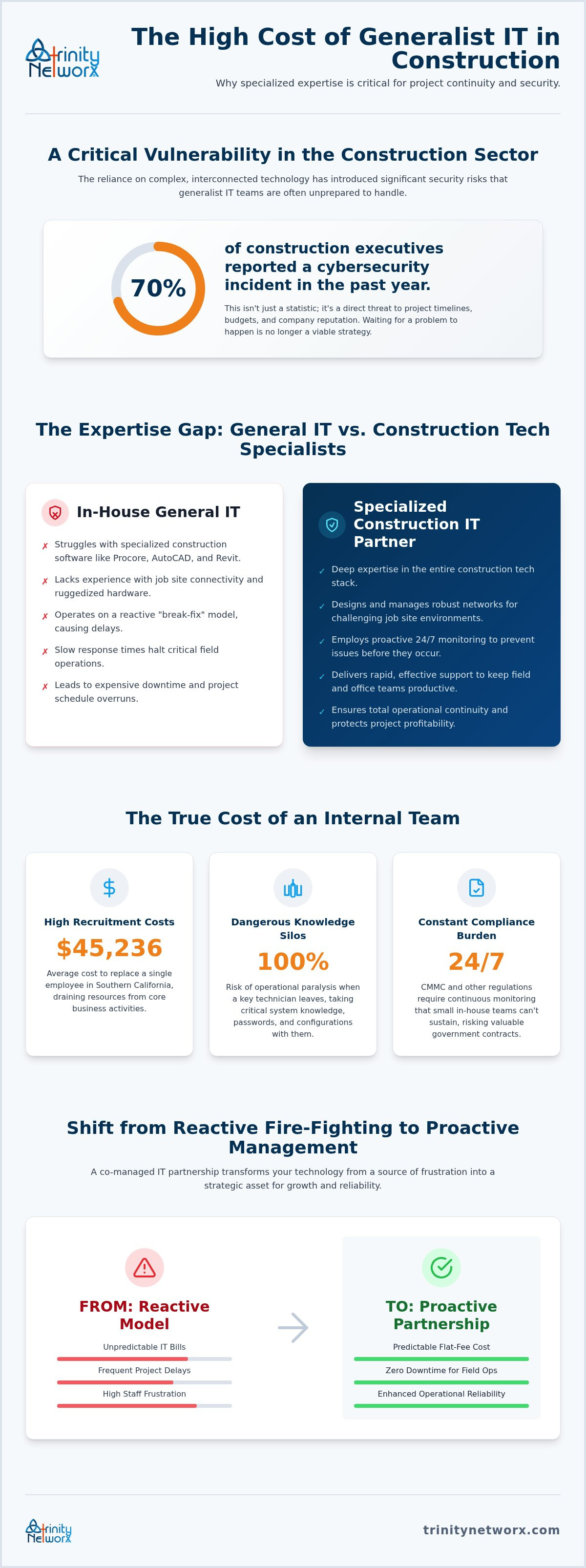
Seventy percent of construction executives reported a cybersecurity incident in the past year. This statistic exposes a massive vulnerability in the sector. You probably built an internal team to maintain control, but now you face unpredictable bills and slow response times. The challenges of managing an in-house IT department often boil down to a lack of specialized construction expertise. Your field staff cannot afford to wait for a technician who does not understand their specific software. It's a drain on your momentum. We will explore why internal teams struggle with modern construction technology and how to bridge these operational gaps. You will learn how to secure predictable costs while ensuring zero downtime for your critical field operations. This guide moves past reactive fixes to a model of total operational continuity, including expert support for CMMC and compliance.
• Specialized construction software requires more than general IT knowledge. See why your team needs experts who know Procore and AutoCAD inside out.
• Uncover the true financial risks and challenges of managing an in-house IT department, from high Southern California recruitment costs to dangerous knowledge silos.
• Field staff cannot afford slow response times during critical operations. Learn to identify the vulnerabilities in reactive support models that halt your project progress.
• Move beyond the status quo with a proactive strategy that ensures operational continuity. Stop surprise expenses by switching to a predictable flat fee model.
General IT knowledge is common. Construction specific expertise is not. One of the primary challenges of managing an in-house IT department is the gap between standard office support and the demands of a high pressure job site. Most internal technicians understand email servers and basic desktop support. They often lack the depth required to manage complex tools like Procore or AutoCAD. When these systems fail, projects stall. Money evaporates. You need technicians who speak the language of the field, not just the language of the server room.
Field operations demand specialized networking knowledge. A standard office Wi-Fi setup won't survive the interference and physical barriers of an active construction site. Finding staff who can handle Information technology management while also understanding low voltage cabling and ruggedized connectivity is nearly impossible in the current labor market. You aren't just looking for an IT guy; you're looking for a construction technologist. These professionals are in high demand and short supply.
Internal staff often struggle to connect field data with office project management tools. This creates data silos that slow down decision making. Generalists frequently fail to support specialized BIM environments during critical deadlines because they don't understand the hardware requirements for heavy 3D rendering. This lack of it services for commercial construction leads to expensive downtime. If your IT team cannot troubleshoot a Revit sync error at 6:00 am, they are a liability to your project schedule. Reliability in the field is non-negotiable.
Hiring in Southern California is a constant battle. The average cost to replace a single construction employee reached $45,236 in 2026. This financial drain highlights the core challenges of managing an in-house IT department. When a technician leaves, they take institutional knowledge with them. This creates a dangerous knowledge silo. Small teams usually depend on one person who knows every network password and server configuration. If they quit, your operations stop. You lose time and money while searching for a replacement in a crowded market.
Training requirements add significant overhead. Cybersecurity threats change every day. Keeping an internal team updated on these shifts requires constant investment. The industry is already struggling with a massive talent gap, needing 499,000 new workers in 2026 alone. Research shows the sector will need nearly 2.5 million more professionals by 2035 to support technological transformation. Finding someone who stays current while managing your daily tickets is difficult and expensive. Most firms cannot afford the downtime that comes with a revolving door of staff.
CMMC compliance is a moving target that requires constant attention. Southern California subcontractors risk losing defense contracts if their internal security audits fail to meet strict standards. Most small in-house teams lack the bandwidth for the continuous monitoring required. Managing these protocols alone is a gamble with your project eligibility. You should consult with CMMC experts to ensure your firm stays compliant and competitive. If your staff turnover is hurting your bottom line, contact our team for a more stable solution.
Reactive IT models are project killers. Most firms wait for a server to crash or a field tablet to disconnect before calling for help. This delay stops work on the job site. It creates friction between the office and the field. The challenges of managing an in-house IT department often stem from this constant fire fighting loop. Your team spends their day fixing old problems instead of preventing new ones. Downtime on a job site isn't just an inconvenience; it's a logistical nightmare that pushes back every subsequent trade. When your network fails, your crew stands idle. You pay for labor that isn't producing results.
Co-managed IT offers a direct solution to these operational gaps. It allows your internal staff to focus on high level strategy while external experts handle the technical heavy lifting. You gain access to 24/7 monitoring and specialized construction expertise without the cost of a full time hire. This partnership removes the burden of mundane maintenance from your shoulders. It ensures your network stays operational through every phase of construction. You get the stability of an enterprise level network with the personal touch of your own staff.
Follow these steps to stabilize your technical operations and secure your project timelines:
Audit current field to office connectivity to find existing bottlenecks. We analyze how your data moves between the site and the central office to eliminate lag.
Implement 24/7 proactive monitoring to catch hardware failures before they occur. We watch your servers and routers around the clock to prevent sudden outages.
Connect with Trinity Networx for a 20-minute response guarantee.
Steady progress requires a network that doesn't quit. Don't let technical lag dictate your project schedule. Take control of your infrastructure now to protect your bottom line.
Operational continuity depends on more than just basic technical support. You need a partner who understands the specific demands of Procore, CAD, and job site connectivity. The challenges of managing an in-house IT department often manifest as expensive downtime and high staff turnover. These issues drain your budget and stall your field operations. You can eliminate these risks today. We provide a flat-fee IT service model that removes the stress of unpredictable costs. Our 100% US-based help desk delivers expert assistance when you need it most. We back our performance with a 20-minute response guarantee for critical emergencies. Stop fighting your technology and start using it as a strategic driver of progress. Contact Trinity Networx today to solve your IT nightmares. Your firm deserves a stable foundation for every project you build.
The primary risk is the creation of a dangerous knowledge silo. When one person holds all administrative credentials and network configurations, your firm is vulnerable to total operational paralysis if they resign or fall ill. You lose the institutional memory required to maintain your infrastructure. This single point of failure often leads to extended downtime during critical project phases.
Costs extend far beyond base salaries. You must account for benefits, taxes, ongoing training, and the high price of recruitment. One of the major challenges of managing an in-house IT department is the hidden expense of turnover. Replacing a single staff member in 2026 averages $45,236. These unpredictable financial drains make it difficult to maintain a stable technology budget.
Yes, co-managed IT provides the specialized oversight required for strict CMMC standards. Most internal teams lack the bandwidth to perform continuous security monitoring and rigorous internal audits. A partner adds an extra layer of defense, ensuring your firm meets all level requirements for local subcontractors. This proactive approach protects your eligibility for lucrative defense contracts in Southern California and beyond.
Internal staff are often office generalists who lack experience with ruggedized job site hardware and specialized construction software. They struggle with low voltage cabling and the unique networking hurdles of active project sites. This mismatch results in slow response times for field crews. Without construction specific technical expertise, your office staff cannot provide the zero downtime support that field operations demand.

Article by
Lance Reichenberger, Ph.D.., J.D. (Candidate)
Dr. Lance Reichenberger is the founder of Trinity Networx, a Southern California technology firm specializing in managed IT services, cybersecurity, network infrastructure, and business technology strategy. With nearly four decades of experience in the IT industry, he works with businesses to improve operational efficiency, strengthen security, and align technology with long-term growth objectives.
Lance focuses on proactive IT management, enterprise wireless infrastructure, cybersecurity integration, and scalable technology solutions for growing organizations throughout Southern California.
The content published on this website is provided for general informational and educational purposes only. Articles may be created, edited, or enhanced with the assistance of artificial intelligence and automation tools under the direction and review of Trinity Networx. While every effort is made to ensure accuracy and relevance, the information provided should not be considered professional, legal, financial, cybersecurity, or technical advice specific to your organization. Businesses should consult directly with a qualified professional regarding their unique environment, compliance requirements, and operational needs. Trinity Networx makes no warranties regarding completeness, reliability, or applicability of the information contained within these articles.
Schedule a brief conversation with Trinity Networx to discuss your business technology needs.
Get a practical roadmap built around your business, your users, your systems, and the technology issues that need attention first.
Put the right technology, support, security, and infrastructure in place so your business can grow, adapt, and move forward with confidence.