3281 E. Guasti Rd, STE 700, Ontario, CA 91761
1712 9th Ave SW, Watertown, SD 57201

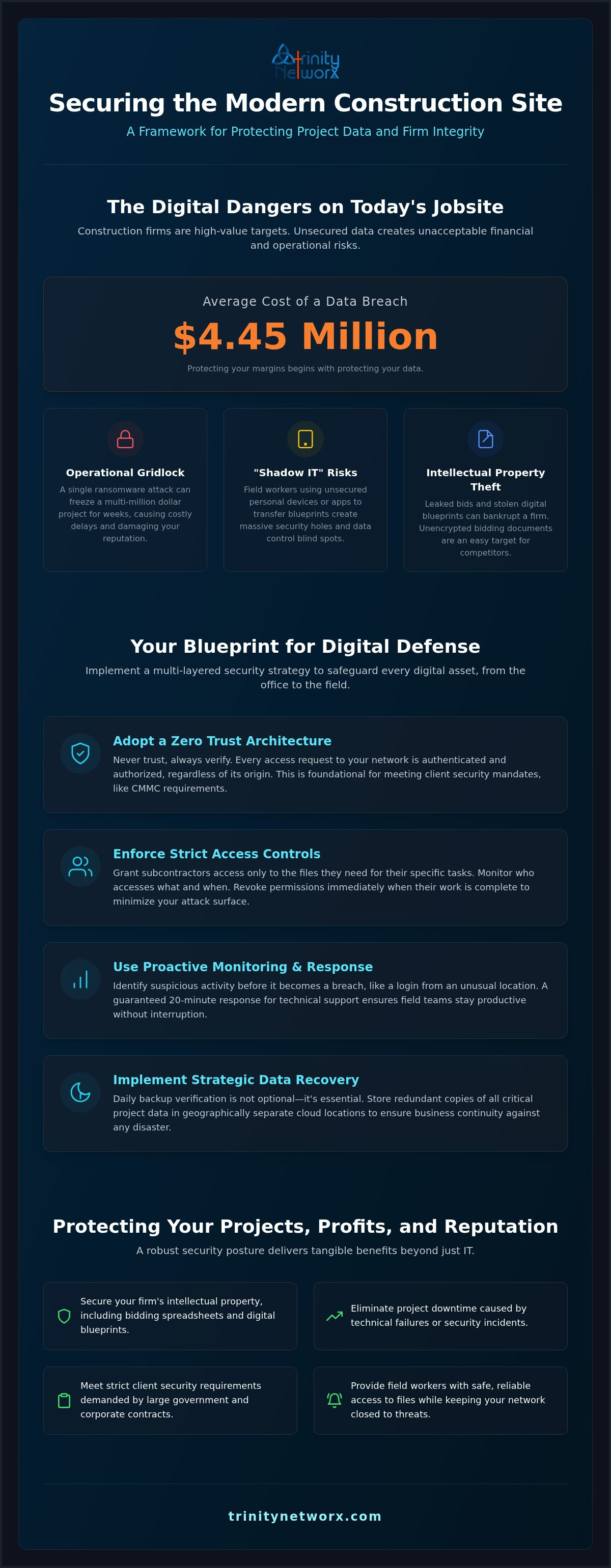
A single ransomware attack on a multi-million dollar project can freeze operations for weeks. It usually starts with a field worker accessing blueprints on an unsecured personal phone. You know the frustration of chasing down project files while wondering if your bidding data is actually safe. Many owners feel the weight of this uncertainty. If you need support managing the stress of business leadership, read more about professional therapy options. Adopting cloud data security best practices for small business is the only way to protect your firm from becoming another statistic in a year where data breaches averaged over 4.45 million dollars.
You need a clear plan to secure your digital assets without slowing down the build. We'll provide the exact protocols to protect your project data and ensure your office and field teams stay connected. You will learn how to manage subcontractor access easily and meet every client security requirement for those massive government contracts, especially as CMMC Phase 1 self-assessments remain mandatory. This article breaks down the shift toward zero trust architecture and proactive monitoring for the modern construction site.
• Secure your firm's intellectual property by protecting bidding spreadsheets and digital blueprints during every field transmission.
• Implementing cloud data security best practices for small business allows field workers to access files safely while keeping your network closed to ransomware.
• Control subcontractor risk through strict user permissions that limit data access to specific project tasks.
• Eliminate project downtime with daily backup verification and redundant storage in separate geographic cloud environments.
• Meet strict client security requirements for large government contracts by adopting proactive monitoring and zero trust protocols.
Construction firms often treat digital blueprints like simple PDFs. They aren't. These files represent years of specialized engineering and proprietary bidding logic. In 2026, malicious actors target project management software because it holds the keys to multi-million dollar builds. Securing this data requires more than a password. It demands a strategy built on cloud data security best practices for small business that accounts for the harsh reality of the jobsite. Proactive monitoring identifies when a user in another state tries to download your bidding spreadsheets at 2 AM. This isn't just IT support; it's asset protection.
Field teams move fast. If your official systems are slow, they will use personal Dropbox accounts or unencrypted messaging apps to send project updates. This "Shadow IT" creates massive holes in your security perimeter. You lose control of where your intellectual property lives. Centralizing all project data through secure cloud solutions eliminates these blind spots. It ensures every photo and CAD file stays within your protected environment. You can't protect what you can't see.
A leaked bid can bankrupt a firm before the first shovel hits the dirt. Competitors look for any edge, and unencrypted bidding documents are an easy target. You must apply Cloud computing security principles to every byte of financial data. This means encrypting files while they sit on your server and while they travel to a foreman's tablet. If a device is stolen, the data remains useless to the thief. Protecting your margins starts with protecting your data. Secure your competitive advantage today by contacting the team at contact us.
Connectivity between the office and the field is the lifeblood of modern construction. It's also your biggest vulnerability. Every field tablet and personal smartphone used to check a BIM model represents a potential door into your corporate network. Implementing cloud data security best practices for small business starts with enforcing multi-factor authentication (MFA) across every single device. Don't let a stolen password compromise a multi-million dollar build. You must also secure temporary jobsite trailers. Managed firewalls are required to protect Wi-Fi networks from local intruders who target unencrypted construction traffic.
Subcontractors need access to project files, but they don't need the keys to your entire kingdom. Use a single sign-on approach to manage credentials across various construction software platforms. This allows your team to monitor who is accessing specific blueprints and when. When a subcontractor finishes their portion of the project, revoke their access immediately. This reduces your attack surface and keeps your proprietary bidding data clean. Precision in access management is just as important as precision in your foundation work.
Technical failures in the field halt production. If a field worker can't sync blueprints or access the cloud, the crew stands idle. This is why you need an IT partner that guarantees a 20-minute response time. We focus on proactive maintenance to stop these errors before they occur. Aligning your operations with SBA cybersecurity best practices helps you stay ahead of federal requirements and client expectations.
Human error remains a top cause of data breaches. Regular security awareness training ensures your field staff can spot phishing attempts before clicking a malicious link. Don't leave your jobsite security to chance. If you are ready to tighten your field operations and protect your margins, speak with our construction IT experts today.
Backup verification isn't a task for next week. It's a daily requirement. If your firm isn't verifying backups every 24 hours, you don't have a recovery plan. You have a gamble. We implement cloud data security best practices for small business by storing redundant copies of your critical project data in geographically separate cloud environments. This ensures that a regional disaster or a direct attack on one data center won't wipe out your digital blueprints. We use rapid virtualization to spin up virtual project servers in under 40 minutes. This speed keeps your project on schedule even when your primary hardware fails. Stop relying on luck and start relying on a verified recovery timeline.
A ransomware attack can lock your team out of project files for days. Without a solid plan, the build stops. Your margins disappear. You need detailed network documentation to speed up recovery efforts during a crisis. Aligning your firm with FTC cybersecurity guidelines provides a necessary layer of protection for your operational data. For a deeper look at protecting your firm, review our guide to business data backup. It's designed for executives who need results, not technical jargon.
Managing cloud security in-house often leads to alert fatigue. When your internal staff is overwhelmed, they miss the small vulnerabilities that lead to big breaches. Our Southern California NOC provides 24/7 proactive monitoring. We identify suspicious patterns before they turn into downtime. Having local, US-based support ensures your field teams have help when they need it most. We don't just react to problems; we prevent them. Secure your construction environment and protect your bidding integrity. Contact the experts at Trinity Networx today to build a more resilient digital foundation.
Construction firms cannot afford to treat data security as a secondary concern. Your digital blueprints and bidding data represent the core intellectual property of your firm. Securing these assets requires a commitment to cloud data security best practices for small business that goes beyond basic antivirus software. We've detailed the necessity of multi-factor authentication for mobile field teams and the critical nature of 40-minute server virtualization for business continuity. These protocols ensure your projects stay on schedule and your proprietary data stays private.
Trinity Networx acts as a strategic driver of progress for Southern California firms. We are proud to be recognized among CIO Review's 20 Most Promising IT Services Companies. Our 100% US-based local technicians understand the specific technical demands of a modern jobsite. We back our service with a 20-minute response time guarantee because we know that idle crews mean lost revenue. Don't wait for a ransomware attack to reveal the gaps in your network. Secure your construction technology today with Trinity Networx and keep your momentum building.
Yes, the cloud is safe when you use enterprise-grade encryption and strict access controls. Major cloud providers invest billions in physical security that most individual firms can't match on their own. The real safety depends on how your firm configures its specific environment. Applying cloud data security best practices for small business ensures your blueprints remain encrypted while they sit on the server and while they travel to a foreman's tablet.
Implement the principle of least privilege through granular user permissions. Subcontractors should only have access to the specific files and folders required for their current phase of the build. Use single sign-on (SSO) tools to track every document download and view in real time. You must revoke all credentials the moment their portion of the contract ends to prevent any unauthorized data exports after they leave the jobsite.
Your data remains secure in the cloud, but your team needs offline sync capabilities to maintain productivity. Most modern construction software allows field workers to view and edit files without an active connection. Once the jobsite Wi-Fi or cellular signal returns, the system automatically syncs those changes back to the central project server. This ensures that field-to-office communication stays accurate despite local connectivity issues.

Article by
Lance Reichenberger, Ph.D.., J.D. (Candidate)
Dr. Lance Reichenberger is the founder of Trinity Networx, a Southern California technology firm specializing in managed IT services, cybersecurity, network infrastructure, and business technology strategy. With nearly four decades of experience in the IT industry, he works with businesses to improve operational efficiency, strengthen security, and align technology with long-term growth objectives.
Lance focuses on proactive IT management, enterprise wireless infrastructure, cybersecurity integration, and scalable technology solutions for growing organizations throughout Southern California.
The content published on this website is provided for general informational and educational purposes only. Articles may be created, edited, or enhanced with the assistance of artificial intelligence and automation tools under the direction and review of Trinity Networx. While every effort is made to ensure accuracy and relevance, the information provided should not be considered professional, legal, financial, cybersecurity, or technical advice specific to your organization. Businesses should consult directly with a qualified professional regarding their unique environment, compliance requirements, and operational needs. Trinity Networx makes no warranties regarding completeness, reliability, or applicability of the information contained within these articles.
Schedule a brief conversation with Trinity Networx to discuss your business technology needs.
Get a practical roadmap built around your business, your users, your systems, and the technology issues that need attention first.
Put the right technology, support, security, and infrastructure in place so your business can grow, adapt, and move forward with confidence.