3281 E. Guasti Rd, STE 700, Ontario, CA 91761
1712 9th Ave SW, Watertown, SD 57201

Your field crew is standing around a tablet waiting for a blueprint to load while your overhead costs tick upward by the second. It's a common nightmare caused by outdated servers sitting in a dusty office closet. You know that relying on on-premise hardware is dragging down your project momentum. The reality is that cloud migration for legacy business applications isn't just a tech upgrade; it's a survival strategy for the modern job site. You're tired of the data silos and the constant fear that a single ransomware attack could lock your entire operation. We agree that your technology should work as hard as your foremen do.
Moving your critical construction software to a hosted environment doesn't have to mean a week of downtime or lost data. You'll discover exactly how to move your outdated construction software to the cloud without losing project momentum or risking your historical records. This guide breaks down the process of securing your data and stabilizing your IT spend. We'll show you how to bridge the gap between the office and the field to ensure your team has instant access to project data from any job site. Momentum matters.
• Identify the specific software causing field delays and calculate the real financial drain of maintaining on-premise hardware in Ontario.
• Choose the right path for cloud migration for legacy business applications by weighing the speed of rehosting against the performance gains of refactoring.
• Build a secure private or Azure environment that eliminates data silos and protects your firm from ransomware threats.
• Follow a five step execution plan to move your critical data while maintaining project momentum on the job site.
• Shift to a predictable IT cost model that supports your business growth instead of acting as a technical bottleneck.
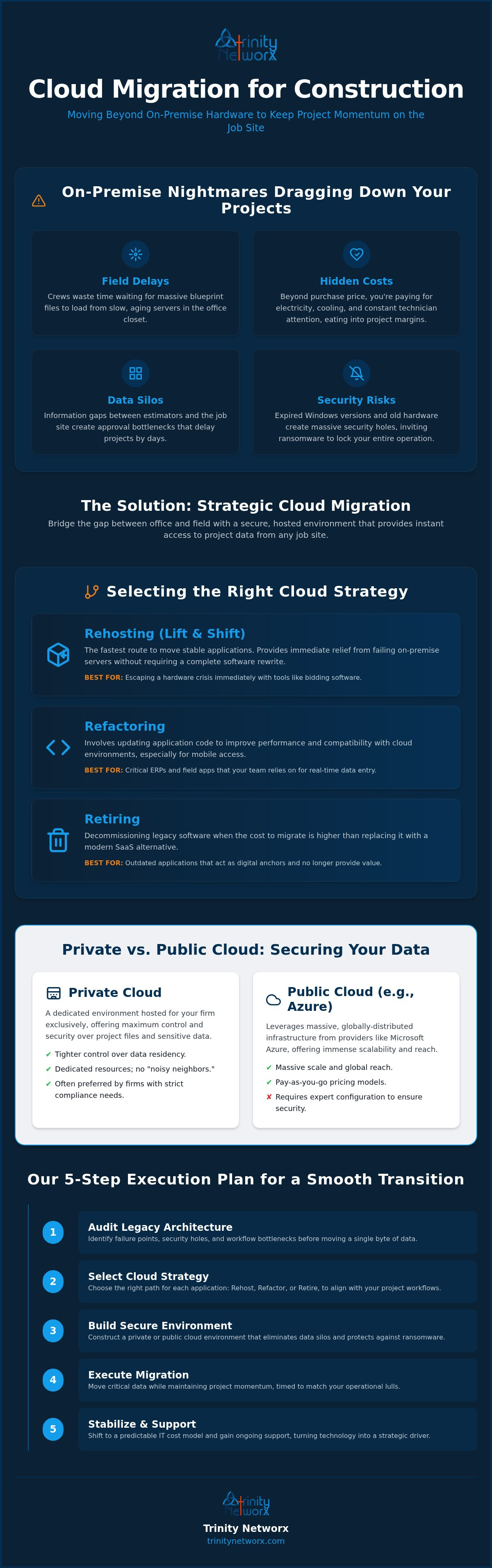
Moving a broken process to a new environment only results in a more expensive broken process. Before you initiate cloud migration for legacy business applications, you must identify which parts of your current system are already failing your team. Many construction firms in Southern California struggle with software that freezes the moment a field superintendent tries to sync a 200MB blueprint file. This isn't just a minor glitch. It is a symptom of aging architecture that cannot handle the demands of modern cloud computing environments. If your bidding tools are running on expired Windows versions, you are not just dealing with slow performance. You are operating with a massive security hole that invites ransomware.
Calculate the true cost of maintaining on-premise hardware in Ontario, CA. Beyond the initial purchase, you are paying for electricity, cooling, and the constant attention of a technician just to keep the lights on. These hidden expenses eat into your project margins every month. Data silos between your estimators and the job site office create approval bottlenecks that can delay a project by days. Mapping these gaps reveals exactly where your money is leaking. We focus on software and workflows to ensure your digital foundation is ready for the transition.
Check your database for lag. If real-time updates from the field take minutes instead of seconds, your database structure is likely the bottleneck. Old hardware often lacks the processing power to support modern security patches, leaving your project data exposed. We look for these specific failure points to ensure your migration fixes the problem rather than just moving it. Stability is the priority.
Instant data access isn't a luxury. It directly improves project profit margins by reducing downtime. Compare the unpredictable costs of emergency hardware repairs against a predictable, flat-fee cloud model. Moving away from the cycle of hardware refreshes allows you to treat IT as a strategic driver of progress rather than a recurring headache. You gain stability. You gain security. Momentum stays on the job site where it belongs.
Picking the wrong method for cloud migration for legacy business applications can stall a project faster than a supply chain delay. You need a strategy that respects your tight deadlines and high stakes. Not every piece of software deserves the same treatment. We categorize your tools into three distinct paths to ensure you aren't overspending on code that belongs in the past. Stability is the focus. We aim for a transition that keeps your estimators and project managers working without interruption.
This is the fastest route for moving stable bidding tools to Azure. It provides immediate relief from failing office servers without requiring a total software rewrite.
This involves updating your ERP code to improve performance on mobile tablets. It is the right choice for apps that your field teams rely on for real-time data entry.
Some software simply isn't worth the effort. If an application costs more to move than it does to replace with a modern SaaS alternative, it's time to retire it. Don't waste capital on digital anchors.
Aligning these choices with Southern California project schedules is critical. You don't want to migrate a core database in the middle of a massive bid. We time the move to match your operational lulls. This proactive approach prevents technical debt from piling up. If you are unsure which path fits your current project load, let's discuss your roadmap.
Rehosting works best when you need to escape a hardware crisis immediately. If your server is on its last legs, we move the application as-is to stabilize your operations. Refactoring is the choice for firms prioritizing field connectivity. It ensures your legacy database can handle the bursty nature of job site syncing. Balancing these choices requires specialized project planning to avoid work stoppages during peak seasons.
Local construction firms often prefer private cloud hosting for its tighter control over data residency. It offers a dedicated environment where your project files aren't competing for resources. Public cloud options like Azure provide massive reach but require expert configuration to stay secure. For a deeper look at infrastructure, read our cloud computing services for business guide. We help you choose the environment that protects your margins.
Execution is the stage where most IT projects fail. You cannot afford a "wait and see" approach when project deadlines are looming. A successful cloud migration for legacy business applications requires a methodical, five step approach that prioritizes operational continuity. We don't just move files; we move your entire workflow into a more stable environment. Our team handles the heavy lifting so your estimators and project managers can stay focused on the build.
Provision a secure Azure or private cloud environment tailored to your specific software requirements.
Initiate a pilot project. Moving a single active job site first allows us to identify potential friction points without risking your entire database.
Train field supervisors on new remote access protocols. They need to know how to reach their data securely from any device without compromising safety.
Perform the full database migration during off-peak hours. This timing ensures your team starts the next workday with a fully functional system and zero downtime.
Implement proactive monitoring. We catch and resolve lag before your users even notice a delay, keeping project momentum high.
Theory means nothing without field results. We run rigorous speed tests from active job sites across the Inland Empire to ensure your team can pull up heavy CAD files and blueprints without the spinning wheel of death. It's vital that your cloud azure and ai services are configured specifically for low latency in areas with spotty cellular coverage. We verify every connection point before declaring the migration a success. Performance is our benchmark.
Moving to the cloud is the perfect time to harden your defenses. We verify that your new environment aligns with CMMC compliance standards; this is essential if you handle defense contracts in Southern California. Our team sets up multi-layered security protocols to protect your proprietary blueprints from ransomware. You get a faster system and a safer one. If you are ready to eliminate the technical debt holding your firm back, reach out to our team at contact us to start your migration plan today.
Your firm can't afford to be anchored by hardware that belongs in the previous decade. We've shown that successful cloud migration for legacy business applications starts with a rigorous audit of your current failure points and ends with a methodical execution plan. Moving to the cloud is about more than just storage. It's about ensuring your field teams have the data they need to keep projects on schedule. You need a partner who understands the unique pressure of a Southern California job site. Stability is the only option when your margins are on the line.
We provide local Southern California support and a 20-minute response guarantee to keep your operations moving. Our flat-fee predictable pricing ensures that your IT costs never surprise your accounting team. You deserve a system that acts as a strategic driver of progress rather than a technical bottleneck. Stop fighting your servers and start focusing on your build. We are here to ensure your digital foundation supports your growth.
Secure your project data and eliminate field lag: Contact Trinity Networx today. Your digital foundation is ready for an upgrade.
A full transition typically takes between 30 and 90 days from the initial audit to the final handoff. This timeline depends on the complexity of your data and the number of active job sites. We prioritize a phased approach to ensure project momentum never stops. Pilot testing happens early to verify connectivity before we move your entire database during off-peak hours.
Field lag is eliminated through specialized configuration and localized network routing. We don't just dump files into a generic folder. Our team tunes the environment to handle the massive file sizes common in construction. Superintendents get instant access to blueprints even from remote sites. We monitor the connection constantly to resolve any speed issues before your crew notices a delay.
You can absolutely move legacy bidding software even if the original developer has disappeared. We use virtualization to host these applications in a secure cloud container. This process is a core part of cloud migration for legacy business applications. It allows you to keep your critical tools running without the risk of maintaining 10-year-old physical servers in a dusty office.
Migration improves your CMMC status by replacing vulnerable local servers with encrypted, compliant cloud architecture. We configure the environment to meet the strict data handling rules required for defense contracts. This transition makes auditing easier and ensures your project data is protected against ransomware. It is a proactive step toward securing your firm's eligibility for high-value government work.

Article by
Lance Reichenberger, Ph.D.., J.D. (Candidate)
Dr. Lance Reichenberger is the founder of Trinity Networx, a Southern California technology firm specializing in managed IT services, cybersecurity, network infrastructure, and business technology strategy. With nearly four decades of experience in the IT industry, he works with businesses to improve operational efficiency, strengthen security, and align technology with long-term growth objectives.
Lance focuses on proactive IT management, enterprise wireless infrastructure, cybersecurity integration, and scalable technology solutions for growing organizations throughout Southern California.
The content published on this website is provided for general informational and educational purposes only. Articles may be created, edited, or enhanced with the assistance of artificial intelligence and automation tools under the direction and review of Trinity Networx. While every effort is made to ensure accuracy and relevance, the information provided should not be considered professional, legal, financial, cybersecurity, or technical advice specific to your organization. Businesses should consult directly with a qualified professional regarding their unique environment, compliance requirements, and operational needs. Trinity Networx makes no warranties regarding completeness, reliability, or applicability of the information contained within these articles.
Schedule a brief conversation with Trinity Networx to discuss your business technology needs.
Get a practical roadmap built around your business, your users, your systems, and the technology issues that need attention first.
Put the right technology, support, security, and infrastructure in place so your business can grow, adapt, and move forward with confidence.