3281 E. Guasti Rd, STE 700, Ontario, CA 91761
1712 9th Ave SW, Watertown, SD 57201
The July 2026 suspension of CMMC Phase II requirements isn't a signal to stall your security investments. It's a strategic pivot. While the Department of War conducts its 60 day review, the new Acquisition Transformation System (ATS) is already moving the goalposts for speed and capability. You've likely noticed that CMMC compliance costs for SoCal manufacturers and construction firms haven't vanished. They've just shifted toward foundational self assessments and the necessity of securing the hardware that connects your remote field offices to the home base.
You're probably tired of the regulatory whiplash and the rising price of specialized technical hardware. We understand that uncertainty is the enemy of a profitable 2026 budget. This guide will help you master the financial realities of the latest directives so you can win more defense construction contracts. We provide valid cost estimates for Level 1 assessments, a technical blueprint for your field site hardware, and a clear strategy to manage the ATS landscape with confidence.
• Learn how the Department of War shift to the Acquisition Transformation System (ATS) impacts your 2026 budgeting and contract eligibility.
• Calculate CMMC compliance costs for SoCal manufacturers by focusing on the $4,000 to $6,000 required for foundational Level 1 self assessments.
• Identify the technical hardware necessary to protect Controlled Unclassified Information at remote field offices and job sites.
• Secure a competitive advantage for ATS contracts by deploying automated status monitoring to prove your security posture instantly.
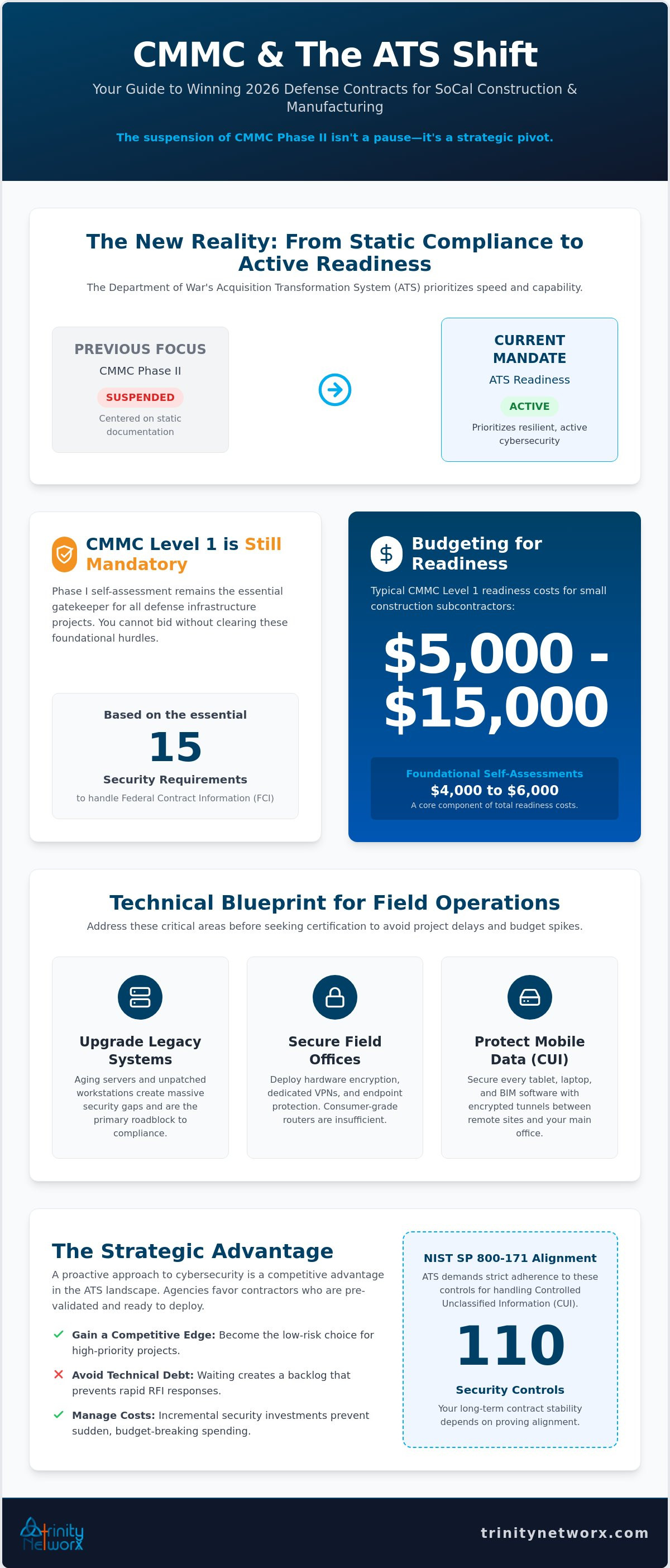
On July 13, 2026, the Department of War suspended Phase II requirements. This move redefined the entire defense landscape. The Acquisition Transformation System (ATS) now dictates the pace of procurement. It prioritizes resilient, active cybersecurity over static documentation that traditionally sat in binders. For Southern California defense infrastructure projects, Phase I self assessment remains the mandatory gatekeeper. You cannot bid on upcoming projects without clearing these foundational hurdles. Retool now. Secure your bids. Win the contract.
Calculating CMMC compliance costs for SoCal manufacturers and construction firms requires looking beyond the pause. Level 1 readiness costs typically range from $5,000 to $15,000 for small construction subcontractors. This investment covers the essential 15 security requirements needed to handle Federal Contract Information. Understanding the Cybersecurity Maturity Model Certification (CMMC) framework helps you see these expenses as a strategic asset rather than a burden. It is the cost of entry for the most lucrative contracts in the region.
Your standing against the basic 15 security requirements determines your eligibility for every federal project. ATS speed to capability mandates favor contractors who maintain pre validated security stacks. These agencies need partners who can deploy immediately without waiting for a security audit. If your internal systems are already verified, you become the low risk choice for high priority projects. Failing to meet these baseline standards effectively removes you from the 2026 bidding pool.
Waiting for Phase II to be reinstated creates significant technical debt. This backlog prevents your team from responding to RFIs with the speed required by modern defense agencies. A proactive approach to managed cybersecurity services acts as a competitive advantage. It ensures your field office connectivity and mobile devices are hardened against current threats. CMMC compliance costs for SoCal manufacturers are manageable when addressed incrementally. Sudden, reactive spending is what breaks the budget. Contact our team at contact us to start your assessment today.
Legacy systems are the primary roadblock for Southern California builders. Aging servers and unpatched workstations create massive security gaps. Upgrading this technical foundation is a necessary step before any certification process begins. CMMC compliance costs for SoCal manufacturers often spike because firms ignore these technical prerequisites until the last minute. Proactive investment in modern infrastructure prevents project delays. It ensures your data remains protected. It keeps your business moving.
Mapping the flow of Controlled Unclassified Information (CUI) is critical for field operations. Mobile devices and Building Information Modeling (BIM) software are standard on modern job sites. These tools must be secured. Every tablet and laptop used in the field represents a potential entry point for unauthorized access. We deploy specialized IT hardware to support encrypted tunnels between your main office and remote sites. This setup creates a secure environment for sensitive project data regardless of physical location.
Temporary trailers lack the physical security of a permanent headquarters. You must audit your low voltage cabling and wireless networking infrastructure for physical tampering vulnerabilities. Standard consumer routers won't cut it. You need hardware encryption. You need dedicated VPNs. Budgeting for endpoint protection on every job site device is a non negotiable part of your 2026 financial planning. Secure the perimeter first.
ATS resilient measures demand strict adherence to the 110 security controls of NIST SP 800-171. These controls govern how CUI is handled, stored, and transmitted. Long term contract stability depends on your ability to prove this alignment during an audit. Specialized CMMC compliance consultants are necessary to interpret these requirements for the construction sector. They help you bridge the gap between technical jargon and operational reality. If you have questions about your current setup, speak with a construction IT expert to identify your specific hardware needs.
ATS procurement cycles move fast. You need a leadership model that keeps pace. Executing Virtual CIO services aligns your technical spend perfectly with specific defense contract requirements. This isn't just about security. It's about business health. We focus on reducing the friction of bureaucratic compliance through automated status monitoring. This provides real time proof of your security posture without the administrative headache.
Stabilizing CMMC compliance costs for SoCal manufacturers requires a predictable financial approach. We recommend a flat fee security model. This protects your budget from the spikes typically associated with rapid ATS procurement shifts. You get consistent protection and expert guidance without surprise invoices. It allows your team to focus on building while we handle the technical gatekeeping.
Our local, in house technical teams maintain 24/7/365 readiness for San Diego bids. We don't outsource. Every technician is a local SoCal professional who understands the specific needs of the San Diego to Los Angeles defense corridor. We even offer a 20 minute response guarantee for critical field issues. This level of availability is essential when your contract depends on continuous operational continuity.
Use virtual CIO services to bridge the gap between technical security and executive strategy. Your technical roadmap must survive shifting Department of War policies. A vCIO acts as your strategic partner. They translate complex mandates into actionable business plans. This guarantees your technology drives progress instead of creating a bottleneck.
A 100 percent US based help desk is critical for handling sensitive defense data. We keep your information local. Our team provides the assertive reliability you need to secure your Southern California defense construction contracts. Don't leave your compliance to a distant, faceless vendor. CMMC compliance costs for SoCal manufacturers are an investment in your firm's future. Contact the Trinity Networx team for a specialized construction security assessment today.
The suspension of Phase II isn't a pause. It's an opportunity. You have the lead time to harden field infrastructure and align your technical roadmap with new ATS mandates. Managing CMMC compliance costs for SoCal manufacturers requires a shift from reactive repairs to proactive technical leadership. Don't let legacy hardware or unverified security stacks disqualify your firm from the 2026 bidding cycle. We eliminate the friction of defense contracting through specialized construction technical expertise.
Trinity Networx brings over 30 years of collective IT expertise to your job site. Recognized by CIO Review as one of the 20 Most Promising IT Services Companies, we operate an entirely in house NOC based right here in Southern California. We provide the assertive reliability needed to protect your data and your profit margins. It's time to stop worrying about shifting policies and start winning more contracts.
Secure your next defense contract with a specialized CMMC assessment
Your firm is built to last. Your technology should be too.
The July 13, 2026, suspension halts mandatory third party assessments for Level 2 while a 60 day review occurs. It doesn't remove the need for security. Phase I self assessments remain in effect for all active bids. Your contracts still require adherence to NIST 800-171 standards to handle sensitive data. Delaying your security upgrades now will only increase the total CMMC compliance costs for SoCal manufacturers when the review period ends.
Job site trailers must implement strict physical and technical access controls. You must secure all low voltage cabling and use hardware encryption for devices handling Controlled Unclassified Information. Wireless networks in these temporary environments require proper segmentation to prevent unauthorized access. Physical tampering protections for servers and routers are mandatory. These measures ensure that your field office is just as secure as your main headquarters during active projects.
While a self assessment is technically possible, it carries significant risk for firms without internal technical expertise. The 15 basic requirements are the minimum baseline for contract eligibility. Incorrectly validating your own security controls can lead to contract loss or legal penalties. Many firms realize that the long term CMMC compliance costs for SoCal manufacturers are reduced by partnering with experts who ensure the assessment is done right the first time.
The Acquisition Transformation System is a Department of War strategy aimed at speeding up procurement and capability delivery. It prioritizes active security over old school paperwork. This drives costs by demanding sophisticated monitoring hardware and rapid technical response capabilities. You must move away from reactive IT. Modern ATS contracts favor partners who can prove their security posture is resilient and ready to deploy at a moment's notice.
For specialized construction technical expertise and a clear path to compliance, contact the team at Trinity Networx, LLC today.

Article by
Lance Reichenberger, Ph.D.., J.D. (Candidate)
Dr. Lance Reichenberger is the founder of Trinity Networx, a Southern California technology firm specializing in managed IT services, cybersecurity, network infrastructure, and business technology strategy. With nearly four decades of experience in the IT industry, he works with businesses to improve operational efficiency, strengthen security, and align technology with long-term growth objectives.
Lance focuses on proactive IT management, enterprise wireless infrastructure, cybersecurity integration, and scalable technology solutions for growing organizations throughout Southern California.
The content published on this website is provided for general informational and educational purposes only. Articles may be created, edited, or enhanced with the assistance of artificial intelligence and automation tools under the direction and review of Trinity Networx. While every effort is made to ensure accuracy and relevance, the information provided should not be considered professional, legal, financial, cybersecurity, or technical advice specific to your organization. Businesses should consult directly with a qualified professional regarding their unique environment, compliance requirements, and operational needs. Trinity Networx makes no warranties regarding completeness, reliability, or applicability of the information contained within these articles.
Schedule a brief conversation with Trinity Networx to discuss your business technology needs.
Get a practical roadmap built around your business, your users, your systems, and the technology issues that need attention first.
Put the right technology, support, security, and infrastructure in place so your business can grow, adapt, and move forward with confidence.