3281 E. Guasti Rd, STE 700, Ontario, CA 91761
1712 9th Ave SW, Watertown, SD 57201

Lance Reichenberger, Ph.D.
Contact our team at contact us to secure your compliance roadmap. Share this guide: [LinkedIn] [X] [Facebook]
Only 8% of defense contractors requiring Level 2 certification have successfully secured it as of February 2026. This is a crisis of readiness. The Department of Defense is moving from policy to hard enforcement. You feel the November 10, 2026, Phase 2 deadline closing in. It's a binary reality. You're either compliant or you're out of the supply chain. Having CMMC levels explained in plain language is the first step toward securing your business future. We'll cut through the noise.
You're likely tired of the confusion between Federal Contract Information and Controlled Unclassified Information. The fear of losing a contract due to a failed audit is real and justified. I'll help you master the three tiers of compliance so you can stay focused on growth. This guide provides a roadmap for SPRS affirmations and gives you the confidence to choose the right partner. We're moving past the status quo to ensure your business remains a strategic driver in the defense sector.
Lance Reichenberger, Ph.D.
Contact our team at contact us to verify your compliance status. Share this guide: [LinkedIn] [X] [Facebook]
• Stop guessing about your eligibility; Phase 1 is already live and Phase 2 mandates third-party assessments by November 2026.
• Get the CMMC levels explained by focusing on the data you handle; Level 1 covers basic FCI while Level 2 is required for CUI.
• Execute a gap analysis immediately to identify where your current IT setup fails the newest NIST 800-171 Revision 3 standards.
• Build an active System Security Plan; static documentation won't survive the scrutiny of a Certified Third-Party Assessment Organization.
• Secure your defense revenue by shifting to managed cybersecurity that provides the continuous monitoring and threat detection the DoD now demands.
Lance Reichenberger, Ph.D.
Contact our team at contact us to verify your compliance status. Share this guide: [LinkedIn] [X] [Facebook]
The Department of Defense has shifted the landscape for every contractor in the supply chain. The Cybersecurity Maturity Model Certification (CMMC) is no longer a distant policy goal; it's the mandatory gatekeeper for defense revenue. If you want to win or keep contracts, you must prove your security posture meets specific benchmarks. It's that simple. Getting the CMMC levels explained is about protecting your bottom line as much as your data. CMMC 2.0 replaced the older system with three distinct tiers of security maturity. If you fail to meet the required tier for your specific contract, you face immediate disqualification from the award process. There are no grace periods. The DoD is prioritizing national security over vendor convenience.
The clock is ticking on your current eligibility. Phase 1 began on November 10, 2025, and it runs until November 9, 2026. During this window, contractors must perform Level 1 or Level 2 self-assessments for certain new contracts. You can't just check a box and hope for the best. You must submit your affirmations to the Supplier Performance Risk System (SPRS). Phase 1 is the era of self-assessment accountability. Accuracy is vital. The Department of Justice is increasingly using the False Claims Act to target companies that misrepresent their cybersecurity status. If your score in SPRS doesn't match your actual internal controls, you're looking at significant legal and financial risk.
The DIB consists of 221,286 companies. Data shows that 74% of these are small businesses. This massive network is a primary target for foreign adversaries seeking to steal intellectual property. They don't just attack the massive primes. They target smaller subcontractors with weaker defenses to find a back door into sensitive programs. CMMC hardens the entire supply chain. It forces every link to hold its weight. If you're struggling to map your current IT setup to these new rules, CMMC compliance consultants at Trinity Networx, LLC can help you verify your infrastructure. Security isn't a utility; it's a strategic driver of your business health and a requirement for operational continuity in the defense sector.
Lance Reichenberger, Ph.D.
Contact our team at contact us to secure your compliance roadmap. Share this guide: [LinkedIn] [X] [Facebook]
CMMC 2.0 creates a clear hierarchy of security expectations. It's built on a "crawl, walk, run" philosophy. Each tier adds layers of complexity and oversight. Understanding these CMMC levels explained through the lens of data sensitivity is the only way to avoid wasted investment. You don't want to overspend on security you don't need. Conversely, underestimating your requirements leads to immediate contract loss. The model is cumulative. You cannot achieve Level 2 without first mastering the foundational hygiene of Level 1. This structure ensures that as the data becomes more sensitive, the defenses become more resilient and verifiable.
Level 1 is the baseline. It covers 15 basic security requirements found in FAR 52.204-21. If you handle Federal Contract Information (FCI), this is your floor. While the technical bar is lower than other tiers, the legal requirement for an annual self-assessment remains a serious commitment. You must submit your affirmation to the SPRS every single year. It's the minimum entry point for any DoD work. Don't treat it as a mere checklist. Even basic hygiene requires evidence. If you can't prove you're doing the work, you aren't compliant. It's that simple. Most small businesses start here, but many quickly realize they need to move up as they pursue more lucrative subcontracts.
Level 2 is where the pressure intensifies. It mirrors the 110 security requirements of NIST SP 800-171. If your contract involves Controlled Unclassified Information (CUI), you belong here. The big shift in 2026 is the move toward third-party verification. While some contracts allow self-assessments, many now require a Certified Third-Party Assessment Organization (C3PAO) to audit your environment. This is a rigorous process. You can review the CMMC level 2 requirements checklist to see how your current stack measures up. If you're unsure which tier applies to your upcoming bids, you can consult with our compliance team to clarify your path.
Level 3 is for the heavy hitters. This tier protects against Advanced Persistent Threats (APTs) in the most sensitive DoD programs. It builds on Level 2 by adding a subset of requirements from NIST SP 800-172. You won't deal with a C3PAO here. The government, specifically the Defense Industrial Base Cybersecurity Assessment Center (DIBCAC), conducts these audits directly. The costs are high. The scrutiny is absolute. Only a small fraction of the DIB will ever need to reach this level. However, for those who do, it represents the highest standard of cybersecurity maturity in the private sector.
Lance Reichenberger, Ph.D.
Contact our team at contact us to secure your compliance roadmap. Share this guide: [LinkedIn] [X] [Facebook]
Your company's headcount or annual revenue does not dictate your compliance tier. The data you touch does. This is the central truth of having CMMC levels explained. If your systems process Federal Contract Information (FCI), you belong at Level 1. If you handle Controlled Unclassified Information (CUI), you must meet Level 2. Misidentifying these data types is a fatal error. It leads to failed audits and immediate contract disqualification. You must audit your data flow before you audit your systems. Many contractors realize too late that they've been handling sensitive data on unprotected networks. This oversight can lead to heavy fines and a permanent loss of eligibility in the defense sector.
FCI is non-public information provided by or generated for the government under a contract. It is the baseline data of the defense industry. Think about emails discussing contract specifications. Delivery schedules. Project status reports that aren't for public release. Most machine shops start here. They assume their work is simple. Then they receive a specific part number or a non-sensitive project update. Level 1 exists to protect this basic data set. It ensures a minimum standard of cyber hygiene for everyone in the Defense Industrial Base. Even at this level, your documentation must prove you are following the 15 basic requirements. If you can't show the evidence, the government assumes the work isn't happening.
CUI is a different beast entirely. It requires specific safeguarding or dissemination controls because its loss would harm national security. This category includes technical drawings, export-controlled data under ITAR, and sensitive financial records. Handling even a single piece of CUI triggers an immediate move to CMMC Level 2. There is no middle ground. This data is the primary target for foreign cyber espionage. Protecting it requires the advanced controls found in NIST SP 800-171. This shift is why cybersecurity for defense contractors has become so specialized. You aren't just protecting a private network; you're protecting national secrets from persistent threats. You must know exactly where CUI resides on your servers. If it leaks into an unmanaged folder, your compliance is void. Failure to segregate this data often results in a massive increase in assessment costs and technical hurdles.
Lance Reichenberger, Ph.D.
Contact our team at contact us to secure your compliance roadmap. Share this guide: [LinkedIn] [X] [Facebook]
The transition from Level 1 to Level 2 is a massive technical leap. You're moving from 15 controls to 110. It's not just more work. It's a different kind of scrutiny. Having the CMMC levels explained won't save your contracts if you don't act on the data. You must start with a gap analysis. This isn't a casual checkup. It's a forensic look at your IT infrastructure to see where you fail NIST 800-171 standards. Most contractors discover that 38% of their foundational requirements, like incident response plans, are missing or untested. You can't fix what you haven't measured. Establish your baseline score and upload it to the Supplier Performance Risk System (SPRS) immediately. The DoD uses this database to judge your eligibility before they even look at your bid.
Your System Security Plan (SSP) is the heart of your compliance. It isn't a static folder on a shelf. It's a living document that proves your security posture to an auditor. If a control isn't in the SSP, it doesn't exist. For everything you haven't fixed yet, you need a Plan of Action and Milestones (POA&M). This is your tactical to-do list. It shows the DoD that you recognize your flaws and have a funded, scheduled plan to fix them. Level 2 contractors must have these documents ready for inspection at a moment's notice. Without them, you're effectively invisible to prime contractors looking for reliable partners. They won't risk their own standing on a subcontractor with messy paperwork.
A Certified Third-Party Assessment Organization (C3PAO) is the only entity that can grant you a Level 2 certificate. There's a looming bottleneck. By the third quarter of 2026, wait times for these assessments are expected to exceed 18 months. There are only about 92 authorized C3PAOs serving over 220,000 companies. Waiting until the last minute is a recipe for disaster. You'll find yourself at the back of a very long line while your competitors scoop up your contracts. You should review our guide on how to become CMMC compliant to understand the timeline. Don't let a lack of planning kill your business growth. If you're ready to stop guessing, schedule your gap analysis with our team today.
Lance Reichenberger, Ph.D.
Contact our team at contact us to secure your compliance roadmap. Share this guide: [LinkedIn] [X] [Facebook]
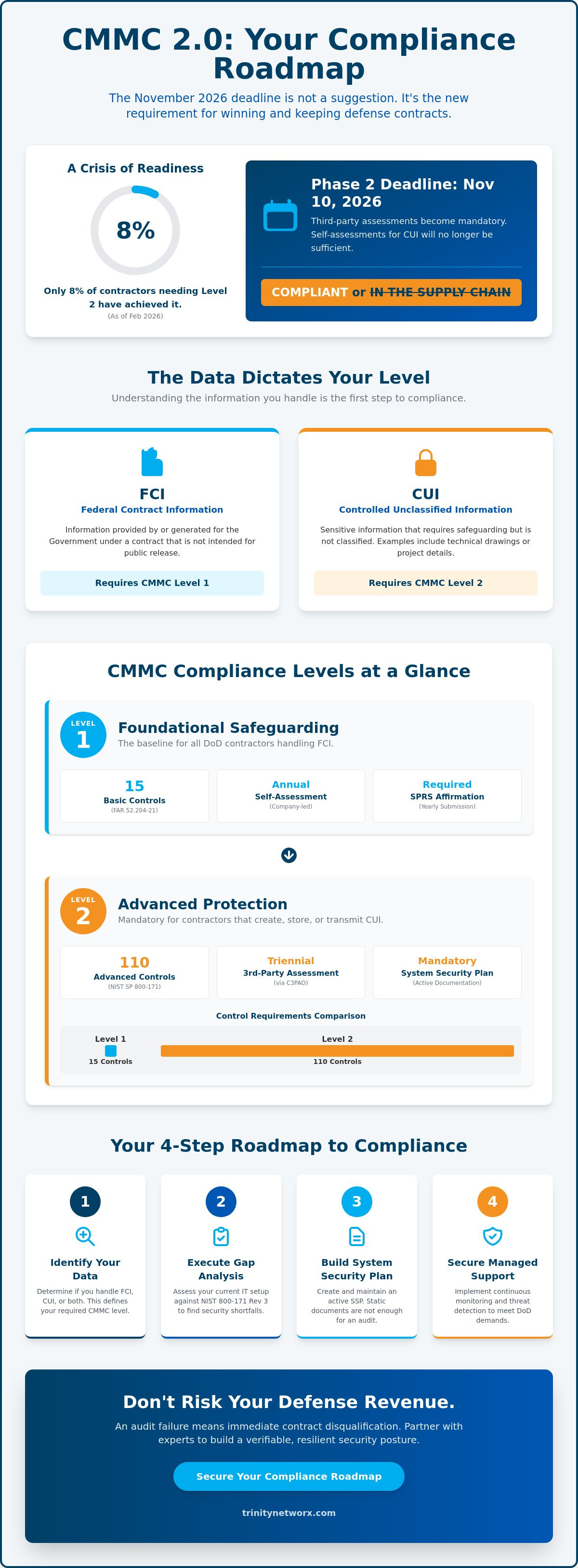
Compliance isn't a trophy you win once and put on a shelf. It's a persistent state of operational readiness. Once you've had the CMMC levels explained, the next step is maintaining that posture every single day. The Department of Defense doesn't just care about your initial certification. They care about your ability to detect and stop threats in real time. If your security lapses between audits, you're a liability. Managed IT services provide the continuous oversight required to stay within the lines of CMMC Level 2. We move your business away from reactive habits. You can't wait for a system failure to address a security gap. Proactive security keeps your network running while satisfying the most demanding auditors. It's about protecting your revenue as much as your data packets.
Reactive IT is a relic of a slower era. It waits for a breach to happen before it triggers a response. In the defense sector, that delay is a death sentence for your contracts. Proactive defense identifies vulnerabilities before an adversary can find them. Continuous monitoring is a core requirement for higher CMMC levels. You need logs. You need alerts. You need a team that sees a suspicious login attempt at 2:00 AM and kills the session immediately. This level of vigilance is why many firms move toward managed cybersecurity services. It replaces guesswork with evidence-based protection. We focus on business continuity so your team can stay focused on production schedules. If your IT guy only shows up when something breaks, you aren't compliant. You're just lucky; luck isn't a strategy the DoD accepts.
Trinity Networx, LLC understands the specific pressures facing manufacturers in the Inland Empire and aerospace firms in Orange County. We know the local landscape. You're part of a massive regional hub that's a prime target for foreign espionage. Our team specializes in managed IT services that prioritize response times under 20 minutes. When a technical glitch threatens your output, we're already on the phone. We act as a strategic driver of your business health. We don't just act as a distant vendor. You need a partner who can walk your production floor and map your technical controls to your physical reality. Don't let a bottleneck in auditor availability or a weak IT setup derail your 2026 growth. Contact us at the Trinity Networx, LLC Contact Page to start your CMMC readiness assessment. We'll help you secure your baseline and protect your future in the defense supply chain.
Lance Reichenberger, Ph.D.
Contact our team at contact us to secure your compliance roadmap. Share this guide: [LinkedIn] [X] [Facebook]
The 2026 enforcement window is a hard boundary. You can't bypass it with excuses. You need a verified, documented environment. Having CMMC levels explained is only the first step toward a secure supply chain. You must differentiate between your data types with absolute precision. If you handle sensitive information, the shift to third-party assessments means your window for action is closing. Auditor queues are growing. Don't wait until the supply chain leaves you behind. A failed audit isn't just a technical glitch. It's a business catastrophe.
Trinity Networx, LLC provides specialized support for Southern California aerospace and manufacturing firms. We understand the high stakes of NIST standards. Our team maintains response times under 20 minutes to keep your production line moving. We act as a strategic driver of your business health. Secure your defense contracts today; contact Lance Reichenberger, Ph.D. and the team at Trinity Networx, LLC for a CMMC readiness assessment. You have the talent to build for the DoD. We have the expertise to keep your networks compliant. Let's get to work.
Lance Reichenberger, Ph.D.
Contact our team at contact us to secure your compliance roadmap. Share this guide: [LinkedIn] [X] [Facebook]
Your specific requirement is dictated by the Department of Defense contract itself. Look for the DFARS 252.204-7021 clause in your solicitation or contract documents. If you handle Controlled Unclassified Information, you must achieve Level 2. If you only touch basic contract data, Level 1 is the standard. Having these CMMC levels explained in your RFP is the only way to bid with confidence.
You can only self-certify for Level 2 if the specific contract involves non-prioritized CUI. Starting November 10, 2026, the DoD will begin requiring C3PAO assessments for most contracts. Check your solicitation carefully. If you wait until the last minute to find an auditor, you'll face a massive backlog. Preparation must start months before the Phase 2 deadline.
Federal Contract Information (FCI) is non-public data provided by the government that isn't sensitive enough to harm national security. Controlled Unclassified Information (CUI) includes technical blueprints, ITAR data, and sensitive financial records. CUI mandates the 110 controls of NIST 800-171. Handling even one piece of CUI moves your compliance requirement from Level 1 to Level 2 immediately.
Yes, if you handle any Federal Contract Information. The DoD requires prime contractors to flow down these security requirements to every subcontractor in the chain. Even if you only manufacture a small component, you must meet Level 1 foundational hygiene. Failing to do so makes you a liability for the prime contractor. It blocks you from the award.
Most defense contractors spend between 6 and 18 months reaching full Level 2 readiness. The duration depends on the results of your initial gap analysis and how quickly you fix technical flaws. You must factor in the time needed to generate evidence and the current 18 month backlog for C3PAO auditors. Start your preparation now to meet the 2026 deadlines.
You lose the contract award immediately. There are no partial credits in a CMMC assessment. If you fail to meet even one control, you'll need to fix the issue and pay for a follow-up assessment. This delay often results in the DoD awarding the contract to a compliant competitor. They're ready to execute. You aren't.
Yes, compliance is mandatory regardless of your contract volume. If the contract contains the CMMC requirement clause, you must be certified to receive the award. The government doesn't grant waivers based on the size of the deal. One contract is enough to require a full audit of your handling of sensitive defense data.
Level 1 requires an annual self-affirmation submitted to the SPRS database. Level 2 and Level 3 certifications are valid for three years. However, you must still provide an annual affirmation from a senior company official stating that you've maintained the required security controls. Compliance is a continuous process; it isn't a one-time event for your IT team.

Article by
Lance Reichenberger, Ph.D.., J.D. (Candidate)
Dr. Lance Reichenberger is the founder of Trinity Networx, a Southern California technology firm specializing in managed IT services, cybersecurity, network infrastructure, and business technology strategy. With nearly four decades of experience in the IT industry, he works with businesses to improve operational efficiency, strengthen security, and align technology with long-term growth objectives.
Lance focuses on proactive IT management, enterprise wireless infrastructure, cybersecurity integration, and scalable technology solutions for growing organizations throughout Southern California.
The content published on this website is provided for general informational and educational purposes only. Articles may be created, edited, or enhanced with the assistance of artificial intelligence and automation tools under the direction and review of Trinity Networx. While every effort is made to ensure accuracy and relevance, the information provided should not be considered professional, legal, financial, cybersecurity, or technical advice specific to your organization. Businesses should consult directly with a qualified professional regarding their unique environment, compliance requirements, and operational needs. Trinity Networx makes no warranties regarding completeness, reliability, or applicability of the information contained within these articles.
Schedule a brief conversation with Trinity Networx to discuss your business technology needs.
Get a practical roadmap built around your business, your users, your systems, and the technology issues that need attention first.
Put the right technology, support, security, and infrastructure in place so your business can grow, adapt, and move forward with confidence.