3281 E. Guasti Rd, STE 700, Ontario, CA 91761
1712 9th Ave SW, Watertown, SD 57201

Your main office network might be locked down, but an unmanaged laptop inside a jobsite trailer can disqualify your team from the next military bid. You already know it's tough winning prime awards across Camp Pendleton, Naval Base San Diego, or Edwards Air Force Base under strict federal scrutiny. Completing a CMMC readiness assessment for defense contractors in SoCal is the clearest path to protect your project pipeline before auditors inspect your systems.
Discover how defense construction contractors in Southern California achieve CMMC certification and safeguard Department of Defense contract eligibility. We break down the exact steps to isolate Controlled Unclassified Information across field trailers and prepare your technical infrastructure to pass a formal C3PAO evaluation on the first attempt.
• NAVFAC Southwest and USACE contract awards require verified protection for building plans, electrical designs, and facility schematics before bid finalization.
• A targeted CMMC readiness assessment for defense contractors in SoCal pinpoints hidden security gaps across project trailers, mobile field devices, and estimating workstations.
• Benchmarking jobsite technology against all 110 NIST SP 800-171 controls ensures your System Security Plan satisfies third-party C3PAO auditors.
• Partnering with a local, US-based engineering team provides hands-on hardware verification across regional military installations without foreign export exposure.
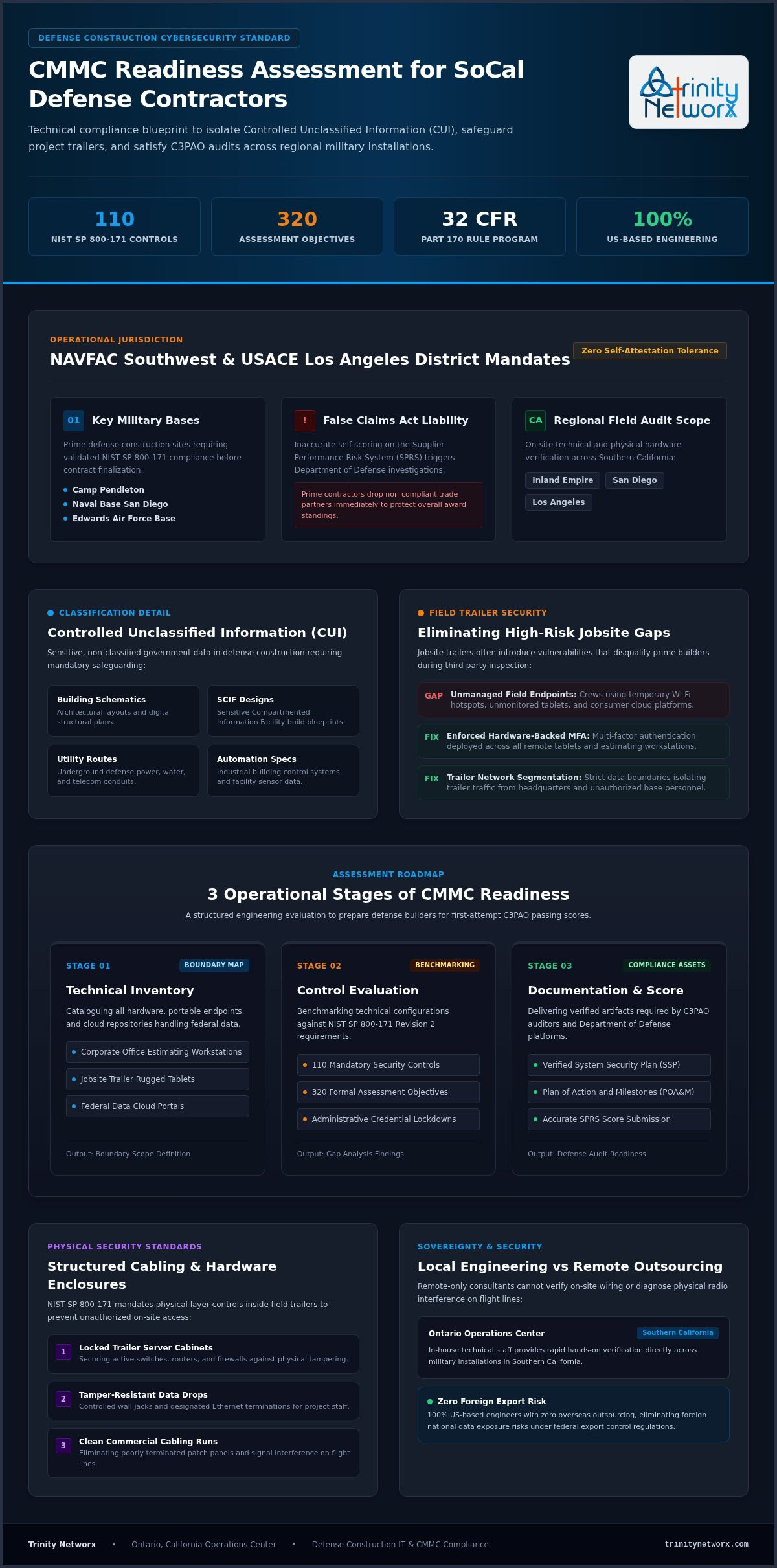
Winning facility awards through NAVFAC Southwest or the USACE Los Angeles District hinges on verified digital defenses. Self-attestation is no longer enough. Performing a structured CMMC readiness assessment for defense contractors in SoCal exposes technical gaps before a formal third-party evaluation begins. Under the Cybersecurity Maturity Model Certification program, missing a single required control can pull a builder from lucrative base projects at Camp Pendleton or Naval Base San Diego. Prime contractors now drop unverified trade partners immediately to protect their own standing. The Department of Defense requires strict accountability. Inaccurate self-scoring invites False Claims Act investigations, creating severe operational liability.
Controlled Unclassified Information (CUI) in defense construction refers to sensitive, non-classified government data that requires mandatory safeguarding, such as building schematics, SCIF designs, utility routes, and building automation specifications.
Field trailers present major security exposures. Crews frequently access digital blueprints across temporary Wi-Fi hotspots, unmanaged mobile devices, and consumer cloud platforms. Under NIST SP 800-171, every subcontractor handling CUI must implement multi-factor authentication, continuous endpoint monitoring, and strict data boundaries. Deploying dedicated commercial construction IT services isolates project data between field trailers and corporate headquarters. A proactive CMMC readiness assessment for defense contractors in SoCal identifies these field vulnerabilities before they trigger contract penalties.
A structured CMMC readiness assessment for defense contractors in SoCal follows three precise operational stages. First, engineers map your technical boundaries across corporate offices and mobile job trailers. This inventory catalogues every estimating workstation, rugged tablet, and cloud portal touching federal data. Second, technical specialists benchmark your practices against the 110 controls and 320 assessment objectives within NIST SP 800-171 Revision 2 to satisfy official 32 CFR Part 170 CMMC Program requirements. Third, the evaluation delivers a verified System Security Plan (SSP) paired with a clear Plan of Action and Milestones (POA&M) to fix outstanding flaws.
Certified Third-Party Assessment Organizations (C3PAOs) fail builders quickly when access controls fall short on site. Remediating these gaps means enforcing hardware-backed multi-factor authentication on every remote tablet, segmenting trailer networks, and locking down administrative credentials. Once technicians close these vulnerabilities, you can submit an accurate, defensible score to the Supplier Performance Risk System (SPRS). Accurate data keeps your bids compliant and protects leadership from regulatory scrutiny. Aligning with seasoned CMMC compliance consultants removes the guesswork from remediation. If your field networks need immediate review before an upcoming proposal deadline, connect with our engineering team to inspect your current cybersecurity standing.
Remote consulting firms cannot verify physical wiring, inspect trailer server cabinets, or diagnose radio interference on a flight line. Running an effective CMMC readiness assessment for defense contractors in SoCal requires boots on the ground. Hands-on engineering teams provide direct physical audits across facilities in the Inland Empire, San Diego, and Los Angeles. Trinity Networx relies entirely on in-house, US-based technical staff from our Ontario operations center. We never outsource project support overseas, eliminating foreign national data exposure risks under export control regulations. Contact our team through our scheduling portal to review your security posture.
Defense compliance extends well beyond corporate firewalls. Meeting strict physical security mandates under published NIST SP 800-171 standards requires locked network cabinets, tamper-resistant data drops, and clean commercial cabling runs inside temporary project trailers. Poorly terminated patch panels or unmonitored switches expose internal traffic to unauthorized base personnel. Combining structured cabling with active managed cybersecurity services shields field telemetry and protects jobsite access points around the clock.
General commercial IT providers lack field construction experience. Specialized construction IT services deliver rugged office-to-field connectivity, rapid virtualization, and defense-grade network segregation directly to jobsite superintendents. Scheduling a professional CMMC readiness assessment for defense contractors in SoCal ensures your physical infrastructure and digital defenses withstand rigorous defense scrutiny from day one.
Protecting your contract standing requires defined data boundaries, verified NIST SP 800-171 controls, and clean jobsite physical cabling. Don't risk disqualification or federal scrutiny when upcoming proposal deadlines arrive. Scheduling a CMMC readiness assessment for defense contractors in SoCal gives your leadership team the exact technical roadmap needed to satisfy C3PAO audits with complete confidence.
Trinity Networx backs your firm with over 30 years of technical expertise, a dedicated NOC facility in Ontario, California, and 100 percent in-house staff without overseas outsourcing. We know what regional defense installations expect from their trade partners. Schedule your CMMC readiness assessment with our Ontario team today and protect your DoD bid eligibility for years to come.
Level 1 covers basic protection for Federal Contract Information through 15 fundamental security practices verified by an annual self-assessment. Level 2 protects Controlled Unclassified Information across 110 NIST SP 800-171 controls. Construction trades handling sensitive blueprints, utility designs, or physical access plans for military installations must achieve Level 2 certification through an accredited third-party evaluation.
A comprehensive technical evaluation typically takes two to four weeks depending on network size and jobsite complexity. Engineers inspect corporate endpoints, trailer Wi-Fi setups, and mobile devices. Running a CMMC readiness assessment for defense contractors in SoCal provides a clear gap report and System Security Plan, giving your team actionable milestones well before formal audits begin.
No, trade contractors handling covered federal data cannot participate once DFARS requirements take effect in project solicitations. Prime builders operating across Camp Pendleton, Edwards Air Force Base, or Coronado enforce strict flowdown clauses. Primes drop non-compliant mechanical, electrical, and framing contractors immediately to protect their own award standing from procurement disqualification.
A low readiness score simply highlights vulnerabilities so your team can correct them before submitting official entries. The assessment findings populate your Plan of Action and Milestones to prioritize technical fixes. Conducting a formal CMMC readiness assessment for defense contractors in SoCal prevents misrepresenting your security controls in federal databases, protecting your business from False Claims Act penalties.

Article by
Lance Reichenberger, Ph.D.., J.D. (Candidate)
Dr. Lance Reichenberger is the founder of Trinity Networx, a Southern California technology firm specializing in managed IT services, cybersecurity, network infrastructure, and business technology strategy. With nearly four decades of experience in the IT industry, he works with businesses to improve operational efficiency, strengthen security, and align technology with long-term growth objectives.
Lance focuses on proactive IT management, enterprise wireless infrastructure, cybersecurity integration, and scalable technology solutions for growing organizations throughout Southern California.
The content published on this website is provided for general informational and educational purposes only. Articles may be created, edited, or enhanced with the assistance of artificial intelligence and automation tools under the direction and review of Trinity Networx. While every effort is made to ensure accuracy and relevance, the information provided should not be considered professional, legal, financial, cybersecurity, or technical advice specific to your organization. Businesses should consult directly with a qualified professional regarding their unique environment, compliance requirements, and operational needs. Trinity Networx makes no warranties regarding completeness, reliability, or applicability of the information contained within these articles.
Schedule a brief conversation with Trinity Networx to discuss your business technology needs.
Get a practical roadmap built around your business, your users, your systems, and the technology issues that need attention first.
Put the right technology, support, security, and infrastructure in place so your business can grow, adapt, and move forward with confidence.