3281 E. Guasti Rd, STE 700, Ontario, CA 91761
1712 9th Ave SW, Watertown, SD 57201
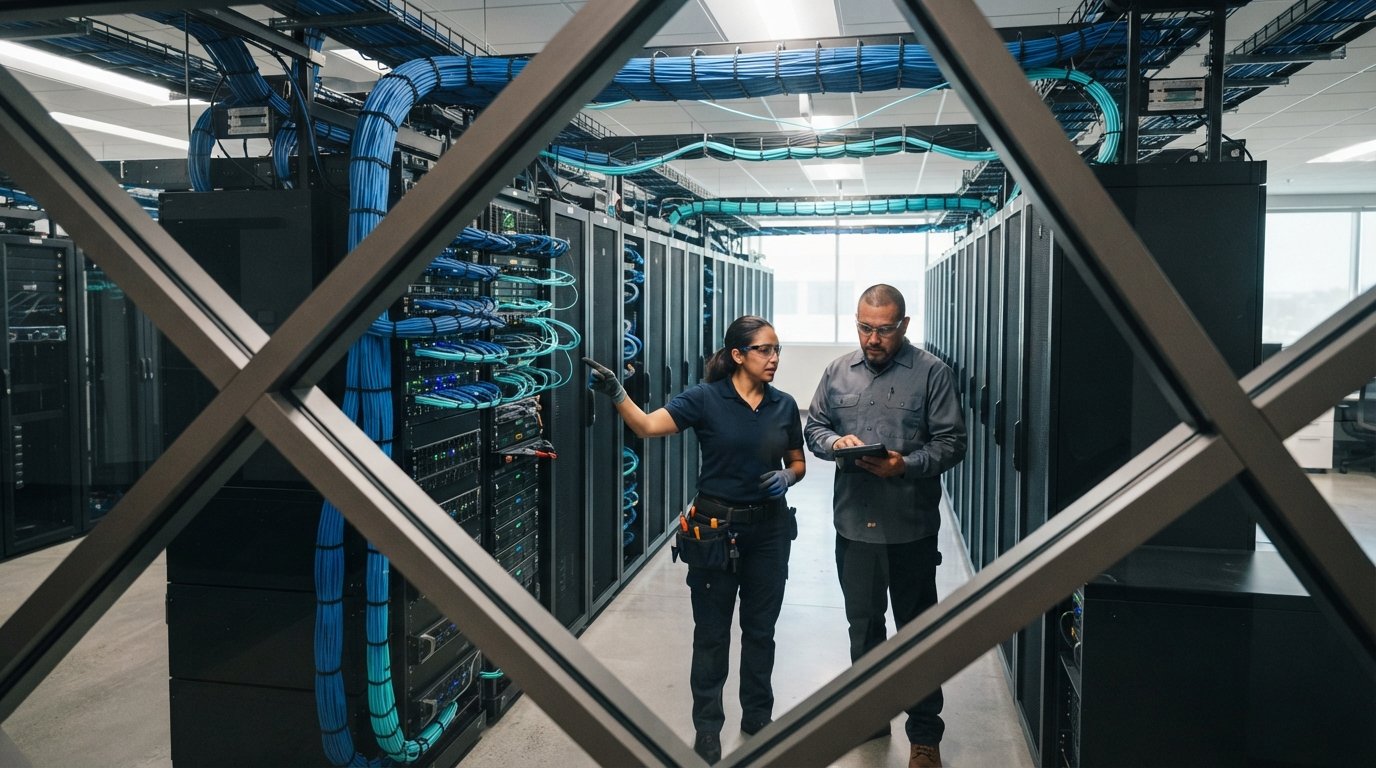
Ninety-six out of every one hundred companies face a network outage every single quarter, and messy infrastructure inside the server room is often the direct culprit. A successful commercial server room cabling installation requires far more than pulling bulk wire through drop ceilings. It demands disciplined physical pathway planning, strict standards compliance, and proactive field execution from the start.
You already know the frustration of jobsite scheduling disputes between electrical and low-voltage teams, dangerous heat buildup around unmanaged bundles, and cables failing Fluke certification due to tight bend radiuses. Structured low-voltage cabling design eliminates downtime and supports demanding commercial construction environments without compromise. This guide details ANSI/TIA-942-C design rules, MEP trade coordination tactics, and the certified test reports required to protect your construction timeline.
• Master ANSI/TIA-942 layout guidelines and hot-aisle containment methods to stop thermal buildup around high-density server racks.
• Plan your commercial server room cabling installation with the correct balance of Category 6A copper and OM4 or OS2 fiber backbones to eliminate bandwidth limits and maintain bend radius standards.
• Align low-voltage pathway milestones with electrical, mechanical, and drywall teams early to prevent jobsite trade conflicts.
• Enforce strict jobsite dust mitigation and environmental checkpoints before mounting sensitive hardware and conducting final Fluke certification runs.
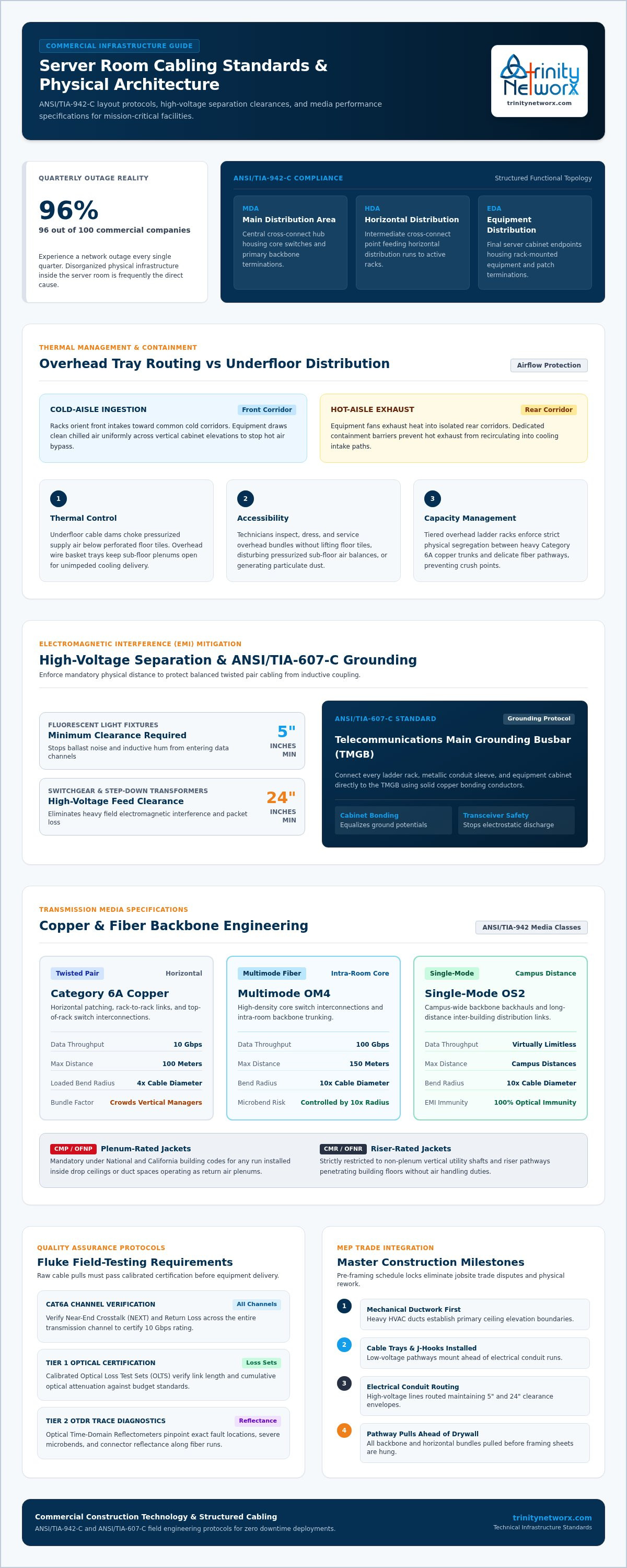
Precision layouts prevent project overruns. Under ANSI/TIA-942-C standards, server room architecture hinges on distinct functional spaces: the Main Distribution Area (MDA), Horizontal Distribution Areas (HDA), and Equipment Distribution Areas (EDA). A proper structured cabling system aligns these zones to eliminate messy point-to-point cross-connects. In commercial facilities, adopting hot-aisle and cold-aisle containment is equally critical. Orient server racks so equipment intakes draw cold air from common front aisles, exhausting heat into isolated rear corridors. This stops thermal recirculation dead in its tracks.
Choosing pathways dictates long-term airflow. Overhead wire basket trays provide clear advantages over legacy underfloor distribution:
Underfloor cable dams block pressurized supply air from reaching perforated floor tiles. Overhead trays keep floor plenums clear.
Technicians inspect, drop, and bundle runs without pulling floor tiles or disturbing pressurized sub-floor plenums.
Overhead ladder racks allow strict physical separation between Category 6A copper trunks and fragile fiber lines.
Planning these routing runs early guarantees that your commercial server room cabling installation avoids costly physical rework. Professional execution through dedicated commercial structured cabling and network infrastructure ensures rack elevations support predictable cooling before hardware arrives.
Inductive coupling ruins network performance. Unshielded twisted pair lines run parallel to electrical feeders suffer severe electromagnetic interference (EMI), creating cyclical packet loss. Installers must enforce a minimum physical clearance of five inches from fluorescent lighting fixtures and at least twenty-four inches from high-voltage switchgear or step-down transformers. Per ANSI/TIA-607-C, connect every ladder rack, metallic conduit sleeve, and equipment cabinet directly to the Telecommunications Main Grounding Busbar (TMGB) using solid copper bonding conductors. Clean grounding protects sensitive transceivers and ensures stable data transmission across every termination point.
Every commercial server room cabling installation relies on matching transmission media to equipment density. Category 6A copper handles 10 Gbps up to 100 meters. It serves horizontal patching and top-of-rack switch links effectively, but thick copper bundles crowd vertical managers. Under the current ANSI/TIA-942 standard, high-density server rooms turn to fiber backbones. Multimode OM4 pushes 100 Gbps across distances up to 150 meters, making it practical for intra-room core switches. Single-mode OS2 provides virtually limitless bandwidth over campus distances, completely immune to external electronic interference.
Physical constraints also dictate your choices:
Maintain four times the outer cable diameter for Cat6A runs under loaded tension. Standard fiber requires ten times its diameter to stop microbends.
National and California building safety codes require plenum-rated (CMP or OFNP) jackets inside drop ceilings acting as return air plenums. Riser-rated (CMR or OFNR) jackets are strictly restricted to non-plenum vertical shafts.
Never accept raw cable pulls without documented performance passes. Cat6A certification requires verifying near-end crosstalk (NEXT) and return loss across the entire channel. For optical fiber, Tier 1 optical loss test sets measure attenuation, while Tier 2 optical time-domain reflectometers (OTDR) pinpoint microbends and connector reflectance. Partnering with specialists for infrastructure network cabling ensures you receive calibrated certification reports for every termination. If your facility needs certified backbone cabling ahead of equipment delivery, speak with our technical team to lock in your project specifications.
Uncoordinated schedules derail project delivery. A successful commercial server room cabling installation requires low-voltage milestones locked into the master construction timeline before framing starts. Pull pathways before drywall crews hang sheets. Cable trays and J-hooks must go in after major mechanical ductwork but ahead of electrical conduit runs. Building reliable network facilities demands a true multidisciplinary process of planning to stop trade collisions in congested ceiling plenums.
Never mount active networking switches or servers while drywall sanding continues. Gypsum dust pulls directly into server fans, coating circuit boards and ruining optical transceiver faces. Enforce strict jobsite controls:
Seal the server room with plastic sheeting and maintain positive air pressure until dirty trades clear out.
Terminate and dress copper runs into patch panels before server cabinets receive live power.
Complete industrial HEPA vacuuming before pulling fiber jumpers from backbone distribution boxes.
Turnover packages require absolute clarity. We apply ANSI/TIA-606-B labeling across every drop, patch panel port, and server cabinet using durable thermal-transfer labels. No handwritten tape. Facility managers receive full CAD as-built drawings detailing cable routes, conduit fill ratios, and pull box placements. Reach out to Trinity Networx for expert commercial cabling project planning across Southern California jobsites.
Disciplined cabling design prevents costly network bottlenecks before they disrupt operations. Structuring overhead pathways, isolating high-voltage power feeds, and matching the right fiber backbones to rack densities protect hardware longevity while keeping airflow clear. A flawless commercial server room cabling installation demands proactive alignment with trade schedules long before dry-in milestones arrive.
Trinity Networx delivers dedicated commercial construction IT specialization across Southern California. Our 100% in-house technical team handles every run without third-party outsourcing, providing documented Fluke certification passes and clear as-built CAD drawings for every project. Connect with our team by visiting Trinity Networx commercial services to schedule your jobsite assessment. Start your next facility buildout with total peace of mind.
Maintain a minimum clearance of five inches from fluorescent fixtures and at least twenty-four inches from large transformers or main service panels. When data pathways cross branch circuits, always run them at ninety-degree right angles. This orientation minimizes electromagnetic interference along unshielded network lines and prevents transmission errors across critical infrastructure.
Category 6A reliably runs full 10-Gigabit speeds across complete 100-meter channel distances. Standard Cat6 chokes on high data throughput, limiting 10-Gigabit rates to roughly 37 to 55 meters depending on bundle thickness. Investing in Cat6A protects your physical investment as server hardware, storage arrays, and wireless backhauls demand higher throughput over time.
Engage your low-voltage crew during the rough-in planning phase alongside mechanical and electrical trades. Technicians should install overhead pathways before insulation and drywall go up, right after primary ductwork installation. Pulling wire through open stud framing is much cleaner and eliminates expensive retrofits once finishes are complete.
A complete turnover package includes calibrated Fluke certification reports for every single copper and fiber run. General contractors also need as-built CAD drawings detailing exact pathway routes, rack elevations, and firestop sleeve placements. Clear ANSI/TIA-606-B port mapping ensures facility managers trace circuits instantly during future hardware additions or office reconfigurations.

Article by
Lance Reichenberger, Ph.D.., J.D. (Candidate)
Dr. Lance Reichenberger is the founder of Trinity Networx, a Southern California technology firm specializing in managed IT services, cybersecurity, network infrastructure, and business technology strategy. With nearly four decades of experience in the IT industry, he works with businesses to improve operational efficiency, strengthen security, and align technology with long-term growth objectives.
Lance focuses on proactive IT management, enterprise wireless infrastructure, cybersecurity integration, and scalable technology solutions for growing organizations throughout Southern California.
The content published on this website is provided for general informational and educational purposes only. Articles may be created, edited, or enhanced with the assistance of artificial intelligence and automation tools under the direction and review of Trinity Networx. While every effort is made to ensure accuracy and relevance, the information provided should not be considered professional, legal, financial, cybersecurity, or technical advice specific to your organization. Businesses should consult directly with a qualified professional regarding their unique environment, compliance requirements, and operational needs. Trinity Networx makes no warranties regarding completeness, reliability, or applicability of the information contained within these articles.
Schedule a brief conversation with Trinity Networx to discuss your business technology needs.
Get a practical roadmap built around your business, your users, your systems, and the technology issues that need attention first.
Put the right technology, support, security, and infrastructure in place so your business can grow, adapt, and move forward with confidence.