3281 E. Guasti Rd, STE 700, Ontario, CA 91761
1712 9th Ave SW, Watertown, SD 57201

By Lance Reichenberger, Ph.D.
Contact our team at https://www.trinitynetworx.com/contact-us to secure your network. Share this strategy: [Facebook] [LinkedIn] [X]
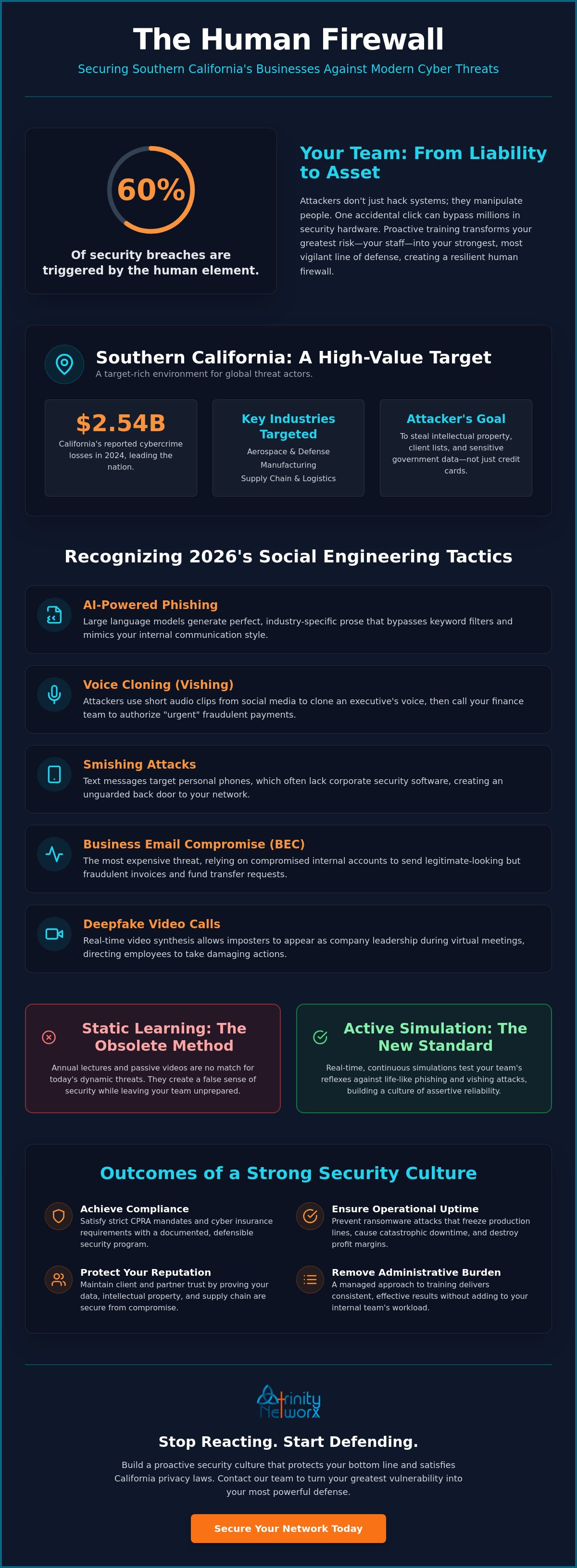
The human element triggers 60% of all security breaches, yet many local executives treat their staff as a liability rather than a defense. Implementing professional cybersecurity awareness training for employees in Southern California isn't just a suggestion anymore; it's a requirement for survival. You're likely exhausted by the constant threat of ransomware shutting down your operations or the mounting pressure from CPRA auditors. It's frustrating when one accidental click by a distracted team member can bypass millions of dollars in hardware. You know that your people are your greatest risk, but you also know they can be your greatest asset if they're trained to spot a trap.
This strategy shows you how to turn that vulnerability into a vigilant human firewall that stops threats before they touch your servers. We will explore the 2026 regulatory landscape, the rise of AI-driven voice phishing, and the exact training protocols needed to achieve zero successful phishing attempts. Stop reacting to disasters. Start building a culture of assertive reliability that protects your bottom line and satisfies California privacy laws.
• Southern California defense and manufacturing sectors are high value targets requiring aggressive, localized protection strategies.
• You'll see why cybersecurity awareness training for employees in Southern California must now combat AI driven voice cloning and sophisticated social engineering.
• Ditch the annual lectures for active simulations that test your team's reflexes in real time.
• Satisfy strict CPRA mandates and insurance requirements by building a documented culture of security within your organization.
• Discover how a managed approach to training removes the administrative burden while securing your supply chain.
Cybersecurity awareness training for employees in Southern California is the systematic process of educating your team to recognize and report digital threats before they manifest as breaches. It's the most critical layer of your defense. Most local firms invest heavily in hardware but ignore the person sitting at the keyboard. This is a mistake. Attackers have shifted their focus from brute forcing servers to manipulating people through social engineering tactics. These psychological traps are designed to bypass expensive firewalls by convincing a trusted staff member to hand over the keys to your network.
Our region is a target rich environment for global threat actors. California led the nation in cybercrime losses in 2024, reporting $2.54 billion in damages. Hubs like Orange County and the Inland Empire house massive concentrations of manufacturing, aerospace, and defense firms. These industries hold high value intellectual property and sensitive government data. Criminals aren't just looking for credit card numbers anymore. They want your blueprints, your client lists, and your supply chain access. The fast paced nature of the SoCal business culture works in their favor. Employees are often juggling multiple high stakes projects and are prone to clicking on links that promise urgent updates or immediate action. This artificial urgency is the primary lever used to crack open your systems.
Operational downtime is the silent killer of Inland Empire businesses. When a staff member falls for a phishing scam, the resulting ransomware can freeze your production lines for weeks. Beyond the immediate recovery costs, the reputational damage is often permanent. Major defense contractors and global retailers won't work with vendors who can't prove their data is secure. Negligence is no longer an excuse. According to 2026 data, the human element remains a factor in 60% of all security breaches. This makes employee training a non negotiable part of your managed IT strategy.
Waiting for a breach to happen before taking action is a strategy that kills profit margins. Reactive IT support is a game of whack a mole that keeps your business in a state of constant vulnerability. Proactive training shifts the burden away from your helpdesk and prevents the need for expensive emergency remediation. It turns your staff into an active defense force. Security isn't just a utility expense or a box to check for compliance. It's a strategic driver of business health. By investing in your people, you ensure operational continuity and maintain the momentum your business needs to thrive in a competitive market.
The defense strategies of 2024 are obsolete. By 2026, attackers have replaced sloppy emails with high fidelity deceptions that mimic your company's internal culture. Traditional spam filters are failing because they look for technical anomalies, not psychological manipulation. Effective cybersecurity awareness training for employees in Southern California must address these sophisticated vectors head on. You cannot rely on software to catch a threat that looks and sounds exactly like your CEO.
Five primary tactics dominate the current threat environment:
Large language models now generate perfect prose. These messages bypass keyword based filters and mirror your specific industry jargon.
Attackers use short audio clips from social media to clone an executive's voice. They call your accounting department to authorize "urgent" vendor payments.
Text messages target personal phones. Since these devices often lack corporate security software, they're an open door to your network.
This remains the most expensive threat. It relies on compromised internal accounts to send legitimate looking invoices.
Real time video synthesis allows imposters to appear as your leadership during Zoom or Teams meetings.
Social engineering isn't a technical flaw. It's a behavioral one. Attackers weaponize psychological triggers like fear, curiosity, or greed to force quick decisions. They scrape LinkedIn profiles to identify specific team members and their responsibilities. A well crafted lure might mention a local project in Irvine or a recent contract win in San Diego to build immediate trust. Teaching your staff to spot social engineering and phishing attacks involves more than just looking at the sender's address. It requires a critical eye for context. One sentence explaining how to hover over a URL can prevent a total network lockout.
Modern threats no longer contain the spelling errors or broken grammar that once signaled a scam. Deception is now polished. Your staff must learn to identify inconsistencies in communication style. Does your CFO usually send texts at 10 PM asking for gift cards? Probably not. Strict internal protocols for verifying high value requests are your best defense. If a request involves money or sensitive data, it needs a secondary, out-of-band confirmation. Comprehensive cybersecurity awareness training for employees in Southern California focuses on these behavioral shifts. If you aren't sure where your vulnerabilities lie, it's time to talk to a professional partner who understands the local threat landscape.
Annual compliance meetings are a relic of a slower era. They don't work. Sitting through a forty minute video once a year creates a false sense of security that vanishes within weeks. Real protection requires muscle memory. Effective cybersecurity awareness training for employees in Southern California should mimic the actual threats your team faces every day. If your staff only thinks about security once a year, they are already vulnerable to the next vishing or smishing attack. You need a method that keeps security at the front of their minds without disrupting their productivity.
Active phishing simulations provide a safe environment to fail. We send realistic, non-malicious lures to your team. If they click, they receive immediate feedback. This turns a potential disaster into a powerful learning moment. Instead of a lecture, the employee gets a brief, high impact correction while the experience is fresh. This methodology builds a resilient human firewall. It moves security from an abstract concept to a practical, daily habit. Management receives a clear report on which departments are most susceptible, allowing for targeted interventions rather than broad, ineffective mandates.
Checking a box for an insurance carrier is not a strategy. It is an administrative chore. Boring presentations lead to total disengagement. Your team mutes the video and waits for the quiz at the end. This passivity is exactly what hackers exploit. They know your staff is tired and distracted. Effective training must be short and frequent. It needs to be integrated into the daily workflow so that vigilance becomes second nature. A once-a-year approach leaves a massive gap in your defenses that AI-driven threats will find and penetrate.
You cannot manage what you do not measure. Static training offers no data on actual risk reduction. In contrast, active simulations provide concrete metrics. We track click rates to see who is falling for traps. More importantly, we track reporting rates. A successful program sees a sharp increase in the number of staff members who actively alert IT to suspicious activity. This shift from victim to defender is the ultimate goal. Linking this data to your IT optimization strategy allows for a clear view of your total network health. Management can then identify high risk departments and provide targeted support where it's needed most. This isn't about punishment. It is about precision. It ensures that your cybersecurity awareness training for employees in Southern California actually delivers the peace of mind you're paying for.
California's legal environment shifted on January 1, 2026. The CPRA now mandates that employee data receives the same level of protection as consumer information. This shift means cybersecurity awareness training for employees in Southern California is no longer a luxury for the tech elite. It is a legal necessity for any business handling sensitive personal data. If you process high risk information, mandatory cybersecurity audits are on the horizon. Beyond the law, your insurance carrier is watching. Most providers in the Los Angeles and Orange County markets now require documented proof of proactive training before they will bind a policy. They know that a trained workforce is a cheaper risk.
A true security culture starts at the top. If executives do not participate in simulations, the rest of the staff won't take them seriously. You must balance network monitoring with strict California privacy laws. This requires clear policies and transparent communication about how and why you test your systems. It is about building trust, not just installing software. Balancing security with employee privacy requires a methodical approach. Employees under CPRA have new rights to access and delete their personal data. Your monitoring tools must be configured to protect the network without overstepping these boundaries. This is where many SoCal firms stumble. They focus so much on the technical side that they forget the human and legal implications of their internal surveillance.
Security is a sales tool. Proving your staff is trained can be the deciding factor in winning a legal or manufacturing bid in a crowded market. Meeting CMMC compliance standards opens doors to lucrative federal contracts that are otherwise unreachable. Professional service firms in Southern California are finding that a documented security posture is a core requirement for doing business with major enterprise clients. It proves you are a strategic partner, not a liability. When you can demonstrate a zero successful phishing attempt history, you move to the top of the vendor list.
Don't make training an after hours chore. Schedule sessions during normal business hours to ensure full participation. Use local examples of businesses in the Inland Empire or San Diego that have faced breaches. This makes the threat feel immediate and real. Create a simple, one click process for reporting suspicious activity to the helpdesk. If reporting is hard, people will ignore the red flags. If you need help aligning your team with these new standards, it is time to secure your compliance strategy today. Clarity and speed are your best defenses in the 2026 threat environment.
Trinity Networx delivers a managed approach to security awareness. We remove the administrative burden from your leadership team. Our programs aren't generic. We build cybersecurity awareness training for employees in Southern California that reflects the specific risks of the manufacturing, legal, and supply chain sectors. These industries face unique pressures. A breach in a supply chain can halt production across the state. Our training prepares your people for those exact scenarios. We don't just give them a video to watch. We give them the skills to defend your data.
We integrate this education into our broader managed cybersecurity services. It's a unified front. When an employee reports a suspicious email, our team is already on it. We provide a 20 minute response time guarantee. This ensures that threats are neutralized instantly. Speed is our standard. We don't wait for tickets to pile up while your network sits exposed. You get assertive reliability that keeps your business moving forward.
I focus on the direct relationship between technical efficiency and your bottom line. We avoid the dense jargon that plagues most IT firms. Instead, we speak the language of executive priorities: continuity, stability, and growth. You deserve a strategic partner who values your time. We don't just teach your staff to click less; we teach them to protect your momentum. Experience the difference of a partnership built on professional assurance and results. We treat your security as a driver of progress, not a hurdle.
Every engagement begins with a baseline assessment. We need to see where your staff stands today. This isn't a guessing game. From there, we manage the ongoing simulations and reporting. You stay informed without having to manage the details. Our team handles the heavy lifting so you can focus on running your business. High quality cybersecurity awareness training for employees in Southern California shouldn't be a distraction. It should be a shield. Contact us to see how we can protect your bottom line through better education. It's time to move past reactive support and start building a vigilant defense.
Hardware is only half the battle. In a landscape defined by AI driven vishing and deepfake deceptions, your staff must be prepared. Professional cybersecurity awareness training for employees in Southern California converts a potential liability into an assertive human firewall. This shift is vital for maintaining your competitive edge in the Inland Empire and beyond. It ensures your business survives the scrutiny of CPRA auditors and the demands of high stakes supply chains. You can't afford to be the weak link in a connected economy.
Trinity Networx provides the expertise you need to stay ahead. We offer a 20 minute response time guarantee and 24/7 proactive monitoring to keep your operations stable. Our deep experience with CMMC and HIPAA compliance means your data is handled with precision. Don't wait for a breach to reveal your weaknesses. Secure your SoCal business by contacting Trinity Networx today. Take control of your network and build a resilient culture that drives your growth and protects your peace of mind.
Yes, it's required for many organizations under the California Privacy Rights Act (CPRA). The law mandates that businesses processing high risk personal information conduct annual cybersecurity audits. While certification for firms with over $100 million in revenue begins April 1, 2028, smaller companies face phased deadlines through 2030. Most insurance providers in the state also demand proof of training before they'll issue a policy. It's a legal and financial necessity.
Continuous training is the only way to ensure your team stays sharp. Static, annual sessions are useless because security knowledge often fades within a few weeks. You should engage your staff with monthly or quarterly simulations. Short, frequent touchpoints ensure that your cybersecurity awareness training for employees in Southern California becomes a reflex. Vigilance must be a daily habit to counter the fast paced evolution of modern threats.
Local businesses face a mix of sophisticated digital deceptions. Voice cloning, or vishing, has become a primary threat in 2026 as attackers impersonate executives to authorize wire transfers. Business Email Compromise (BEC) remains the most expensive vector for firms in the Inland Empire. We also see a rise in "quishing," where malicious QR codes are sent via mail or email to bypass traditional security filters and steal credentials.
Professional training is accessible for organizations of all sizes. Industry data from early 2026 shows that costs generally range from $0.60 to $6 per employee each month. Trinity Networx integrates these simulations into managed cybersecurity packages to keep your costs predictable. This approach provides small and mid sized firms with the same level of protection used by global corporations without needing a massive internal IT department.
Failure is a critical learning opportunity, not a cause for punishment. When a staff member clicks a simulated malicious link, they receive immediate, non punitive feedback. This correction happens while the experience is fresh, which reinforces the correct behavior. We focus on building a culture where employees feel confident reporting suspicious activity. Fear of mistakes only leads to hidden breaches; we prefer to build a vigilant, vocal defense force.
It's your most effective defense against encryption events. Since the human element is a factor in 60% of all security breaches, educated employees act as a filter for your network. They catch the vishing calls and smishing texts that technical firewalls often miss. By reducing the success rate of initial access attempts, you stop ransomware before it can be deployed. It's the difference between a minor incident and a total operational shutdown.
Training provides the documented evidence you need for regulatory audits. Under California law, you must prove that you've taken reasonable steps to protect consumer and employee data. Training logs and simulation results show the California Privacy Protection Agency (CPPA) that your business isn't just reactive. It demonstrates a proactive stance toward data privacy. This documentation is essential for avoiding the heavy fines associated with negligence and non compliance.
Your handbook should be short, direct, and actionable. It must include clear procedures for reporting suspicious emails and strict rules for multi factor authentication. Define expectations for remote work and the use of personal devices for company business. Don't fill it with technical jargon that people will ignore. Focus on the practical steps your team needs to take to protect the network. Clarity is your best asset when a threat appears.

Article by
Lance Reichenberger, Ph.D.., J.D. (Candidate)
Dr. Lance Reichenberger is the founder of Trinity Networx, a Southern California technology firm specializing in managed IT services, cybersecurity, network infrastructure, and business technology strategy. With nearly four decades of experience in the IT industry, he works with businesses to improve operational efficiency, strengthen security, and align technology with long-term growth objectives.
Lance focuses on proactive IT management, enterprise wireless infrastructure, cybersecurity integration, and scalable technology solutions for growing organizations throughout Southern California.
The content published on this website is provided for general informational and educational purposes only. Articles may be created, edited, or enhanced with the assistance of artificial intelligence and automation tools under the direction and review of Trinity Networx. While every effort is made to ensure accuracy and relevance, the information provided should not be considered professional, legal, financial, cybersecurity, or technical advice specific to your organization. Businesses should consult directly with a qualified professional regarding their unique environment, compliance requirements, and operational needs. Trinity Networx makes no warranties regarding completeness, reliability, or applicability of the information contained within these articles.
Schedule a brief conversation with Trinity Networx to discuss your business technology needs.
Get a practical roadmap built around your business, your users, your systems, and the technology issues that need attention first.
Put the right technology, support, security, and infrastructure in place so your business can grow, adapt, and move forward with confidence.