3281 E. Guasti Rd, STE 700, Ontario, CA 91761
1712 9th Ave SW, Watertown, SD 57201

By: Lance Reichenberger, Ph.D.
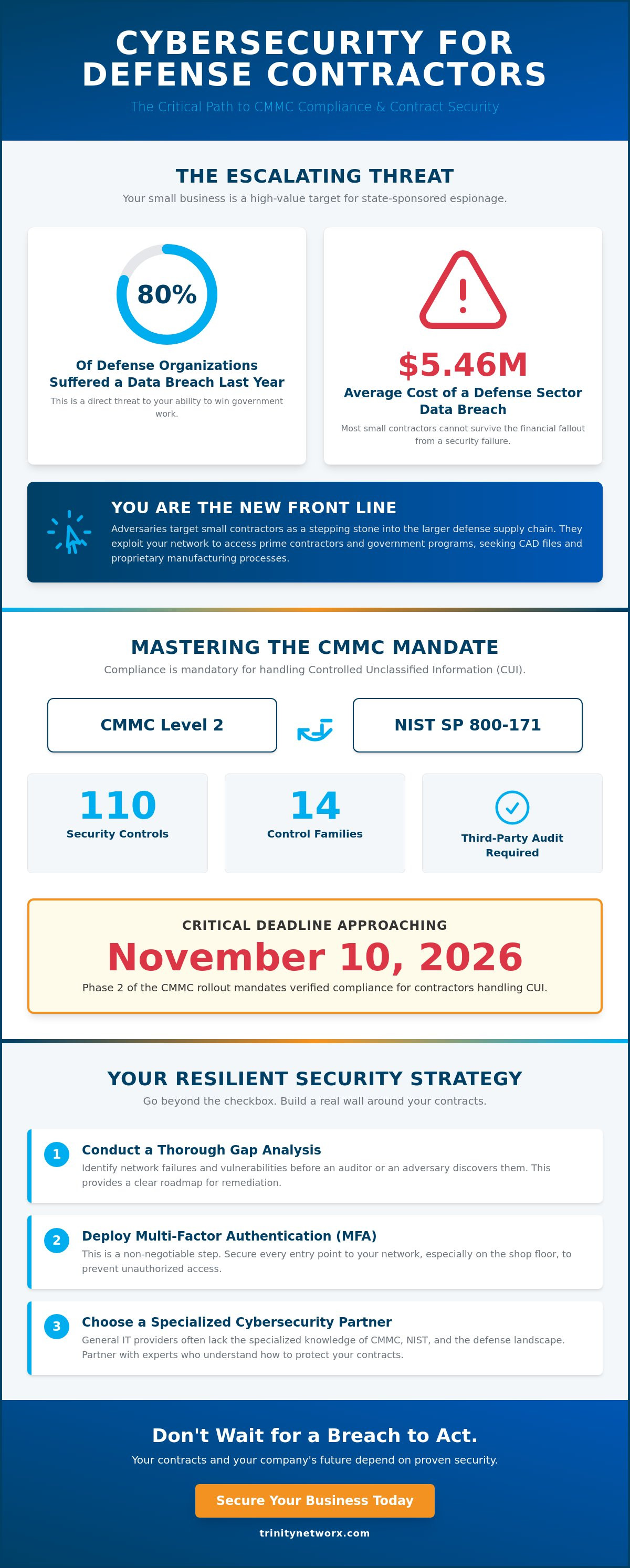
Over 80% of aerospace and defense organizations suffered a data breach in the last year. This fact isn't just a technical problem; it's a direct threat to your ability to win work. When you're managing cybersecurity for defense contractors, the stakes involve more than just digital files. Your entire revenue stream depends on proving you can protect Controlled Unclassified Information. You likely feel the pressure of the upcoming Phase 2 rollout. The cost of failure is too high to ignore. Don't wait.
You need a clear path to compliance that doesn't sacrifice your operational speed. We'll show you how to secure your manufacturing floor while meeting the latest CMMC and NIST 800-171 requirements. This guide looks at the November 10, 2026, deadline and the specific controls you need to master today. You'll gain the confidence to face auditors and the peace of mind that comes with a hardened network. Stop guessing about your status and start building a wall around your contracts.
Contact Trinity Networx, LLC to secure your business: contact us. Share this article: [Facebook] [LinkedIn] [Twitter]
• Small manufacturing shops are now the primary targets for state-sponsored espionage. Stop thinking you're too small to matter.
• CMMC Level 2 aligns with NIST 800-171 standards to create a unified defense requirement. Mastering cybersecurity for defense contractors ensures you stay eligible for Department of Defense acquisitions.
• A passed audit won't stop a hacker if you only treat security as a checkbox. Real protection requires a proactive stance that goes beyond the bare minimum.
• Start with a thorough gap analysis to identify network failures before an auditor does. Deploying multi-factor authentication across every entry point is a non-negotiable step for shop floor security.
• Choose a partner who understands the specific pressures of the SoCal defense landscape. General IT providers often lack the specialized knowledge required to protect your contracts.
By: Lance Reichenberger, Ph.D.
Foreign intelligence services hunt for your data. Your small machine shop isn't invisible; it's a high value target. State sponsored cyber espionage has shifted its focus away from the massive prime contractors. Those giants have billion dollar budgets to build digital fortresses. Instead, adversaries now target the small businesses that make the specialized components. They want your CAD files. They want your proprietary manufacturing processes. If you manage cybersecurity for defense contractors, you must realize that your shop floor is a digital battlefield. A single compromised workstation can give a foreign actor the blueprints for the next generation of American defense technology.
The financial fallout from a breach goes far beyond a lost contract. While the immediate loss of a Department of Defense (DoD) agreement is devastating, the secondary costs are often the ones that shutter a business. You'll face forensic investigation fees, massive legal bills, and the cost of notifying every affected party. According to recent industry data, the average cost of a data breach in the defense sector has reached $5.46 million. Most small contractors can't survive that kind of hit. You aren't just protecting data; you're protecting your company's existence. Managing cybersecurity for defense contractors is now a matter of business survival.
Adversaries use your business as a stepping stone. This is the reality of supply chain vulnerability. Attackers know that your network likely connects to larger partners or government portals. By breaching your systems, they find a path of least resistance into larger programs. In early 2026, we've seen a sharp change in tactics. Hackers now use automated tools to scan for unpatched industrial control systems. They don't need to be experts in your specific field to steal your intellectual property. The Cybersecurity and Infrastructure Security Agency (CISA) frequently issues warnings about these evolving threats, but the responsibility to lock the door sits with you. You need active Managed IT Services to stay ahead of these automated attacks.
Trust is the only currency that matters in the defense world. If you lose it, you lose everything. A security failure leads to a permanent stain on your reputation within the DoD community. News of a breach travels fast. Beyond the bad press, you face the very real threat of permanent debarment. This means you're banned from bidding on any future government work. The government has no interest in working with vendors who can't secure sensitive information. Your business depends on your ability to prove your network is a vault, not a sieve. Don't let a single oversight end your legacy.
Contact Trinity Networx, LLC to secure your contracts: contact us
Share this article: [Facebook] [LinkedIn] [Twitter]
By: Lance Reichenberger, Ph.D.
The Department of Defense isn't asking for a pinky promise anymore. The Cybersecurity Maturity Model Certification (CMMC) represents a hard shift from self-attestation to verified security. If you handle sensitive data, you're likely aiming for Level 2. This level directly mirrors the 110 controls found in NIST SP 800-171 Revision 2. While Revision 3 exists, the DoD currently requires adherence to Revision 2. This creates a clear, fixed target for cybersecurity for defense contractors.
Don't confuse a self-assessment with a third-party audit. Under the old rules, you could grade your own homework. Starting November 10, 2026, Phase 2 of the rollout mandates that most contractors handling sensitive info pass an assessment by a Certified Third-Party Assessment Organization (C3PAO). You can't fake this. The 14 families of security requirements cover everything from who enters your building to how you encrypt your emails. These include Access Control, Awareness and Training, Audit and Accountability, and Configuration Management. Each family demands proof that your processes are active and documented.
Controlled Unclassified Information (CUI) is the heart of the matter. It's not top secret, but it's sensitive enough that our adversaries want it. In your shop, CUI often looks like technical drawings or specific assembly instructions. Look for labels like "DISTRIBUTION STATEMENT" or "FEDCON" in your contract documents. If you're unsure if a file is CUI, treat it as if it is until you get a formal answer. Protecting this data is a legal obligation and a requirement for cybersecurity for defense contractors.
Preparation starts with paperwork. You need a System Security Plan (SSP) that explains exactly how you meet every one of the 110 controls. If you have gaps, you list them in a Plan of Action and Milestones (POAM). Think of the POAM as your checklist for survival. It shows auditors you know where you fall short and have a schedule to fix it. If you need help identifying these gaps, an expert compliance review can reveal exactly where your network stands.
Audit readiness isn't a weekend project. It takes months of disciplined record-keeping and technical adjustments. You need to prove that your security isn't just a policy on a shelf, but a daily reality. This discipline protects your revenue and your reputation in the defense industrial base.
Contact Trinity Networx, LLC to secure your business: contact us
Share this article: [Facebook] [LinkedIn] [Twitter]
By: Lance Reichenberger, Ph.D.
A CMMC certificate on your office wall won't stop a data breach. It only proves you met a baseline of requirements at a single point in time. When managing cybersecurity for defense contractors, treating compliance as a checkbox is a dangerous mistake. Hackers don't care about your paperwork. They look for the technical cracks that static regulations often miss. If your security strategy stops at the bare minimum, you're leaving the door open for sophisticated actors who move faster than government standards can evolve. You need a strategy that values active defense over static lists.
Compliance is the floor, not the ceiling. Many shops pass their audits and then stop paying attention. This creates a gap where threats can live for months without being noticed. Attackers exploit the space between what the law requires and how your network actually functions. You might have the right software, but if nobody is watching the alerts, the software is useless. Real security requires a proactive stance. You must hunt for threats rather than waiting for an alarm to sound. This shift in mindset is what keeps your contracts safe when an actual attack occurs.
Policies on paper don't equal safety on the shop floor. We often see manufacturers with 50 page security manuals that gather dust while employees use personal thumb drives to move files. This is a massive failure of enforcement. If you have security tools but don't monitor them, you have a false sense of safety. You're paying for silence, not protection. Unmanaged employee devices or BYOD (Bring Your Own Device) setups are another major risk. A single personal phone connected to your shop Wi-Fi can bypass every firewall rule you've painstakingly set up. Documentation is just the start; active enforcement is what actually stops an intruder.
Real protection is active and constant. You need a system that catches breaches before they spread through your network. This is why IT optimization is vital for your business. It ensures your hardware and software are tuned for maximum security rather than just meeting a basic standard. You shouldn't wait for a crisis to find out your defenses failed. Active monitoring provides the visibility you need to see an intruder's first move. Combining this with 24/7 technical support ensures that when a threat appears, you have the force needed to stop it. Don't settle for a passed audit when you can have a hardened business.
Contact Trinity Networx to secure your business: contact us
Share this article: [Facebook] [LinkedIn] [Twitter]
By: Lance Reichenberger, Ph.D.
Action beats intent every time. You can't fix a problem you haven't identified. Start with a rigorous gap analysis to find exactly where your current network fails. This isn't a casual check; it's a deep dive into your hardware, software, and user habits. Once you see the holes, you can plug them. Managing cybersecurity for defense contractors requires this level of precision to avoid wasting resources on the wrong fixes. You need facts, not guesses.
Enact multi-factor authentication (MFA) across every single entry point. This includes your email, your cloud storage, and your remote access portals. MFA is the single most effective way to stop credential theft. If a password leaks, the second factor keeps the intruder out. Pair this with advanced encryption to secure your IT infrastructure. Data at rest and data in transit must stay unreadable to anyone without the key. This adds a layer of protection that keeps your proprietary designs safe even if a drive is stolen.
Don't let your defenses go stale. Perform regular vulnerability scans to find and patch weaknesses before they're exploited. Attackers look for unpatched software; don't give them an easy win. At the same time, train your staff to recognize sophisticated phishing attempts. Your team is your first line of defense. If they can spot a fake login page, they can stop a breach before it starts. If you want a clear view of your current risks, schedule a security assessment with our team today.
Your CNC machines and IoT devices are massive risks. These tools often lack the built-in security features of a modern PC. Use network segmentation to isolate these machines from your main office network. This way, if a machine is compromised, the attacker can't jump to your sensitive files. For legacy systems that can't be updated, wrap them in extra layers of monitoring. You don't have to replace every old machine to stay secure, but you must isolate them from the internet at large.
Security starts in the front office, not the server room. If leadership doesn't value these protocols, the staff won't either. Run regular incident response drills to ensure everyone knows their role during a crisis. This builds the muscle memory needed to act fast when it matters. Don't forget physical security. Access badges, locked server racks, and visitor logs are mandatory for any defense facility. A secure network is worthless if someone can walk in and plug a device into your switch.
Contact Trinity Networx to secure your business: contact us
Share this article: [Facebook] [LinkedIn] [Twitter]
By: Lance Reichenberger, Ph.D.
General IT providers often stumble when faced with the complexities of the defense industrial base. They might understand basic networking, but they rarely grasp the specific technical controls required by the Department of Defense. When you manage cybersecurity for defense contractors, there is no room for errors. You need a partner who lives and breathes these regulations. We take the heavy lifting of compliance off your plate so you can focus on your manufacturing output. Many local shops struggle with the high costs of professional security tools. We solve that by providing enterprise-grade protection as part of a steady, reliable service model. We manage the constant updates, the patch management, and the documentation needed for your System Security Plan. You shouldn't have to spend your nights worrying about NIST 800-171 families. That is our job.
A 20 minute response time for critical issues isn't a luxury. It's a requirement for operational continuity. If your network goes down, your production stops. Your data is at risk. We don't wait for things to break. We act before a failure occurs. This proactive stance keeps your shop moving while others stay stuck in reactive loops. We focus on the relationship between technical efficiency and your overall business health. If your IT isn't driving your progress, it's holding you back. We speak the language of both technical experts and executive level priorities, ensuring your technology aligns with your growth goals.
Our CMMC compliance consultants have seen every common failure point. We know the pitfalls that cause shops to fail their assessments. By integrating proactive managed IT services, we build security into your daily workflow. Whether your shop is in Ontario or Rancho Cucamonga, we provide local, hands-on support. We are part of the SoCal defense community. We understand the specific pressures of the local aerospace and defense market. Your success is our mission. Our approach moves beyond abstract descriptions and focuses on the practical business impact of our work.
The path to a secure 2026 starts with a single conversation. We invite you to a preliminary security assessment to find the gaps in your current setup. From there, we build a custom security roadmap tailored to your specific shop floor and contract obligations. This isn't a generic plan. It's a strategic driver of your business health. We look at your current hardware, your data flow, and your user access. We identify where you are strong and where you are exposed. Don't wait for the Phase 2 rollout to scramble for solutions. Secure your future now. Our team is ready to stand as a protective and empowering force for your business.
Contact Trinity Networx to secure your business: contact us
Share this article: [Facebook] [LinkedIn] [Twitter]
By: Lance Reichenberger, Ph.D.
The deadline for Phase 2 is fast approaching. You can't afford to treat CMMC as a distant worry. Real cybersecurity for defense contractors means moving past the compliance checkbox. Build a network that actually fights back. You've worked hard to build your business. Don't let a single failed audit or a foreign breach erase your progress. A passed assessment is your ticket to play. Constant vigilance is how you stay in the game.
We provide the specialized CMMC Level 2 expertise you need to satisfy the DoD's demands. Our team stays active with proactive 24/7 monitoring to catch threats before they reach your shop floor. We back our work with a 20 minute response guarantee for critical issues. You get more than a vendor. You get a partner who values your time and your growth. Stop wondering if your network is safe. Start knowing it is.
Contact Trinity Networx today to secure your defense contracts. Share this article: [Facebook] [LinkedIn] [Twitter]. Your contracts are worth the effort. Let's get to work.
By: Lance Reichenberger, Ph.D.
Perform a gap analysis. You need to know where your systems fail before you spend money on software. This review compares your current network against the 110 controls of NIST 800-171. It builds your System Security Plan. Without this roadmap, you're just guessing. You must find every weak point in your access control and data storage. This clear view allows you to fix what actually matters for your audit.
You cannot self-certify for most Level 2 contracts after November 10, 2026. Phase 2 of the CMMC rollout requires a third-party assessment by a C3PAO. While some Level 1 requirements still allow self-attestation, Level 2 handling CUI demands independent verification. Check your specific contract clauses for the exact requirement. Waiting until the last minute to find an assessor is a mistake. Demand for these audits will be high as the deadline nears.
Costs depend on your current technical debt and the size of your network. Investing in cybersecurity for defense contractors is about protecting your primary revenue stream. While professional tools and consulting have costs, they're far lower than the price of losing your biggest contract. Focus on the value of staying eligible for DoD work. A small shop with modern systems will spend less than a firm running old hardware that needs replacement.
Failing an audit means you lose the contract. The DoD won't award work to a vendor that can't prove its security status. You may also face a ban from future bidding. This isn't just a slap on the wrist; it's a total stop to your government revenue. Fix the gaps before the auditor arrives. If you fail, you might spend months in a recovery cycle while your competitors win the work you wanted.
You don't need a separate physical network, but logical segmentation is a smart move. Creating a secure enclave for CUI reduces the scope of your audit. This means fewer machines to manage and lower compliance costs. It keeps your sensitive defense data away from your general office traffic. If you don't segment, every device in your building becomes part of the audit. This includes your lobby Wi-Fi and office printers.
Conduct formal training at least once a year. Supplement this with monthly phishing simulations to keep your team sharp. CMMC auditors look for a persistent culture of awareness. It isn't enough to check a box; you must show that your staff knows how to handle CUI every day. Your employees are your biggest risk. Regular drills ensure they don't click on a link that gives a hacker the keys to your shop.
NIST 800-171 is the list of security requirements; CMMC is the program that verifies you're following them. Think of NIST as the textbook and CMMC as the final exam. For Level 2, the requirements are identical. You must meet all 110 controls to earn your certification. Under the old rules, you could just claim you met the standards. Now, you need a certified assessor to prove it to the government.
A small shop can defend itself by making the attack too difficult. State-sponsored hackers look for easy targets. By following the CMMC framework and using active monitoring, you harden your network. You don't need a massive budget to lock your digital doors effectively. Most breaches happen because of simple mistakes. If you eliminate those errors, most attackers will move on to a softer target that hasn't bothered with security.
Contact Trinity Networx to secure your business: contact us
Share this article: [Facebook] [LinkedIn] [Twitter]

Article by
Lance Reichenberger, Ph.D.., J.D. (Candidate)
Dr. Lance Reichenberger is the founder of Trinity Networx, a Southern California technology firm specializing in managed IT services, cybersecurity, network infrastructure, and business technology strategy. With nearly four decades of experience in the IT industry, he works with businesses to improve operational efficiency, strengthen security, and align technology with long-term growth objectives.
Lance focuses on proactive IT management, enterprise wireless infrastructure, cybersecurity integration, and scalable technology solutions for growing organizations throughout Southern California.
The content published on this website is provided for general informational and educational purposes only. Articles may be created, edited, or enhanced with the assistance of artificial intelligence and automation tools under the direction and review of Trinity Networx. While every effort is made to ensure accuracy and relevance, the information provided should not be considered professional, legal, financial, cybersecurity, or technical advice specific to your organization. Businesses should consult directly with a qualified professional regarding their unique environment, compliance requirements, and operational needs. Trinity Networx makes no warranties regarding completeness, reliability, or applicability of the information contained within these articles.
Schedule a brief conversation with Trinity Networx to discuss your business technology needs.
Get a practical roadmap built around your business, your users, your systems, and the technology issues that need attention first.
Put the right technology, support, security, and infrastructure in place so your business can grow, adapt, and move forward with confidence.