3281 E. Guasti Rd, STE 700, Ontario, CA 91761
1712 9th Ave SW, Watertown, SD 57201

Lance Reichenberger, Ph.D.
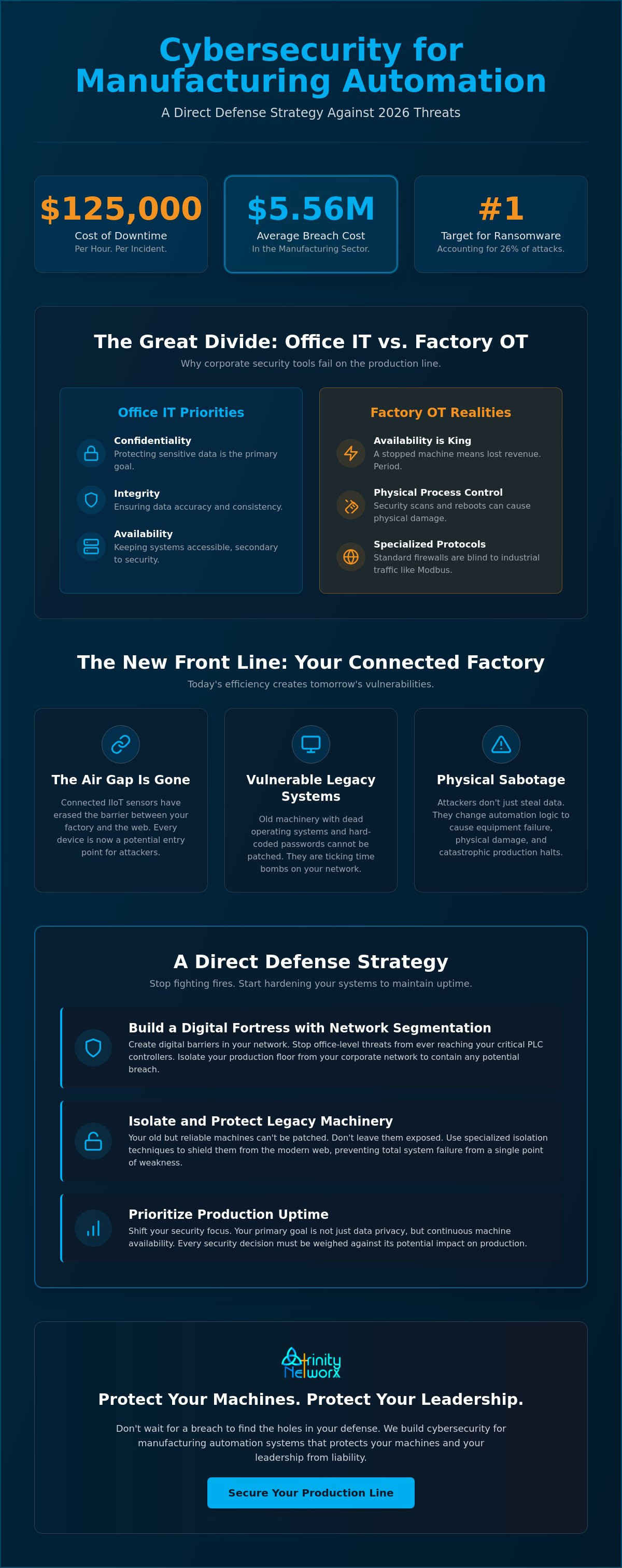
Unplanned downtime from a cyberattack now costs manufacturing companies up to $125,000 per hour. That is a direct hit. It kills your bottom line. You probably struggle with legacy hardware that refuses to take a patch. You are right to worry. This manual delivers a direct defense strategy for cybersecurity for manufacturing automation systems to keep your facility running. We skip the fluff. We focus on securing your industrial control systems against 2026 threats. The global average cost of a data breach in the manufacturing sector has climbed to $5.56 million. This is 2026. It is the new standard. If you feel stuck between office IT and factory OT, you aren't alone. Most plant managers face the same wall. We are here to tear it down. This guide breaks down how to protect your production line from sophisticated digital extortion. We look at the personal liability risks under the NIS2 directive and the new govern function in NIST 2.0 standards. You will finish this with a plan that protects your machines and your leadership team.
Contact our team at https://www.trinitynetworx.com/contact-us to secure your production line. Share this guide: Facebook | LinkedIn | X | Email
• Connected sensors and IIoT devices have erased the traditional air gap between the factory floor and the open web.
• Secure your production by building cybersecurity for manufacturing automation systems that prioritizes machine availability over simple data privacy.
• Legacy machinery with hard-coded passwords and dead operating systems needs specialized isolation to prevent total system failure.
• Network segmentation creates a physical barrier that stops office-level threats from reaching your critical PLC controllers.
• Move from reactive fire-fighting to proactive system hardening to maintain uptime in a high-threat environment.
Modern manufacturing plants aren't isolated islands anymore. Your factory floor talks to your office. Your sensors talk to the cloud. This connectivity drives efficiency, but it also invites every digital predator on the web into your shop. Every IIoT sensor and connected PLC acts as a potential door for attackers. In 2026, the strategy for Industrial Control System (ICS) cybersecurity has shifted because the targets have changed. Hackers don't just want your emails. They want your motor controls and your temperature sensors. This shift makes cybersecurity for manufacturing automation systems a physical safety priority, not just an IT task.
Ransomware groups have moved past simple data theft. They now target production availability. If your assembly line stops, your revenue stops. Attackers can manipulate automation logic to cause physical damage to expensive machinery. A slight change in valve timing or a furnace threshold can lead to catastrophic equipment failure. It's not just about bits and bytes. It's about steel and safety. Your IT infrastructure must account for these physical risks. According to recent 2026 data, the manufacturing sector is the most targeted industry for ransomware, accounting for 26% of all incidents. These aren't random glitches. They are coordinated strikes on your ability to produce.
Industrial espionage is back with a vengeance. Competitors and nation-state actors want your proprietary processes. They don't need to break into your safe if they can monitor your assembly logic. Small manufacturers often serve as the weakest link in a larger supply chain. Attackers use your network as a backdoor to reach larger partners. Critical infrastructure is the ultimate prize. Your plant is part of a larger machine. If it breaks, the ripple effect is massive. You are a target because of who you supply, not just what you make.
Every minute of a stopped line bleeds cash. In 2026, unplanned downtime from a cyberattack can cost manufacturing companies as much as $125,000 per hour. You can't just reboot a factory like a laptop. Recovery from an industrial breach takes significantly longer than fixing office IT. You have to verify every sensor and recalibrate every motor. Your reputation is on the line too. Distributors don't care about your excuses. They care about their empty shelves. If you can't deliver, they will find someone who can. Proactive defense is the only way to protect your growth.
Contact our team at https://www.trinitynetworx.com/contact-us to secure your production line. Share this guide: Facebook | LinkedIn | X | Email
Traditional office security tools are a mismatch for the factory floor. Dropping standard antivirus software onto a high-speed assembly line is a recipe for disaster. It's about timing. In the office, a half-second lag in an email is invisible. On the plant floor, that same delay can cause a robotic arm to miss its mark or trigger a false emergency stop. This fundamental friction is why cybersecurity for manufacturing automation systems requires a specific approach. You cannot simply copy-paste your corporate security policy onto your industrial controllers. It won't work. It will cause more problems than it solves.
IT departments live by the CIA triad: confidentiality, integrity, and availability. In the office, confidentiality usually wins. On the factory floor, availability is king. A machine that stops is a machine that loses money. Security scans often flood networks with probe traffic that can overwhelm older Programmable Logic Controllers (PLCs). Automated updates are another threat. A forced Windows reboot in the middle of a continuous production run can ruin a batch or damage hardware. Insights from NIST's project on Cybersecurity for Smart Manufacturing confirm that smart systems need defenses that respect the physical process. If you are struggling to balance these needs, our team can help with Managed IT Services tailored for the shop floor.
Standard firewalls are built to inspect web traffic like HTTP or SMTP. They are effectively blind to industrial protocols like Modbus, EtherNet/IP, or Profinet. These proprietary languages often lack basic authentication. If a command reaches the machine, the machine obeys it without question. Your office firewall won't see a malicious command sent to a PLC because it doesn't speak the language. This lack of visibility creates a massive blind spot for your cybersecurity for manufacturing automation systems. You need tools that understand industrial traffic to stop lateral movement between the office and the shop. If you aren't sure where your blind spots are, you should speak with a specialist before the next audit.
Contact our team at https://www.trinitynetworx.com/contact-us to secure your production line. Share this guide: Facebook | LinkedIn | X | Email
Lance Reichenberger, Ph.D.
Your thirty-year-old press isn't safe just because it lacks a Wi-Fi card. Legacy hardware is a massive blind spot in cybersecurity for manufacturing automation systems. These machines often run on operating systems that haven't seen a security update in a decade. Windows XP and NT still power thousands of factory floors. Hackers know this. They use these ancient systems as a beachhead to move through your network. If the machine cannot defend itself, you must build a fort around it. This is about physical survival in a digital age.
Thinking your floor is air-gapped is a dangerous fantasy. All it takes is one technician with a compromised USB drive or a laptop connected for quick maintenance. Once that bridge is crossed, your unpatchable hardware is defenseless. Many of these machines have hard-coded passwords. You can't change them. You can't update them. You have to defend them from the outside using strict IT infrastructure controls. This is not a suggestion. It is a requirement for any plant that intends to stay operational through 2026.
Identifying end-of-life hardware is your first priority. If you can't patch the machine, you have to patch the network traffic. Virtual patching acts as a temporary shield for old systems. You place a security layer in front of the device that filters out malicious traffic before it hits the vulnerable firmware. This creates a safety zone around hardware that cannot support modern security protocols. It is a practical way to manage risk without a multi-million dollar hardware replacement. We focus on what works right now.
Vendor backdoors are a gaping hole in your defense. Manufacturers often demand remote access to troubleshoot their machines. Don't give them a permanent key. Implement timed access for every third-party technician. Every minute an outside vendor is in your system is a minute of exposure. VPNs alone are not enough for industrial remote access. You need granular control that limits their movement. They should only see the machine they are fixing, nothing else. If you are unsure how to lock down these connections, our Managed IT Services team can audit your vendor access points and close the gaps.
Contact our team at https://www.trinitynetworx.com/contact-us to secure your production line. Share this guide: Facebook | LinkedIn | X | Email
Stop treating your factory floor like an extension of your guest Wi-Fi network. Hardening cybersecurity for manufacturing automation systems requires a deliberate separation of duties. You need to lock down the perimeter and the interior simultaneously. This is about building a defense that assumes the attacker is already in your office network. If they get into your billing department, they should find a brick wall when they try to reach your PLC controllers. This level of IT hardening is what separates survivors from victims in the next wave of industrial attacks.
Implementing the principle of least privilege is your next move. Shop floor workers don't need administrative rights to the HMI. They need to run the machine. That is it. Every extra permission is a vulnerability waiting for a mistake. You must pair this with continuous monitoring. You need to see the traffic patterns. If a sensor suddenly starts talking to an external IP in another country, you need to know in seconds, not months. This isn't about micromanagement. It is about visibility.
Creating a demilitarized zone (DMZ) between IT and OT is the gold standard. You use managed switches to dictate exactly which packets can cross the line. This stops lateral movement cold. If a virus hits an office workstation, it stays in the office. It cannot jump to the assembly line because the switches won't allow the protocol. This physical and logical barrier is the single most effective way to prevent a total plant shutdown. It keeps your production humming while the office cleans up a breach.
For manufacturers in Southern California, compliance is more than just a legal hurdle. It is a sales tool. Meeting NIST 800-82 standards shows your partners that you are a stable link in their chain. If you are chasing defense contracts, CMMC is your entry ticket. You cannot win these bids without proof of security. Working with CMMC compliance consultants helps you clear these hurdles without slowing down your production. This is how you win larger contracts while others are stuck in audits. Hardening cybersecurity for manufacturing automation systems is not about checking a box. It is about staying in the game. If you want to secure your defense manufacturing pipeline, the time to act is before the audit notice arrives.
Contact our team at https://www.trinitynetworx.com/contact-us to secure your production line. Share this guide: Facebook | LinkedIn | X | Email
Lance Reichenberger, Ph.D.
Southern California manufacturers can't afford a distant vendor who doesn't know the difference between a CNC machine and a desktop computer. You need local eyes on your hardware. Distance matters when your production line halts. A technician in a different time zone can't help you when a robotic cell locks up because of a suspected breach. This is why cybersecurity for manufacturing automation systems requires a partner who can be on-site when the situation demands it. We focus on local facilities in the Inland Empire, Orange County, and Los Angeles because physical proximity equals faster recovery.
Reactive repairs are a death sentence for your monthly quotas. If you wait for a screen to turn red before you call for help, you've already lost the battle. Proactive system hardening stops the threat before it touches your PLC. We maintain a 20-minute response time because every second of idle machinery is money leaving your bank account. Your security must live within your managed IT infrastructure. It isn't an afterthought. It is the foundation of your uptime. This integrated approach ensures that cybersecurity for manufacturing automation systems remains a business driver rather than a technical burden.
We build defense strategies that respect your production cycle. 24/7 monitoring shouldn't mean 24/7 interruptions to your workflow. Our team understands that you have shifts to run and deadlines to meet. We keep your facility running through IT optimization that focuses on the shop floor, not just the front office. We look at your power backups, your cabling, and your wireless signal strength. If the network drops, the line drops. We don't let that happen.
Start with a non-disruptive security assessment. We can look at your network traffic without unplugging a single machine. This gives you a clear picture of your vulnerabilities without the fear of a crash. Train your staff on physical security and social engineering. A stranger at the loading dock with a USB drive is just as dangerous as a hacker in another country. Most breaches start with a simple human error. Once you have the data, we can build a customized automation security plan that fits your specific machinery and compliance needs. Don't wait for the audit. Don't wait for the attack. Secure your future now.
Contact our team at https://www.trinitynetworx.com/contact-us to secure your production line. Share this guide: Facebook | LinkedIn | X | Email
Lance Reichenberger, Ph.D.
A stalled assembly line is a failed strategy. You now understand that office security fails on the factory floor. You know that legacy hardware requires a fortress of network segmentation to survive. These aren't just technical choices. They are the difference between meeting your 2026 quotas and explaining a massive breach to your board. Most plant managers wait for a crisis to act. You don't have to be one of them. We provide specialized experience in Southern California manufacturing to keep your machines running. Our 20-minute response guarantee ensures that if a threat appears, it doesn't stay. Lance Reichenberger, Ph.D. leads our expertise in cybersecurity for manufacturing automation systems to provide a defense that actually works. We don't do fluff. We do uptime. Protect your production line today. Contact Trinity Networx for an automation security assessment and take control of your floor. Your facility is ready for a new level of stability.
Contact our team at https://www.trinitynetworx.com/contact-us to secure your production line. Share this guide: Facebook | LinkedIn | X | Email
Lance Reichenberger, Ph.D.
No. Small manufacturers are frequently used as backdoors into larger supply chains. Attackers use automated scans to find any open port, regardless of company size. In 2026, 26% of ransomware attacks hit the manufacturing sector. Your plant is a target because of your connections to larger partners. Size doesn't protect you. Vulnerability does. If you supply a major firm, you are a high-value target for industrial espionage.
differs from office security by prioritizing physical uptime over data privacy. Standard IT tools can crash a PLC by flooding it with traffic. Factory security must be passive to avoid interfering with real-time machine logic. Timing is everything on the floor. A single millisecond of jitter can cause a robotic arm to fail. IT tools don't respect that reality.
Yes. You can use network segmentation and virtual patching to protect old hardware. This involves wrapping the machine in a secure layer that filters traffic before it hits the vulnerable firmware. You don't need to rip out a working press. You just need to hide it from the open network using managed switches and strict access rules. This approach stops the need for expensive hardware swaps while keeping your legacy assets running safely.
Not if the architecture is designed correctly. Properly configured industrial firewalls handle traffic at wire speed without adding latency. The goal is to remove the network noise that causes glitches, which actually improves reliability. Security should be an invisible guard, not a bottleneck for your assembly speed. We focus on low-latency hardware that keeps your cycles fast while blocking malicious packets. It keeps the line moving.
The first step is a non-disruptive network audit to see what is actually connected. You cannot protect what you can't see. Identifying every PLC, HMI, and sensor is the foundation of cybersecurity for manufacturing automation systems. Many managers find devices they didn't even know were on the web. Visibility is your first line of defense. It stops the guesswork and lets you build walls where they matter most.
Yes, if your contract involves Controlled Unclassified Information (CUI). The Department of Defense flows these requirements down the entire supply chain. If you want to keep your sub-contracts in 2026, you must meet the specific level required by your prime contractor. Failing an audit means losing your spot in the defense industrial base. It is a business survival issue, not just a technical one. You have to prove you are secure.
You should conduct a full assessment annually and perform continuous monitoring every day. The threat landscape changes too fast for a "one and done" approach. Regular spot checks on remote access logs help catch vendor backdoors before they are exploited. Stay proactive to stay running. Don't wait for a yearly checkup if you've added new machines or changed vendors. Every change is a new risk that requires verification.
Without proper segmentation, the breach will spread laterally to your shop floor. Ransomware often enters through an office email and then hunts for industrial controllers to lock. If your networks are flat, an office virus can stop your entire production line in minutes. Proper isolation ensures that even if your billing department goes dark, your machines keep spinning. It keeps a business problem from becoming a production disaster.
Contact our team at https://www.trinitynetworx.com/contact-us to secure your production line. Share this guide: Facebook | LinkedIn | X | Email

Article by
Lance Reichenberger, Ph.D.., J.D. (Candidate)
Dr. Lance Reichenberger is the founder of Trinity Networx, a Southern California technology firm specializing in managed IT services, cybersecurity, network infrastructure, and business technology strategy. With nearly four decades of experience in the IT industry, he works with businesses to improve operational efficiency, strengthen security, and align technology with long-term growth objectives.
Lance focuses on proactive IT management, enterprise wireless infrastructure, cybersecurity integration, and scalable technology solutions for growing organizations throughout Southern California.
The content published on this website is provided for general informational and educational purposes only. Articles may be created, edited, or enhanced with the assistance of artificial intelligence and automation tools under the direction and review of Trinity Networx. While every effort is made to ensure accuracy and relevance, the information provided should not be considered professional, legal, financial, cybersecurity, or technical advice specific to your organization. Businesses should consult directly with a qualified professional regarding their unique environment, compliance requirements, and operational needs. Trinity Networx makes no warranties regarding completeness, reliability, or applicability of the information contained within these articles.
Schedule a brief conversation with Trinity Networx to discuss your business technology needs.
Get a practical roadmap built around your business, your users, your systems, and the technology issues that need attention first.
Put the right technology, support, security, and infrastructure in place so your business can grow, adapt, and move forward with confidence.