3281 E. Guasti Rd, STE 700, Ontario, CA 91761
1712 9th Ave SW, Watertown, SD 57201

By Lance Reichenberger, Ph.D.
Manufacturing cyberattacks now cost victims an average of $8.7 million per incident. It's a staggering figure. It makes your factory floor a primary target for digital extortion. If you operate in the Inland Empire or Orange County, cybersecurity for manufacturing Southern California isn't a luxury anymore. It's the only way to keep your machines moving. You know that even one hour of silence on the production line costs thousands. It's a nightmare that keeps owners awake at night.
We understand the pressure of meeting CMMC 2.0 deadlines while trying to ship orders on time. You shouldn't have to choose between security and speed. This case study shows how a proactive defense strategy keeps your proprietary designs safe and your sensors active. We'll show you how to achieve zero downtime during security updates and lock down defense contracts without the usual headache. It's about moving from a reactive panic to a state of total operational certainty.
• See why local machine shops are prime targets for intellectual property theft and how to protect both office and shop floor systems.
• Calculate the real cost of production silence through a ransomware scenario where ERP access vanishes in seconds.
• Learn why CNC controllers need specialized protection and how network segmentation strengthens cybersecurity for manufacturing Southern California.
• Get a clear breakdown of CMMC Level 2 rules and NIST 800-171 standards to protect your federal defense contracts.
• Find out how a local partner with a sub-20 minute response time keeps your machines running when every second counts.
Lance Reichenberger, Ph.D.
The Inland Empire isn't just a logistics hub. It's the engine room for the nation's aerospace sector. Hundreds of machine shops across Ontario, Riverside, and Irvine build the parts that keep planes in the sky. This density makes cybersecurity for manufacturing Southern California a high-stakes game. It isn't just about protecting your email. You have to lock down the shop floor. Most owners think their firewalls are enough. They aren't. A standard office setup won't stop an attacker from reaching your CNC machines.
Manufacturing security covers two distinct worlds. You have the Information Technology (IT) in the front office and the Operational Technology (OT) on the floor. Most shops treat them as one big pool. That's a mistake. A single phishing link in the office shouldn't be able to kill a lathe. You need Industrial Control System (ICS) cybersecurity to keep these systems separate and safe. Modern manufacturing relies on data. Your machines are connected to the cloud and your ERP system. This connectivity is a double-edged sword. It drives efficiency but opens doors for attackers. A proactive defense isn't just a checkbox; it's a survival tactic.
Foreign actors want your CAD files. They don't want to spend years on R&D when they can just steal your proprietary designs. If you're a defense supplier, a data leak doesn't just cost money. It ends your relationship with the DoD. IBM's 2025 X-Force report found that manufacturing is the most targeted industry for the fourth year in a row. It accounts for 26% of all ransomware incidents. The average cost of a ransomware incident in manufacturing hit $8.7 million in 2024. That's a death sentence for a mid-sized shop in Chino or Corona. Your shop isn't too small to be a target. It's the perfect size for an easy win.
Standard antivirus programs work for laptops. They don't work for PLC controllers or milling machines. Many factory floors run on "flat networks." This means there's no wall between the breakroom Wi-Fi and the production line. If one person clicks a bad link, the whole shop goes dark. You need a proactive strategy that treats your machines as the priority. This involves hardware-level security and constant monitoring. We focus on it-infrastructure that isolates your money-making assets from the messy outside world. It's about building a perimeter that actually holds.
Keep your production line moving. Contact Trinity Networx today to secure your shop floor: contact us
Share this article: [Facebook] [LinkedIn] [Twitter]
Lance Reichenberger, Ph.D.
Imagine a Tuesday morning at a mid-sized machine shop in Ontario, California. The rhythmic hum of CNC machines is the sound of profit. Suddenly, that sound vanishes. The shop floor goes cold. Screen after screen displays a red ransom note. Your ERP system is the brain of your operation. Now, it's locked. This isn't just an IT glitch. It's a full scale attack on a business within the Critical Manufacturing Sector. For those managing cybersecurity for manufacturing Southern California, this is the ultimate nightmare.
The owner watches 40 machinists stand idle. Every minute they wait, the company bleeds cash. Missed shipping deadlines for an aerospace client trigger massive penalties. We're talking about a $50,000 per hour silence. Without a verified incident response plan, the panic is thick. The owner calls his current IT guy and gets a voicemail. This is the reality of a reactive approach. You're paying for labor that can't produce and overhead that doesn't stop.
The breach started through an unpatched legacy server. It sat in a corner, forgotten but connected to the main network. Attackers used this weak link to move sideways. They didn't just stay on that one box. They hunted for the production scheduling data and encrypted it. The existing IT provider failed to catch the breach because they weren't looking. They only reacted to broken hardware. They missed the quiet signals of a predator moving through the system. Effective cybersecurity for manufacturing Southern California demands a partner who hunts for threats before they strike.
Recovery began with a hard disconnect. We isolated the factory floor from the infected office network to stop the spread. Because the shop had a solid business data backup, they had a way out. They didn't have to pay the hackers a single cent. We wiped the servers and restored the data from an offline point. The transition to a proactive security model started that afternoon. Now, they have 24/7 monitoring that kills threats in seconds. If a bad actor tries to enter, the system shuts the door automatically. You can't afford to wait for a disaster to find your weak spots. It's better to audit your current security setup before the machines stop.
Protect your production line from expensive downtime. Contact Trinity Networx today: contact us
Share this case study: [Facebook] [LinkedIn] [Twitter]
Lance Reichenberger, Ph.D.
Don't treat a five-axis mill like a front-desk laptop. It's a common mistake in cybersecurity for manufacturing Southern California. Standard antivirus software is often too heavy for CNC controllers. If a security scan spikes the CPU during a precision cut, you risk a tool crash. That's a $15,000 mistake you can't afford. Operational Technology (OT) requires a lighter touch and a different set of rules. You need protection that stays out of the way of your production cycle.
Legacy systems are another major headache. Many shops run on Windows XP or Windows 7 because the hardware it controls is still perfectly functional. You can't patch these old operating systems. They are open doors for modern malware. The answer isn't to scrap a million dollars in equipment. Instead, you must isolate these machines. They shouldn't have direct access to the internet or your office network. This isolation is the only way to keep them running safely in a hostile digital environment.
Most machine shops have a "flat" network. This means every device can talk to every other device. It's a disaster waiting to happen. If a bookkeeper opens a bad attachment, the infection can jump straight to your PLC controllers. You need managed firewall services to build internal borders. These digital walls keep office traffic away from your production data. It limits lateral movement during an attack. If one area gets hit, the rest of the shop stays clean. This containment strategy is a core part of Cybersecurity Risk Mitigation for Small Manufacturers.
Securing the floor means looking beyond software. You need it-infrastructure that can survive the shop environment. Dust, metal shavings, and heat destroy standard servers. We use hardened hardware that acts as a security gateway for your machines. This creates a protective shell around your equipment without slowing down the work. Remote access for maintenance techs must also be locked down. Instead of a permanent link, use "just-in-time" access. Give them a window of time to work, then slam the door shut. This keeps your perimeter strong and your vendors accountable.
Stop guessing about your shop floor security. Get a professional assessment from Trinity Networx: contact us
Share this article: [Facebook] [LinkedIn] [Twitter]
Lance Reichenberger, Ph.D.
The Department of Defense isn't asking for security anymore. It's demanding it. For shops in the Inland Empire or San Diego, cybersecurity for manufacturing Southern California is now tied directly to your ability to bid. CMMC 2.0 is moving fast. Phase 1 is already active. Phase 2 starts on November 10, 2026. This date is the finish line for mandatory Level 2 certifications. If you aren't ready by then, you're out of the supply chain. It's that simple. You can't afford to wait until the last minute to start this process.
NIST SP 800-171 is the baseline you must meet. It's a list of 110 controls designed to protect sensitive data. Many owners see this as a burden. We see it as a moat. Meeting these standards doesn't just keep you legal. It makes you a more attractive partner for prime contractors like Northrop Grumman or Lockheed Martin. They want to know their data is safe in your hands. Security upgrades pay for themselves by opening doors that were previously locked. It's a strategic move for business growth.
In your shop, CUI takes the form of digital blueprints, material specs, and proprietary CAD files. This data cannot sit on a standard office PC. You must follow strict rules for how you store and send it. Encryption is mandatory. Access must be restricted to only those who need it for the job. If you feel overwhelmed by the paperwork, you aren't alone. Many local shops work with CMMC compliance consultants to navigate the red tape. It's about building a system that proves you can be trusted with national security data.
Compliance isn't a one-time event. You need an audit trail that shows constant vigilance. This means keeping logs of who accessed what and when. If an auditor walks in tomorrow, can you show them six months of security data? You need a system that watches your network every second. Our managed cybersecurity services handle this heavy lifting for you. We provide the proof that auditors demand. Leadership must drive this change. It starts at the top. A culture of security is the best defense against a failed audit.
Don't lose your defense contracts to a failed audit. Get a CMMC readiness assessment today.
Share this article: [Facebook] [LinkedIn] [Twitter]
Lance Reichenberger, Ph.D.
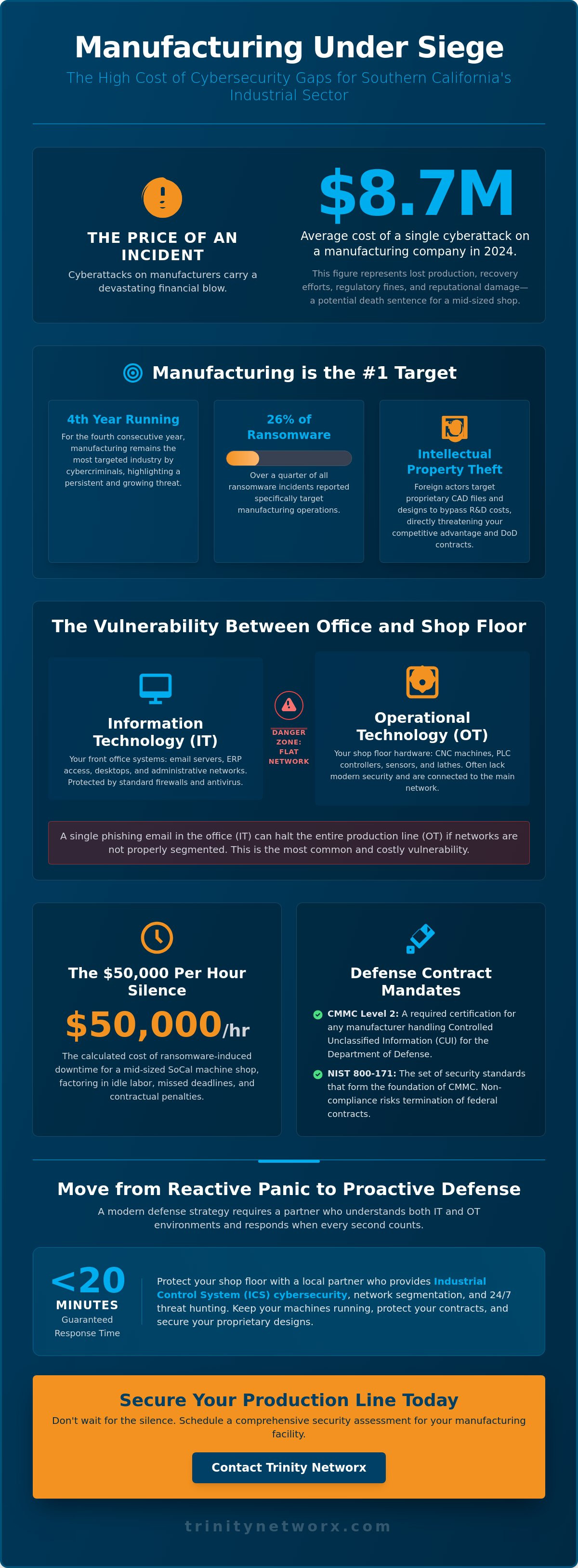
Trinity Networx is different. We don't hide behind a ticket system or a distant help desk while your shop floor sits silent and your machines stop turning. We guarantee a sub-20 minute response time. That's the standard for cybersecurity for manufacturing Southern California. Our team physically visits your shop floor to understand the layout of your machines and the flow of your data. We look at the dust on the servers and the heat in the racks. This local presence is how we build a defense that actually works for your specific shop. It's about assertive reliability.
Our it-management approach is built for the factory, not just the front office. We don't just fix broken computers. We act as a strategic driver for your business health. A proactive review of your systems identifies vulnerabilities before they turn into expensive downtime. You need to be ready before the next audit or the next hacker finds your IP address. We take the stress of technical efficiency off your plate so you can focus on shipping parts.
Efficiency is the lifeblood of manufacturing. Every second of machine idle time is lost profit. We use it-performance tuning to clear the digital bottlenecks that slow down your ERP and CAD software. This isn't about abstract technology. It's about cutting waste in your production cycle. Our culture is no-nonsense. We focus on results that show up on your balance sheet. We're tired of the status quo where IT is a cost center. We make it a tool for growth and a protective force for your proprietary designs.
The 2026 CMMC deadlines are coming fast. The supply chain is tightening for those who can't prove their security. You need to act now to secure your place in the defense sector. We invite you to a site-specific security assessment to see where your perimeter is thin. We'll walk your floor and find the gaps. Don't wait for a breach to realize your defense was weak. Effective cybersecurity for manufacturing Southern California starts with a local partner who knows the grit of a machine shop.
Contact Trinity Networx today for a site-specific security assessment: contact us
Share this article: [Facebook] [LinkedIn] [Twitter]
Lance Reichenberger, Ph.D.
Protecting a machine shop requires more than just a locked gate. It demands a digital perimeter that doesn't flinch. We've explored how proactive defense prevents the $50,000 per hour silence that follows a ransomware strike. Your shop floor needs a strategy that separates office traffic from your CNC controllers. This isn't just about safety. It's about maintaining your status in the defense supply chain. Meeting CMMC 2.0 standards is the only way to keep bidding on high value contracts as the 2026 deadlines approach.
Trinity Networx is the strategic partner you need for cybersecurity for manufacturing Southern California. Our local team understands the grit of the Inland Empire's production lines. We bring deep expertise in CMMC and NIST compliance to every project. With a guaranteed response time under 20 minutes, we ensure your sensors stay active and your data stays online. Don't wait for a red screen to find your weaknesses. Secure your shop floor and contact Trinity Networx today. Your production heartbeat is too valuable to leave to chance.
Lance Reichenberger, Ph.D.
Ransomware remains the top threat for 2026. Data shows manufacturing is hit more than any other sector. Attackers now use extortion, threatening to leak blueprints rather than just encrypting files. This makes cybersecurity for manufacturing Southern California a daily battle for shop owners. You need active monitoring to catch these predators before they lock your servers and freeze your revenue.
Yes, compliance is mandatory for any shop touching Department of Defense contracts. The Phase 2 deadline on November 10, 2026, requires Level 2 certification for applicable solicitations. Size doesn't grant an exemption. If you handle sensitive data, you must meet the NIST 800-171 standards. It's the cost of doing business with the military. Procrastination puts your revenue at risk.
Segmentation acts as a digital firewall inside your own building. It keeps the front office Wi-Fi separate from your milling machines. If a bookkeeper clicks a malicious link, the infection stops at the office door. It can't jump to your PLC controllers. This containment strategy keeps your machines moving while you clean up the office mess. It prevents a single mistake from killing your production.
You can protect legacy gear without replacing it. We use hardware-level isolation to wrap old Windows XP or 7 machines in a protective shell. These machines stay off the open internet. They only talk to the specific servers they need. This approach keeps your million-dollar assets productive without exposing them to modern exploits. You don't have to scrap functional hardware to stay secure.
The average cost of a manufacturing breach reached $8.7 million in 2024. Most of that loss comes from idle labor and missed delivery penalties. If your machines stop for three days, you might lose your biggest client. cybersecurity for manufacturing Southern California is an investment to protect your cash flow from these sudden, massive hits. It's cheaper to defend than to recover.
Most shops need six to twelve months to reach full audit readiness. You have to document 110 different controls and prove they work over time. It isn't a quick fix you can buy in a box. It requires a culture shift and steady technical work. Starting today is the only way to meet the late 2026 deadlines without a panic.
Proper security tools actually help your performance. We focus on low-latency protection that stays out of the way of your CPU cycles. If a tool is slowing down your CAD rendering, it's configured wrong. Our proactive approach includes performance tuning to ensure your software runs at peak speed while staying locked down. You get safety without sacrificing your output.
Local providers offer a sub-20 minute response time that national firms can't match. We don't just send a ticket; we drive to your shop in Ontario or Irvine. We understand the specific heat and dust challenges of a local machine shop. Having a partner who knows your floor layout makes your defense faster and more reliable. We are neighbors, not just vendors.
Ensure your shop is ready for 2026. Contact Trinity Networx today for a detailed security audit: contact us
Share this FAQ: [Facebook] [LinkedIn] [Twitter]

Article by
Lance Reichenberger, Ph.D.., J.D. (Candidate)
Dr. Lance Reichenberger is the founder of Trinity Networx, a Southern California technology firm specializing in managed IT services, cybersecurity, network infrastructure, and business technology strategy. With nearly four decades of experience in the IT industry, he works with businesses to improve operational efficiency, strengthen security, and align technology with long-term growth objectives.
Lance focuses on proactive IT management, enterprise wireless infrastructure, cybersecurity integration, and scalable technology solutions for growing organizations throughout Southern California.
The content published on this website is provided for general informational and educational purposes only. Articles may be created, edited, or enhanced with the assistance of artificial intelligence and automation tools under the direction and review of Trinity Networx. While every effort is made to ensure accuracy and relevance, the information provided should not be considered professional, legal, financial, cybersecurity, or technical advice specific to your organization. Businesses should consult directly with a qualified professional regarding their unique environment, compliance requirements, and operational needs. Trinity Networx makes no warranties regarding completeness, reliability, or applicability of the information contained within these articles.
Schedule a brief conversation with Trinity Networx to discuss your business technology needs.
Get a practical roadmap built around your business, your users, your systems, and the technology issues that need attention first.
Put the right technology, support, security, and infrastructure in place so your business can grow, adapt, and move forward with confidence.