3281 E. Guasti Rd, STE 700, Ontario, CA 91761
1712 9th Ave SW, Watertown, SD 57201

A security culture grows when risk decisions become part of everyday work, not a binder left on a shelf. The NIST Cybersecurity Framework provides a shared structure for identifying vulnerabilities, prioritizing responses, and tracking progress. Its four implementation tiers help organizations assess how they manage cybersecurity risk. Cybersecurity framework implementation gives your program direction, but it does not eliminate risk.
That structure matters because security isn’t only an IT concern. Leadership, compliance teams and employees all influence how well policies hold up in practice. You’ll learn how the NIST CSF can bring those priorities together, how ISO/IEC 27001 organizes information security management, and how to choose an approach that fits your business needs.
This article compares what each framework helps you do, how frameworks can work together, and how your current processes and obligations shape the decision. The goal is a security program people can act on, not a framework that gathers dust.
• Compare framework options against your industry, risk exposure, and business obligations before choosing where to focus.
• See how an information security management system connects security policies with ongoing review and improvement.
• Use your existing security practices and business priorities to decide whether one framework or a combination fits best.
• Learn when managed IT or cybersecurity support can help turn framework goals into practical work across your organization.
The NIST CSF gives an organization shared language for discussing cybersecurity risk and setting priorities. Its four tiers describe risk management practices, not a maturity score or a guarantee against attacks.
Organization-wide risk tolerance is the level of cybersecurity risk leadership accepts while pursuing business goals. It guides which systems, data, and operations to assess first. A manufacturer, for example, may prioritize production networks and business-critical data. Leadership can then align security spending and response plans with operational impact instead of treating every vulnerability as equally urgent.
Frameworks organize risk management by helping teams identify vulnerabilities, prioritize mitigation, and monitor progress. They can also map existing controls to relevant standards and obligations, giving IT, compliance, and leadership a shared view of gaps. The NIST CSF can complement existing processes across industries. It supports resilience by connecting protection with the ability to detect attacks, respond, and recover.
Tier 2 describes organizations that use risk management to inform cybersecurity priorities, while practices remain inconsistent across the organization. Teams may receive information from their business ecosystem without sharing it internally or externally. Naming this gap helps leaders set a practical next priority: standardize how teams communicate risks, apply decisions, and escalate issues across the enterprise.
For small and midsize businesses, implementation costs depend on scope, existing controls, staff time, technology gaps, and any external expertise needed. NIST CSF work can begin by setting the scope, recording current practices, selecting target outcomes, prioritizing gaps, assigning owners, and reviewing progress. Leadership should approve risk tolerance; IT and compliance teams can manage control work and report status. Common challenges include unclear ownership, limited staff capacity, inconsistent practices, and overlooked systems, all of which can leave cybersecurity risks unmanaged.
ISO/IEC 27001 gives organizations a management system for directing information security work. It links risk decisions, responsibilities, and continual improvement to business operations.
According to the International Organization for Standardization, ISO/IEC 27001 specifies requirements for establishing, carrying out, maintaining, and continually improving an information security management system. An ISMS connects security policies with operational practices, helping leaders assess risks and record why they accept or treat them. This structure matters when information moves across teams, suppliers, and business systems. It ties decisions to a defined security program, rather than isolated technical fixes.
System and asset identification means recording the information systems, data, and connections that support business operations. Start with each asset’s owner and business purpose, then note what information it holds and how it connects to other assets. A production system, for example, may depend on identity services and shared business data. This inventory helps teams assess system risk before authorizing use, set protection priorities, and spot changes that could affect the organization’s security posture.
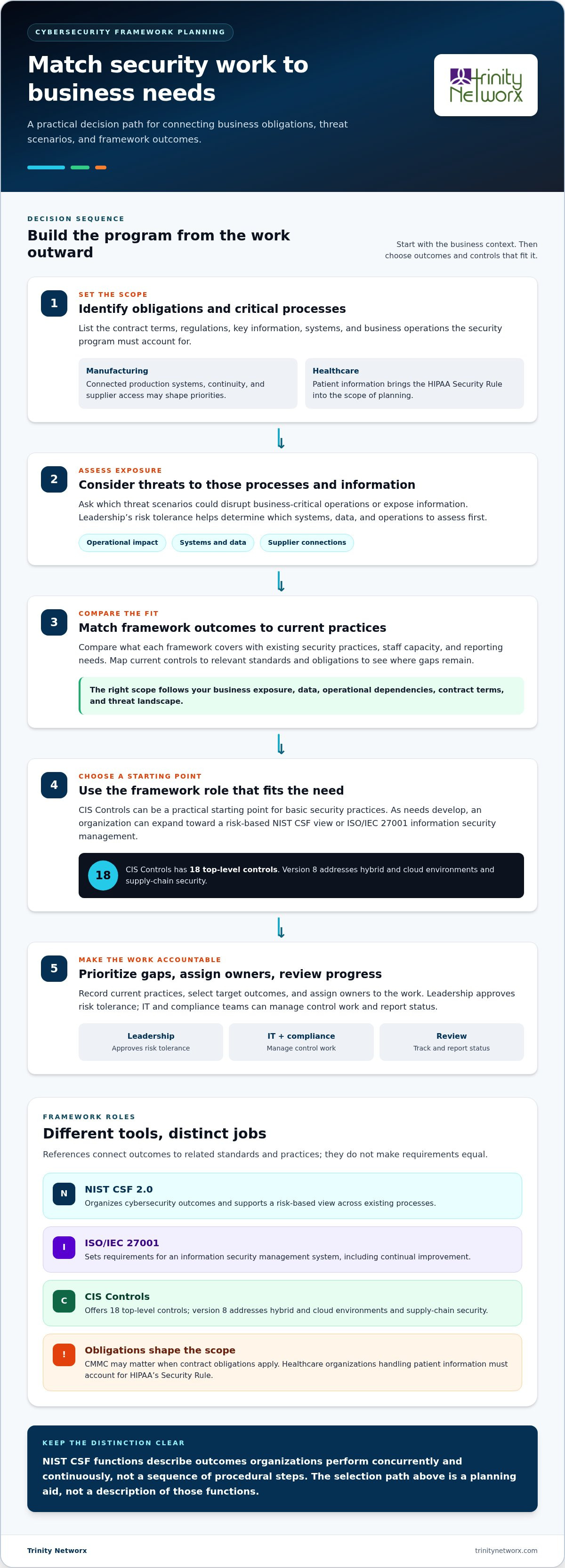
Informative references connect framework outcomes with related standards and practices, but a reference does not establish equal requirements. NIST CSF 2.0 organizes cybersecurity outcomes; ISO/IEC 27001 sets ISMS requirements; CIS Controls offers 18 top-level controls. CMMC may matter to organizations with applicable contract obligations. These distinctions help leaders match tools to security needs and business decisions. NIST CSF references ISO/IEC 27001:2013, which can guide comparisons without implying that one framework satisfies another. For help connecting security goals to business operations, discuss your security program.
The right security program starts with your business exposure, not a popular framework name. Match the approach to your industry, the data you handle, operational dependencies, contract terms, and threat landscape. A manufacturer with connected production systems may prioritize continuity and supplier access; a healthcare organization handling patient information must account for HIPAA’s Security Rule. These differences shape the program’s scope, controls, and compliance work.
Use a simple decision sequence. First, identify your obligations and business-critical processes. Next, assess which threat scenarios could disrupt those processes or expose information. Then compare framework outcomes with your existing security practices, staff capacity, and reporting needs. This keeps information security tied to decisions leaders can explain, rather than building a program around controls that do not fit.
CIS Controls can offer a practical starting point for organizations building basic security practices. The framework contains 18 top-level controls, and version 8 addresses hybrid and cloud environments and supply-chain security. As security needs develop, an organization can expand toward NIST CSF for a risk-based view or ISO/IEC 27001 for information security management. The choice can evolve; frameworks need not be treated as competing systems.
NIST CSF functions describe outcomes that organizations perform concurrently and continuously, not a sequence of procedural steps. That distinction helps teams align controls across detection, response, and recovery while adapting to changing threats. Choose the framework that makes priorities actionable for both technical teams and business owners. For help mapping framework goals to your organization’s processes, contact Trinity Networx.
Trinity Networx helps businesses connect security goals with day-to-day technology through Managed IT Services and Cybersecurity Solutions. In manufacturing, gaps between production technology and business systems can complicate access control and risk ownership. Trinity Networx’s commercial construction expertise also helps frame security around how operational systems, teams, and project environments depend on one another.
Turn to Managed IT Services when your internal team needs support coordinating security work with business operations. Co-Managed IT can supplement an existing IT team, while Data Backup & Recovery supports preparation to restore business data after disruption. The right fit depends on your systems, team capacity, and operational priorities.
To discuss your organization’s security goals and technology environment, contact Trinity Networx.
A framework earns its place when people use it to make clear decisions, assign ownership, and connect security work to business operations. Choose a manageable priority and give it a named owner. That might mean reviewing access to a production system, clarifying how teams escalate a suspected incident, or checking whether recovery plans support essential work.
Cybersecurity framework implementation is ongoing work, shaped by changes in systems, responsibilities, and business needs. Trinity Networx offers Managed IT Services, Cybersecurity Solutions, and Data Backup & Recovery to support businesses working on those priorities. If you’re ready to discuss how security goals fit your IT environment, contact Trinity Networx to discuss cybersecurity. A clear first action can help your team move forward with purpose.
The NIST CSF gives teams a shared way to discuss and organize cybersecurity work. A manufacturing company could use it to connect production continuity, vendor access, and data protection in one risk discussion. Its flexible structure can complement existing processes and help leaders compare priorities across departments. It guides decisions, but it cannot eliminate cybersecurity risk or replace sound operational judgment.
A cybersecurity framework is a structured set of outcomes or practices that helps organizations organize security decisions. Common options include NIST CSF, ISO/IEC 27001, and CIS Controls. They serve different purposes: NIST CSF organizes cybersecurity outcomes, ISO/IEC 27001 sets requirements for an information security management system, and CIS Controls focuses on practical defensive actions. CMMC may also matter to businesses working with applicable contracts.
Start by listing business systems, data stores, user accounts, and connections, including operational technology where relevant. Assign each asset an owner and record its business purpose. Then compare written practices with available evidence, such as access settings, backup records, and incident procedures. A gap is the difference between the protection in place and the outcome the organization needs to support its operations.
Build the roadmap around business outcomes, not just a checklist. Record current safeguards, choose target outcomes, and rank gaps by their effect on essential processes, sensitive information, and recovery needs. For example, a company that depends on production systems may prioritize access control and restoration readiness ahead of lower-impact tasks. Assign owners, define evidence of completion, and revisit priorities when systems or business conditions change.
Applicable requirements depend on the information an organization handles, its industry, and its contracts. The HIPAA Security Rule is mandatory for healthcare entities in the United States and specifies administrative, physical, and technical safeguards for health information. PCI DSS is a payment-card security standard. Contract terms may also set cybersecurity expectations, so map each obligation to the systems and data it covers.

Article by
Lance Reichenberger, Ph.D.., J.D. (Candidate)
Dr. Lance Reichenberger is the founder of Trinity Networx, a Southern California technology firm specializing in managed IT services, cybersecurity, network infrastructure, and business technology strategy. With nearly four decades of experience in the IT industry, he works with businesses to improve operational efficiency, strengthen security, and align technology with long-term growth objectives.
Lance focuses on proactive IT management, enterprise wireless infrastructure, cybersecurity integration, and scalable technology solutions for growing organizations throughout Southern California.
The content published on this website is provided for general informational and educational purposes only. Articles may be created, edited, or enhanced with the assistance of artificial intelligence and automation tools under the direction and review of Trinity Networx. While every effort is made to ensure accuracy and relevance, the information provided should not be considered professional, legal, financial, cybersecurity, or technical advice specific to your organization. Businesses should consult directly with a qualified professional regarding their unique environment, compliance requirements, and operational needs. Trinity Networx makes no warranties regarding completeness, reliability, or applicability of the information contained within these articles.
Schedule a brief conversation with Trinity Networx to discuss your business technology needs.
Get a practical roadmap built around your business, your users, your systems, and the technology issues that need attention first.
Put the right technology, support, security, and infrastructure in place so your business can grow, adapt, and move forward with confidence.