3281 E. Guasti Rd, STE 700, Ontario, CA 91761
1712 9th Ave SW, Watertown, SD 57201

Lance Reichenberger, Ph.D.
Contact the Trinity Networx, LLC team at contact us | Share this strategy: [LinkedIn] [Facebook] [X]
California businesses now have exactly thirty days to report a breach or face civil penalties up to $7,500 for every intentional violation. Waiting for an attack to happen before deciding how to react is no longer just a risk; it's a financial death sentence. You need a cybersecurity incident response plan for Southern California businesses that functions as an active shield rather than a dusty binder on a shelf.
Speed is your only defense. We understand the anxiety that comes with shifting CMMC requirements and the looming threat of operational downtime that costs millions. You want to protect your data without getting buried in regulatory paperwork. This guide shows you how to build and execute a proactive strategy that meets 2026 California standards and stops active threats in minutes. We will outline the mandatory notification timelines, the latest Attorney General filing rules, and the exact steps to ensure your recovery is measured in minutes, not weeks.
• Identify why regional logistics hubs face heightened supply chain risks in the current threat environment.
• Construct a cybersecurity incident response plan for Southern California businesses that relies on active monitoring rather than passive defense.
• Master the 30 day notification window required by California law to protect your company from heavy civil penalties.
• Replace theoretical planning with quarterly tabletop simulations that prepare your staff for actual breach scenarios.
• Secure a 20 minute response time to keep your network stable and your business moving forward during a crisis.
Lance Reichenberger, Ph.D.
Contact the Trinity Networx team at contact us | Share this strategy: [LinkedIn] [Facebook] [X]
The threat environment changed. Hackers don't just lock your files anymore; they steal them first. This shift makes a generic, one-size-fits-all strategy useless for companies in the Inland Empire or Orange County. You need a cybersecurity incident response plan for Southern California businesses that accounts for local infrastructure and the aggressive tactics used by modern threat actors. Proactive defense moves faster than a breach. If you are reacting to a notification on your screen, you've already lost the first round. Speed wins. Wait and see is a failed policy that leads to bankruptcy.
Dual extortion is the primary 2026 threat where attackers steal sensitive data before they ever trigger encryption. It's a double-edged sword. Even if your backups are perfect, the threat of a public data leak remains. Reputational damage often costs more than the ransom itself. According to 2026 projections, the global average cost of a data breach has climbed to $4.88 million. California businesses faced the highest victim loss in the nation last year, totaling over $2.159 billion. This isn't just about technical recovery; it's about computer security incident management that protects your brand's integrity. You must assume your data is already in transit the moment an anomaly is detected.
Ontario and Rancho Cucamonga serve as the backbone of the regional economy. These logistics hubs are prime targets for disruption. Interconnected vendor networks create multiple entry points for criminals. One weak link in a third-party warehouse system can bring your entire operation to a halt. Local expertise is required to secure these complex digital perimeters. We see specific threat patterns in the Inland Empire that national firms often overlook. Understanding the regional IT infrastructure and local vendor dependencies allows for a faster, more precise response. Static documents won't save you. You need a plan that recognizes the specific traffic patterns and business cycles of the Southern California market to maintain continuity when the grid is targeted.
Lance Reichenberger, Ph.D.
Contact the Trinity Networx team at contact us | Share this strategy: [LinkedIn] [Facebook] [X]
A static document is a liability. It creates a false sense of security while hackers move through your network at light speed. To survive, your cybersecurity incident response plan for Southern California businesses must be an operational framework, not a dusty binder. It starts with people. Establish a dedicated team with clear roles and direct contact protocols. If an employee notices a suspicious login at 2:00 AM, they shouldn't be hunting for an emergency phone number. Every second wasted is another file stolen. You need a chain of command that functions under pressure without hesitation.
Monitoring is your early warning system. Implement real time monitoring to detect anomalies before they scale into full blown disasters. Catching a single compromised credential in minutes can save you millions. Once a threat is identified, you need containment procedures that isolate infected endpoints immediately. This stops lateral movement. If you can't kill the connection, the attacker will find your backups. Finally, prepare your communication strategy for stakeholders and regulatory bodies today. Drafting a press release or a board report during a crisis is a recipe for errors. Speed requires preparation.
Automation tools identify threats faster than human observation. Use these tools to analyze the root cause and prevent immediate reinfection during recovery. Integrating it-infrastructure monitoring provides total network visibility. You cannot defend what you cannot see. By the time a human notices a slow system, the breach is likely hours old. Rapid analysis tells you exactly how they got in so you can slam the door shut for good.
Short term containment prevents the spread to critical backup servers. This is the "stop the bleeding" phase. Eradication involves removing every trace of the attacker from the system. Consult the CISA incident response playbook for a breakdown of technical eradication steps. Verify all backdoors are closed before beginning the restoration process. If you don't find the source, they will just come back tomorrow. If you aren't sure where to start, speak with our team to evaluate your current containment speed.
Lance Reichenberger, Ph.D.
Contact the Trinity Networx team at contact us | Share this strategy: [LinkedIn] [Facebook] [X]
Compliance is no longer an IT afterthought. It is a core business function. For companies in Orange County and the Inland Empire, ignoring the law is a fast track to litigation. Your cybersecurity incident response plan for Southern California businesses must prioritize these legal guardrails. California Civil Code §1798.82 dictates how you handle failure. If you don't follow the California data breach reporting requirements, the state will hold you accountable. Contracts vanish when trust breaks. Partners won't wait for you to fix your security. They will move to a vendor who already has their house in order.
As of January 1, 2026, the law is crystal clear. You have exactly 30 calendar days from the discovery of a breach to notify affected residents. This isn't a suggestion. If the breach hits more than 500 people, you must alert the Attorney General within 15 days of notifying individuals. Notification letters require specific, non negotiable language. Legal costs for non compliance can bankrupt an unprotected SMB. Civil penalties reach $2,500 per violation. Those fines jump to $7,500 if the state proves the violation was intentional. Speed is the only currency that matters when the clock is ticking on these deadlines.
Defense contractors in the Southland face even tighter scrutiny. You need CMMC compliance consultants to ensure your incident response meets federal standards. Losing a contract because of a paperwork error is a preventable tragedy. Healthcare providers face similar pressure under HIPAA. Your response plan must protect patient privacy or risk fines that dwarf the cost of the breach itself. Proactive IT support keeps these frameworks audit ready around the clock. We ensure your documentation matches your actions. When an auditor asks for your logs, you should be able to produce them in seconds. Don't let a compliance gap be the reason your business fails.
Lance Reichenberger, Ph.D.
Contact the Trinity Networx team at contact us | Share this strategy: [LinkedIn] [Facebook] [X]
A plan is just ink on paper if your team freezes during a crisis. Many organizations treat their strategy as a checkbox. They write it once and store it in a drawer. This is a mistake that leads to total chaos when the screen goes black. A cybersecurity incident response plan for Southern California businesses only works if your staff knows how to use it. You can't afford to learn on the fly while ransomware spreads through your servers. Speed requires muscle memory. You must move from theory to practice to ensure your business survives an intrusion.
Conduct quarterly tabletop exercises to simulate various attack scenarios. These sessions reveal who knows the protocols and who doesn't. It is better to find a gap in your communication chain during a drill than during a live breach. Perform regular restoration drills to verify business data backup integrity. If you can't restore your data in hours, your plan is a failure. Data that exists but can't be accessed is worthless. Update the plan based on lessons learned from every drill. Refine your steps until the response becomes second nature for everyone involved.
Test how your staff reacts to a simulated phishing attempt. Phishing is expected to be a factor in 42% of all global data breaches in 2026. Measure the time it takes to identify and report the incident. Does the report reach the security team in minutes, or does it sit in an inbox for hours? Identify gaps in the technical perimeter during the simulation. If a user clicks a malicious link, your system should catch the threat before it reaches the database. Simulations turn your employees from liabilities into active defenders.
Define exactly how much downtime your business can survive. For some firms, four hours of silence is a nuisance; for others, it's a financial catastrophe. Test the speed of data restoration from immutable backups to see if you meet those goals. Use it-optimization to reduce recovery windows and clear bottlenecks. The goal is a state where recovery is a standard procedure, not a miracle. If you haven't tested your restoration speed this month, you don't have a plan. Contact us today to schedule your first tabletop exercise and find your weak spots before the hackers do.
Lance Reichenberger, Ph.D.
Contact the Trinity Networx team at contact us | Share this strategy: [LinkedIn] [Facebook] [X]
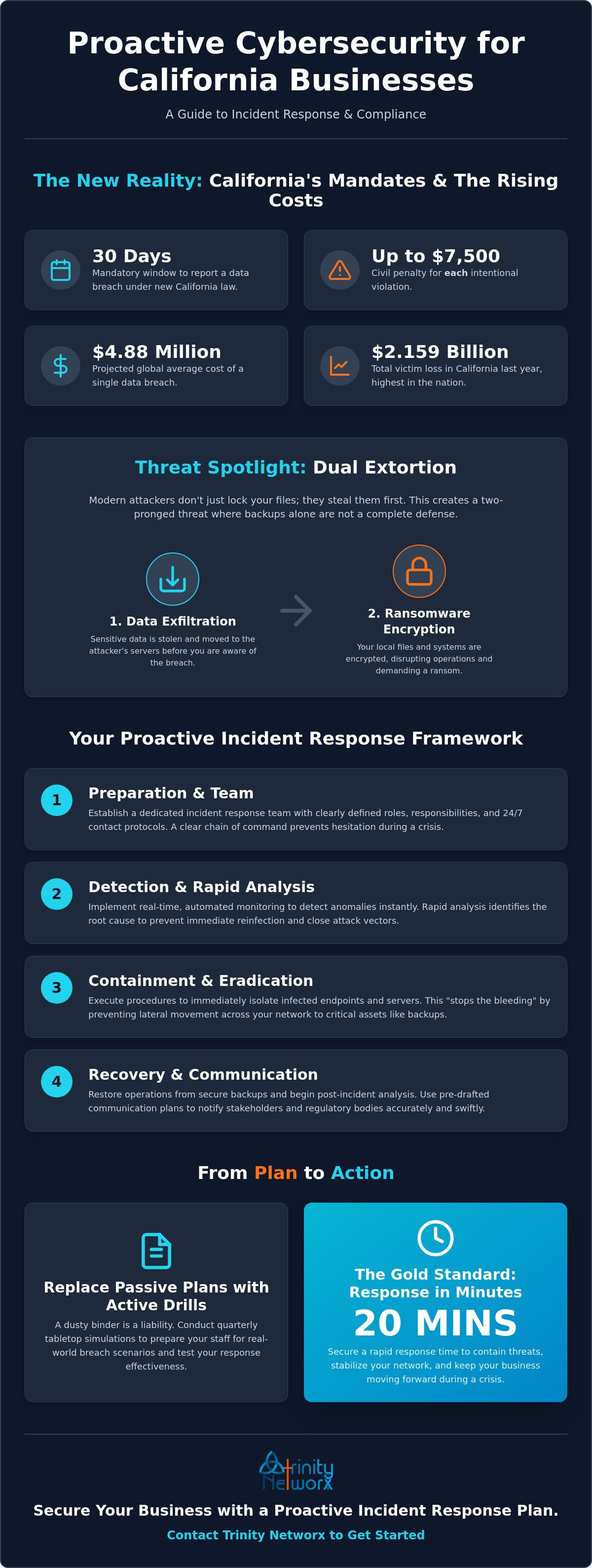
Speed is not a luxury. It is the only metric that determines if your business recovers or folds after a breach. While national providers offer generic help desks and slow ticket queues, we provide a guaranteed 20 minute response time. This isn't a goal; it's our standard for reliability. Your cybersecurity incident response plan for Southern California businesses requires a partner who can move as fast as the threats you face. We don't wait for you to call us. Our 24/7 network monitoring is specifically configured to protect the unique digital landscape of the Southland, catching anomalies before they reach your core database.
Strategic defense is about more than just software. It's about technical health driving business progress. Led by Lance Reichenberger, Ph.D., our team focuses on assertive reliability. We understand that every minute of downtime in a logistics hub or a medical office translates to lost revenue and broken trust. We act as an empowering force that allows you to focus on growth while we handle the technical complexity of defense. By the time a threat is even detected, our protocols are already in motion to isolate and eliminate the risk.
We act as your proactive it-management force. This means we don't just fix what is broken; we prevent the break from occurring. Our local presence ensures we understand the Inland Empire business climate and the specific vendor risks inherent in our regional supply chains. Steady competence replaces the chaos of a reactive IT model. You get a seasoned professional partner who values your time and growth above all else. We are tired of the status quo where businesses are left vulnerable by distant, faceless vendors. We stay in the fight with you.
Stop waiting for a breach to define your business future. A plan on paper is a start, but execution is what saves your reputation and your bottom line. Build a plan that acts as a strategic driver of growth rather than a reactive expense. We provide the stability you need to operate with total confidence in a hostile digital environment. Don't let your company become another statistic in the next Attorney General report. Contact Trinity Networx to start your proactive security assessment and lock down your perimeter today.
Lance Reichenberger, Ph.D.
Contact the Trinity Networx team at contact us | Share this strategy: [LinkedIn] [Facebook] [X]
Survival in the 2026 threat landscape isn't about having a document. It's about how fast your team moves when the clock starts. You've seen that dual extortion makes every second count and that California law doesn't forgive delays. A cybersecurity incident response plan for Southern California businesses must be a living, breathing part of your operations. We've proven that regular testing and strict compliance with CMMC or HIPAA standards are the only ways to stay ahead of regional threats. Don't wait for an auditor or a hacker to find your weaknesses.
Our team provides a sub-20-minute response guarantee because we know that technical health drives business progress. We monitor your network 24/7 from right here in Southern California to stop anomalies before they become disasters. Protect your business with a plan that actually works. Connect with Trinity Networx for a sub-20-minute response strategy. You have the tools to lead your industry with confidence. Let's build your defense today.
Lance Reichenberger, Ph.D.
Contact the Trinity Networx team at contact us | Share this strategy: [LinkedIn] [Facebook] [X]
California law effectively mandates a plan through the California Privacy Rights Act (CPRA) and strict data breach notification statutes. If you handle personal data of state residents, you must have protocols to meet the 30 day notification window. Failing to have a documented process makes it impossible to comply with mandatory audit requirements due every April 1st.
A functional baseline usually takes four to eight weeks to develop. This timeline includes identifying critical assets, defining team roles, and establishing clear communication trees. It isn't a one and done project. You must integrate it into your daily operations to ensure the strategy actually works when a real threat emerges.
Small businesses can draft a document alone, but executing a cybersecurity incident response plan for Southern California businesses requires technical speed most internal teams lack. Most SMBs don't have 24/7 monitoring or the forensic tools needed to stop lateral movement. Partnering with an expert ensures you meet the sub 20 minute response time necessary to prevent total data loss.
Incident response focuses on stopping an active attack and containing the damage. Disaster recovery is the process of restoring your systems and data after the threat is gone. Think of incident response as the firefighters putting out the blaze and disaster recovery as the contractors rebuilding the house. You need both to maintain business continuity.
Missing the 30 day notification deadline triggers immediate civil liability. The California Attorney General can levy fines up to $7,500 for each intentional violation. Beyond state fines, your business faces private rights of action from affected individuals. These legal battles often cost significantly more than the initial security investment.
Review your plan at least quarterly. Southern California is a high target zone; threat patterns shift monthly. You should also update the plan whenever you add new hardware, switch cloud providers, or change key personnel. Testing the plan through tabletop exercises every 90 days keeps your team sharp and your protocols relevant.
Most insurance providers now require a formal, tested plan before they will issue a policy. Carriers want to see that you are a lower risk. If you have a breach and can't prove you followed a documented response strategy, the insurer might deny your claim entirely. A proactive plan often leads to lower premiums and better coverage terms.
Logistics hubs in the Inland Empire and defense contractors in Orange County are primary targets. Healthcare providers also face extreme risk due to the high value of patient records on the dark web. Any business involved in the global supply chain must prioritize a cybersecurity incident response plan for Southern California businesses to avoid massive operational bottlenecks.

Article by
Lance Reichenberger, Ph.D.., J.D. (Candidate)
Dr. Lance Reichenberger is the founder of Trinity Networx, a Southern California technology firm specializing in managed IT services, cybersecurity, network infrastructure, and business technology strategy. With nearly four decades of experience in the IT industry, he works with businesses to improve operational efficiency, strengthen security, and align technology with long-term growth objectives.
Lance focuses on proactive IT management, enterprise wireless infrastructure, cybersecurity integration, and scalable technology solutions for growing organizations throughout Southern California.
The content published on this website is provided for general informational and educational purposes only. Articles may be created, edited, or enhanced with the assistance of artificial intelligence and automation tools under the direction and review of Trinity Networx. While every effort is made to ensure accuracy and relevance, the information provided should not be considered professional, legal, financial, cybersecurity, or technical advice specific to your organization. Businesses should consult directly with a qualified professional regarding their unique environment, compliance requirements, and operational needs. Trinity Networx makes no warranties regarding completeness, reliability, or applicability of the information contained within these articles.
Schedule a brief conversation with Trinity Networx to discuss your business technology needs.
Get a practical roadmap built around your business, your users, your systems, and the technology issues that need attention first.
Put the right technology, support, security, and infrastructure in place so your business can grow, adapt, and move forward with confidence.