3281 E. Guasti Rd, STE 700, Ontario, CA 91761
1712 9th Ave SW, Watertown, SD 57201

Lance Reichenberger, Ph.D.
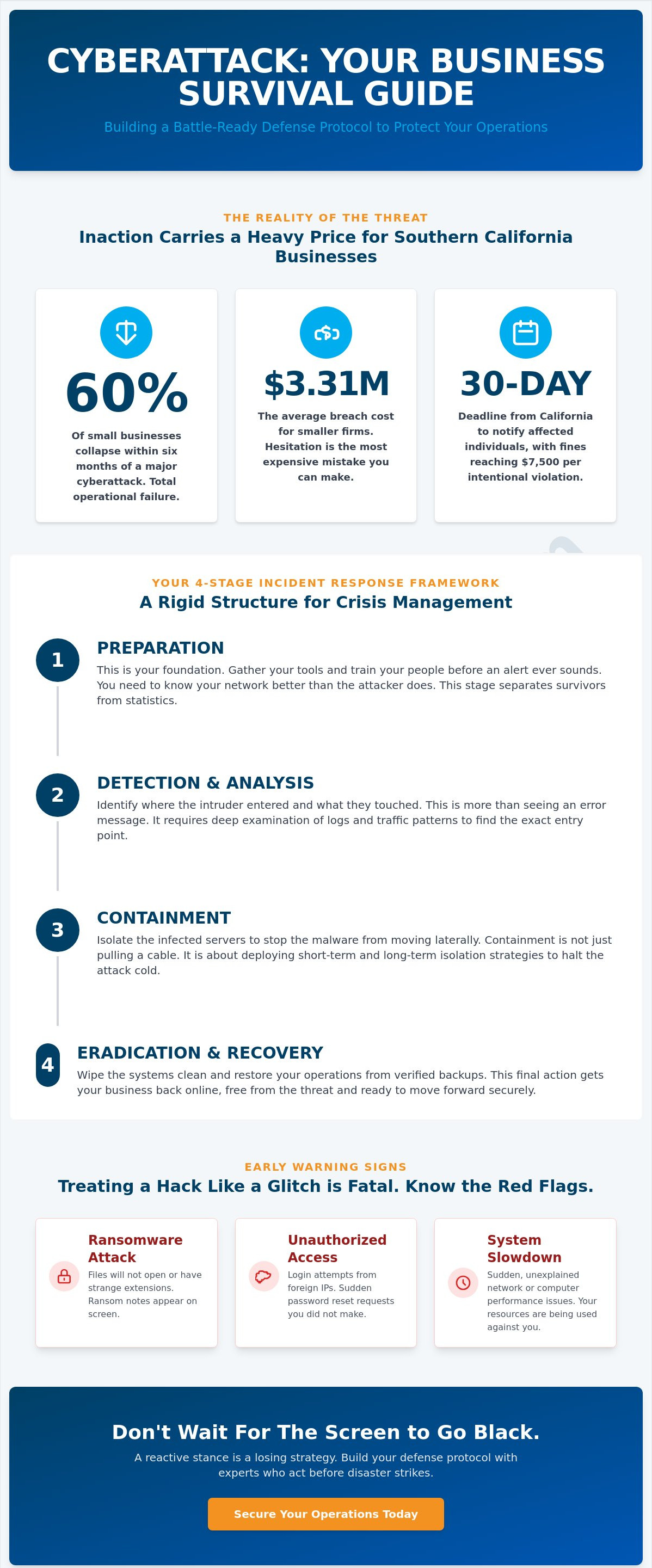
Sixty percent of small businesses collapse within six months of a major cyberattack. Total operational failure. This reality hits hard for Southern California business owners who juggle tight margins and strict local laws. You likely feel the weight of California's 30 day notification deadline or the fear of a total data wipe. It's exhausting to manage tech while worrying about legal penalties that reach $7,500 for intentional violations. No more guesswork. You need a cybersecurity incident response plan template that actually works when the screen goes black.
You already know that a reactive stance is a losing strategy in a region where hackers target SMBs more than any other group. This guide shows you how to build a battle-ready defense protocol to protect your business from total collapse. We are moving past the theoretical talk to give you a clear one-page document for emergencies. You will walk away with defined roles for your staff and the confidence to meet CMMC or HIPAA requirements. We will look at the specific steps to take during a crisis, how to handle the California Attorney General's reporting rules, and ways to keep your data safe.
Contact Trinity Networx, LLC at contact us to secure your operations today. Share this guide: [Facebook] [Twitter] [LinkedIn]
• Stop ransomware from paralyzing your operations by treating your response protocol as a survival manual.
• Build a cybersecurity incident response plan template that maps your data assets and fixes your emergency contact list so your team knows exactly who to call at 3 AM.
• Find the exact source of a breach quickly to limit damage and meet strict California reporting deadlines.
• Test your defenses with tabletop exercises to prove your team can handle a live threat without panic.
• Turn your defense strategy into a driver of business stability.
Lance Reichenberger, Ph.D.
The first sixty minutes of a cyberattack decide if your business survives or disappears. Chaos is the default setting when screens lock and ransom notes appear. Without a cybersecurity incident response plan template, your team will likely make moves that destroy evidence or accelerate data loss. This document is your survival manual. It replaces panic with a sequence of high-impact actions designed to stop the bleeding immediately. Hesitation is the most expensive mistake you can make. Every second an encryption script runs, your recovery costs climb. In the United States, the average cost of a data breach has reached $10.22 million. For smaller firms, that figure sits around $3.31 million. Those are not numbers you can ignore while your profit margins are already under pressure in Southern California.
Speed protects your bank account. A fast response preserves the incident response lifecycle, ensuring you can prove to insurance carriers that you followed protocol. If you can't show a clear chain of custody or a documented response, your claim might face rejection. We don't just talk about security; we treat it as a financial necessity. A battle-ready plan ensures that when a crisis hits, your leadership knows the exact chain of command. This clarity prevents the operational collapse that kills 60% of small businesses within six months of a breach.
Waiting for things to break before fixing them is a recipe for bankruptcy. Reactive IT means you are paying for emergency repairs at the highest possible rates while your staff sits idle. Proactive support changes that dynamic. We aim for a 20 minute response time because we know that speed is the only way to beat a modern threat. If you are looking for Managed IT Services in Ontario CA, you want a partner who acts before the disaster, not one who just cleans up the mess. Scrambling for help during an active breach is twice as expensive as having a team already on the line.
Not every computer glitch is a hack, but treating a hack like a glitch is fatal. You must know the red flags. If files won't open or have strange extensions, it's likely ransomware. Unauthorized login attempts from foreign countries or sudden system slowdowns are also major warnings. Early detection is your only path to minimizing damage. You need to know if you are facing a simple software bug or a malicious breach of your cybersecurity incident response plan template. One requires a reboot; the other requires you to isolate your network and call in the experts immediately. Don't guess. Act.
Contact Trinity Networx, LLC at contact us to secure your operations today.
Share this guide: [Facebook] [Twitter] [LinkedIn]
Lance Reichenberger, Ph.D.
A strong cybersecurity incident response plan template isn't a suggestion; it is a rigid framework. It functions in four distinct stages. First, preparation. This involves gathering your tools and training your people before an alert ever sounds. You need to know your network better than the attacker does. Second, detection and analysis. You must identify where the intruder entered and what they touched. This is about more than seeing an error. It requires looking at logs and traffic patterns to find the entry point. Third, containment. You isolate the infected servers to stop the malware from moving laterally through your network. Containment isn't just about pulling a cable; it's about short term and long term isolation strategies. Finally, eradication and recovery. You wipe the systems clean and restore operations from verified backups.
You need a chain of command that doesn't crumble under pressure. Assign one primary leader with the absolute authority to shut down the entire network if necessary. This person shouldn't be hunting for consensus while data leaks. Speed is the priority. You also need a dedicated communications lead. This person manages updates for clients and staff so the technical team can stay focused on the fix. Your managed cybersecurity services partner should be the first call on your list. They provide the extra hands and specialized tools that most internal teams lack. This partnership ensures that your business can expand its response even if your in-house IT is overwhelmed.
If your email server is encrypted, how do you talk? You must establish an out of band communication method like a secure messaging app or a separate phone tree. Your cybersecurity incident response plan template must list exactly who contacts your legal counsel and insurance provider. Delaying these calls can void your coverage or lead to regulatory fines. Set strict rules for your staff. They must not post about the event on social media or speak to reporters. Control the narrative to protect your brand. For a look at how the pros do it, the CISA incident response playbooks offer a high level look at federal standards. These resources help you align your internal steps with industry best practices.
Speed and precision are the only things that matter here. Every minute of downtime is a minute of lost revenue. If you are unsure if your current team can handle a live breach, it might be time to talk to a professional strategist. We help Southern California businesses move from a state of worry to a state of total readiness.
Contact Trinity Networx, LLC at contact us to secure your operations today.
Share this guide: [Facebook] [Twitter] [LinkedIn]
Lance Reichenberger, Ph.D.
Most templates fail because they are too long to read during a crisis. You don't need a 50 page binder when your data is being encrypted. You need a cybersecurity incident response plan template that fits on a single sheet of paper. Start with a high level contact list. This must include 24/7 phone numbers for your internal IT lead, your legal counsel, and your cyber insurance provider. Don't store this list solely on your server. If your network is locked, you won't be able to reach it. Print a physical copy and keep it in a secure, accessible location. This ensures you can start making calls within minutes of discovering a breach.
Your template must also map your most vital data assets and their backup locations. You can't protect what you haven't identified. Create specific playbooks for different scenarios. A ransomware event requires a different set of moves than a quiet data theft incident. Ransomware is a race to isolate hardware and restore systems. Data theft is a legal and forensic challenge. Aligning your steps with NIST's incident handling guide ensures your internal process follows federal standards for evidence preservation and recovery.
You must list every server and cloud application your team uses to stay operational. Use IT infrastructure management to audit your environment. Rank these assets by how much their absence hurts your daily revenue. If your primary database goes offline, does your production line stop? If your email is down for four hours, what is the dollar cost of that silence? This ranking tells your response team exactly what to fix first. It moves the focus from technical noise to business survival.
Technical isolation is about stopping the spread without destroying the evidence. Draft clear instructions for disabling network ports or killing cloud synchronization. Your team needs to know how to preserve volatile memory for forensic analysis. This memory often contains the encryption keys or the attacker's origin point. Never just pull the power plug from a machine during an active event. Pulling the power plug can destroy evidence that your insurance company or law enforcement will need later. Instead, use software level isolation to cut the connection while keeping the system running. This precision keeps your recovery options open and your legal standing firm.
Contact Trinity Networx, LLC at contact us to secure your operations today.
Share this guide: [Facebook] [Twitter] [LinkedIn]
Lance Reichenberger, Ph.D.
A plan sitting in a drawer is a liability. You don't want to find out your cybersecurity incident response plan template has holes while your servers are actively being wiped. You must break your own defenses in a controlled environment to ensure they hold up under real pressure. Testing turns a theoretical document into a functional tool. It reveals if your team actually knows where the backups are kept or who has the authority to cut the network feed. If you haven't run a drill in the last six months, your plan is likely out of date. New employees, updated software, and fresh hardware all change your risk profile. Every drill identifies weaknesses that you must close immediately. This is not a one-time event; it is a cycle of constant improvement.
Gather your leadership team in a room and throw a crisis at them. Start with a realistic scenario, such as a spoofed email from the CEO requesting an immediate wire transfer or a sudden lock on all financial files. Watch how they react. Does the communication break down? Do people wait for permission when they should be taking action? Focus on the speed of decision making. Technical perfection matters less than the ability to move quickly and decisively. If it takes your team two hours to decide to isolate a server, you've already lost the battle. These exercises expose the friction points in your command structure before a real attacker exploits them. Write down every failure. Use those failures to update your protocols and training.
A backup is worthless if you can't restore it in time to save your business. You must verify that your business data backup actually works by running a full system restore. Don't just check the status logs. Pull the data and see how long the process truly takes. Backups must be physically or logically separated from your main network. If a hacker gets admin rights, they will delete your backups first. Use infrastructure performance tuning to keep your recovery times low and your systems efficient. High recovery time objectives lead to total operational collapse. Testing ensures your safety net is actually there when you fall. It gives you the confidence to tell your clients that their data is safe.
Stop guessing about your security. If you want to see how your team handles a simulated attack, schedule a vulnerability assessment with our experts. We help you find the cracks before the hackers do.
Contact Trinity Networx at contact us to secure your operations today.
Share this guide: [Facebook] [Twitter] [LinkedIn]
Lance Reichenberger, Ph.D.
A battle-ready plan is a major competitive advantage for firms in the Inland Empire and Orange County. Most businesses stumble when a crisis hits. If you can prove resilience, you win the trust of clients who fear data loss. Your cybersecurity incident response plan template serves as your shield, but a shield is heavy to carry alone. Maintaining these protocols without a dedicated security partner is a recipe for exhaustion. You have a business to run; you shouldn't be spending your nights auditing firewall logs. Using managed firewall services creates an active defense that stops threats before they reach your internal network. Prevention is always more cost-effective than recovery. If the firewall does its job, you never have to trigger the emergency protocol.
California has the most demanding privacy laws in the country. As of January 1, 2026, your business must notify affected residents within 30 calendar days of discovering a breach. You then have only 15 calendar days to report the event to the Attorney General after notifying individuals. Missing these deadlines leads to civil penalties of up to $2,500 per violation, or $7,500 for intentional ones. These costs add up fast. Our CMMC compliance consultants help defense contractors navigate even stricter federal requirements. A local SoCal team understands these regional threats and legal traps better than a distant vendor. We are on the ground, ensuring your cybersecurity incident response plan template meets every state and federal mandate.
Stop treating your network security as an afterthought. It is a strategic driver of your progress. DIY security is a gamble that eventually ends in a loss. Trinity Networx acts as your authoritative partner, handling the technical heavy lifting so you can focus on growth. We replace your uncertainty with steady competence. A professional security audit is the only way to find the cracks in your armor before a hacker exploits them. We move you from a reactive posture to a state of total readiness. Don't wait for a total operational collapse to realize your plan was incomplete.
Contact Trinity Networx at contact us to secure your operations today.
Share this guide: [Facebook] [Twitter] [LinkedIn]
Lance Reichenberger, Ph.D.
You have the blueprint. Now you must act. A cybersecurity incident response plan template is your first step toward operational stability. Speed is your greatest weapon during a breach. By defining your team roles and testing your data restoration today, you ensure that a hacker's attempt doesn't become your business's end. Southern California firms face unique legal pressures and aggressive threats. You need a partner who understands the local landscape and the high stakes of compliance.
We have served this region since 2001. Our team provides 24/7 helpdesk support with response times under 20 minutes. We bring specialized expertise in CMMC and HIPAA compliance to keep your data locked down. Secure your business and get a professional security assessment by contacting Lance Reichenberger, Ph.D. at Trinity Networx today. Your business is too valuable to leave to chance. Take control of your security now and move forward with total confidence.
Share this guide: [Facebook] [Twitter] [LinkedIn]
Lance Reichenberger, Ph.D.
The most important part is a clearly defined chain of command. You cannot afford to hunt for consensus while ransomware encrypts your database. A successful plan identifies exactly who has the authority to isolate the network without waiting for a committee. This clarity stops the spread of malware and prevents the total operational collapse that kills most small businesses. Speed and authority are the only things that matter in the first hour.
Your business should update its cybersecurity incident response plan template every six months. Technology changes fast, and your staff list likely changes even faster. If you wait a year, your emergency contact list will be out of date. You must also refresh the document after any major software migration or hardware upgrade. Regular updates ensure the protocol remains a functional survival manual rather than a piece of useless paperwork.
Every small business needs a formal response team, even if it consists of just three key people. You need a technical lead, a communications lead, and a decision maker. Many Southern California SMBs use a co-managed IT model to fill these roles with external experts. This structure ensures that someone is always responsible for the next move. Without a formal team, the first hour of a breach is spent in total confusion.
You can use standard backups only if they are logically or physically separated from your main network. Standard backups that sit on the same server as your live data will be deleted by modern ransomware. You need immutable backups that hackers cannot touch. Testing these backups is the only way to verify they will work during a real recovery event. Don't assume your data is safe just because a status light is green.
California law requires you to notify affected residents within 30 calendar days of discovering a data breach. You must also report the event to the Attorney General within 15 days of notifying those individuals. These strict timelines are part of the California Consumer Privacy Act. Failing to meet these deadlines can result in civil penalties of up to $7,500 per intentional violation. Your response plan must include these specific legal triggers.
A documented plan provides proof of due diligence to your insurance carrier. Carriers are demanding more documentation before they pay out on a claim. If you can show a clear log of your response, your claim is much more likely to be approved. Having a tested cybersecurity incident response plan template can also help you secure lower premiums. It shows the insurer that you are a lower risk because you have a protocol for containment.
An incident response plan focuses on the immediate technical and legal actions taken during a cyberattack. A disaster recovery plan is broader, covering how you restore your entire IT infrastructure after a fire, flood, or total system failure. The incident response plan is about stopping the intruder and preserving evidence. Disaster recovery is about getting the lights back on and the phones ringing. You need both to protect your profit margins.
Paying the ransom is rarely the right move if you have a functional response plan and verified backups. There is no guarantee that the hackers will provide a working decryption key. Paying also marks your business as a soft target for future attacks. Your focus should be on isolating the threat and restoring from your data backup and recovery systems. Professional guidance is the best way to handle these high pressure negotiations.
Contact Trinity Networx at contact us to secure your operations today.
Share this guide: [Facebook] [Twitter] [LinkedIn]

Article by
Lance Reichenberger, Ph.D.., J.D. (Candidate)
Dr. Lance Reichenberger is the founder of Trinity Networx, a Southern California technology firm specializing in managed IT services, cybersecurity, network infrastructure, and business technology strategy. With nearly four decades of experience in the IT industry, he works with businesses to improve operational efficiency, strengthen security, and align technology with long-term growth objectives.
Lance focuses on proactive IT management, enterprise wireless infrastructure, cybersecurity integration, and scalable technology solutions for growing organizations throughout Southern California.
The content published on this website is provided for general informational and educational purposes only. Articles may be created, edited, or enhanced with the assistance of artificial intelligence and automation tools under the direction and review of Trinity Networx. While every effort is made to ensure accuracy and relevance, the information provided should not be considered professional, legal, financial, cybersecurity, or technical advice specific to your organization. Businesses should consult directly with a qualified professional regarding their unique environment, compliance requirements, and operational needs. Trinity Networx makes no warranties regarding completeness, reliability, or applicability of the information contained within these articles.
Schedule a brief conversation with Trinity Networx to discuss your business technology needs.
Get a practical roadmap built around your business, your users, your systems, and the technology issues that need attention first.
Put the right technology, support, security, and infrastructure in place so your business can grow, adapt, and move forward with confidence.