3281 E. Guasti Rd, STE 700, Ontario, CA 91761
1712 9th Ave SW, Watertown, SD 57201

Lance Reichenberger, Ph.D.
Contact our team at contact us. Share this guide on LinkedIn, X, or Facebook.
By November 10, 2026, your standing with the Department of Defense rests on a single third party assessment. Most defense contractors in the region view this as a bureaucratic anchor. It drags down operational speed. It doesn't have to be that way. Selecting the right cybersecurity solutions for CMMC Level 2 in Southern California means the difference between a failed audit and an efficient business that grows. You shouldn't have to choose between compliance and momentum.
You likely feel the weight of the 110 controls required by NIST SP 800-171 Revision 2. The fear of losing your primary revenue source is real. We're here to show you a straightforward method to C3PAO success that avoids hidden fees and technical downtime. This guide breaks down how to earn your certification while maintaining predictable monthly costs and a clear security posture. We will examine the specific steps to prepare your infrastructure for the upcoming Phase 2 rollout without exhausting your internal resources. Compliance is your new competitive edge.
Lance Reichenberger, Ph.D.
Contact our team at contact us. Share this guide on LinkedIn, X, or Facebook.
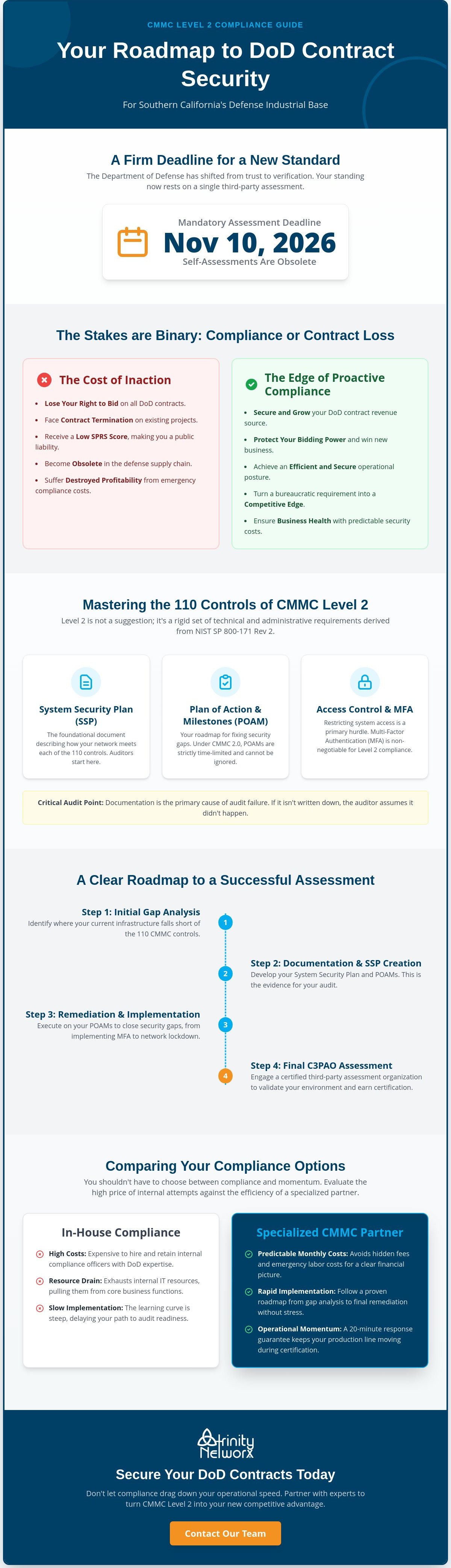
• Stop relying on self-assessments. Your DoD contracts depend on third-party verification by November 2026.
• Identify the cybersecurity solutions for CMMC Level 2 in Southern California that protect your profit margins.
• Compare the high price of hiring internal compliance officers against the rapid implementation offered by specialized partners.
• Follow a clear roadmap from initial gap analysis to final remediation to remove the stress from your next audit.
• Maintain operational momentum. A 20-minute response guarantee keeps your production line moving during the certification process.
Lance Reichenberger, Ph.D.
Contact our team at contact us. Share this guide on LinkedIn, X, or Facebook.
The Department of Defense has shifted from trust to verification. CMMC Level 2 is the mandatory benchmark for any contractor handling Controlled Unclassified Information. This isn't just another checklist. It's a structural overhaul of how the Southern California defense industrial base operates. Previously, you could self-attest to your security posture. Those days are over. Now, a certified third-party assessment organization (C3PAO) must validate your environment. For businesses from San Diego to the Inland Empire, the stakes are binary. You either pass the audit or you lose your right to bid on DoD contracts. By November 10, 2026, the second phase of this rollout will be in full effect. Trinity Networx, LLC observes that non-compliant vendors will face contract termination. This timeline is aggressive. Waiting until the last minute will likely result in a failed assessment because remediation takes time.
Contractors handling CUI are the specific targets for this tier. While Level 1 focuses on basic safeguarding of Federal Contract Information, Level 2 requires the implementation of 110 controls. This aligns with NIST 800-171 Rev 2 standards. Our local aerospace, maritime, and weapons systems industries are under the microscope. The Cybersecurity Maturity Model Certification (CMMC) standard was designed to stop intellectual property theft at every level of the supply chain. If you provide components for the F-35 or naval radar systems, you must act. You're part of a massive ecosystem that includes thousands of firms in the Inland Empire and San Diego. Delaying your preparation only creates a bottleneck when audit dates become scarce. Your competitors are already booking their assessments.
Small machine shops in Riverside or Orange County often face the harshest consequences. Failing to secure your network means losing your status as a prime or even a sub-tier contractor. Your Supplier Performance Risk System (SPRS) score is now a public record for DoD procurement officers. A low score makes you a liability. Implementing proactive cybersecurity solutions for CMMC Level 2 in Southern California protects your bidding power. Reactive security is expensive. It leads to rushed IT infrastructure upgrades and emergency labor costs that destroy your profitability. Proactive compliance ensures your business stays healthy and your contracts remain secure. It turns a regulatory requirement into a tool for growth. If you don't have the internal IT expertise to manage these complex controls, your business risks becoming obsolete. The cost of inaction is far higher than the cost of a managed security plan.
Lance Reichenberger, Ph.D.
Contact our team at contact us. Share this guide on LinkedIn, X, or Facebook.
CMMC Level 2 isn't a suggestion. It's a rigid set of 110 technical and administrative requirements. These controls originate from NIST Special Publication 800-171. For a business in Ontario or Riverside, this means every single device touching Controlled Unclassified Information must be locked down. You need a System Security Plan (SSP). This document describes how your specific network meets each control. If you have gaps, you need a Plan of Action and Milestones (POAM). However, under CMMC 2.0, POAMs are strictly time-limited. You can't just list a problem and ignore it for years. Documentation is the primary cause of audit failure. If it isn't written down, the auditor assumes it didn't happen. Most Inland Empire businesses struggle with the sheer volume of paperwork required to prove their security posture.
Restricting system access to authorized users is the first hurdle. Multi-Factor Authentication (MFA) is non-negotiable for Level 2 compliance. On a busy shop floor in Corona, employees often share logins to save time. This practice will fail your audit instantly. Every person needs a unique identity. Physical security matters too. You must control who walks into your server room or picks up a printed blueprint. Protecting your hardware is as vital as protecting your software.
Who did what? When? Log management is the backbone of accountability. You need to collect and review system logs to spot intruders. 24/7 monitoring stops data exfiltration before it happens. This is a heavy lift for internal IT. Many firms find that managing these compliance logs requires professional oversight to ensure nothing slips through the cracks. If your current documentation feels like a liability, it might be time to speak with a compliance specialist who understands the local defense landscape.
You will eventually face a threat. Level 2 demands a tested plan for detection and reporting. This includes strong data backup. If a breach occurs, you must report it to the DoD within 72 hours. Proactive cybersecurity solutions for CMMC Level 2 in Southern California prioritize recovery speed to keep your production lines running. You need a plan that has been rehearsed, not just a folder sitting on a shelf. Recovery isn't just about technical restoration; it's about business continuity.
Lance Reichenberger, Ph.D.
Contact our team at contact us. Share this guide on LinkedIn, X, or Facebook.
Deciding between an internal compliance team and a managed partner determines your speed to market. Hiring a full-time CMMC compliance officer in Southern California is expensive. Salaries for these specialists often exceed six figures before benefits. Most small to mid-sized defense contractors can't justify that overhead. You also face a massive implementation gap. Internal teams often lack the specific knowledge of the DoD CMMC Program requirements. This leads to slow progress and missed deadlines. Working with a provider shifts the technical liability. You gain a team of experts who have already navigated the C3PAO process. Local SoCal engineers are essential. They can visit your facility in Irvine or San Diego to address physical security controls. Remote-only vendors often miss the environmental details that lead to audit failure. You need boots on the ground to verify hardware placement and secure access points.
DIY compliance is a gamble. You'll spend heavily on hardware. Remediation accounts for the majority of certification costs, and doing it without a clear roadmap leads to wasted capital that your business cannot afford to lose. Your current IT staff is likely already overextended. Forcing them to manage NIST 800-171 controls without specific training results in burnout. It also increases the risk of configuration errors. Self-assessment has a high failure rate during the actual C3PAO audit. Without an outside perspective, you'll miss critical gaps in your IT infrastructure. You shouldn't risk your contracts on a "best effort" approach. Investing in the wrong tools because you lack expert guidance is a mistake that costs more than the certification itself.
Managed services replace high capital expenses with a predictable subscription. You get a complete security stack immediately. This includes 24/7 monitoring and endpoint protection. These IT performance strategies keep your business lean and agile. Ongoing security awareness training for your employees is part of the package. Compliance isn't a one-time event. It requires constant maintenance to pass the triennial recertification. Choosing professional cybersecurity solutions for CMMC Level 2 in Southern California ensures you remain audit-ready every day. You focus on manufacturing and defense. Trinity Networx, LLC focuses on the digital perimeter. This proactive model prevents the frantic scramble that happens when an audit date is finally set. Efficiency is the natural result of expert management.
Lance Reichenberger, Ph.D.
Contact our team at contact us. Share this guide on LinkedIn, X, or Facebook.
Earning your certification isn't a matter of luck. It requires a disciplined, step-by-step approach. Many contractors in the Inland Empire assume they can fix their security in a weekend. They can't. You need a concrete plan that moves from initial discovery to final validation. This process demands total visibility into your network. You must account for every laptop, server, and mobile device. Implementing cybersecurity solutions for CMMC Level 2 in Southern California involves three distinct phases. Each phase builds on the last. If you skip a step, the C3PAO auditor will find the hole. Stop guessing about your status. Start following a proven path that leads to a passing score and contract security.
The readiness assessment is an invasive look at your current environment. We audit every device. We track every user. You must identify exactly where Controlled Unclassified Information (CUI) lives in your workflow. This isn't just about digital files. It includes printed blueprints and physical parts. Gap analysis is the objective comparison of your current security state against the 110 requirements of NIST 800-171. This phase reveals the truth about your vulnerabilities before an auditor does.
Remediation is where the actual technical work happens. You install firewalls. You encrypt hard drives. But hardware is only half the battle. Your written policies must match what your shop actually does. If your policy says you change passwords every 90 days but your server says never, you will fail. Professional IT infrastructure management ensures your hardware and software are ready for scrutiny. This phase turns your security gaps into documented strengths that meet federal standards.
The formal audit is your final hurdle. A C3PAO auditor will walk your shop floor. They want evidence. They want to see your logs. They want to interview your staff to ensure they follow the rules. Once you finalize your System Security Plan (SSP), you must upload your score to the Supplier Performance Risk System (SPRS). This score tells the DoD you're a safe bet for a contract award. Expect the certification process to take several weeks after the auditor leaves your facility. If you're unsure where to start, contact our compliance team for a readiness review today.
Lance Reichenberger, Ph.D.
Contact our team at contact us. Share this guide on LinkedIn, X, or Facebook.
Trinity Networx, LLC is the assertive partner Southern California defense contractors need to survive the 2026 compliance shift. We don't just provide technical support. We act as a strategic driver for your business health. Our team provides cybersecurity solutions for CMMC Level 2 in Southern California that protect your revenue without slowing down your shop floor. We know that for a manufacturer in Riverside or a machine shop in Irvine, every minute of downtime is a direct hit to the bottom line. That's why we offer a 20-minute response guarantee. If your network stumbles, we are already moving to fix it. We prioritize operational continuity because a secure network is useless if it stops your production line. Our experience in the manufacturing and supply chain sectors allows us to secure complex environments where legacy hardware and modern cloud systems coexist.
Large IT vendors treat small and medium contractors like a ticket number in a queue. Trinity Networx, LLC rejects that distant approach. Our personalized care model ensures you have direct access to experts who know your specific facility and your specific contracts. We understand that you aren't looking for a software bundle. You're looking for a way to stay eligible for DoD work without wasting capital on tools you don't need. We provide the professional assurance that your security posture is audit-ready at all times. By choosing a partner that values your time as much as your security, you turn a regulatory burden into a functional advantage.
Trinity Networx, LLC is physically present in Southern California and the Inland Empire. This proximity is a critical component of your CMMC strategy. When a C3PAO auditor evaluates your physical security, they look at your server racks, your cabling, and your access points. If a hardware failure threatens your compliance status, you can't wait for a technician to fly in from across the country. Our engineers can be on-site quickly to resolve physical vulnerabilities. We understand the local defense industrial base and the specific pressures from aerospace primes in the region. Being local means we are part of your community and invested in your growth.
Compliance is a floor, not a ceiling. While we ensure you meet every NIST 800-171 control, our IT performance services focus on making your business more efficient. Security is the foundation for your digital growth. A secure, well-managed network allows your team to work faster and with more confidence. Trinity Networx, LLC helps you move away from reactive fixes and toward a proactive model that supports long-term stability. Don't let the 2026 deadline stall your business. Contact Trinity Networx, LLC today to start your readiness assessment and lock in your future with the Department of Defense.
Lance Reichenberger, Ph.D.
Contact our team at contact us. Share this guide on LinkedIn, X, or Facebook.
The November 10, 2026, deadline isn't a distant hurdle. It's an immediate call to action for your leadership team. You've seen the risks of DIY attempts and the high stakes of losing DoD contracts. Securing your environment isn't just about avoiding a failed audit. It's about positioning your firm as a reliable partner in the regional supply chain. Selecting the right cybersecurity solutions for CMMC Level 2 in Southern California turns compliance from a burden into a functional asset.
Trinity Networx, LLC brings over 20 years of local expertise to your specific facility. We focus on defense and manufacturing sectors because we know those shop floors require precision. Our 20-minute response guarantee means your business never stops moving while we lock down your network. We handle the technical complexity of the 110 controls so you can keep building for our national defense. Contact Lance Reichenberger, Ph.D. and the Trinity Networx, LLC team to start your CMMC assessment today. Your contracts are too valuable to leave to chance. Let's ensure your business remains a leader in the Southern California defense industrial base.
Lance Reichenberger, Ph.D.
Contact our team at contact us. Share this guide on LinkedIn, X, or Facebook.
Small defense firms usually spend between $50,000 and $100,000 to achieve full certification. This total includes your gap analysis, hardware remediation, and the mandatory C3PAO assessment fees. The Department of Defense suggests the audit alone averages about $76,743 for smaller organizations. Selecting professional cybersecurity solutions for CMMC Level 2 in Southern California helps control these costs by avoiding redundant tool purchases and emergency labor rates.
No, you cannot self-certify for contracts that mandate Level 2 once Phase 2 begins on November 10, 2026. While self-assessments were common in the past, the new framework requires an independent audit by a C3PAO. You must have this third-party verification to be eligible for contract awards involving Controlled Unclassified Information. Waiting to start this process puts your primary revenue streams at risk.
Most contractors require approximately 14 months to move from an initial gap analysis to a successful audit. This timeframe accounts for the procurement of new equipment, the writing of formal policies, and the mandatory period of generating logs to prove the controls work. If you delay your start until late 2026, you'll likely face a backlog of auditors and higher implementation costs. Speed depends on your current network maturity.
NIST 800-171 is the list of 110 security requirements, while CMMC Level 2 is the program that verifies you actually follow them. Previously, the DoD allowed you to promise compliance through self-attestation. CMMC removes that trust. You now need a certified auditor to walk your facility and check your digital logs to prove every NIST control is active. It's the difference between having a rulebook and passing a professional inspection.
Failing an audit stops you from winning any contract that requires CMMC Level 2 certification. You'll receive a list of deficiencies that must be fixed before you can try again. This means paying for a second assessment and waiting for a new opening in the auditor's schedule. A failed audit can sideline your production for months. We recommend a full readiness review to ensure you pass on your first attempt.
Level 2 requirements apply to every company in the supply chain that handles Controlled Unclassified Information. If you are a subcontractor and your prime contractor shares CUI with you, you must be certified. Large aerospace and defense primes are already checking their suppliers for compliance. If you can't prove your security posture, those primes will find a different partner who can. Compliance is now a requirement for doing business at any level.
You must undergo a full recertification assessment every three years. This triennial cycle ensures your security stays current as new threats emerge. You're also required to perform annual self-assessments and keep your scores updated in the Supplier Performance Risk System. Compliance isn't a one-time project. It's a permanent change in how you manage your business technology.
A Managed Service Provider can manage the technical controls and documentation, but your company leadership is still responsible for the final results. We provide the cybersecurity solutions for CMMC Level 2 in Southern California that meet the 110 NIST requirements. This includes 24/7 monitoring and incident response. While we handle the heavy lifting, your staff must still follow the internal security policies we help you establish. It's a partnership designed for audit success.

Article by
Lance Reichenberger, Ph.D.., J.D. (Candidate)
Dr. Lance Reichenberger is the founder of Trinity Networx, a Southern California technology firm specializing in managed IT services, cybersecurity, network infrastructure, and business technology strategy. With nearly four decades of experience in the IT industry, he works with businesses to improve operational efficiency, strengthen security, and align technology with long-term growth objectives.
Lance focuses on proactive IT management, enterprise wireless infrastructure, cybersecurity integration, and scalable technology solutions for growing organizations throughout Southern California.
The content published on this website is provided for general informational and educational purposes only. Articles may be created, edited, or enhanced with the assistance of artificial intelligence and automation tools under the direction and review of Trinity Networx. While every effort is made to ensure accuracy and relevance, the information provided should not be considered professional, legal, financial, cybersecurity, or technical advice specific to your organization. Businesses should consult directly with a qualified professional regarding their unique environment, compliance requirements, and operational needs. Trinity Networx makes no warranties regarding completeness, reliability, or applicability of the information contained within these articles.
Schedule a brief conversation with Trinity Networx to discuss your business technology needs.
Get a practical roadmap built around your business, your users, your systems, and the technology issues that need attention first.
Put the right technology, support, security, and infrastructure in place so your business can grow, adapt, and move forward with confidence.