3281 E. Guasti Rd, STE 700, Ontario, CA 91761
1712 9th Ave SW, Watertown, SD 57201

Your construction firm is a high-value target for ransomware, and your physical safety manuals won't stop a digital breach from freezing your job sites. You've spent years building a reputation for on-time delivery. It's frustrating to feel like your technical expertise stops at the office door while your field teams rely on insecure connections to access critical blueprints. Developing a company cybersecurity policy doesn't have to mean adding layers of friction that stall your projects. You can build a practical defense plan that secures your data and satisfies insurance requirements without slowing down your crew. This guide provides a clear path. We'll connect your office to the site. We'll walk through the essential steps to reduce operational downtime and keep your high-value project data out of the hands of attackers.
• Identify high-value digital assets like project bids and architectural blueprints that are often targeted by ransomware.
• Master the 5-step process for developing a company cybersecurity policy that accounts for every rugged laptop and cellular hotspot used in the field.
• Secure job site connections by implementing role-based access controls that limit data exposure without hindering project delivery.
• Ensure compliance with insurance and client requirements through regular network audits that eliminate operational downtime.
General IT templates fail construction firms. They ignore the reality of a foreman accessing blueprints from a truck or a subcontractor uploading payroll from a tablet. Developing a company cybersecurity policy requires identifying your specific digital crown jewels. Project bids, architectural drawings, and sensitive employee records are high-value targets for ransomware groups. If these assets are locked, your projects freeze. The financial impact is immediate. Idle crews and missed deadlines lead to liquidated damages that eat your profit margins in days.
Remote job sites are your biggest vulnerability. Field operations rely on cellular hotspots and mobile devices that often sit outside your office security perimeter. A single breach at the site level doesn't stay local. Attackers use these connections to move into your main office network. They hunt for financial data or move to halt your entire operation. You need a strategy that treats the job site as a secure extension of your business, not a technical afterthought.
Office-to-field connectivity presents a massive attack surface for commercial firms. Subcontractors often use public Wi-Fi or unmanaged personal phones to access your project management software. This creates gaps in your defense. Proper construction-focused IT planning is essential to secure these data flows. When developing a company cybersecurity policy, you must account for every connection point. You cannot afford to leave your office server exposed to the risks of an unsecured job site trailer. Contact our team at contact us to protect your project data.
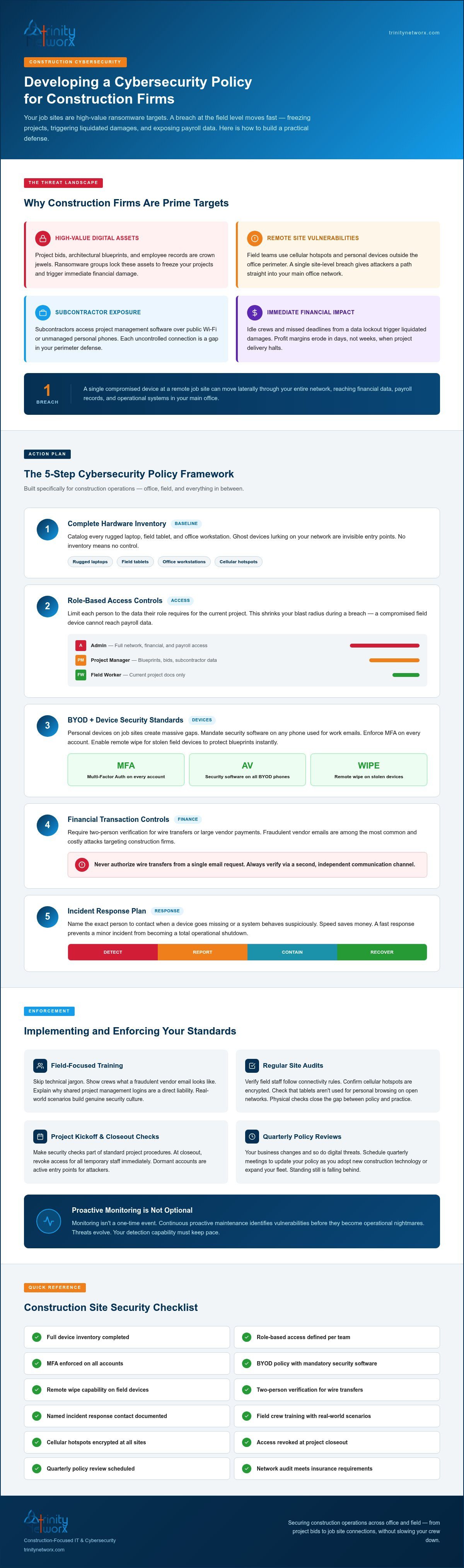
Developing a company cybersecurity policy begins with a hard look at your hardware. You need a complete inventory of every rugged laptop, field tablet, and office workstation. This baseline prevents ghost devices from lingering on your network. Once you know what is connected, define access by job role. A field worker should only access data required for their current project. This limit reduces your blast radius during a breach. It ensures that a compromised device in the field cannot easily reach sensitive payroll data in the office.
Developing a company cybersecurity policy is a practical tool for profit protection. Personal devices on job sites create massive gaps. Your policy must include a formal BYOD section that mandates security software on any phone used for work emails. Establish strict procedures for financial transactions. Require two-person verification for wire transfers or large vendor payments. Finally, build a response plan. It should name the exact person to call when a device goes missing or a system acts suspicious. Speed saves money. A quick response prevents a minor incident from becoming a total operational shutdown.
Passwords are your first line of defense. Force complexity and implement multi-factor authentication (MFA) across every account. You can manage these risks through proactive it management and antivirus solutions. If a laptop is stolen from a job site trailer, your team needs the ability to perform a remote wipe immediately. This prevents sensitive blueprints from falling into the wrong hands. Our experts can help you audit your current device security to find hidden vulnerabilities.
A policy is just paper until your team acts on it. Launching your standards requires training that speaks the language of the job site. Skip the technical jargon. Instead, use real-world scenarios. Show your crew what a fraudulent vendor email looks like or why a shared login for the project management portal is a liability. When developing a company cybersecurity policy, you must ensure the people in the field understand their role in protecting the firm’s assets. This creates a culture of accountability that physical locks cannot provide.
Audits are your next step. You need to verify that field staff are actually following the connectivity rules you established. Check the job site trailers. Ensure cellular hotspots are encrypted and that tablets aren't being used for personal browsing on unsecured networks. Integration is key. Make security checks part of your standard project kickoff and closeout procedures. When a project ends, revoke access for temporary staff immediately. This prevents dormant accounts from becoming entry points for attackers. Consistency here reduces the risk of operational downtime.
Monitoring isn't a one-time event. Use proactive maintenance to identify vulnerabilities before they turn into operational nightmares. Your business changes, and so do digital threats. Schedule quarterly review meetings to update your policy. This ensures your standards remain relevant as you adopt new construction technology or expand your fleet. Partnering with an expert team provides the monitoring you need without hiring a full internal IT department. Contact our team at contact us to align your technology with your business goals. We handle the heavy lifting of threat detection so you can focus on delivering projects.
Securing your construction firm is about protecting your reputation and your bottom line. You've learned that general templates aren't enough for the unique risks of remote job sites and high-value blueprints. Developing a company cybersecurity policy creates a standard that keeps your field operations moving without compromising office data. It ensures your crew stays focused on project delivery while your digital assets remain locked down against ransomware. You don't have to manage this alone. Trinity Networx, LLC provides a 20-minute response time guarantee and a team of 100% in-house local Southern California staff. We were recognized as one of the CIO Review 20 Most Promising IT Services Companies 2019. Solve your IT nightmares once and for all by contacting Trinity Networx, LLC today. Your business deserves a partner that values progress as much as you do.
Ransomware remains the top threat because it halts job site operations immediately. Attackers target high-value project bids and architectural drawings to demand massive payouts. Phishing emails often impersonate vendors or subcontractors to redirect wire transfers. Unsecured cellular hotspots at remote sites act as open doors. Hackers use them to enter your main office network and steal sensitive employee records.
Update your policy at least quarterly to stay ahead of emerging threats. Developing a company cybersecurity policy isn't a one-time project. You must adjust your standards whenever you adopt new field technology or hire large groups of subcontractors. Regular reviews ensure your access controls match your current project load. This prevents your security rules from becoming obsolete as your firm grows.
Templates fail. Generic options are dangerous because they lack construction-specific technical expertise. They often ignore the risks of rugged mobile devices and job site trailers. Use a template for basic structure, but customize every section to reflect your actual workflows. You need specific rules for handling project management software and field-to-office data transfers. A custom document satisfies insurance requirements that generic templates often miss.
Focus on training that uses job site scenarios instead of technical jargon. Show your crew how a single breach can cause weeks of operational downtime. When developing a company cybersecurity policy, implement role-based access. This ensures workers only see the data they need. Simple rules for personal devices ensure compliance without stalling project delivery. Contact our team at contact us to secure your operations.

Article by
Lance Reichenberger, Ph.D.., J.D. (Candidate)
Dr. Lance Reichenberger is the founder of Trinity Networx, a Southern California technology firm specializing in managed IT services, cybersecurity, network infrastructure, and business technology strategy. With nearly four decades of experience in the IT industry, he works with businesses to improve operational efficiency, strengthen security, and align technology with long-term growth objectives.
Lance focuses on proactive IT management, enterprise wireless infrastructure, cybersecurity integration, and scalable technology solutions for growing organizations throughout Southern California.
The content published on this website is provided for general informational and educational purposes only. Articles may be created, edited, or enhanced with the assistance of artificial intelligence and automation tools under the direction and review of Trinity Networx. While every effort is made to ensure accuracy and relevance, the information provided should not be considered professional, legal, financial, cybersecurity, or technical advice specific to your organization. Businesses should consult directly with a qualified professional regarding their unique environment, compliance requirements, and operational needs. Trinity Networx makes no warranties regarding completeness, reliability, or applicability of the information contained within these articles.
Schedule a brief conversation with Trinity Networx to discuss your business technology needs.
Get a practical roadmap built around your business, your users, your systems, and the technology issues that need attention first.
Put the right technology, support, security, and infrastructure in place so your business can grow, adapt, and move forward with confidence.