3281 E. Guasti Rd, STE 700, Ontario, CA 91761
1712 9th Ave SW, Watertown, SD 57201

An unmonitored jobsite trailer network can disqualify your construction firm from federal projects faster than a critical safety violation. Defense agencies now hold general contractors strictly accountable for protecting digital schematics and project schedules, yet unpredictable hourly IT fees often create more financial friction than answers. Practical DFARS compliance consulting eliminates this operational friction, turning federal data security into a reliable business asset.
You already know the frustration of deciphering overlapping Department of Defense mandates while managing subcontractors and tight project deadlines. You don't need an expensive internal IT army to defend your contract revenue. This guide outlines how to satisfy DFARS 252.204-7012, master the 110 controls of NIST SP 800-171, and build a competitive SPRS score that protects your federal awards.
• Understand how everyday project files, including CAD blueprints, MEP schematics, and bid submittals, qualify as Controlled Unclassified Information.
• Discover how fixed-fee DFARS compliance consulting controls technology expenses while systematically closing security gaps across headquarters and field trailers.
• Recognize why 100% US-based technical personnel are mandatory to prevent unauthorized foreign access to sensitive defense construction data.
• Learn how proactive network management and a guaranteed 20-minute response time defend critical project deadlines and maintain federal contract eligibility.
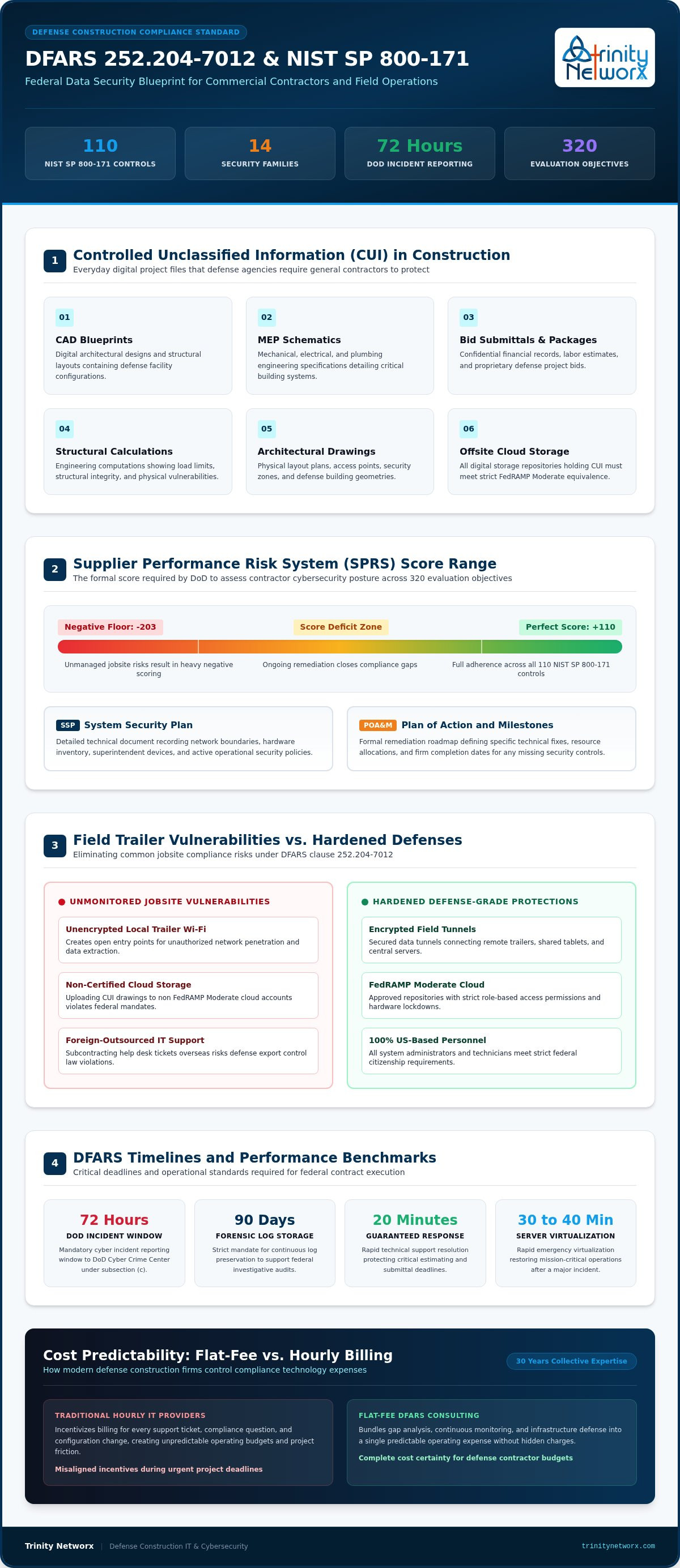
DFARS clause 252.204-7012 requires defense contractors to safeguard Controlled Unclassified Information (CUI). For commercial builders, CUI isn't abstract code. It lives inside architectural drawings, structural engineering calculations, mechanical layouts, and sensitive bid packages. When foreign adversaries target defense infrastructure, they don't attack the Pentagon's front gate. They target commercial builders holding the facility blueprints.
Standard IT vendors fail because fixing broken office printers won't satisfy the 110 controls in NIST SP 800-171 Rev 2 across all 14 security families. Construction firms often score negative values in the Supplier Performance Risk System (SPRS), which spans from +110 down to -203. Specialized DFARS compliance consulting closes these technical gaps before audit failures hit your bottom line. Under subsection (c), any cyber incident involving CUI requires reporting to the DoD Cyber Crime Center within 72 hours, alongside a 90-day forensic log preservation mandate. Reactive IT simply cannot meet that clock.
Field security remains a massive regulatory blind spot. Jobsite trailers, shared tablets, and unencrypted local Wi-Fi create open entry points into federal project records. Storing building models in non-certified cloud drives directly violates DFARS requirements, which mandate FedRAMP Moderate equivalence for offsite storage.
Securing remote sites demands encrypted tunnels between field trailers and central servers, strict access permissions, and hardware lockdowns. Through dedicated IT services for commercial construction, firms establish defense-grade controls on every superintendent device. This technical baseline prepares builders for formal audits under the Cybersecurity Maturity Model Certification framework, keeping your jobsite data protected and your federal contracts intact.
Hourly billing destroys project budgets. Traditional IT providers bill for every compliance question, phone call, and network tweak. That structure creates misaligned incentives. Smart executives partner with providers using flat-fee pricing models that wrap continuous cybersecurity, gap analysis, and monitoring into one predictable operating expense. If a cyber incident occurs, your provider must also offer rapid server virtualization within 30 to 40 minutes, keeping estimating and operations moving without missing project delivery deadlines.
Location matters just as much as pricing structure. Your technical partner must rely exclusively on 100% US-based personnel. Subcontracting system administration or help desk tickets to foreign teams introduces catastrophic data leakage risks under defense export control laws. Choosing specialized DFARS compliance consulting ensures that every technician accessing your infrastructure meets strict federal citizenship requirements under DFARS clause 252.204-7012.
Winning defense awards requires an accurate Supplier Performance Risk System score on file. Calculating this number requires an exhaustive gap analysis backed by concrete operational proof across 320 evaluation objectives:
Documents your network boundaries, hardware inventory, and operational security policies.
Defines specific remediation paths and completion dates for missing controls.
These living records bridge the gap between initial assessment and formal third-party certification. Review how our CMMC compliance consultants connect DFARS obligations to upcoming acquisition criteria. To verify your current standing, contact our construction IT specialists for a thorough assessment.
Post-breach investigations cannot recover lost defense contracts. Waiting until an audit flags a compliance gap or an attacker extracts digital site schematics leaves your operations exposed. Trinity Networx takes a proactive stance, continuously identifying infrastructure vulnerabilities across jobsite trailers and corporate offices before they interrupt daily production. Backed by 30 years of collective IT expertise, our team provides construction firms with the operational certainty required on federal projects.
Field superintendents facing technical lockouts cannot wait half a day for support. When critical submittals stall, every minute burns project margin. We deliver an ironclad 20-minute response guarantee, resolving technical issues rapidly to keep field personnel working. Our Southern California-based Network Operations Center monitors your systems day and night. Through a predictable, flat-fee Managed Network Service Plan, builders gain multi-layered defenses aligned directly with mandatory NIST SP 800-171 standards, preventing surprise IT invoices.
Hardware failures on an active jobsite shouldn't freeze federal progress. With Datto business continuity technology, we spin up virtualized replacement servers within 30 to 40 minutes, protecting schedule integrity and preventing data corruption. Defense acquisitions now demand continuous alignment rather than annual check-ins.
Adopting proactive managed cybersecurity services maintains an audit-ready state that satisfies contracting officers. Don't leave your federal revenue vulnerable to unexpected compliance infractions or slow technical support. Partner with expert DFARS compliance consulting designed for the dirt and steel reality of commercial construction. Secure your bidding standing today by visiting our contact page to schedule a technical evaluation.
Federal compliance isn't a checklist you complete once. It's an active operating standard that shields your digital site plans and preserves your eligibility for Department of Defense awards. By replacing unpredictable hourly billing with a flat-fee model, commercial builders routinely cut technology support expenses by 30% to 50% while securing every network touchpoint from the headquarters to the field trailer.
Recognized by CIO Review as one of the 20 Most Promising IT Services Companies, Trinity Networx pairs 100% US-based engineering with an ironclad 20-minute response guarantee. Experienced DFARS compliance consulting gives your leadership total certainty across every project schedule, blueprint, and jobsite system. Stop the IT nightmares and secure your contracts today. Contact Trinity Networx for a specialized assessment.
Yes. Prime contractors must flow down DFARS 252.204-7012 requirements to every sub-tier trade that handles Covered Defense Information. Specialty trades handling electrical, structural, mechanical, or low-voltage work across California, Nevada, Arizona, and Utah cannot access federal blueprints or project specs without documented compliance. Prime contractors will drop non-compliant subcontractors from their bid rosters to protect their own awards.
DFARS represents the contractual legal obligation, while CMMC acts as the verification mechanism enforcing it. DFARS clause 252.204-7012 mandates that builders implement the 110 technical controls within NIST SP 800-171. CMMC establishes the formal assessment process to verify those safeguards are actively running before the Department of Defense awards a contract.
Total cost depends on whether a firm hires hourly consultants or partners with a flat-fee provider. Hourly consultants bill for every audit question, creating budget overruns. Choosing flat-fee DFARS compliance consulting bundles continuous network defense, gap analysis, and policy updates into a fixed monthly expense, protecting cash flow while reducing overall technical support overhead.
Yes. Commercial builders routinely meet federal standards by partnering with specialized external technical providers. Outfitting an internal compliance department is cost-prohibitive for regional contractors. Construction-specific DFARS compliance consulting supplies 100% US-based engineers who secure jobsite trailers, manage SPRS documentation, and maintain audit readiness without the payroll burden of an internal cybersecurity staff.

Article by
Lance Reichenberger, Ph.D.., J.D. (Candidate)
Dr. Lance Reichenberger is the founder of Trinity Networx, a Southern California technology firm specializing in managed IT services, cybersecurity, network infrastructure, and business technology strategy. With nearly four decades of experience in the IT industry, he works with businesses to improve operational efficiency, strengthen security, and align technology with long-term growth objectives.
Lance focuses on proactive IT management, enterprise wireless infrastructure, cybersecurity integration, and scalable technology solutions for growing organizations throughout Southern California.
The content published on this website is provided for general informational and educational purposes only. Articles may be created, edited, or enhanced with the assistance of artificial intelligence and automation tools under the direction and review of Trinity Networx. While every effort is made to ensure accuracy and relevance, the information provided should not be considered professional, legal, financial, cybersecurity, or technical advice specific to your organization. Businesses should consult directly with a qualified professional regarding their unique environment, compliance requirements, and operational needs. Trinity Networx makes no warranties regarding completeness, reliability, or applicability of the information contained within these articles.
Schedule a brief conversation with Trinity Networx to discuss your business technology needs.
Get a practical roadmap built around your business, your users, your systems, and the technology issues that need attention first.
Put the right technology, support, security, and infrastructure in place so your business can grow, adapt, and move forward with confidence.