3281 E. Guasti Rd, STE 700, Ontario, CA 91761
1712 9th Ave SW, Watertown, SD 57201

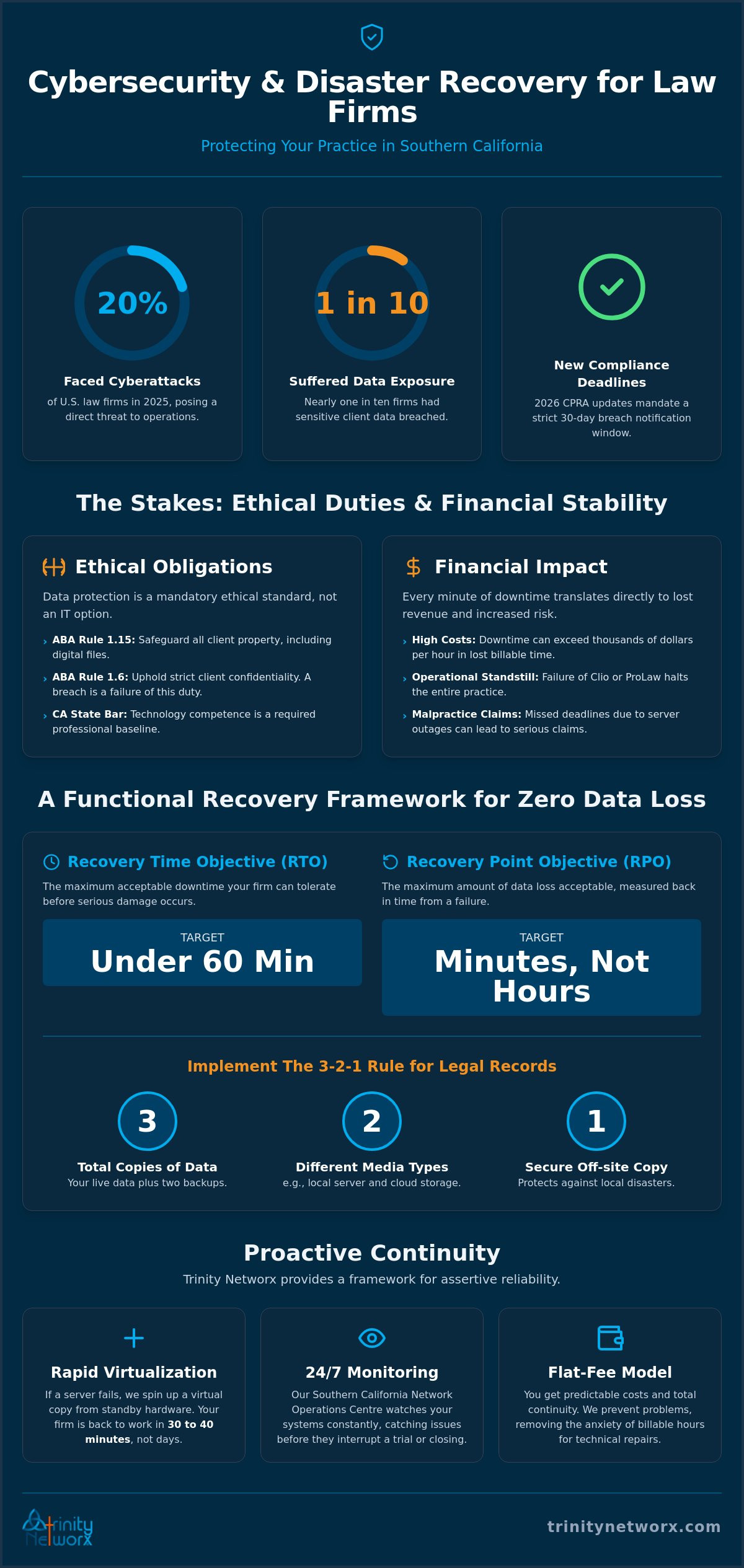
In 2025, 20% of U.S. law firms faced cyberattacks, with nearly one in ten suffering actual data exposure. For legal professionals in Southern California, these aren't just IT hurdles. They're direct threats to your standing with the State Bar. Effective disaster recovery planning for law firms in Orange County must now account for the 2026 CPRA updates and the strict 30 day notification window for breaches. If your practice relies on Clio or ProLaw, a standard backup isn't enough to prevent a total operational standstill.
You know that every minute your team spends staring at a spinning wheel is a minute of lost revenue. It's a mounting ethical risk. We'll show you how to build a proactive framework that guarantees zero data loss. Our method gets your servers back online in under an hour. This guide breaks down the 2026 strategy for local firms to maintain compliance while eliminating the high cost of unexpected downtime.
• Understand why ABA Model Rules 1.15 and 1.6 turn data protection into a mandatory ethical standard for your firm.
• See how modern disaster recovery planning for law firms in Orange County meets the 2026 California privacy mandates for rapid breach reporting.
• Pinpoint the exact recovery metrics needed to keep your billable hours steady when hardware fails or servers crash.
• Protect your practice management software by mapping out a recovery timeline that targets less than 60 minutes of downtime.
• Replace reactive IT fixes with a proactive monitoring system that catches server issues before they interrupt a trial or closing.
Legal disaster recovery defines your ability to maintain practice continuity during hardware failure or a cyberattack. It isn't just a file copy. It's about business momentum. ABA Model Rule 1.15 requires you to safeguard client property while Rule 1.6 demands strict confidentiality. Modern disaster recovery planning for law firms in Orange County aligns these ethical duties with technical reality. The California State Bar now treats technology competence as a professional baseline. If you lose access to case files, you fail your clients. You also lose money. Downtime costs for firms in Irvine or Santa Ana often exceed thousands of dollars per hour in lost billable time.
A simple backup won't save you from ransomware. Modern attackers target local backups first. If your case files vanish, ethical violations follow. You face malpractice claims if discovery deadlines pass because your server is dark. Effective IT disaster recovery principles focus on availability. Your clients expect immediate responses. They don't care about your server room issues. They care about their cases. Protecting data is a fiduciary act. It requires more than a hard drive in a desk drawer.
Your framework starts with a hard look at your digital assets. List every application that keeps your firm running. This includes Clio, ProLaw, or iManage, along with your billing software and email servers. If these stop, your firm stops. Effective disaster recovery planning for law firms in Orange County requires precise mapping of these dependencies. You cannot protect what you haven't identified. Establish clear metrics that align with your billable hour targets. If a partner's hour is worth $600, a four-hour outage is a major loss. You need a setup that protects against local hardware failure and site-wide disasters simultaneously.
Recovery Time Objective (RTO) is your countdown. It marks the maximum time your firm can stay dark before the financial damage becomes permanent. Recovery Point Objective (RPO) measures data loss. It's the point in time you revert to when restoring. If your RPO is 24 hours, you lose a full day of work. For modern practices, these targets should be measured in minutes, not days. Setting these early prevents confusion during a crisis.
Redundancy is your insurance policy. The 3-2-1 rule is the industry standard for protecting sensitive case files. It requires three copies of case data across two different media types. Store at least one copy in a secure, off-site cloud location separate from the Orange County office. This strategy ensures that a fire in Irvine or a flood in Anaheim won't wipe out your entire history. A solid business data backup strategy forms the bedrock of this rule. It prevents a single point of failure from ending your practice.
Static plans are useless. You must test your recovery systems monthly. Verify that your backups actually boot and that data integrity remains intact. Running a fire drill for your data ensures that when a real crisis hits, your team knows exactly how to respond. If you aren't sure where to start, speak with a technical advisor to evaluate your current setup and find gaps in your current protection.
Trinity Networx, LLC functions as your internal IT department. We don't just fix things when they break. We prevent the break from happening. Effective disaster recovery planning for law firms in Orange County requires a partner that understands the high stakes of attorney downtime. Our flat-fee model removes the anxiety of billable hours spent on technical repairs. You get predictable costs and assertive reliability. Instead of paying for every hour of a technician's time, you pay one price for total continuity. We operate out of our local Southern California Network Operations Centre to provide 24/7 monitoring that keeps your firm moving forward.
If your physical server fails, you can't afford to wait days for a replacement. We eliminate that delay. Our system allows for instant virtualization of your failed environment. Your staff can be back to work in 30 to 40 minutes. We host your environment on local standby hardware so you don't have to wait for parts to arrive in the mail. By using data backups and disaster recovery tools, we ensure your practice stays operational even if your office hardware is completely destroyed. This isn't a simple file restore. It's a full system spin-up that maintains your workflows without interruption.
Speed matters in the legal field. Our 100% in-house local staff understands the Orange County market. We don't use outsourced helpdesks that waste your time with scripts. You get a 20-minute response time guarantee for all support requests. Our proactive maintenance process identifies hardware risks before they lead to a crash. We monitor your infrastructure to catch failing drives or security gaps before they impact your ability to serve clients. This steady competence ensures your firm never loses its momentum. Contact us at contact us to secure your practice today.
The 2026 legal landscape in Southern California leaves no room for reactive IT. You've seen how the convergence of ethical mandates and local environmental risks turns disaster recovery planning for law firms in Orange County into a survival necessity. Protecting your practice means moving beyond simple file storage to a framework that prioritizes immediate availability. It's about ensuring your team can continue to advocate for clients without the shadow of data loss or disciplinary action.
Trinity Networx, LLC stands ready as your strategic partner in this mission. We provide the 20 minute response time guarantee and 30 to 40 minute server virtualization that modern firms require to stay competitive. Our local Southern California NOC acts as your protective force, catching infrastructure risks before they disrupt a single billable hour. We value your growth and time above all else.
Secure your law firm with a Free Security Assessment
Backup is a copy. Disaster recovery is a process. One stores data; the other restores business operations. Disaster recovery planning for law firms in Orange County focuses on the speed of returning to billable work. If your server dies, a backup sits on a shelf. A recovery plan spins that server back up in minutes. It's the difference between having a map and having a car.
Firms without a plan often wait days to rebuild. Ransomware encrypts everything, including local backups. We target a recovery window of 30 to 40 minutes through instant virtualization. This method doesn't wait for hardware shipping or OS reinstallation. It runs your firm from the cloud while we scrub your local environment. Speed prevents malpractice claims and keeps your deadlines on track.
Encryption is the key to compliance. The California Bar doesn't forbid the cloud, but it demands technological competence. You must verify that your vendor provides secure, encrypted storage that prevents unauthorized disclosure. Consumer platforms don't offer the audit trails required for legal work. Professional managed services ensure your data stays within the bounds of Rule 1.6 and the 2026 CPRA notification requirements.
A mid-sized firm should target an RTO of less than one hour. Your RPO should be no more than 15 minutes. Losing four hours of work across twenty attorneys is a financial catastrophe. Disaster recovery planning for law firms in Orange County must focus on these tight windows to protect your bottom line. Anything longer than two hours puts your court deadlines and client trust at high risk.

Article by
Lance Reichenberger, Ph.D.., J.D. (Candidate)
Dr. Lance Reichenberger is the founder of Trinity Networx, a Southern California technology firm specializing in managed IT services, cybersecurity, network infrastructure, and business technology strategy. With nearly four decades of experience in the IT industry, he works with businesses to improve operational efficiency, strengthen security, and align technology with long-term growth objectives.
Lance focuses on proactive IT management, enterprise wireless infrastructure, cybersecurity integration, and scalable technology solutions for growing organizations throughout Southern California.
The content published on this website is provided for general informational and educational purposes only. Articles may be created, edited, or enhanced with the assistance of artificial intelligence and automation tools under the direction and review of Trinity Networx. While every effort is made to ensure accuracy and relevance, the information provided should not be considered professional, legal, financial, cybersecurity, or technical advice specific to your organization. Businesses should consult directly with a qualified professional regarding their unique environment, compliance requirements, and operational needs. Trinity Networx makes no warranties regarding completeness, reliability, or applicability of the information contained within these articles.
Schedule a brief conversation with Trinity Networx to discuss your business technology needs.
Get a practical roadmap built around your business, your users, your systems, and the technology issues that need attention first.
Put the right technology, support, security, and infrastructure in place so your business can grow, adapt, and move forward with confidence.