3281 E. Guasti Rd, STE 700, Ontario, CA 91761
1712 9th Ave SW, Watertown, SD 57201

Seven out of ten construction executives reported at least one cybersecurity incident in the past twelve months. With the average cost of a U.S. data breach hitting $10.22 million in 2026, an untested disaster recovery test plan is a liability you cannot afford. You already know the stakes. Inaccessible BIM files or corrupted CAD drawings lead to immediate, expensive delays. When the server goes down, your field teams lose their momentum. Profit margins vanish into the overhead of idle crews and silent job sites.
We are here to move you from reactive fear to proactive assurance. This guide provides a field-ready roadmap to validate your data safety before a crisis occurs. You will learn how to verify that your technical testing requirements actually meet the demands of a fast-paced construction environment. We are delivering the steps to ensure your teams can work through a server failure, while simultaneously positioning your firm to reduce insurance premiums through documented proof of resilience.
• Field offices and job site trailers require specialized recovery strategies to keep crews active during local outages.
• Establishing a disaster recovery test plan ensures your firm can validate data safety and meet strict Recovery Time Objectives.
• Tabletop exercises allow your team to practice roles and communication before a real system failure halts your projects.
• Documentation of every simulation failure provides the necessary evidence to lower insurance premiums and refine internal security protocols.
• Rapid virtualization technology restores access to critical BIM and CAD files in less than 40 minutes to prevent costly downtime.
A single hour of downtime for a mid-size enterprise in 2026 costs over $300,000. In construction, that number translates to idle excavators, silent cranes, and hundreds of workers waiting for access to project data. General backups are just a storage solution; they aren't a strategy. Without a rigorous Disaster recovery plan that includes a verified disaster recovery test plan, you are gambling with your project profit margins. Real recovery is about speed. It's about getting your field teams back to work before the delay penalties kick in.
Field offices and job site trailers are the front lines of your operations. They are also the most vulnerable. Local Southern California outages can sever the link between your headquarters and remote sites in an instant. When you lose access to real-time project management software, coordination collapses. Subcontractors can't verify specs. Safety protocols might be missed. This isn't just an IT problem; it's an operational crisis. Executives should consult the Beyond the Safety Net guide to understand how these technical risks impact the bottom line. Trinity Networx, LLC takes a proactive approach to identify these vulnerabilities before the power goes out.
Your firm's value is locked in high-bandwidth files that are notoriously difficult to recover quickly. Essential assets include:
• BIM files and 3D models
• CAD drawings and site plans
• Payroll records and compliance documentation
Recovering these assets under pressure requires more than just hitting restore. It demands a validated disaster recovery test plan that accounts for the massive size of construction data. If you haven't simulated a recovery, you don't actually have one. Our Southern California staff ensures that your servers can spin up in 30 to 40 minutes. We focus on ensuring your data is not just safe, but available within minutes. This level of precision protects your reputation and your schedule.
Construction firms cannot wait days for data. Every hour of downtime on an active site burns through your budget. Your disaster recovery test plan must define how many minutes of downtime are acceptable (RTO) and how much data loss your projects can survive (RPO). If your last backup happened at midnight and the server crashes at 4:00 PM, you lose an entire day of field updates. That is unacceptable. You need a baseline that reflects the high stakes of job site operations and the immediate needs of your crews.
Setting realistic RTOs for your office staff prevents confusion during a crisis. If your project managers need CAD files within an hour, your technology must reflect that urgency. A tabletop drill identifies if your contact list is outdated or if roles are unclear. This verbal walk-through is a core part of an IT Disaster Recovery Plan. Regular proactive maintenance ensures your systems are ready for a recovery simulation. Without these drills, your team will scramble when the screen goes dark.
Technical testing begins with a simulation test as outlined in your disaster recovery test plan. Restore a single critical project folder, like an active BIM model, to verify that the data is uncorrupted. The final step is a full failover using local NOC resources. You run your entire office environment in a virtual state to ensure every application functions. Trinity Networx, LLC provides rapid virtualization that restores your systems in 30 to 40 minutes. This level of speed keeps your field teams moving and your subcontractors on schedule. We validate every connection from the field to the cloud to ensure no project data is left behind.
If you are unsure about your current recovery speed, contact Trinity Networx, LLC for a speed audit today.
A disaster recovery test plan is only as good as the data it produces. If your test runs perfectly without a single error, you likely didn't test hard enough. Document every failure encountered during the simulation. Whether it's a slow file transfer or a forgotten password, these gaps are the keys to a better defense. You must update your recovery protocols immediately based on these findings. Compare your actual recovery speeds against the goals you set earlier. If your BIM files took 90 minutes to restore but your RTO was 40, you have work to do. Schedule your next test the moment this one concludes to maintain your momentum.
Finding technical errors during a drill is a win. It allows you to patch vulnerabilities before a ransomware actor finds them first. These outcomes often reveal a need for more advanced managed cybersecurity services to block threats before they trigger a recovery event. A strong security posture relies on this feedback loop. When you treat every test failure as a roadmap for improvement, you build a firm that can withstand any outage.
Effective recovery isn't just about software; it's about business continuity. Integrating your project planning with your IT strategy ensures that technology supports your growth instead of hindering it. You need a partner who understands the specific urgency of a Southern California job site. Our 100% in-house staff at Trinity Networx, LLC listens to your operational needs before suggesting technical fixes. We ensure your disaster recovery test plan aligns with your actual field requirements. This strategic alignment turns IT from a cost center into a driver of project success.
Ready to validate your firm's resilience? Contact Trinity Networx, LLC for a disaster recovery assessment and ensure your projects stay on schedule.
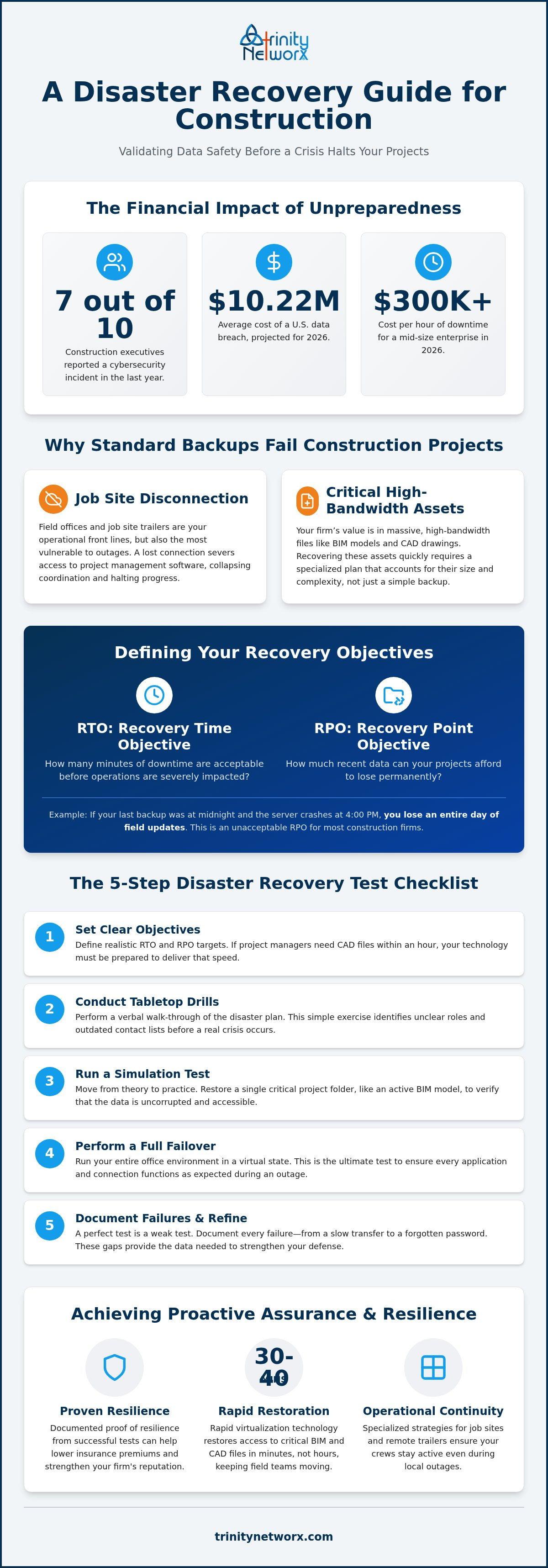
A document sitting on a shelf won't save your firm when a server fails. You need a living disaster recovery test plan that evolves alongside your construction technology. By following the five step checklist and validating results through rigorous simulation, you turn IT from a potential liability into a strategic advantage. You ensure that critical BIM files stay accessible and field crews stay productive regardless of local outages or hardware failures.
Trinity Networx provides the specialized expertise to make this resilience a reality. Our Southern California NOC provides 24/7 proactive monitoring to catch issues before they halt your operations. We guarantee server virtualization in just 30 to 40 minutes, supported by response times under 20 minutes. Stop guessing and start validating. Eliminate your IT nightmares with a professional recovery assessment today. Your firm deserves the security of a partner who values your schedule as much as you do.
Perform a test at least twice a year. You should also test whenever your firm undergoes major infrastructure changes. Construction firms frequently cycle through projects and subcontractors, which can alter your network requirements. New job site trailers or office expansions introduce fresh variables into your disaster recovery test plan. Bi-annual testing ensures your protocols stay current with your active project list. It keeps your personnel ready.
A tabletop exercise is a verbal walk-through of roles and communication protocols. A simulation involves actual technical data restoration. The tabletop identifies if your project managers know which vendor to call first during a power outage. A simulation proves that your BIM files and CAD models can actually be opened after a restore. You need both. Syncing your staff and your technology before a real crisis hits is the only way to ensure project continuity.

Article by
Lance Reichenberger, Ph.D.., J.D. (Candidate)
Dr. Lance Reichenberger is the founder of Trinity Networx, a Southern California technology firm specializing in managed IT services, cybersecurity, network infrastructure, and business technology strategy. With nearly four decades of experience in the IT industry, he works with businesses to improve operational efficiency, strengthen security, and align technology with long-term growth objectives.
Lance focuses on proactive IT management, enterprise wireless infrastructure, cybersecurity integration, and scalable technology solutions for growing organizations throughout Southern California.
The content published on this website is provided for general informational and educational purposes only. Articles may be created, edited, or enhanced with the assistance of artificial intelligence and automation tools under the direction and review of Trinity Networx. While every effort is made to ensure accuracy and relevance, the information provided should not be considered professional, legal, financial, cybersecurity, or technical advice specific to your organization. Businesses should consult directly with a qualified professional regarding their unique environment, compliance requirements, and operational needs. Trinity Networx makes no warranties regarding completeness, reliability, or applicability of the information contained within these articles.
Schedule a brief conversation with Trinity Networx to discuss your business technology needs.
Get a practical roadmap built around your business, your users, your systems, and the technology issues that need attention first.
Put the right technology, support, security, and infrastructure in place so your business can grow, adapt, and move forward with confidence.