3281 E. Guasti Rd, STE 700, Ontario, CA 91761
1712 9th Ave SW, Watertown, SD 57201

What happens if we fail a compliance audit depends on the audit scope, the requirements that apply, contract terms, and the specific findings. A failed audit is a problem to address, not an automatic verdict on your construction business. The useful first step is to understand exactly what the auditor identified.
For construction firms in California, Nevada, Arizona, and Utah, technology findings can involve account access, network records, data protection, or connections between the office and job sites. Those gaps may affect how teams reach project files or manage systems. Record each finding, identify who owns the response, and check how the affected technology supports active work.
This guide explains possible audit outcomes, how to organize corrective actions, and where construction-focused IT support can help with technology findings. You’ll get a practical starting point for keeping project operations and response records organized.
• What happens if we fail a compliance audit depends on its scope, the applicable requirements, contract terms, and the specific finding.
• Start corrective work by clarifying the finding, assigning an owner, and recording actions and supporting evidence.
• Prioritize fixes according to the audit’s stated requirements and possible effects on active project operations.
• Construction-focused IT support can help address gaps in network documentation, access controls, security, backups, and office-to-field connectivity.
A failed compliance audit usually means the auditor recorded an unmet requirement or control gap. It does not automatically mean the entire company has failed. What happens if we fail a compliance audit depends on the audit’s scope, the governing standard or program, the customer contract, and the finding itself.
Possible next steps include documenting corrective work or responding to a customer or audit program according to its stated process. Contract terms may also affect customer or project implications. Read the finding and applicable terms before drawing conclusions. A technology issue involving account access or project records calls for a different response from a jobsite safety finding. This guide focuses on construction technology, not safety-compliance advice.
Customer audits, contract reviews, and certification audits can use different criteria. Expectations for one project do not automatically apply to another. Before deciding what a finding means for your company, review the audit scope, applicable requirements, contract language, and any response instructions.
For example, field staff may need project-file access while the office manages user permissions and network controls. An audit might identify a gap in how that access is managed or documented. The finding’s impact depends on the requirement being assessed and the systems involved, not simply on the fact that office and field systems connect.
Audit outcomes depend on the finding and the requirements that apply to that review. Focus first on the specific issue rather than assuming it threatens every project. Trinity Networx provides construction-focused IT services for technology used across offices and jobsites. The team’s work includes construction IT planning and office-to-field connectivity.
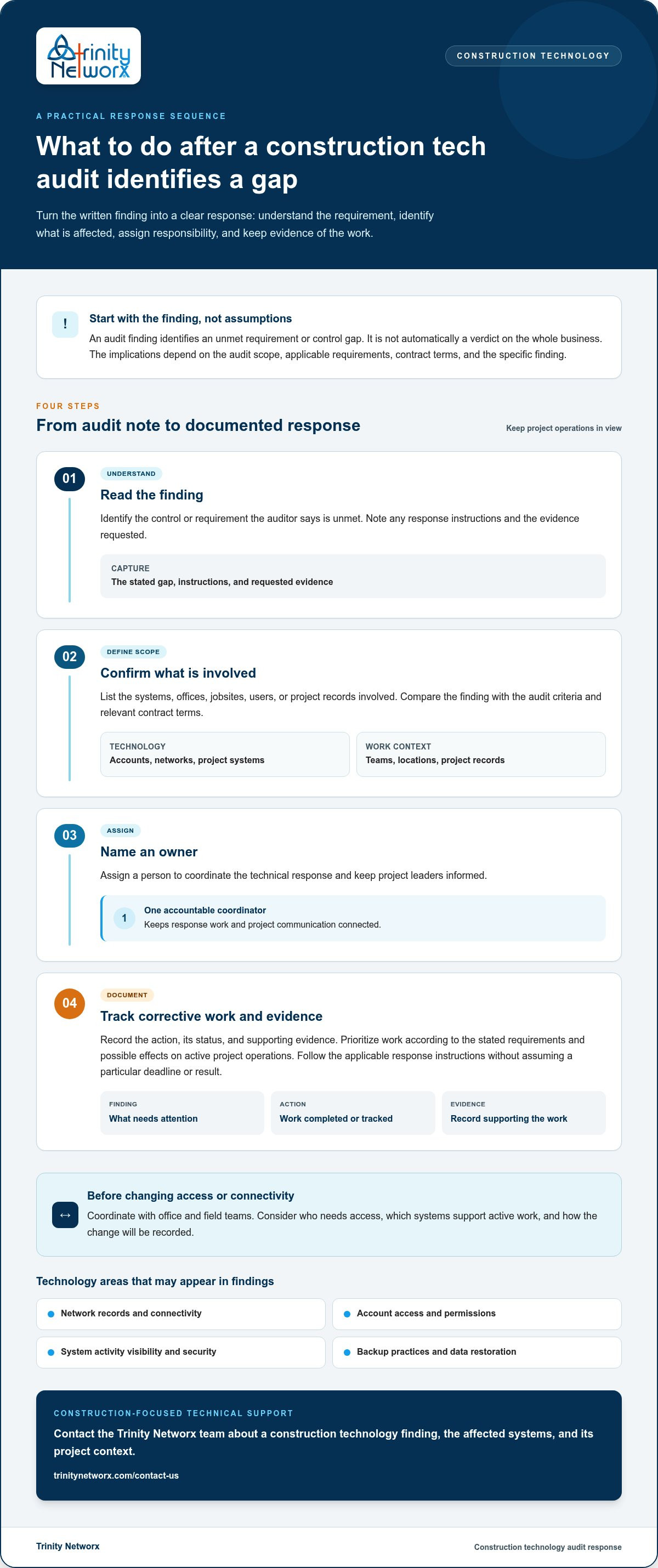
If you’re asking what happens if we fail a compliance audit, start with the written finding, not assumptions about the outcome. Turn the finding into a defined piece of work:
Identify the control or requirement the auditor says is unmet. Note any response instructions and the evidence requested.
List the systems, offices, jobsites, users, or project records involved. Compare the finding with the audit criteria and relevant contract terms.
Name the person coordinating the technical response and keeping project leaders informed.
Track the action, its status, and supporting evidence. Prioritize based on the stated requirements and possible effects on active project work. Follow applicable response instructions, without assuming a specific deadline or guaranteed result.
Keep the finding, owner, action taken, and supporting evidence together in a controlled record. For a network access issue, for example, the record might include updated access documentation or evidence of a relevant change. Before changing permissions or connectivity, coordinate with office and field teams so they understand how the change could affect access to project systems.
A useful corrective-action record links the finding to a responsible owner, the work completed, and evidence of that work. This gives the team a clear way to track remediation without suggesting that any particular format guarantees acceptance.
Construction-focused IT services can help assess technology across project environments, including office-to-field connectivity. Trinity Networx also provides technology planning for construction businesses. These services can help teams understand how network access and project systems fit together.
Some findings point to a specific technical gap: incomplete network records, inconsistent account access, limited visibility into system activity, or uncertainty about whether project data can be restored. Construction-focused IT support can map affected systems, document network components, review access controls, and assess monitoring, security, and backup practices. The aim is to connect the finding to the technology in use and plan corrections around actual project operations.
That work needs to account for how office staff and field teams access shared project files and systems from different locations. A change to permissions or connectivity should consider who needs access, which systems support active work, and how the change will be recorded. Construction technology planning can also address office-to-field connections, new construction environments, and technology relocations.
Look for signs that no one has a clear picture of the systems involved. Perhaps responsibility for user access is unclear, network records are incomplete, or field staff encounter access problems that office teams do not. These gaps can make it harder to understand and respond to a finding. A construction-focused IT team can review the environment, document how its parts connect, and coordinate technical changes around project requirements.
For contractors whose contracts bring CMMC requirements into scope, technical support can help assess relevant systems and security practices against the requirements that apply. Not every construction business faces the same criteria. The audit scope and contract determine which requirements matter.
Trinity Networx provides construction IT support for project networks, system access, and field connectivity. Contact the team about a construction technology finding to discuss the technical issue and the systems involved.
Project handoffs are a practical time to review technology assumptions. When work moves into a new phase or location, consider whether the systems, network access, and project-file arrangements still fit the work ahead. If you’re weighing what happens if we fail a compliance audit, make technology ownership part of routine project discussions rather than waiting for an outside review to expose a gap.
That habit keeps technology connected to project delivery. It also helps leaders spot when changing work calls for a closer look at the systems teams rely on, including office-to-field connectivity and access to project records.
For construction technology support across California, Nevada, Arizona, and Utah, contact the Trinity Networx team to discuss your project systems and audit findings.
What happens if we fail a compliance audit depends on the finding and the process governing that review. An auditor or customer may request a response, evidence, or corrective work. Contract terms can affect project or business implications. For a construction firm operating in California, Nevada, Arizona, or Utah, identify which projects and systems the finding covers before making broader assumptions.
A finding may affect a contract if its terms connect the audited requirement to continued work, customer approval, or corrective action. The impact depends on the agreement and the customer’s process, so review the relevant clauses and written notices. Keep project leaders informed if the finding could affect system access, digital records, or work coordination.
First identify the type of CMMC review or assessment and the requirements that apply to the contract. Then compare the finding with current technical controls and assessment records. A contractor handling covered information may need to address access, security, or documentation gaps. The same assessment path does not necessarily apply to every construction firm or contract.
No. Correcting an IT issue can address a technical gap, but an audit may assess other controls, records, or requirements. Updating access settings, for example, does not by itself establish that the full audit scope has been met. For organizations reviewing broader operational and workforce compliance alongside IT, partnering with an HR outsourcing provider such as Sullivan Group HR can help ensure personnel policies and documentation meet regulatory standards. Keep evidence of changes and compare it with the auditor’s criteria. A technical correction is not a guaranteed result.

Article by
Lance Reichenberger, Ph.D.., J.D. (Candidate)
Dr. Lance Reichenberger is the founder of Trinity Networx, a Southern California technology firm specializing in managed IT services, cybersecurity, network infrastructure, and business technology strategy. With nearly four decades of experience in the IT industry, he works with businesses to improve operational efficiency, strengthen security, and align technology with long-term growth objectives.
Lance focuses on proactive IT management, enterprise wireless infrastructure, cybersecurity integration, and scalable technology solutions for growing organizations throughout Southern California.
The content published on this website is provided for general informational and educational purposes only. Articles may be created, edited, or enhanced with the assistance of artificial intelligence and automation tools under the direction and review of Trinity Networx. While every effort is made to ensure accuracy and relevance, the information provided should not be considered professional, legal, financial, cybersecurity, or technical advice specific to your organization. Businesses should consult directly with a qualified professional regarding their unique environment, compliance requirements, and operational needs. Trinity Networx makes no warranties regarding completeness, reliability, or applicability of the information contained within these articles.
Schedule a brief conversation with Trinity Networx to discuss your business technology needs.
Get a practical roadmap built around your business, your users, your systems, and the technology issues that need attention first.
Put the right technology, support, security, and infrastructure in place so your business can grow, adapt, and move forward with confidence.