3281 E. Guasti Rd, STE 700, Ontario, CA 91761
1712 9th Ave SW, Watertown, SD 57201

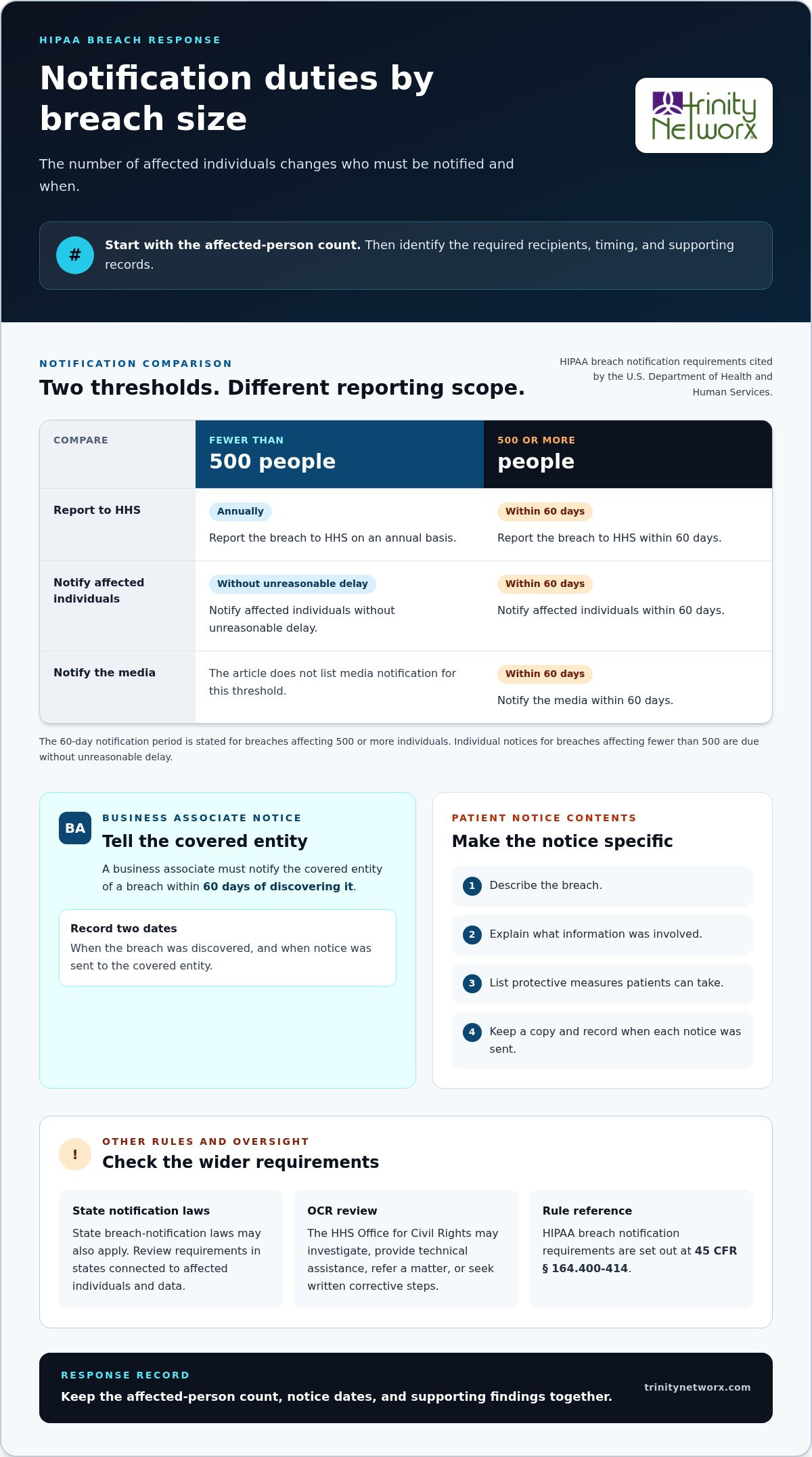
Act quickly, preserve the evidence, and follow HIPAA’s notification deadlines. Knowing how to respond to a HIPAA data breach starts with identifying affected information and determining who must be notified. According to the U.S. Department of Health and Human Services, breaches affecting fewer than 500 individuals must be reported to HHS annually and to affected individuals without unreasonable delay; breaches affecting 500 or more individuals must be reported to HHS, affected individuals, and the media within 60 days. For breaches affecting fewer than 500 individuals, organizations report to HHS annually and notify affected individuals without unreasonable delay.
A business associate’s role matters, too. According to HHS, business associates must notify covered entities of a breach within 60 days of discovering it. That notice helps the covered entity assess the incident and meet its own obligations.
This guide explains how to identify suspicious activity, investigate what happened, assess the impact, and follow applicable notification rules. It also covers third-party reporting and how it fits into a response that protects patients and supports continued operations.
• Flag unusual account activity, preserve relevant logs, and contain affected systems so investigators can work from reliable evidence.
• Trace what happened, which records were exposed, whether the data was encrypted, and what steps limited further access.
• Use the affected-person count to determine reporting obligations, and make patient notices clear about the breach, exposed information, and protective steps.
• Set clear reporting and escalation procedures with business associates so their breach findings reach the covered entity in time for action.
• Review electronic health record (EHR) and network alerts every day. Healthcare organizations take an average of 96 days to discover a data breach, leaving time for suspicious activity to go unnoticed. Flag unfamiliar sign-ins, repeated failed logins, unexpected permission changes, and large file downloads for prompt review.
• Compare each alert with the account’s normal activity. For example, investigate a staff account accessing patient files outside its usual role or at an unusual time. Check the user, device, access time, and records involved. An alert may have an ordinary explanation, but document the evidence and reason for closing it.
• Include vendors and other business associates in monitoring. Review alerts involving their accounts, remote connections, or systems that store electronic protected health information. A vendor’s report of unusual access may reveal activity that does not appear in your EHR logs, so route those reports to the people responsible for security response.
• If evidence points to a compromised system, isolate it from the network to limit unauthorized access. Revoke affected account credentials and preserve relevant logs before routine cleanup removes useful details. Record which systems were isolated, whose access changed, and when each action occurred.
• Use the HIPAA Security Rule’s risk assessment process to review security systems and document findings. Confirm that your contingency plan addresses disruptions to electronic health records. If suspicious activity affects EHR access, follow the plan, record the operational impact, and escalate the incident through your response process.
Contain the incident promptly, preserve relevant evidence, and assign an investigation lead. Record what happened, which systems or accounts may be involved, and the actions taken so far.
• Preserve relevant logs, alerts, and system records before routine deletion or cleanup. Note when and where each item was collected, such as from an EHR audit log, email account, or file server. These records help establish the sequence of activity.
• Trace the incident across affected accounts and systems. Identify the first suspicious event, the access method, which records were viewed or taken, and whether activity continued after containment. Compare timestamps across available logs to build a consistent timeline.
• Map the information involved. Record the types of PHI, the people affected, the systems holding the data, and the period of exposure. For example, distinguish patient names and appointment details from records that also contain diagnoses or treatment information.
• Determine whether the compromised data was encrypted and whether the encryption key was also exposed. Document the method used, the affected files or devices, and the evidence supporting your findings. Encryption status is one factor in assessing the incident’s impact.
• Document the root cause, the incident’s scope, mitigation actions, and steps taken to reduce the risk of recurrence. Record who made each decision and when. Keep this documentation with the investigation findings so the response team can explain its conclusions.
For help aligning incident records and response procedures with HIPAA requirements, contact our team.
Failure to meet HIPAA notification duties can prompt review by the U.S. Department of Health and Human Services Office for Civil Rights (OCR). OCR may investigate, provide technical assistance, refer a matter, or seek written corrective steps.
State breach-notification laws may also apply. Review the requirements in states connected to affected individuals and data, because federal HIPAA notices may not meet every applicable state duty.
• Apply the rule at 45 CFR § 164.400-414. HIPAA defines a breach as unauthorized acquisition, access, use, or disclosure of protected health information. Record the determination and the facts supporting it.
• For breaches affecting fewer than 500 individuals, report them to HHS annually and to affected individuals without unreasonable delay; breaches affecting 500 or more individuals must be reported to HHS, affected individuals, and the media within 60 days, according to the U.S. Department of Health and Human Services.
• For a breach affecting fewer than 500 individuals, report it to HHS annually and notify affected individuals without unreasonable delay, according to the U.S. Department of Health and Human Services.
• Send affected patients written notice describing the breach, the information involved, and protective measures they can take. Keep a copy and record when each notice was sent.
• Set a clear reporting route for vendors. According to the U.S. Department of Health and Human Services, business associates must notify covered entities within 60 days of discovering a HIPAA data breach. Record discovery and notice dates, then coordinate the covered entity’s assessment and notifications.
Strengthen your breach notification process with HIPAA compliance support.
Failure to meet HIPAA notification duties may lead OCR to investigate, provide technical assistance, refer the matter, or seek written corrective steps. Applicable state breach-notification laws may impose separate duties as well.
Trinity Networx, LLC supports manufacturers across California, Nevada, Arizona, and Utah with Managed IT Services, Cybersecurity Solutions, and Data Backup & Recovery. In production environments, network interruptions or weak access controls can disrupt work. Co-Managed IT can supplement an internal team as it manages day-to-day technology needs.
Construction technical expertise also matters when manufacturers coordinate office systems with project sites, contractors, or field teams. Planning dependable connectivity across these environments can help teams share information and coordinate operations. Turn to Trinity Networx, LLC when manufacturing technology or construction-related connectivity needs focused IT support.
Contact Trinity Networx, LLC to discuss your IT needs.
Knowing how to respond to a HIPAA data breach takes more than a written plan. Assign clear roles before an alert arrives: who leads the response, gathers technical findings, and coordinates decisions across privacy, security, and leadership teams. Rehearsing how to respond to a HIPAA data breach can expose unclear handoffs or delays in sharing information. A scenario exercise gives staff a practical way to test those responsibilities.
Use the exercise to update response procedures and clarify how technical findings reach the people responsible for notification decisions. Keep the process practical, documented, and familiar to the staff who will carry it out. Trinity Networx can discuss the IT support your organization needs as it strengthens its response planning.
Contact Trinity Networx to discuss your breach response needs. A prepared team can move forward with greater clarity and control.
Third parties can support the response by assigning a contact to coordinate technical findings, preserve relevant records, and explain what their systems show. They should provide the covered entity with a clear incident timeline and identify affected services or data stores. For example, a cloud vendor can clarify which customer files its logs show were accessed.
After the investigation, turn findings into assigned tasks. Name an owner for each corrective measure, record its expected completion point, and retain evidence of what changed. For example, if investigators find an inactive account with unnecessary access, document the account review and action taken. This connects technical findings to operational changes.
Create a decision record that separates verified facts from unanswered questions. Reconcile affected-record counts against EHR, email, and file-storage records, and note how each count was determined. If the incident involves multiple systems, track each system’s contribution separately. A clear evidence trail helps the response team explain its determination and revisit it if new facts emerge.
Make patient communication specific and useful. Identify the person’s information involved, explain what protective action may help, and provide a contact route for questions. Before sending notices, match recipient details against affected records and keep a log of sent notices, returned mail, and follow-up. Clear, tailored messages help patients understand which actions apply to them.
Prepare the OCR submission after the response team has documented its breach determination and assembled a reliable incident record. Include a coherent chronology, the affected population, the systems involved, and actions taken. Organize supporting material so the organization can answer follow-up questions without reconstructing the investigation from scattered logs and emails.

Article by
Lance Reichenberger, Ph.D.., J.D. (Candidate)
Dr. Lance Reichenberger is the founder of Trinity Networx, a Southern California technology firm specializing in managed IT services, cybersecurity, network infrastructure, and business technology strategy. With nearly four decades of experience in the IT industry, he works with businesses to improve operational efficiency, strengthen security, and align technology with long-term growth objectives.
Lance focuses on proactive IT management, enterprise wireless infrastructure, cybersecurity integration, and scalable technology solutions for growing organizations throughout Southern California.
The content published on this website is provided for general informational and educational purposes only. Articles may be created, edited, or enhanced with the assistance of artificial intelligence and automation tools under the direction and review of Trinity Networx. While every effort is made to ensure accuracy and relevance, the information provided should not be considered professional, legal, financial, cybersecurity, or technical advice specific to your organization. Businesses should consult directly with a qualified professional regarding their unique environment, compliance requirements, and operational needs. Trinity Networx makes no warranties regarding completeness, reliability, or applicability of the information contained within these articles.
Schedule a brief conversation with Trinity Networx to discuss your business technology needs.
Get a practical roadmap built around your business, your users, your systems, and the technology issues that need attention first.
Put the right technology, support, security, and infrastructure in place so your business can grow, adapt, and move forward with confidence.