3281 E. Guasti Rd, STE 700, Ontario, CA 91761
1712 9th Ave SW, Watertown, SD 57201

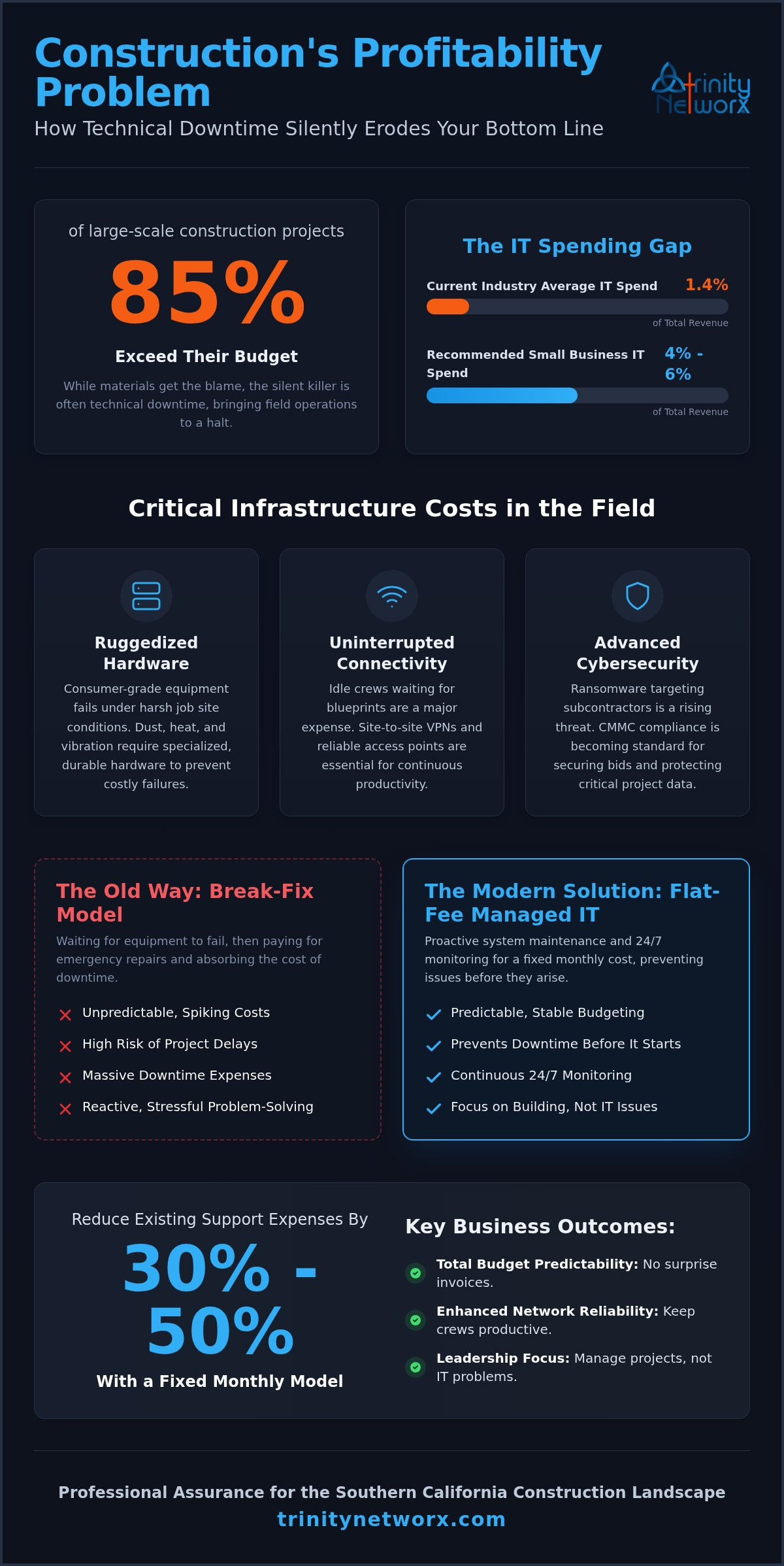
85% of large-scale construction projects globally exceed their budget. While most contractors focus on rising material costs, they often ignore the silent killer of profitability: technical downtime. If your field crew cannot access blueprints because the server is down, you're bleeding money. Many owners ask how much should a small business spend on IT to keep these project engines running. In the construction sector, technology spending currently averages about 1.4% of total revenue. This isn't just another overhead line item. It's an insurance policy against liquidated damages.
You likely feel the frustration of unpredictable monthly bills that spike every time hardware fails. It's difficult to bridge the gap between office staff and field teams when the connection is spotty. Reliability is the goal. This guide will help you calculate a technology budget that protects job site data and prevents delays without overspending. We'll break down the shift toward predictable flat-fee models and CMMC compliant data handling for 2026.
• Calculating how much should a small business spend on IT involves benchmarking against the 4 percent to 6 percent revenue standard while accounting for field infrastructure.
• Maintain high speed field connectivity with specialized networking hardware built to withstand the rigors of a working job site.
• Incorporate CMMC compliant data handling to secure your bids and protect your firm from the rising threat of subcontractor ransomware attacks.
• Adopting a flat fee managed IT model provides total budget predictability and can lower your support expenses by 30 percent to 50 percent.
Determining how much should a small business spend on IT requires looking beyond simple line items to gross revenue. Most small businesses allocate between 4 percent and 6 percent of their annual revenue to technology infrastructure. While construction firms typically lean toward the higher end of this spectrum, other specialized sectors have similarly unique requirements; for instance, healthcare facilities often rely on SpaceCenter Systems for integrated communication and infrastructure support. Managing multiple active job sites demands more than a basic office setup. You need field connectivity that actually works in the dirt. Achieving true IT cost transparency means accounting for both recurring support and the hardware refreshes required every three to five years. If you don't plan for these cycles, you'll face sudden capital expenditures that wreck your quarterly profit margins.
Understanding how much should a small business spend on IT is easier when you look at per user pricing for firms with fluctuating seasonal staff. When you hire up for a massive project, your tech costs should remain predictable. We recommend moving away from the outdated break fix model immediately. Waiting for something to fail before paying to fix it is a recipe for project delays and massive financial risk. Instead, Trinity Networx, LLC pricing focuses on flat fee managed service plans. These plans stabilize growth by providing a fixed monthly cost regardless of how many tickets your field crew opens. It's about proactive maintenance instead of emergency reaction. You get professional assurance that your data remains secure while your team stays focused on the build. This model removes the fear of the unknown from your monthly ledger.
Field operations demand more than standard office hardware. Reliable connectivity requires specialized networking equipment that survives harsh environments. Dust, extreme heat, and constant vibration will destroy consumer grade routers in weeks. When calculating how much should a small business spend on IT, you must account for the premium on ruggedized access points and site to site VPNs. This investment is your primary defense against project delays. If your field crew cannot access project management software or digital blueprints, you're paying for expensive, idle labor. Professional assurance in the field means choosing hardware that is as tough as your crew.
Cybersecurity is the next major cost driver for 2026. Ransomware attacks on subcontractors are rising, often targeting the weakest link in the supply chain. Beyond basic antivirus, specialized firms now require CMMC Level 2 compliance to bid on defense related projects. These regulations necessitate advanced encryption and strict access controls. Along with rising software costs for specialized CAD and BIM tools, these security measures must be part of your core budget. Protecting your bid data is just as critical as protecting your physical equipment.
Downtime is the silent profit killer. Every minute a supervisor spends troubleshooting a connection is a minute lost on the schedule. Specialized construction IT services address these specific vulnerabilities through proactive monitoring. We identify failing components before they cause a total blackout. This approach eliminates the high cost of emergency repairs and keeps your staff connected to critical data. If you want to move away from reactive technical support, connect with our team to evaluate your current field infrastructure. We focus on results that keep your projects moving forward without technical friction.
Shifting from a reactive repair model to a flat fee structure changes the financial trajectory of your firm. When owners evaluate how much should a small business spend on IT, they often overlook the massive cost of technical inefficiency. A fixed monthly model can reduce existing support expenses by 30 percent to 50 percent. This isn't just about lower bills; it's about total network reliability. This global trend toward proactive support is evident in specialized providers offering managed IT services for business Coventry and beyond. Trinity Networx, LLC provides 24 7 monitoring from our Southern California Network Operations Centre to catch hardware failures before they stop production. We eliminate the technical nightmares that distract your leadership team. This allows your supervisors to focus on delivering projects on time and under budget instead of fighting with server errors or field connectivity drops. Profitability thrives when your technology stays out of the way.
We believe in local accountability and professional assurance. Our 100 percent in house staff operates directly out of Chino and Ontario. You deserve to work with experts who understand the Southern California construction landscape. We back our service with a 60 minute response guarantee because we know that speed matters when a job site is stalled. Our technology alignment process goes beyond simple fixes. We analyze your software and field workflows to ensure they actually match your long term business goals. It's about strategic progress, not just utility maintenance. If you're tired of unpredictable tech debt and hidden fees, contact us for a free network assessment valued at 297 dollars. We'll identify exactly where your current setup is leaking profit and how to plug those holes for 2026.
Your technology budget isn't just a cost center. It's a strategic driver of project success. Determining how much should a small business spend on IT requires balancing the 4 percent revenue benchmark with the unique demands of rugged field environments. You've seen how specialized hardware and CMMC compliance protect your bids and your job site uptime. Now is the time to stabilize your expenses and eliminate the friction between the office and the field.
Our flat fee model can reduce your IT support costs by 30 percent to 50 percent while providing professional assurance through our 100 percent local US based help desk. We back every client with a 60 minute response guarantee to ensure your crews never sit idle. Solve your IT nightmares today with a free network assessment from Trinity Networx, LLC. Build your future on a foundation of technical reliability.
Industry benchmarks suggest that construction firms should allocate a portion of their budget per user for technical support. This varies based on your specific job site requirements and security needs. When determining how much should a small business spend on IT, consider the complexity of your field operations. We recommend focusing on a flat fee model to ensure your monthly expenses remain stable and predictable throughout the project lifecycle.
Yes, a dedicated budget is essential to prevent project delays and unexpected capital drains. Most successful firms allocate between 4 percent and 6 percent of gross revenue to their technology infrastructure. Construction companies in Southern California face unique challenges like dust and heat that increase hardware failure rates. Setting aside this percentage ensures your field connectivity remains stable and your job site data stays protected from ransomware.
Most firms should refresh their core IT hardware every three to five years to maintain performance and security. Field equipment like rugged laptops and site routers often require more frequent cycles due to harsh environmental exposure in Nevada or Arizona. Waiting until a device fails on a critical job site is a mistake. Proactive refreshes ensure your team always has the tools needed to access digital blueprints.
The hidden costs include lost labor productivity and high emergency repair fees. When a server goes down, your entire crew sits idle while you wait for a technician to show up. Break fix providers profit from your downtime, which is the opposite of our proactive approach. Our flat fee model can reduce these support costs by 30 percent to 50 percent while guaranteeing a 60 minute response time.

Article by
Lance Reichenberger, Ph.D.., J.D. (Candidate)
Dr. Lance Reichenberger is the founder of Trinity Networx, a Southern California technology firm specializing in managed IT services, cybersecurity, network infrastructure, and business technology strategy. With nearly four decades of experience in the IT industry, he works with businesses to improve operational efficiency, strengthen security, and align technology with long-term growth objectives.
Lance focuses on proactive IT management, enterprise wireless infrastructure, cybersecurity integration, and scalable technology solutions for growing organizations throughout Southern California.
The content published on this website is provided for general informational and educational purposes only. Articles may be created, edited, or enhanced with the assistance of artificial intelligence and automation tools under the direction and review of Trinity Networx. While every effort is made to ensure accuracy and relevance, the information provided should not be considered professional, legal, financial, cybersecurity, or technical advice specific to your organization. Businesses should consult directly with a qualified professional regarding their unique environment, compliance requirements, and operational needs. Trinity Networx makes no warranties regarding completeness, reliability, or applicability of the information contained within these articles.
Schedule a brief conversation with Trinity Networx to discuss your business technology needs.
Get a practical roadmap built around your business, your users, your systems, and the technology issues that need attention first.
Put the right technology, support, security, and infrastructure in place so your business can grow, adapt, and move forward with confidence.