3281 E. Guasti Rd, STE 700, Ontario, CA 91761
1712 9th Ave SW, Watertown, SD 57201

By Lance Reichenberger, Ph.D.
Contact us at https://www.trinitynetworx.com/contact-us to secure your operations. Share this guide: [Social Media Share Options]
The average cost of a data breach in the United States reached a record $10.22 million in 2026. This figure confirms that ignoring digital defense is no longer a viable strategy. You want to protect your assets, but fear of hidden costs often leads to total paralysis. If you are wondering how to create a cybersecurity budget for my business, you are asking the right question. It's about precision. It is about survival. You need a plan that works.
You probably recognize that compliance mandates like CMMC 2.0 or HIPAA aren't just suggestions anymore. They are strict requirements for staying in the game. I promise to show you how to build a defensible, risk based budget that secures your operations without overspending on redundant software. We will examine specific percentage ranges for IT spending. We will identify the non-negotiable items every business needs. This guide provides the evidence needed to justify your security spend to every stakeholder in the room.
• Quantify the cost of downtime for every critical business process. Knowing these numbers allows you to focus spending where it protects your profit most.
• Discover how to create a cybersecurity budget for my business that emphasizes prevention. Focus on multi-factor authentication. Stop threats early.
• Include mandatory compliance costs like CMMC or HIPAA audits in your annual plan. Ignoring these mandates leads to legal trouble and lost contracts.
• Move away from reactive emergency spending by using vCIO services. Predictable monthly fees maintain operational momentum.
• Assign a specific dollar value to your digital assets to justify security spending to stakeholders. Turn technical needs into business logic.
A cybersecurity budget is a calculated financial plan to mitigate specific digital threats. It is not an arbitrary expense. It is a shield for your revenue. Mastering how to create a cybersecurity budget for my business requires moving away from reactive patches and toward proactive protection. You cannot defend a ghost network. You need hard data on every device and data point under your control.
Success starts with a clear list. Catalog every physical server, workstation, and mobile device used by your staff. Include third party SaaS applications. Know where your sensitive customer data lives. This process often reveals massive gaps in your IT infrastructure management. It highlights abandoned accounts and unsecured hardware. You are building a map of your risk. Every unmanaged device is a door left unlocked for an intruder. Knowing how to create a cybersecurity budget for my business starts with seeing the full picture of your digital footprint.
Assign a dollar value to downtime. It's the only way to justify the spend. Determine which departments stop functioning during a ransomware event. For a Southern California firm, the hourly cost of operational paralysis is often staggering. Use principles of IT risk management to quantify these losses. Consider these factors:
• Legal fees for forensic investigations and notification requirements.
• Lost reputation and client churn following a public breach.
• Regulatory fines from CMMC or HIPAA violations.
• The immediate loss of billable hours and production capacity.
Calculating the potential cost of a data breach provides the baseline for your budget. If a day of downtime costs $100,000, spending $20,000 to prevent it is a logical business move. This data driven approach removes the guesswork from your security strategy. You are no longer buying tools. You are buying certainty.
Quantifying risk is only the beginning. You must now distribute your capital across a multi-layered defense. Effective budgeting follows a strict 70/30 split. Dedicate 70 percent of your resources to prevention and 30 percent to detection and response. This ratio ensures you stop most attacks before they breach your perimeter. It prevents small vulnerabilities from becoming million dollar disasters. If you want to know how to create a cybersecurity budget for my business, you must start with the most likely points of failure. The remaining 30 percent covers detection and recovery. You need a plan for when a threat slips through. This portion of the budget funds your incident response playbooks and rapid recovery tools. It ensures that a single breach does not lead to a total business collapse.
Prevention is your most cost effective investment. Focus on identity management and advanced endpoint protection to stop unauthorized access before it starts. Multi-factor authentication is non-negotiable. It is the single most effective way to increase the value of your cybersecurity budget while lowering your risk profile. Deploying managed cybersecurity services provides 24/7 threat detection. This proactive stance secures your network perimeter through managed firewall services. You are buying time and protection, not just software licenses. You are balancing the scales between staying safe and being ready to fight back.
Technology alone cannot save a business from a distracted employee. 68 percent of breaches involve a human element. Set aside recurring funds for monthly phishing simulations and staff education. This is how to create a cybersecurity budget for my business that addresses every angle of risk. Verify that your training costs include the actual time employees spend in these sessions. Security is a culture, not a one time event. Consistent education turns your staff into a human firewall. If you are struggling to balance these layers, reach out to Trinity Networx, LLC for a strategic review of your current security stack.
Compliance is not a trophy you win once. It is a continuous operational expense that demands constant attention. If you want to know how to create a cybersecurity budget for my business, you must look past the initial setup fees. Mandates like CMMC or HIPAA require regular gap assessments and expensive audits. These are not optional. They are the price of entry for staying in your industry. Treat them as recurring investments in your market viability.
Southern California machine shops and defense contractors face unique pressure. Phase 2 of CMMC 2.0 begins on November 10, 2026. Many contracts will require third party certification. This means you must budget for CMMC compliance consultants to navigate the technical complexity. Hardware upgrades are often necessary to meet federal privacy laws. These costs are significant. They must be clear line items in your strategic plan. Ignoring them leads to lost contracts and legal exposure.
Insurance is your financial recovery tool. It is getting more expensive. Premiums are expected to increase by 15 percent to 20 percent in 2026. Carriers now enforce strict eligibility requirements. You will not get coverage without specific technical controls like multi-factor authentication and endpoint detection. Beyond premiums, maintain a reserve fund. Emergency incident response is costly. You need cash on hand to move fast when a crisis hits. Speed saves money during a breach.
Reliable recovery requires a high performance business data backup system. This is your last line of defense. It ensures disaster recovery is possible when prevention fails. Don't let hidden costs sink your operations. Schedule a compliance audit today to identify your hidden financial risks and secure your standing in the supply chain.
A strategic plan is useless without a mechanism for execution. You have audited your assets and prioritized your stack. Now you must manage the capital. This is the final step in how to create a cybersecurity budget for my business. You need a partner who treats your budget as a driver of progress rather than a black hole of technical fees. Moving from reactive fixes to proactive management requires a change in how you view IT costs. You are shifting from unpredictable emergencies to steady, predictable growth.
Engage in a rigorous technology alignment process. A Virtual CIO ensures every dollar supports your long term roadmap. They bridge the gap between technical jargon and executive priorities. Stop buying tools because they sound impressive. Buy them because they mitigate a specific, quantified risk. Review quarterly reports on threat detection. This data proves the value of your security investment to other stakeholders. It turns a technical necessity into a clear business win.
Shift your spending from unpredictable capital expenses to steady monthly operational fees. A subscription model for proactive maintenance and security monitoring provides financial stability. You no longer face massive, unexpected bills when a server fails or a breach occurs. Managed services keep your operations running at peak efficiency. Ensure your provider offers a response time guarantee. This protects your productivity and ensures your team stays focused on billable work. Consolidate your vendors to reduce administrative overhead. Fewer invoices mean less time wasted on paperwork. Evaluate your security spend every ninety days. New threats emerge constantly. Your budget must be flexible enough to pivot when the landscape shifts. This disciplined approach ensures you never overspend on unnecessary tools while keeping your Southern California operations secure.
By Lance Reichenberger, Ph.D.
Contact us at https://www.trinitynetworx.com/contact-us to secure your operations. Share this guide: [Social Media Share Options]
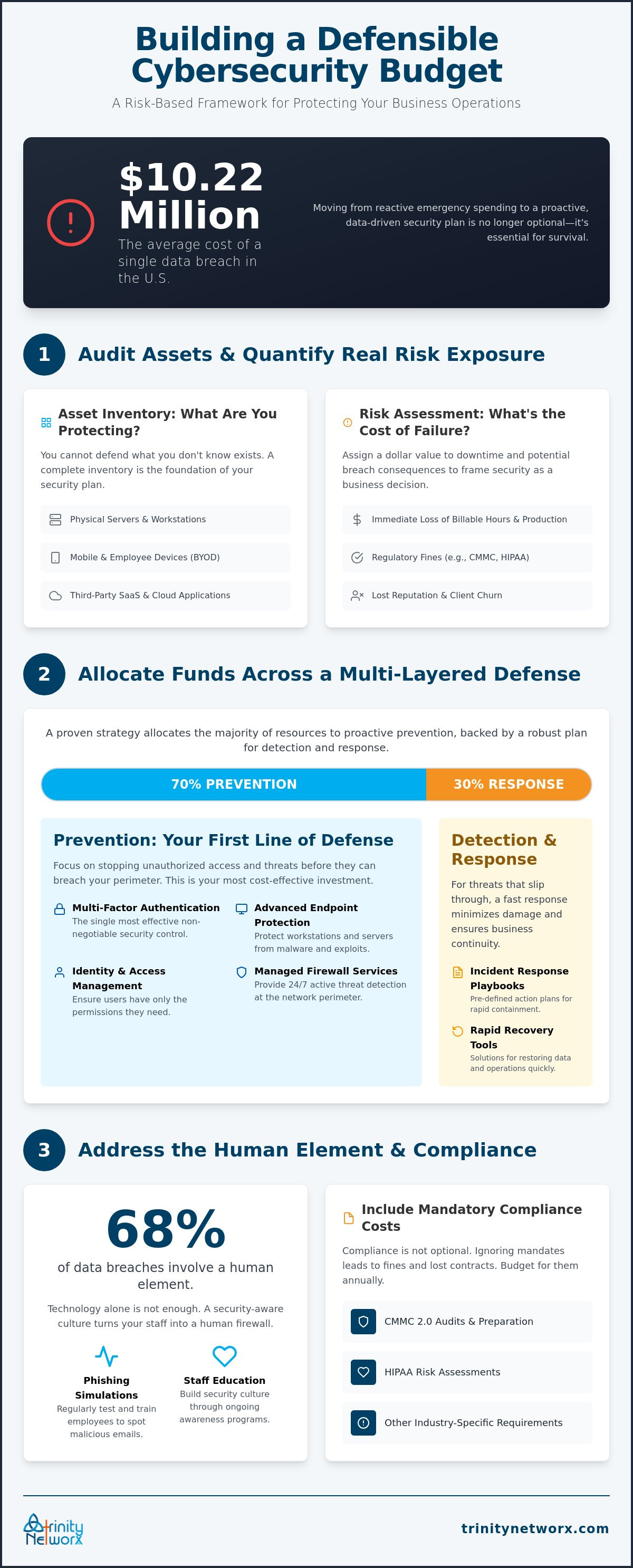
Your business deserves a defense that expands with your ambition. Stop treating security as a reactive technical fix. It's a strategic investment in your operational continuity. By auditing your digital assets and applying the 70/30 rule for prevention versus response, you turn technical debt into a competitive advantage. You now understand how to create a cybersecurity budget for my business that accounts for CMMC audits and insurance premiums without wasting capital on redundant tools. Aligning your IT roadmap with your financial goals creates the stability you need to grow.
Trinity Networx has served Southern California since 2001 with a focus on assertive reliability. We specialize in CMMC and HIPAA compliance to ensure your contracts remain secure. Our 24/7 helpdesk delivers a response in under 20 minutes to keep your team moving forward. Stop guessing about your security spend. Contact Trinity Networx today for a strategic assessment. You have the map. Now it's time to execute with confidence.
By Lance Reichenberger, Ph.D.
Contact us at https://www.trinitynetworx.com/contact-us to secure your operations. Share this guide: [Social Media Share Options]
Small businesses should allocate between 4 percent and 10 percent of their total IT budget to security. Medium sized organizations typically dedicate 8 percent to 15 percent. These ranges provide a baseline for essential protection without overspending. Your specific percentage depends on your industry risk and compliance mandates like CMMC. A strategic assessment helps you find the exact number that secures your operations while supporting your business growth goals.
Cyber insurance is a financial recovery tool rather than a replacement for active security. Carriers now enforce strict eligibility requirements. You won't get coverage without having specific technical controls in place. Budgeting for multi-factor authentication and endpoint detection is mandatory to qualify for a policy. Insurance acts as your last line of defense. It only functions if your primary security stack is already doing its job.
Review your security spending every ninety days to stay ahead of evolving risks. Annual reviews are often too slow to address new vulnerabilities. Quarterly assessments ensure your capital is working effectively and meeting your latest compliance needs. This frequent cadence allows you to pivot resources quickly. It prevents you from wasting money on outdated tools while keeping your Southern California firm protected against new digital risks.
The most common mistake is treating security as a reactive technical expense instead of a strategic business priority. Many firms wait for a crisis to occur before they allocate funds. This leads to emergency costs that are far higher than the price of prevention. Knowing how to create a cybersecurity budget for my business means planning for the long term. You must invest in prevention to avoid devastating downtime and lost reputation.
Co-managed IT services can reduce your total cybersecurity costs by providing specialized expertise without the high price of full time hires. You get access to professional tools and 24/7 monitoring at a fraction of the cost. This model allows your internal team to focus on core operations while experts handle complex security tasks. It is a smart way to maintain high standards and meet compliance goals while keeping your monthly budget predictable.

Article by
Lance Reichenberger, Ph.D.., J.D. (Candidate)
Dr. Lance Reichenberger is the founder of Trinity Networx, a Southern California technology firm specializing in managed IT services, cybersecurity, network infrastructure, and business technology strategy. With nearly four decades of experience in the IT industry, he works with businesses to improve operational efficiency, strengthen security, and align technology with long-term growth objectives.
Lance focuses on proactive IT management, enterprise wireless infrastructure, cybersecurity integration, and scalable technology solutions for growing organizations throughout Southern California.
The content published on this website is provided for general informational and educational purposes only. Articles may be created, edited, or enhanced with the assistance of artificial intelligence and automation tools under the direction and review of Trinity Networx. While every effort is made to ensure accuracy and relevance, the information provided should not be considered professional, legal, financial, cybersecurity, or technical advice specific to your organization. Businesses should consult directly with a qualified professional regarding their unique environment, compliance requirements, and operational needs. Trinity Networx makes no warranties regarding completeness, reliability, or applicability of the information contained within these articles.
Schedule a brief conversation with Trinity Networx to discuss your business technology needs.
Get a practical roadmap built around your business, your users, your systems, and the technology issues that need attention first.
Put the right technology, support, security, and infrastructure in place so your business can grow, adapt, and move forward with confidence.