3281 E. Guasti Rd, STE 700, Ontario, CA 91761
1712 9th Ave SW, Watertown, SD 57201

Your IT provider is holding your business hostage, and you're paying the ransom every month. It's a grim reality for many executives who realize their current support is failing but fear the consequences of a breakup. You know the signs. Response times are dragging. Critical passwords remain hidden in a black box. The thought of technical retaliation during a notice period keeps you awake at night. If you've been wondering how to fire your IT company without losing access to your own data, you're in the right place. This isn't just about a change in vendors. It's about a strategic extraction of your assets to ensure operational continuity.
We've built this tactical guide to help you regain administrative control and secure your business data before you even send the termination letter. As the SECURE Data Act of 2026 pushes for national standards, you need a partner who stays ahead of the curve. You'll learn how to audit your current environment, manage the exit, and move toward a partnership that guarantees a response in under 20 minutes. We're walking through the exact steps needed for a clean break that results in full ownership of your digital infrastructure.
• Spot auto-renewal traps and offboarding fees hidden in your service level agreement.
• Discover how to fire your IT company by securing network diagrams and verifying backups before the notice period.
• Stabilize your environment by onboarding a partner with a 20 minute response guarantee.
• Revoke remote access tools at the exact moment of termination to prevent technical retaliation.
Your contract is likely a minefield. Many providers rely on obscurity to keep clients from leaving. Before you execute the plan for how to fire your IT company, grab your current Service-Level Agreement (SLA). You need to find the specific notice period requirements. Most Southern California contracts demand 30, 60, or even 90 days of lead time. Missing this window by a single day can trigger an evergreen clause. This mistake locks you into another year of mediocre service and wasted capital.
Look for hidden offboarding fees. Some providers charge thousands of dollars to simply hand over passwords or export data. These penalties are often buried in the fine print under transition services. You also need to verify that you hold the keys to the castle. Do you have the primary administrative credentials for your domain and cloud accounts? If your provider is the only one with Global Admin rights, you are vulnerable. Finally, check your backup logs. Don't take their word for it. Ensure your data is being saved and that those backups are accessible to you. Ownership is not a suggestion; it's a requirement for operational survival.
Watch for proprietary hardware. If your firewall or access points are leased as part of the service, they might go dark the moment you terminate. You don't want to find out you don't own your network infrastructure during a transition. Document every outstanding project fee. Providers often hold data hostage until the final invoice is cleared. Avoid billing disputes by settling these accounts before you serve notice. This prevents the old guard from using unpaid balances as leverage against your progress.
Data security cannot lapse during a handoff. If you operate in the manufacturing or legal sectors, your CMMC or HIPAA data must remain encrypted. A sloppy transition can lead to massive fines. You can see how professional handoffs should look to ensure your regulatory standing remains intact. Ownership must transfer without exposing sensitive consumer information to unauthorized eyes. Maintaining compliance is your responsibility, even when your provider is the one failing to perform.
Surprise is your greatest ally. When you're figuring out how to fire your IT company, you must secure your perimeter before they realize the relationship is ending. Start by requesting a full network diagram and a comprehensive asset inventory. Frame this request as a requirement for an upcoming internal audit or an insurance policy renewal. This prevents suspicion while ensuring you have a map of your own digital territory. You need to know exactly where every server, switch, and access point lives. Executing this stealth plan is the most critical phase of learning how to fire your IT company without downtime.
Secure your Global Admin credentials for Microsoft 365 or Google Workspace immediately. If your provider is the sole administrator, you are locked out of your own house. You must have the power to revoke their access the second you serve notice. While you are at it, update the primary contact information on your Internet Service Provider (ISP) and hardware warranty accounts. These accounts should belong to your business, not your vendor. Following federal guidelines on contract termination helps structure these formal transitions without legal friction.
Spreadsheets are for accounting, not security. Demand a secure password vault export from your provider. A PDF or a printed list is insufficient and dangerous. You need a digital handoff that includes every service account, local admin login, and firewall credential. Ensure this export includes Multi-Factor Authentication (MFA) recovery keys and seeds. Without these, you might find yourself locked out of critical infrastructure even with the correct password. If they refuse, it's a clear sign they intend to use your data as a bargaining chip.
A backup you cannot restore is not a backup. It's just wasted storage space. Verify your offsite backups by performing a test restore with a neutral third party. This move confirms that your data is actually being saved and is recoverable in a crisis. Move a copy of your most critical files to a secure cloud solution that you control entirely. This creates a safety net that exists outside of your current provider's reach. If you want to ensure your data remains protected during this move, speak with a strategic partner today.
Firing the old guard leaves a vacuum. You don't want your operations to stall during the gap. When you're ready to execute the plan for how to fire your IT company, your new partner must be on the ground before the notice is served. Select a provider that offers a 20 minute response guarantee. This isn't just a metric; it's a commitment to stabilizing your environment the moment the previous vendor checks out. Schedule a transition meeting where the incoming team leads the technical discovery. They should be the ones asking the hard questions about your network architecture and security protocols.
Authorize your new partner to act as your agent. Technical disputes with a departing firm can get ugly. Let the experts handle the professional friction. Your focus should be on proactive maintenance to root out the vulnerabilities left behind by years of neglect. This shift from reactive fixes to strategic oversight is what separates a vendor from a partner. If you want a team that handles the heavy lifting of the transition for you, contact Trinity Networx, LLC today to discuss your extraction strategy.
Ask potential partners how they manage hostile transitions. You need a team that won't blink when an incompetent predecessor refuses to cooperate. Review our insights on managed IT services in Ontario CA to see what proactive support actually looks like. If a provider cannot explain their extraction process clearly, they aren't ready for the job. You're looking for a partner, not another faceless vendor who avoids accountability.
Maintain dual access for at least 30 days. This ensures no legacy services go dark while the new team builds their baseline. Establish clear boundaries for helpdesk tickets. The outgoing firm handles the old issues while the new team owns all new requests. This prevents finger-pointing and keeps your staff productive. Clear communication prevents the service gaps that often plague businesses during a change in providers. Learning how to fire your IT company is about more than the exit; it's about the quality of the next chapter.
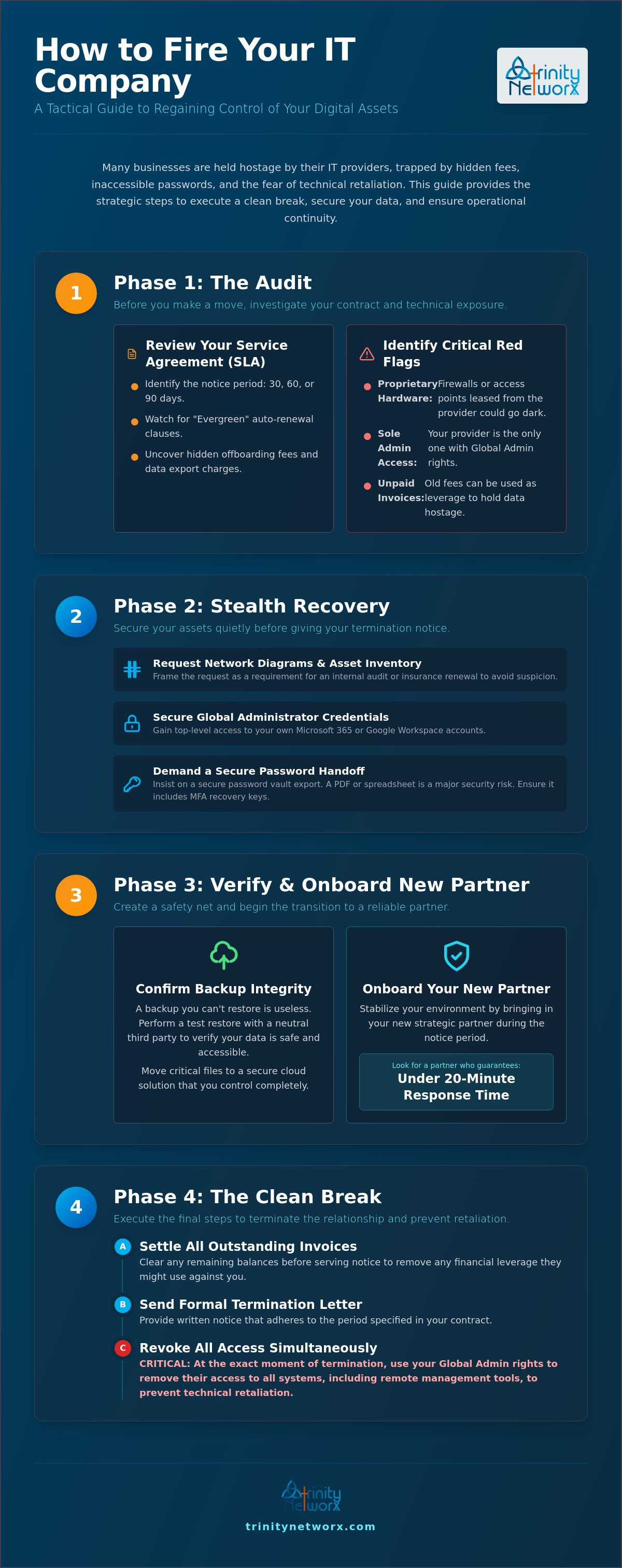
The time for strategic silence is over. Execution begins with the delivery of your formal termination notice. Send this via certified mail and email simultaneously. This creates an undeniable paper trail. You are not just ending a contract; you are reclaiming your sovereignty. Knowing how to fire your IT company means understanding that the technical separation must be as swift as the legal one. Do not leave room for ambiguity or last-minute negotiations.
Revoke all Remote Monitoring and Management (RMM) tool access at the exact moment of termination. Leaving these agents active on your machines allows the former provider to retain a back door into your network. Wipe legacy administrator accounts from every server, firewall, and switch. You must ensure that no ghost credentials remain. Update your cybersecurity protocols immediately. This prevents unauthorized entry and signals to the departing firm that your perimeter is secure and monitored.
Keep the encounter brief. Professionalism is your shield. Much like the sharp, calculated precision found at The Barber House, your demeanor during this transition should reflect a high standard of excellence and control. Avoid debating past technical failures or arguing over missed tickets. Simply state that the business is moving in a different direction. There is no need for a post-mortem during the exit interview. If you have followed the steps in this guide, you already have your passwords and backups. You aren't asking for permission to leave. You are informing them that the transition is already underway.
Verify that the former firm no longer has access to your VoIP systems. Voice networks are often the last hole to be plugged. Change physical security codes. Revoke keycard access. If the previous team held physical keys to your server room or office, rekey the locks today. Total ownership requires physical and digital certainty. This is the final step in how to fire your IT company and starting a new era of proactive growth and reliable support.
Reclaiming your infrastructure is a strategic necessity. You've audited the legal traps and secured the administrative keys. These actions move you from a position of vulnerability to one of strength. By applying this tactical guide, you ensure that how to fire your IT company is an orderly transition rather than a chaotic event. You are no longer reacting to failure. You are building for momentum.
Trinity Networx, LLC brings the assertive reliability required to manage these complex shifts for Southern California SMBs. We offer a 20 minute response guarantee and the professional assurance of a true strategic partner. Our experts handle the extraction so you can maintain your focus on growth. Don't let underperforming support hold your productivity back any longer. Secure your business transition by contacting the experts at Trinity Networx, LLC today. A more efficient way of operating is within your reach. Take the first step toward a healthier network.
Your passwords and network credentials are your property. If a provider withholds this information, they are likely in breach of contract and creating a massive liability for themselves. Have your legal counsel send a formal demand letter immediately to secure these assets. Most providers will comply once they realize you're prepared to take legal action for a "for cause" termination. Don't let them use your own data as a bargaining chip during the exit.
Most managed service providers in Southern California require a notice period of 30, 60, or 90 days. You must check your Master Service Agreement for the exact timeframe and the required delivery method. Missing this window by even one day can trigger an evergreen clause that renews your contract for another full year. Understanding these dates is the first step in learning how to fire your IT company without being trapped by fine print.
Yes, but you need to weigh the costs. You can terminate "for convenience" by paying an early termination fee, or "for cause" if the provider has failed to meet their Service Level Agreement (SLA). Document every instance of slow response times or unresolved technical failures to build your case. This evidence allows you to walk away from a failing partnership without being forced to pay out the remainder of the contract term.
Backup services usually stop the moment your contract ends. You must ensure that a full, restorable copy of your data is moved to a location you control before the final day of service. Do not trust a departing vendor to maintain a "safety" copy of your business information. Once the relationship is over, their legal obligation to protect your data vanishes, making a proactive transfer of your backups a top priority.
Demand transparency and hard metrics. A superior provider will offer a 20 minute response guarantee and provide regular reports on your network's health. You should see fewer emergency tickets because they are performing proactive maintenance to stop issues before they disrupt your staff. If your new partner is constantly reactive and ignores your strategic goals, you haven't solved the problem; you've only changed the name on the invoice.

Article by
Lance Reichenberger, Ph.D.., J.D. (Candidate)
Dr. Lance Reichenberger is the founder of Trinity Networx, a Southern California technology firm specializing in managed IT services, cybersecurity, network infrastructure, and business technology strategy. With nearly four decades of experience in the IT industry, he works with businesses to improve operational efficiency, strengthen security, and align technology with long-term growth objectives.
Lance focuses on proactive IT management, enterprise wireless infrastructure, cybersecurity integration, and scalable technology solutions for growing organizations throughout Southern California.
The content published on this website is provided for general informational and educational purposes only. Articles may be created, edited, or enhanced with the assistance of artificial intelligence and automation tools under the direction and review of Trinity Networx. While every effort is made to ensure accuracy and relevance, the information provided should not be considered professional, legal, financial, cybersecurity, or technical advice specific to your organization. Businesses should consult directly with a qualified professional regarding their unique environment, compliance requirements, and operational needs. Trinity Networx makes no warranties regarding completeness, reliability, or applicability of the information contained within these articles.
Schedule a brief conversation with Trinity Networx to discuss your business technology needs.
Get a practical roadmap built around your business, your users, your systems, and the technology issues that need attention first.
Put the right technology, support, security, and infrastructure in place so your business can grow, adapt, and move forward with confidence.