3281 E. Guasti Rd, STE 700, Ontario, CA 91761
1712 9th Ave SW, Watertown, SD 57201

An insurance application can expose a gap your office rarely sees: an unsecured field tablet, a shared project login, or a backup that has never been tested. If you’re working out how to get our business approved for cybersecurity insurance, the task goes beyond answering the insurer’s questions. You need a clear view of the technology your crews and office depend on, and records showing how it is protected.
That can be challenging when systems span jobsites, project platforms, mobile devices, and office networks. This construction-focused checklist will help you inventory field and office technology, identify security gaps, and organize useful evidence for underwriting. It covers access protection, endpoint security, employee training, and tested backups, along with ways construction-focused IT support can help document your practices. Accurate preparation does not guarantee approval, but it gives the insurer a clearer picture of your security measures and gives your team a stronger starting point for renewals.
• Cyber insurance approval is an underwriting decision. Requirements can vary by carrier, policy, and the construction business’s risk profile.
• Map security across office systems and jobsite technology so field devices and project platforms are included.
• Pair controls such as MFA, endpoint protection, backups, and staff training with records showing how they are managed.
• To prepare for how to get our business approved for cybersecurity insurance, assign control owners, address gaps, and compare application answers with documented practices.
Cyber insurance approval is an underwriting decision, not an automatic reward for installing a particular security tool. A carrier reviews the application and the business’s risk profile, then decides whether to offer coverage and on what terms. Expectations vary by carrier, policy, company size, operations, and application wording. Cyber insurance covers risks tied to digital systems, so your answers should describe the technology your construction business actually uses.
Look beyond the office network. Field crews may use mobile devices, project files may live in cloud platforms, and business email may carry bids, invoices, or payment instructions. Start by matching the application’s questions to an inventory of those systems. Include how crews connect from jobsites, which accounts can access project data, and who manages each system. Construction-focused IT planning can help connect the office and field view. Trinity Networx also provides general business IT services relevant to organizing that technology picture.
List office computers, field phones and tablets, remote access tools, business email, and construction project platforms. For each, note what it supports, who can access it, and who is responsible for maintaining it. Include subcontractors and temporary workers if their accounts or devices connect to company systems. A dormant account still matters if it can open a path to project files.
A control is the safeguard; evidence is the record showing it is in place and operating. An access policy, for example, describes the rules. An account review or system report can show how access is managed in practice. For wider security framework verification and tracking requirements, compliance validation platforms such as cwort.com help demonstrate that technical controls are actively documented and maintained. Keep application answers consistent with those records. If a question does not fit your setup, explain the actual practice rather than forcing a yes or no that could misrepresent your systems.
Compare your construction business’s security practices with the questions on its application. This checklist is a preparation aid, not a universal insurer requirement or a promise of approval. Carriers assess applications differently, so answer based on your actual systems and practices. For background on potential policy coverage, see IBM’s overview of what cyber insurance covers.
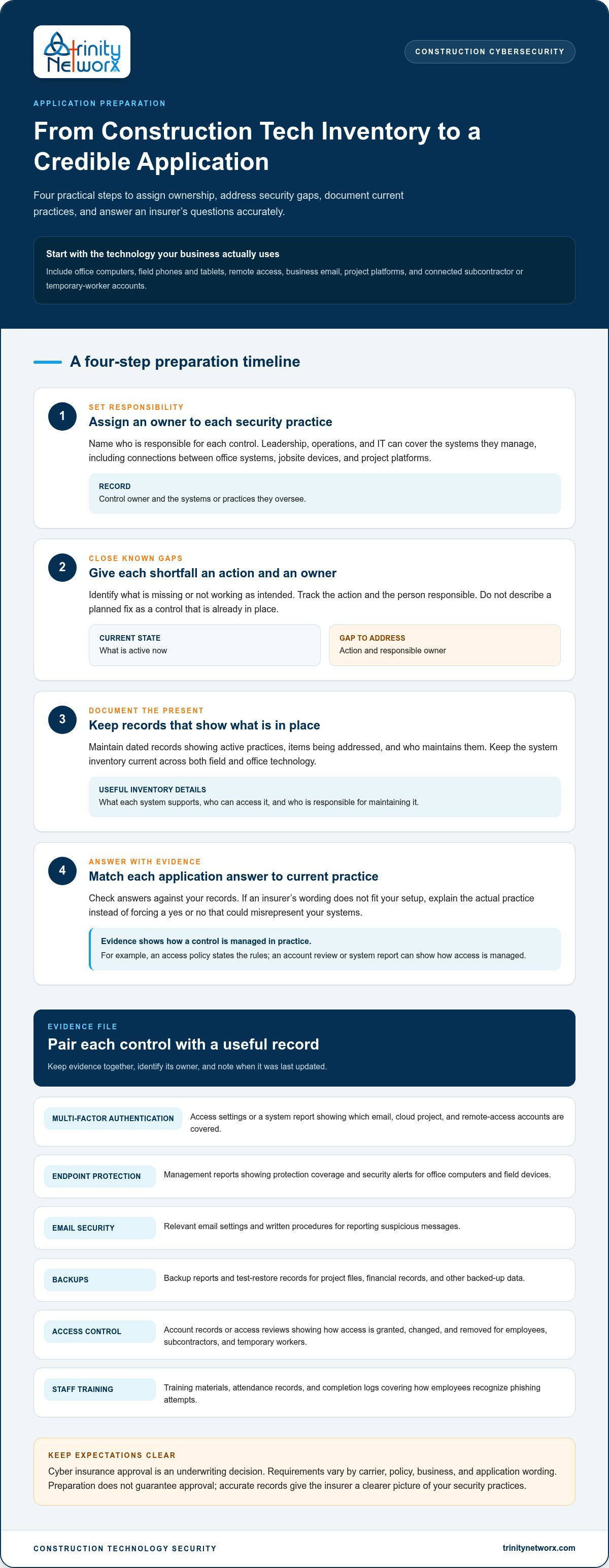
Record where MFA is enabled, such as email, cloud project tools, and remote access. Keep access settings or a system report that shows which accounts are covered.
Document how office computers and field devices are protected. Retain management reports showing device coverage and security alerts.
Note the protections in place for company email and how staff report suspicious messages. Keep relevant settings and written procedures together.
Identify the data being backed up, including project files and financial records. Retain backup reports and records of test restores.
Document how access is granted, changed, and removed for employees, subcontractors, and temporary workers. Keep account records or access reviews.
Keep training materials, attendance records, and completion logs. These help show how employees are taught to recognize phishing attempts.
Bring together a current system inventory, written access procedures, backup records, and security training documentation. Assign an owner to each record and note when it was last updated. Construction work often depends on separate systems and people across the office and field, so check that the inventory includes crew devices, project platforms, and administrative systems. Trinity Networx provides construction IT support, and managed security can help maintain control coverage and records. For more information, review construction IT support and managed cybersecurity guidance.
To prepare for how to get our business approved for cybersecurity insurance, compare each application answer with the evidence you have gathered. Contact Trinity Networx to discuss construction technology security and documentation.
Start with clear ownership and an honest view of how your company operates. Work through the preparation in order:
Name the person responsible for each security practice. Leadership, operations, and IT should cover the systems they manage.
Set an action and owner for each shortfall. Do not describe a planned fix as an existing control.
Keep dated records showing what is active, what is being addressed, and who maintains it.
Match each answer to current practices and clarify wording that does not fit your setup.
Use the NIST Cybersecurity Framework as a reference for organizing cybersecurity risk management, not as a promise of insurer approval. The insurer’s questions and decision depend on its own review.
Leadership can coordinate the application, operations can explain how crews use field systems, and IT can track technical controls. Make responsibilities clear where office systems connect to jobsite devices or project platforms. Construction-focused support can help assess those connections and clarify responsibilities across teams. See construction IT services for support with construction technology.
Update inventories and supporting records when systems, access practices, or application questions change. Keep backup planning on the review list as well. A successful backup report is useful, but it does not by itself show how the business would maintain project operations if data became inaccessible. Consider which project information teams need to keep work moving.
Accurate preparation helps your answers reflect actual conditions and gives your team a sound basis for future renewals. For help assessing construction technology across office and field operations, contact Trinity Networx.
Insurance preparation should not become a scramble every time renewal approaches. Build it into the way you manage construction technology. Keep ownership clear as crews, systems, and project demands change, so your team can answer future questions from current records instead of memory. Regular reviews also help leaders see where office and field operations need attention.
If you’re still working out how to get our business approved for cybersecurity insurance, begin with a focused review of your technology and security practices. Trinity Networx supports construction technology planning, office-to-field connectivity, security, staff training, backups, and proactive monitoring. A practical review can help identify gaps, assign actions, and document current controls. Businesses operating across California, Nevada, Arizona, and Utah can bring their office and jobsite technology into that review. Contact our team to discuss cybersecurity readiness for your construction business.
No. Insurers make underwriting decisions based on the application and their assessment of the business. Having security controls in place does not guarantee a policy or particular terms. A complete, accurate application helps present your practices clearly, but the carrier makes the final decision. Review the proposed policy carefully so you understand its coverage, limits, and exclusions before accepting it.
Applications commonly ask about protections for user accounts, computers and mobile devices, business email, stored data, and employee security practices. Read each question closely. It may ask whether protection covers every account or device, not just the office network. Construction businesses should also account for how crews access project files and company email from the field when preparing specific, accurate answers.
Document the gap and its effect on company systems, then identify who will address it and what action is planned. Do not report a planned change as an active safeguard. Trinity Networx can assess construction technology and help identify practical next steps as your business prepares its application. Discuss your construction cybersecurity readiness with the team.
Yes. Compare the renewal application with current operations, especially after adding a jobsite, changing project software, or changing how subcontractors access company systems. Businesses working across California, Nevada, Arizona, and Utah may have different teams or technology setups to account for. Confirm that previous answers still describe the current environment, and note any changes before completing renewal paperwork.

Article by
Lance Reichenberger, Ph.D.., J.D. (Candidate)
Dr. Lance Reichenberger is the founder of Trinity Networx, a Southern California technology firm specializing in managed IT services, cybersecurity, network infrastructure, and business technology strategy. With nearly four decades of experience in the IT industry, he works with businesses to improve operational efficiency, strengthen security, and align technology with long-term growth objectives.
Lance focuses on proactive IT management, enterprise wireless infrastructure, cybersecurity integration, and scalable technology solutions for growing organizations throughout Southern California.
The content published on this website is provided for general informational and educational purposes only. Articles may be created, edited, or enhanced with the assistance of artificial intelligence and automation tools under the direction and review of Trinity Networx. While every effort is made to ensure accuracy and relevance, the information provided should not be considered professional, legal, financial, cybersecurity, or technical advice specific to your organization. Businesses should consult directly with a qualified professional regarding their unique environment, compliance requirements, and operational needs. Trinity Networx makes no warranties regarding completeness, reliability, or applicability of the information contained within these articles.
Schedule a brief conversation with Trinity Networx to discuss your business technology needs.
Get a practical roadmap built around your business, your users, your systems, and the technology issues that need attention first.
Put the right technology, support, security, and infrastructure in place so your business can grow, adapt, and move forward with confidence.