3281 E. Guasti Rd, STE 700, Ontario, CA 91761
1712 9th Ave SW, Watertown, SD 57201

Lance Reichenberger, Ph.D.
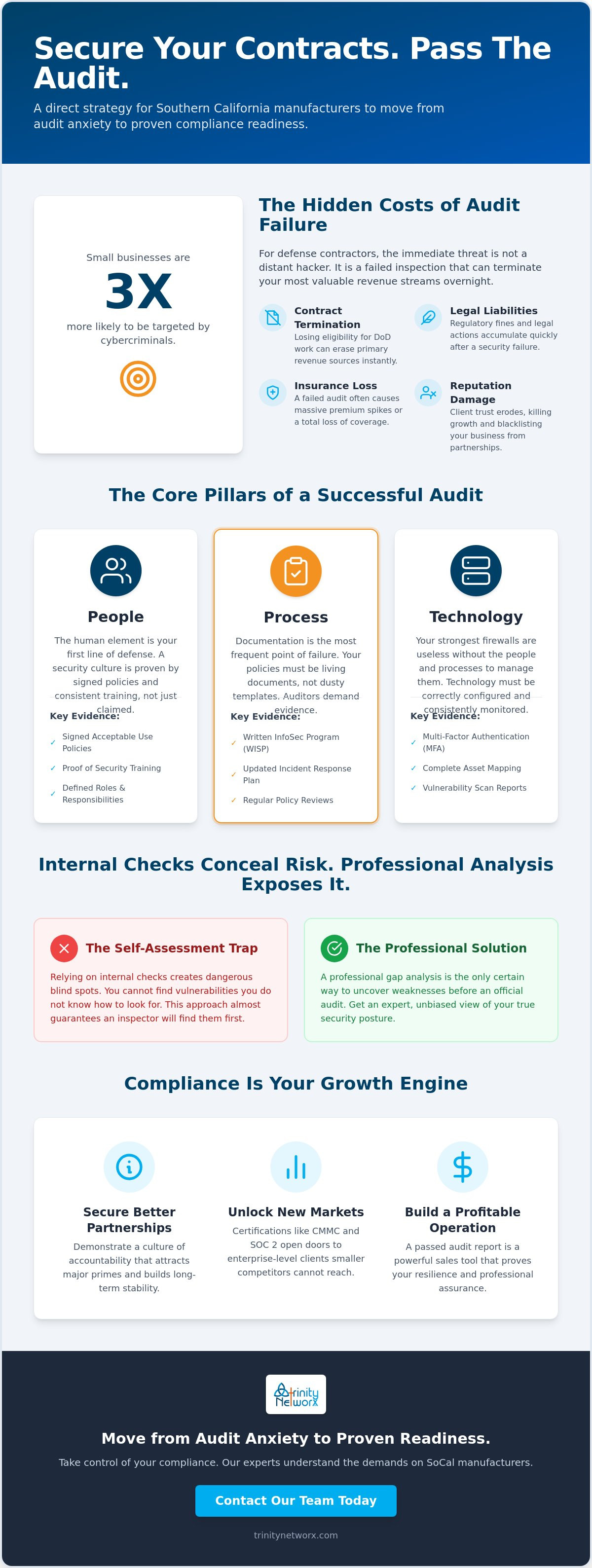
Small businesses are three times more likely to be targeted by cybercriminals than larger corporations, yet the real threat for SoCal manufacturers often comes from an auditor's clipboard. If you handle defense contracts, a single failed inspection can terminate your most valuable revenue streams overnight. You've likely felt the pressure of the 2026 CPRA mandates and the confusing shift to NIST 2.0. It's frustrating to face complex jargon when you just want to keep your doors open and your data safe. Mastering how to pass a cybersecurity audit shouldn't be an exercise in panic or a drain on your limited time.
I am providing a direct strategy to move your business from audit anxiety to proven compliance readiness. We focus on security that actually protects your operations rather than just satisfying a checklist. This guide breaks down the repeatable steps needed to achieve a passed audit with zero major findings. You'll gain a clear path to maintain ISO 27001:2022 standards while ensuring your business remains resilient and competitive in a high-risk market.
• Turn compliance into a high-stakes competitive advantage that secures your position in the Southern California defense supply chain.
• Avoid the trap of self-assessment. Professional gap analysis is the only way to find vulnerabilities before an official inspector does.
• Master the technical requirements for how to pass a cybersecurity audit by focusing on asset mapping and immediate remediation of MFA gaps.
• Replace the "one and done" mentality with a repeatable process. Security belongs in your daily operations.
• Protect your data through the deliberate coordination of people, processes, and technology.
Southern California manufacturers and defense contractors operate in a high-stakes environment. Your ability to secure contracts depends on more than just your output quality. It rests on your security posture. For firms in San Diego or Orange County, an Information security audit acts as a gatekeeper. It is no longer an optional checkup. It is a mandatory requirement for staying in the supply chain. Learning how to pass a cybersecurity audit is the difference between a thriving business and one that gets left behind.
Proactive preparation shifts your company from a defensive crouch to an offensive advantage. When you can prove your compliance, you become a lower risk for major primes. This reliability attracts better partnerships. It builds a foundation for long-term stability. You stop reacting to threats and start driving your business forward with confidence. The financial reality is clear. Investing in readiness now costs far less than the fallout of a failed inspection or a data breach. Understanding how to pass a cybersecurity audit requires more than a checklist; it demands a shift in leadership mindset.
Failure carries a heavy price tag. If you lose eligibility for Department of Defense contracts, your primary revenue could vanish overnight. Legal liabilities also stack up quickly. Insurance providers are tightening their requirements in 2026. A failed audit often leads to massive premium spikes or a total loss of coverage. This reputational damage is hard to repair. It kills client trust and makes future growth nearly impossible. You might find your business blacklisted by partners who cannot afford the risk of your technical gaps. Manufacturing remains a prime target for cyber incidents, making an audit a vital shield for your factory floor and intellectual property.
View compliance as a tool for expansion. Certifications like CMMC and SOC 2 open doors to enterprise-level clients that smaller competitors can't touch. You can use your successful audit reports as a powerful sales tool. It demonstrates a culture of accountability. By focusing on technical transparency, you prove to potential partners that their data is safe in your hands. This level of professional assurance is what separates market leaders from the rest. You aren't just checking boxes; you are building a more resilient, profitable operation. High-performing businesses use these standards to refine their internal IT management and ensure operational continuity. Success in an audit validates your hard work and signals to the market that you are a serious, secure partner.
A cybersecurity audit is a formal verification of technical controls and administrative policies. Think of it as a three-legged stool consisting of people, process, and technology. If one leg is weak, the entire structure collapses under the weight of regulatory scrutiny. For many SoCal businesses, the technology leg is often the strongest, while the process and documentation legs are neglected. This is a fatal mistake. Auditors don't take your word for it. They demand evidence. Understanding how to pass a cybersecurity audit starts with recognizing that it isn't just a technical scan. It's a test of your organizational discipline.
Documentation is the most frequent point of failure in 2026. You might have the best firewalls in California, but if your policies aren't written down and updated, you'll fail. Learning how to pass a cybersecurity audit requires aligning your operations with specific standards. Most organizations find success by adhering to the NIST Cybersecurity Framework, which provides a structured approach to managing risk. If you are unsure where your documentation stands, it's time to talk to an expert who understands the local manufacturing landscape.
Your policy set is the playbook for your entire organization. A Written Information Security Program (WISP) must be a living document, not a template you downloaded and forgot. It defines who has access to what and why. Every staff member must sign an acceptable use policy to ensure they understand their responsibilities. Auditors look for these signatures as proof of a security culture. You also need a clear incident response plan. When a breach happens, the audit will verify if you followed your own rules for containment and reporting. This administrative layer provides the necessary context for your technical defenses.
Technical controls are the digital locks on your doors. Multi-factor authentication is now a non-negotiable requirement across every single entry point. This includes email, VPNs, and even internal file shares. Another critical component is business data backup. An auditor will test your recovery speed and data integrity to ensure you can actually bounce back from a ransomware attack. Your it-infrastructure must also include active threat detection. Basic antivirus doesn't cut it anymore. You need systems that watch for behavioral anomalies in real-time. Knowing how to pass a cybersecurity audit means proving your technical defenses are active, tested, and constantly monitored.
Marking your own homework is a recipe for failure. Most business owners believe their internal teams have security handled. This assumption is dangerous. Internal IT staff often lack the objective distance required to spot systemic flaws. They are too close to the daily fires to see the gaps in the foundation. A professional gap analysis provides a cold, hard look at your actual posture. It uncovers specific vulnerabilities that internal teams miss because of habit or lack of specialized audit training. If you want to know how to pass a cybersecurity audit, you must first accept that your internal view is likely skewed by proximity.
Your current IT provider might even be hiding compliance holes. This isn't always malicious. Sometimes they just don't know what they don't know. They might focus on uptime while ignoring the administrative rigors of CMMC or SOC 2. Balancing the cost of third party preparation against the risk of failure is a simple math problem. A failed audit costs more than a proactive assessment. The loss of a single defense contract can outweigh years of consulting fees. Real readiness requires an outside perspective to validate your controls and policies before the official inspector arrives.
Self-certified data is often viewed with skepticism by professional auditors. They know that internal bias leads to "everything is fine" reports that crumble under scrutiny. Blind spots are common in internal security audits, often including neglected physical security or outdated access lists. Verification is the only currency an auditor accepts. Without an external set of eyes, you are gambling with your business's future. Proactive leaders choose evidence over assumptions every time.
Building a foundation for success requires more than a one-time effort. Managed cybersecurity services provide the continuous oversight needed to stay ready. Compliance shouldn't be a seasonal panic. It should be a managed service subscription running in the background. This approach replaces the "one and done" mentality with constant monitoring. You gain a partner who understands how to pass a cybersecurity audit. This turns a stressful event into a routine verification of your it-optimization efforts.
Preparation is not a passive activity. It is an aggressive hunt for weaknesses before an outsider finds them. To master how to pass a cybersecurity audit, you must treat your evidence with more respect than your actual hardware. If you can't prove a control was active on a specific Tuesday at 2:00 PM, the auditor will assume it was broken. This checklist moves you from a state of hope to a state of certainty.
Identify every asset and data flow. You can't secure what you haven't mapped.
Close obvious technical gaps. Mandatory MFA and full disk encryption are your first priorities.
Conduct staff security awareness training. Documented results are the only way to prove your team is a defense, not a liability.
Centralize all logs. Make evidence access fast and undeniable.
Perform a mock audit. Stress test your defenses under simulated pressure.
A comprehensive hardware and software inventory is the bedrock of compliance. You must know every device connected to your network, from the front office to the factory floor. Identify exactly where sensitive data sits and who has the keys to it. Securing your it-infrastructure against unauthorized physical access is just as critical as your digital firewalls. In 2026, auditors look for the "Govern" function from NIST 2.0, which demands clear oversight of all organizational resources. If you find gaps in your inventory, schedule your mock audit to identify what else you might be missing.
Automation is your best friend when it comes to logs. Manually collecting data during an audit is a recipe for errors and missed deadlines. Use systems that prove consistent monitoring across your entire environment. Organize every policy, training record, and technical log in a secure, central repository. Timestamped proof for patch management is non-negotiable. With the average cost of a data breach rising to $4.88 million, auditors have no patience for missing records. They want to see a clear history of your security actions, not a frantic scramble for documents at the last minute.
Many executives view a passed audit as a finish line. This is a dangerous misconception. An audit captures a single moment in time, but your network changes every hour. New users join. Hardware ages. Software vulnerabilities emerge. Thinking of compliance as a "one and done" project invites disaster. True security requires a continuous state of alertness. When you understand how to pass a cybersecurity audit, you realize the work never actually stops. It becomes a permanent part of your operational DNA. You aren't just hunting for a certificate; you are building a resilient business that can withstand the $74 billion ransomware threat projected for 2026.
Integrating compliance into your daily business operations removes the friction of "prep season." You shouldn't have to scramble for months every year to find missing logs. Effective it-management ensures that your controls are always active and your evidence is always current. This proactive stance protects your business from the "compliance drift" that happens between formal reviews. By making security a standard operating procedure, you turn a high-stress event into a routine validation of your existing excellence. It turns your technical posture into a strategic driver of progress rather than a reactive cost center.
Audit readiness demands a rhythmic approach to security. Quarterly reviews of access controls and user permissions are essential. You must prune old accounts and verify that current employees only have the access they need for their specific roles. As your Southern California business grows, your policies must scale alongside your revenue and employee count. Regular it-optimization keeps your hardware audit-ready and ensures your systems aren't the weak link in your defense. This lifecycle approach prevents small gaps from turning into major findings that could cost you a manufacturing contract.
Partnering with a strategic expert lifts the heavy technical burden off your shoulders. We don't just react to problems; we anticipate auditor questions before they are asked. Our team has deep experience with CMMC and HIPAA, specifically tailored for the unique needs of SoCal manufacturers and defense contractors. We provide the professional assurance you need to focus on your core business. You deserve a partner who values your time and growth as much as you do. Contact our team at trinitynetworx.com/contact-us to start your readiness assessment and master how to pass a cybersecurity audit with confidence. We move you from audit anxiety to proven compliance readiness.
Compliance isn't a hurdle. It's a constant state of readiness. Southern California manufacturers who thrive in 2026 are those that embed security into their daily culture. You now have the roadmap for how to pass a cybersecurity audit. Success comes down to the quality of your proof. Every piece of hardware and every user permission must be accounted for at all times.
Stop guessing. Start proving your security. Our Ph.D. led strategic IT leadership specializes in CMMC and HIPAA compliance for SoCal SMBs. We provide the professional assurance you need with a guaranteed response time under 20 minutes.
Contact Trinity Networx, LLC today for a proactive audit readiness assessment.
Share this guide: LinkedIn | X | Facebook
Your business deserves the stability that comes from proven protection. Take action now to ensure your operations remain resilient and your contracts remain secure. You're ready to lead your industry with total confidence.
A standard cybersecurity audit for a small to medium sized business often spans two to six weeks. This duration depends on the complexity of your network and the specific framework being tested. Preparation often requires several months of remediation and documentation gathering before the auditor arrives. Rushing this timeline usually leads to overlooked evidence and potential failure. You must allow enough time for your controls to generate a history of logs.
An assessment is a preliminary review used to identify gaps, while an audit is a formal verification conducted by an independent third party. Assessments are collaborative tools for improvement. Audits are high stakes examinations that result in a pass or fail grade. Think of the assessment as the practice test and the audit as the final exam that determines your contract eligibility. You need both to ensure your business remains compliant and secure.
You face a high risk of losing defense or manufacturing contracts if you fail to meet mandatory compliance standards. Prime contractors cannot legally share sensitive information with non compliant partners. Failure signals to your clients that their data is a liability rather than an asset. Immediate remediation is often required to maintain your standing in the Southern California supply chain. A failed audit can terminate your most profitable revenue streams overnight.
Preparation costs vary based on your current technical debt and the size of your organization. Factors include the cost of new hardware, software licenses for MFA, and professional consulting fees. It is far more cost effective to invest in readiness than to pay for emergency remediation after a failed inspection. Many businesses find that proactive management reduces the total financial burden of compliance over time. Investing in your security posture protects your long term profitability.
Internal teams often struggle with audit preparation because they lack the objective distance and specialized training required. They are usually focused on daily uptime rather than the administrative rigors of complex frameworks. Bringing in an outside expert ensures that your internal controls are validated against current standards. This prevents the "marking your own homework" bias that frequently leads to audit failure. Expert guidance turns a stressful process into a methodical success.
Missing documentation and incomplete logs are the primary reasons businesses fail. You might have the right technology in place, but if you cannot prove it was active and monitored, it doesn't count. Other common failures include inconsistent patch management and employees who haven't completed security awareness training. Mastering how to pass a cybersecurity audit requires a balance of technical controls and administrative proof. Proactive logging is your best defense against failure.
Most regulatory frameworks, including the CPRA and SOC 2, require an annual audit to maintain compliance. High risk industries or those handling sensitive defense data may face more frequent inspections. Regular internal assessments between formal audits help ensure your security posture doesn't drift. Staying audit ready is a continuous process rather than an annual event. This constant readiness protects your business from emerging threats and shifting regulations.
Multi factor authentication is a non negotiable requirement for every major cybersecurity audit in 2026. This includes NIST 2.0, ISO 27001, and CMMC. Any system that accesses sensitive data or your internal network must be protected by MFA. If you haven't implemented this across all entry points, you are almost guaranteed to fail. Understanding how to pass a cybersecurity audit starts with these fundamental technical controls. It is the single most effective barrier against unauthorized access.

Article by
Lance Reichenberger, Ph.D.., J.D. (Candidate)
Dr. Lance Reichenberger is the founder of Trinity Networx, a Southern California technology firm specializing in managed IT services, cybersecurity, network infrastructure, and business technology strategy. With nearly four decades of experience in the IT industry, he works with businesses to improve operational efficiency, strengthen security, and align technology with long-term growth objectives.
Lance focuses on proactive IT management, enterprise wireless infrastructure, cybersecurity integration, and scalable technology solutions for growing organizations throughout Southern California.
The content published on this website is provided for general informational and educational purposes only. Articles may be created, edited, or enhanced with the assistance of artificial intelligence and automation tools under the direction and review of Trinity Networx. While every effort is made to ensure accuracy and relevance, the information provided should not be considered professional, legal, financial, cybersecurity, or technical advice specific to your organization. Businesses should consult directly with a qualified professional regarding their unique environment, compliance requirements, and operational needs. Trinity Networx makes no warranties regarding completeness, reliability, or applicability of the information contained within these articles.
Schedule a brief conversation with Trinity Networx to discuss your business technology needs.
Get a practical roadmap built around your business, your users, your systems, and the technology issues that need attention first.
Put the right technology, support, security, and infrastructure in place so your business can grow, adapt, and move forward with confidence.