3281 E. Guasti Rd, STE 700, Ontario, CA 91761
1712 9th Ave SW, Watertown, SD 57201

A shorter IT vendor list isn’t automatically a stronger one. Reducing the number of IT vendors we use works best when each remaining supplier supports the way the business operates, not just a target to cut names from a spreadsheet.
When teams rely on scattered providers, ownership can blur and routine decisions can take more coordination. But consolidation without input from the people who depend on those services can create new gaps. The right criteria matter as much as the final count.
This guide explains how to align IT suppliers with business priorities, weigh the practical gains and trade-offs of consolidation, and involve stakeholders in vendor-selection decisions. You’ll learn how to assess supplier performance and fit, then build a shortlist around operational needs, security, and business direction. Fewer vendors should mean clearer accountability, not less support for the work that keeps the business moving.
• Map production technology to plant requirements, then review system performance and facility constraints before choosing upgrades.
• Weigh centralized equipment oversight against downtime risks when production systems depend on fewer platforms.
• Bring manufacturing, facilities, security, and construction teams into planning so equipment, power, and service needs are covered.
• Set expectations for security, accountability, and construction support before connecting or relocating production systems.
For reducing the number of IT vendors we use, start by listing frequent providers and occasional project suppliers. Record each vendor’s services, systems supported, internal owner, contract terms, and dependent teams. A manufacturer may rely on one provider for office systems and another for plant connectivity. Mapping those connections shows what each relationship contributes before a supplier is removed.
Compare supplier capabilities with needs such as production continuity, cybersecurity, data recovery, and planned growth. Price matters, but it shouldn’t outweigh delivery flexibility when a delayed technology change could disrupt production. This comparison separates services that overlap on paper from those with distinct functions.
Look for recurring service problems, missed commitments, and weak communication. Repeated issues can signal that a supplier may not be dependable enough to retain. Ask remaining vendors how they’ll support business goals and contribute to a five-year technology road map. Open discussion can also surface practical ways to improve coordination.
Before reducing the number of IT vendors we use, assess each candidate’s capabilities, support, security, and fit with existing systems. NIST recommends requesting quotes from multiple vendors to compare costs and capabilities. Keep decisions tied to business needs, not a lower price alone. This helps reduce overlap while retaining suppliers that support the company’s direction.
Include infrequent suppliers in the full inventory and assess their contribution alongside that of regular providers. Retain suppliers whose work supports long-term strategic goals, and consider replacing those that no longer meet business needs. Open dialogue can strengthen working relationships and help identify efficiencies. When rapid product turnaround matters, shorter lead times and delivery flexibility may outweigh a lower price.
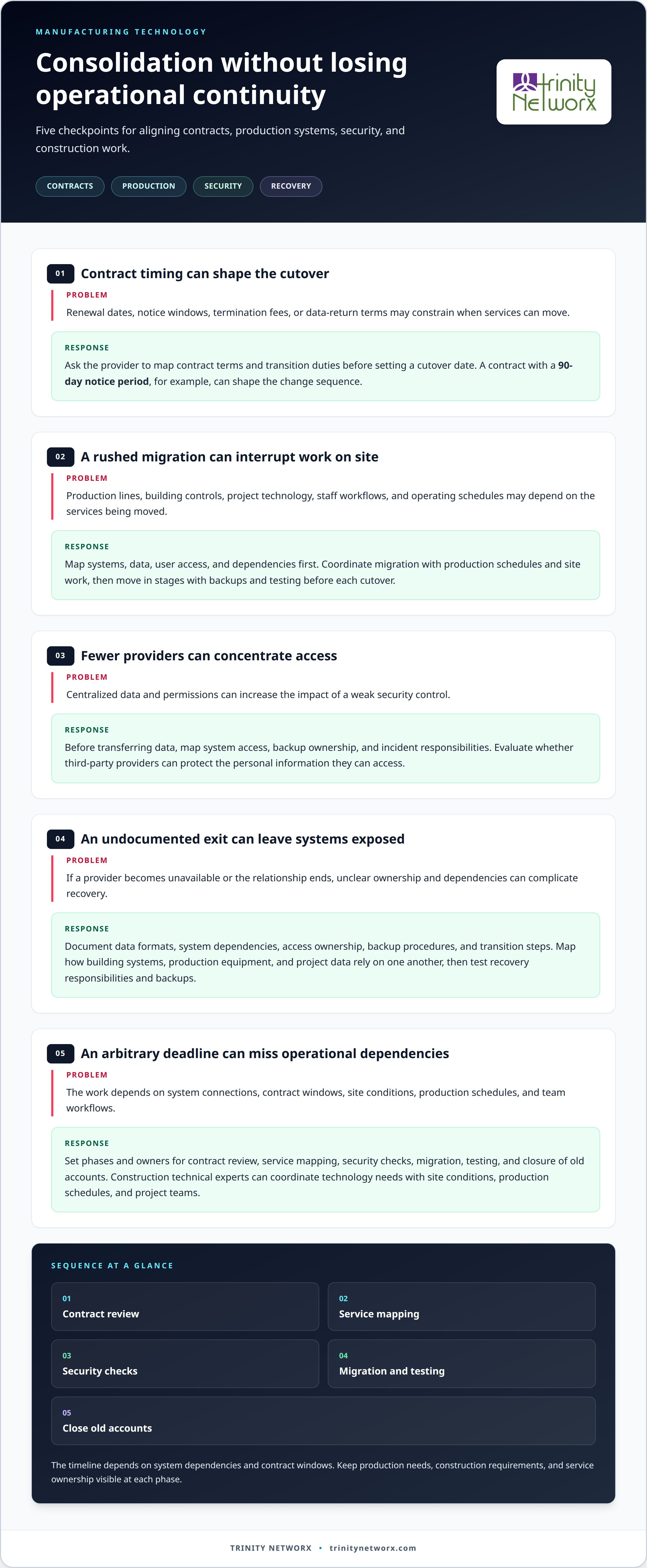
Have the provider map renewal dates, notice windows, termination fees, data-return terms, and transition duties. A contract with a 90-day notice period, for example, can shape the sequence of changes. Clear terms reduce surprise costs and help avoid gaps in construction technology support for manufacturing equipment and facilities while focusing on reducing the number of IT vendors we use.
Before moving services, inventory systems, data, user access, and dependencies across production lines, building controls, and construction project technology. Coordinate changes around operating schedules, site work, and staff workflows. A staged migration, with backups and testing before each cutover, can limit disruption and expose problems while current services remain available.
Fewer providers can simplify oversight, but concentrating data and permissions can increase the impact of a weak control. According to the Internal Revenue Service, businesses should evaluate third-party providers’ ability to maintain appropriate security for personal information they can access. Map access, backup ownership, and incident responsibilities before transferring data, including systems used to manage construction sites and manufacturing operations.
Ask the provider to document data formats, system dependencies, access ownership, backup procedures, and transition steps if the relationship ends. Construction technical experts can map how building systems, production equipment, and project data depend on one another, then test recovery responsibilities and backups. This reduces reliance on undocumented processes and helps protect continuity if a primary provider becomes unavailable.
A sound plan covers contract review, service mapping, security checks, migration, testing, and closure of old accounts. Construction technical experts can coordinate technology requirements with site conditions, production schedules, and project teams. Your team supplies priorities, access approvals, and operational constraints. The timeline depends on system dependencies and contract windows. Contact Trinity Networx, LLC for construction technology consolidation support.
Set selection criteria with the people who rely on IT, not procurement alone. Their priorities can show which services can be combined and which need distinct support.
•
Ask IT, operations, security, finance, and production leaders to rank service needs before reviewing vendors. Compare incident patterns, response quality, system access, and the operational impact of outages. For a small manufacturer, keeping plant systems dependable may outweigh consolidating a low-impact office tool. The Internal Revenue Service says businesses should evaluate third-party providers’ ability to protect personal information they can access.
•
Compare each option using the same categories: recurring charges, migration work, training, support, and overlapping tools. A lower quote can come with higher transition or operating expenses, so assess total ownership over a period relevant to the business. Finance can set budget limits while IT identifies technical dependencies. This gives small and midsized companies a practical basis for phasing out duplicate services.
•
Ask stakeholders in each operating state and regulated business unit to identify data types, access needs, and contractual obligations. A manufacturer handling employee records, for example, should weigh security and privacy alongside production uptime. Avoid a single score that hides local differences. Record each requirement, its business owner, and how a proposed provider would meet it, then compare vendors against that shared record.
Discuss vendor-selection criteria with a team that can align technical choices with business priorities.
Trinity Networx helps manufacturers address technology needs tied to facility construction and production. When project teams, equipment suppliers, and contractors leave gaps in plans for technology infrastructure, coordination can clarify requirements for installation and identify where Construction Technical Expertise can help resolve conflicts before they disrupt work.
Manufacturing technology depends on building systems, equipment, and infrastructure working together. The right construction support depends on the facility, production requirements, and project scope. For a manufacturer, the goal is practical: coordinate technology needs with construction work and keep installation requirements clear across the project.
If you’re assessing technology needs for a construction project, contact Trinity Networx, LLC to discuss your requirements.
A disciplined plan for reducing the number of IT vendors we use should give your business clear ownership and room to adapt. Treat the next move as an operating decision, not simply a supplier reduction. Focus on how technology supports production, protects company data, and serves employees.
For manufacturing teams, a vendor change can affect connected systems and daily workflows. Set a transition sequence around operational priorities, then assign responsibility for each handoff. Clear ownership gives internal teams a steady point of coordination as arrangements change.
Trinity Networx, LLC can help your business assess its IT environment and plan the next steps around operational needs. Contact Trinity Networx, LLC to discuss vendor consolidation. A clear plan puts your team in a stronger position to move forward.
The main benefit is a simpler set of working relationships; one drawback is losing a specialist’s knowledge along with a contract. Before combining services, identify who holds system documentation, configuration history, and administrator credentials. For example, a departing vendor may understand a production application’s setup better than the incoming provider. Plan the knowledge transfer before ending that relationship.
Review how employees use each service and how much internal knowledge sits with each supplier. Look beyond contract names: a rarely used tool may still support a critical reporting task, while a familiar platform may have few active users. Usage records, support tickets, and department interviews help reveal these differences and set a sensible order for review.
No single savings figure applies to every business. To measure the result, record current invoices and the internal time spent managing vendor relationships, then compare them with actual spending after changes. Track transition expenses separately from recurring charges. This gives finance a clear view of whether savings came from lower ongoing bills, fewer administrative tasks, or both.

Article by
Lance Reichenberger, Ph.D.., J.D. (Candidate)
Dr. Lance Reichenberger is the founder of Trinity Networx, a Southern California technology firm specializing in managed IT services, cybersecurity, network infrastructure, and business technology strategy. With nearly four decades of experience in the IT industry, he works with businesses to improve operational efficiency, strengthen security, and align technology with long-term growth objectives.
Lance focuses on proactive IT management, enterprise wireless infrastructure, cybersecurity integration, and scalable technology solutions for growing organizations throughout Southern California.
The content published on this website is provided for general informational and educational purposes only. Articles may be created, edited, or enhanced with the assistance of artificial intelligence and automation tools under the direction and review of Trinity Networx. While every effort is made to ensure accuracy and relevance, the information provided should not be considered professional, legal, financial, cybersecurity, or technical advice specific to your organization. Businesses should consult directly with a qualified professional regarding their unique environment, compliance requirements, and operational needs. Trinity Networx makes no warranties regarding completeness, reliability, or applicability of the information contained within these articles.
Schedule a brief conversation with Trinity Networx to discuss your business technology needs.
Get a practical roadmap built around your business, your users, your systems, and the technology issues that need attention first.
Put the right technology, support, security, and infrastructure in place so your business can grow, adapt, and move forward with confidence.