3281 E. Guasti Rd, STE 700, Ontario, CA 91761
1712 9th Ave SW, Watertown, SD 57201
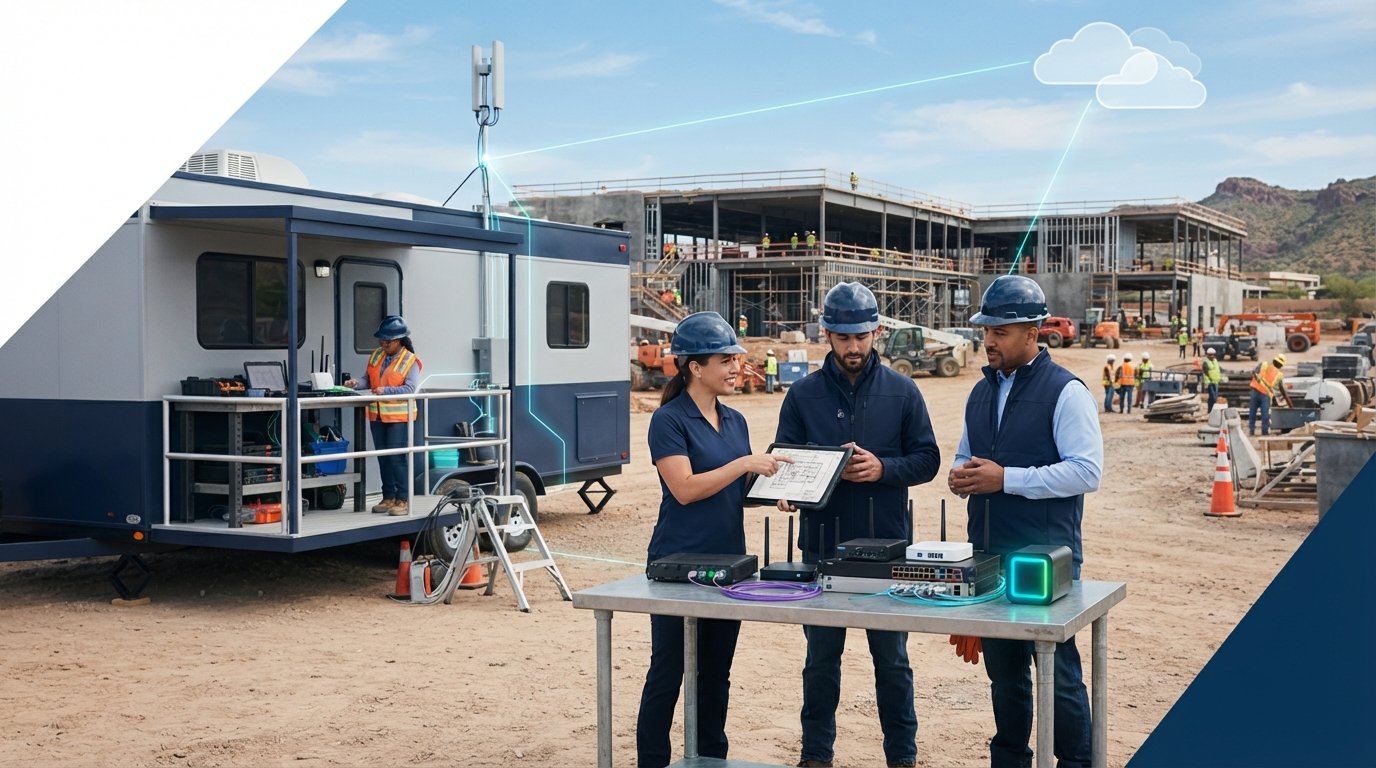
Your superintendent cannot open revised blueprint files inside the job trailer, leaving trade crews stalled on active payroll. You already understand the frustration of waiting hours for distant call centers to fix dropped field internet while ransomware threats jeopardize subcontractor payment files. Commercial schedules leave no room for server crashes, connection dropouts, or unverified backups. It's an exhausting way to run active jobsites. Learning how to stop worrying about IT problems begins when you stop accepting makeshift cellular hotspots and start applying disciplined technology standards to every trailer.
Discover practical methods to eliminate jobsite tech failures, secure critical project data, and build reliable project networks that keep work moving forward. We examine the exact blind spots stalling commercial builds today and outline the operational shift required to achieve zero tech-driven work stoppages across your active projects.
• Unplanned trailer network drops stall field crews and threaten project schedules, turning unmanaged field connections into severe operational liabilities.
• Discover how to stop worrying about IT problems by auditing field hardware before breaking ground and deploying cellular failover systems to maintain continuous uptime.
• Protecting subcontractor portals and enforcing verified, off-site data backups shields your firm from catastrophic ransomware demands and lost project records.
• Replacing unpredictable break-fix billing with flat-fee managed IT delivers stable overhead costs and direct access to technicians who understand commercial building realities.
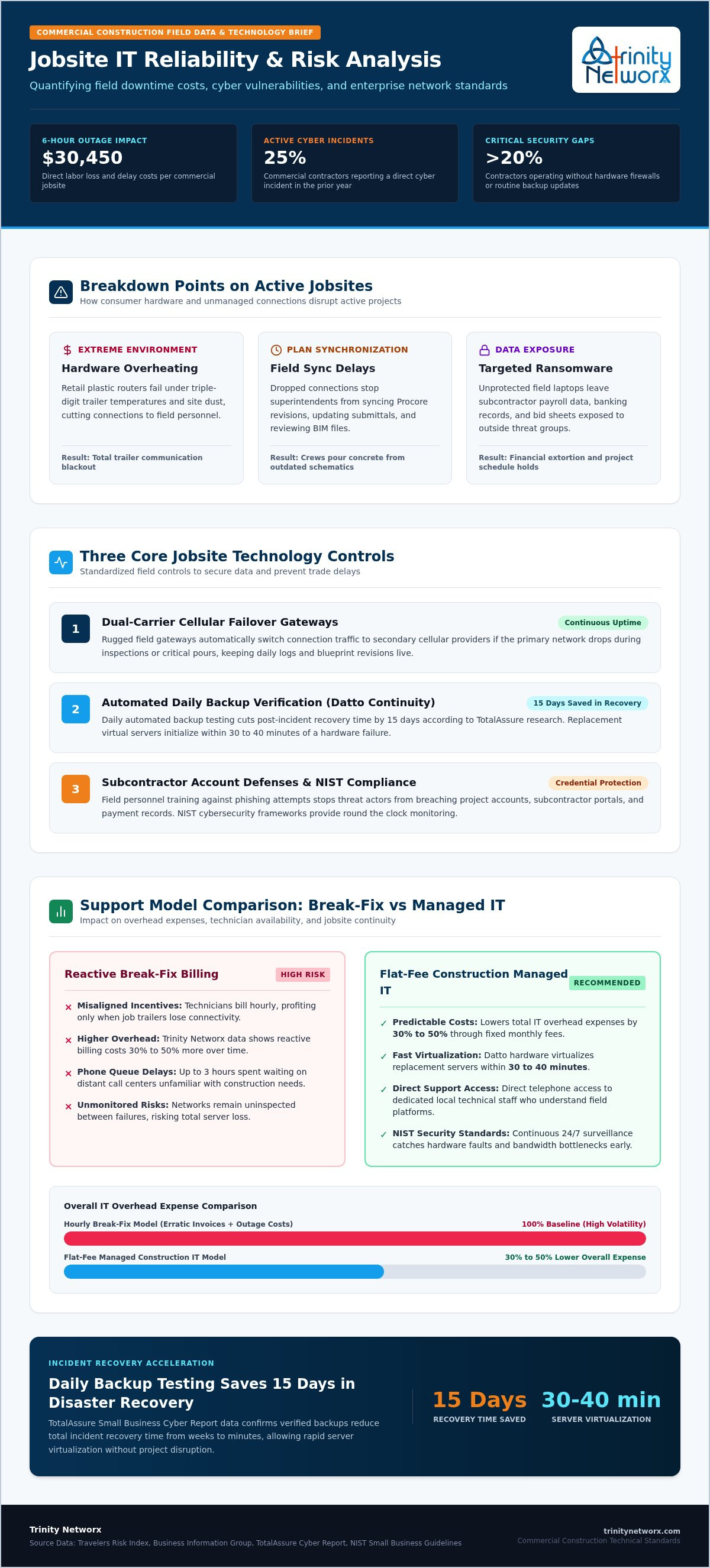
General contractors often treat technology anxiety as an unavoidable mental burden. It isn't. Tech anxiety is an operational symptom of inadequate jobsite hardware and absent security controls. According to the Travelers Risk Index, over 20% of commercial contractors operate without hardware firewalls or routine backup updates, while 25% confirmed an active cyber incident over the prior year. When unmanaged jobsite networks collapse, project managers don't just feel stressed. They face real financial exposure.
Unprotected field laptops expose subcontractor payroll files and competitive bid sheets to ransomware groups targeting project schedules. A single six-hour network disruption on an active commercial build triggers an estimated $30,450 in direct labor losses and delay expenses, according to Business Information Group data. Liquidated damages compile quickly while field teams wait for answers. Adopting a proactive managed IT services model stops this operational bleed. That is how to stop worrying about IT problems before project margins disappear.
Plastic consumer routers bought at retail stores melt down in dusty job trailers under triple-digit heat. When field connections drop, superintendents cannot sync Procore revisions, update submittals, or review BIM coordination files. Subcontractors pour concrete from outdated schematics or sit idle waiting for revised plan sets. Our specialized commercial construction IT services eliminate this breakdown by replacing fragile consumer gear with enterprise field gateways that hold up under punishing site conditions.
Generic business advice suggests deep breathing or designated worry sessions to manage jobsite stress. That advice fails on a commercial build. Concrete pours do not pause for positive thinking. The practical answer for how to stop worrying about IT problems is technical prefabrication: auditing jobsite hardware before breaking ground and replacing vulnerable gear with enterprise standards.
A McKinsey analysis on construction digital transformation demonstrates that integrating field operations with standardized technology architectures drives measurable project gains. That protection begins with three foundational controls:
Install rugged field gateways featuring secondary cellular connections. If your primary provider drops during a city inspection, traffic switches automatically to keep daily logs and plans accessible.
Run daily automated snapshots to Datto continuity hardware. The TotalAssure Small Business Cyber Report found verified daily backup testing cuts recovery time by 15 days after an incident, allowing replacement servers to virtualize within 30 to 40 minutes.
Train field staff against credential phishing to prevent threat actors from breaching project portals and banking records.
To inspect your field network before job mobilization begins, contact our engineering team to protect your active project trailers.
Break-fix support creates misaligned incentives. An hourly repair technician only makes money when your job trailers go dark. That reactive model drains capital and leaves active builds vulnerable between major network crashes. Shifting from hourly repairs to a flat-fee managed agreement lowers overall IT overhead expenses by 30% to 50% according to Trinity Networx business records, turning erratic repair invoices into predictable monthly line items.
Proactive surveillance keeps jobsite routers, firewalls, and endpoints secure around the clock. By applying frameworks outlined in NIST Small Business Cybersecurity resources, continuous oversight catches corrupted drives and bandwidth bottlenecks before they halt trade crews. That structural transition is how to stop worrying about IT problems across active project locations.
Distant overseas call centers don't grasp the urgency of commercial construction. When a trailer drops its connection during a concrete pour or a city inspection, superintendents cannot afford to waste three hours navigating automated phone queues. They need direct telephone access to dedicated, local technical staff who understand construction platforms and trailer configurations.
Trinity Networx enforces a one-hour guaranteed response time on critical tickets, backed by 100% in-house local technicians. Regular network health audits and quarterly strategic reviews pinpoint failing trailer hardware before it triggers field downtime. To protect your active jobsites and maintain continuous project momentum, contact the commercial construction specialists at Trinity Networx.
Persistent job trailer outages and unverified backups should never dictate your project delivery schedule. You now have a clear roadmap for how to stop worrying about IT problems across active commercial builds. By enforcing dual-carrier cellular redundancy, verifying daily backups, and switching to predictable flat-fee management, you keep trade crews productive and protect your profit margins.
Recognized among the CIO Review 20 Most Promising IT Services Companies in 2019, Trinity Networx backs your team with a guaranteed one-hour emergency response from local technicians and instant server virtualization ready in 30 to 40 minutes. Stop losing sleep over field downtime: schedule your free construction technology assessment with Trinity Networx today and build with complete operational confidence.
Construction sites operate in hostile physical environments with extreme desert heat across California and Nevada, airborne dust, and temporary electrical hookups. Field trailers rely on makeshift wiring and shifting cellular signals rather than climate-controlled enterprise server closets. Learning how to stop worrying about IT problems requires deploying ruggedized hardware and enterprise field enclosures built specifically to survive harsh jobsite conditions without dropping connections.
Yes, proactive management prevents blackouts by pairing multi-carrier cellular gateways with automatic line switching. When a primary carrier signal weakens in remote areas across Arizona or Utah, intelligent traffic routing shifts live connections to a secondary carrier instantly. Field supervisors maintain uninterrupted access to cloud blueprints, inspection logs, and submittals, effectively showing project managers how to stop worrying about IT problems during critical build milestones.
System restoration takes between 30 and 40 minutes when using verified business continuity appliances. Instead of waiting days for replacement parts or rebuilding operating systems from bare metal, instant virtualization spins up a mirror image of your server in the cloud. Field personnel continue accessing accounting software, submittals, and project files while technicians rebuild the physical hardware in the background.
Protecting payment records requires multi-factor authentication across all finance portals, strict role-based access, and encrypted cloud storage. Commercial builders must also enforce out-of-band telephone verification protocols before altering subcontractor routing numbers or releasing wire payments. Combining continuous endpoint detection with structured employee awareness training blocks spoofed invoicing emails from compromising accounts payable workflows.

Article by
Lance Reichenberger, Ph.D.., J.D. (Candidate)
Dr. Lance Reichenberger is the founder of Trinity Networx, a Southern California technology firm specializing in managed IT services, cybersecurity, network infrastructure, and business technology strategy. With nearly four decades of experience in the IT industry, he works with businesses to improve operational efficiency, strengthen security, and align technology with long-term growth objectives.
Lance focuses on proactive IT management, enterprise wireless infrastructure, cybersecurity integration, and scalable technology solutions for growing organizations throughout Southern California.
The content published on this website is provided for general informational and educational purposes only. Articles may be created, edited, or enhanced with the assistance of artificial intelligence and automation tools under the direction and review of Trinity Networx. While every effort is made to ensure accuracy and relevance, the information provided should not be considered professional, legal, financial, cybersecurity, or technical advice specific to your organization. Businesses should consult directly with a qualified professional regarding their unique environment, compliance requirements, and operational needs. Trinity Networx makes no warranties regarding completeness, reliability, or applicability of the information contained within these articles.
Schedule a brief conversation with Trinity Networx to discuss your business technology needs.
Get a practical roadmap built around your business, your users, your systems, and the technology issues that need attention first.
Put the right technology, support, security, and infrastructure in place so your business can grow, adapt, and move forward with confidence.