3281 E. Guasti Rd, STE 700, Ontario, CA 91761
1712 9th Ave SW, Watertown, SD 57201

By: Lance Reichenberger, Ph.D.
Contact: contact us | Share: [Facebook] [LinkedIn] [Twitter]
The average cost of a data breach in the United States reached a record $10.22 million in 2026. For a Southern California business, a single security lapse is no longer a minor setback; it is a terminal threat. You likely feel the weight of hidden vulnerabilities and the headache of deciphering CMMC requirements. Waiting hours for a callback while your operations stall is unacceptable. You deserve a partner that acts with urgency and precision. Reactive support is a liability.
Mastering how to vet a cybersecurity provider is the only way to separate true protection from a false sense of safety. This guide delivers a direct checklist to evaluate potential partners based on proactive habits rather than empty marketing claims. We provide the metrics to verify your data stays locked down around the clock. This keeps your business moving forward. We have outlined the necessary 2026 due diligence steps to confirm your next provider understands the regional dynamics of the SoCal market and the technical rigor required for modern compliance.
• Spot red flags in proposals that prioritize software tools over active human defense strategies and operational habits.
• Learn how to vet a cybersecurity provider by requiring concrete proof of internal security audits and industry specific certifications.
• Demand a written 20 minute response guarantee. This ensures technical disruptions never stall your Southern California operations.
• Seek a strategic partner who functions as a vCIO to integrate security measures directly into your business continuity planning.
By: Lance Reichenberger, Ph.D.
Contact: contact us | Share: [Facebook] [LinkedIn] [Twitter]
Proposals often hide behind technical noise. They list expensive software names. They talk about firewalls. But software does not stop a breach; people and processes do. Learning how to vet a cybersecurity provider requires you to look past the tools and scrutinize the operational habits of the firm. If a proposal is vague about response times, walk away. A provider claiming they respond "quickly" without a contractually backed number is a liability. Your business needs a partner that commits to hard metrics, such as a sub 20 minute response guarantee, to ensure uptime remains the priority.
When selecting a Managed Security Service Provider (MSSP), look for operational transparency. 24/7 monitoring must be a standard feature, not an expensive add on. Attacks do not follow a nine to five schedule. If a provider ignores your specific industry needs, like CMMC for defense contractors or HIPAA for legal and medical firms, they don't understand your risk profile. A generic approach leaves gaps that regulators and hackers will exploit.
Break fix models are a disaster for modern security. In this outdated setup, the provider only makes money when your systems fail. This creates a fundamental conflict of interest. You need a proactive partner. A standard helpdesk handles password resets; a Security Operations Center (SOC) hunts for threats. Ensure your provider operates with a SOC mindset that stops attacks before they encrypt your data. Proactive Cybersecurity Solutions focus on prevention rather than just cleaning up the mess.
Demand total clarity on your monthly subscription. Some firms offer a low entry price but charge extra for vulnerability assessments, staff training, or incident response. These are not optional extras; they are essential components of a functional defense. Ask for a flat fee structure that covers the full scope of your protection. If the contract is full of "if/then" billing scenarios, your budget will never be predictable.
By: Lance Reichenberger, Ph.D.
Contact: contact us | Share: [Facebook] [LinkedIn] [Twitter]
Your provider’s internal security must be tighter than yours. Don't take their word for it. Request their latest SOC 2 Type II report, as this document proves an independent auditor verified their controls. If they hesitate to share their own security audits, they are hiding a weakness. This is a non-negotiable step when learning how to vet a cybersecurity provider. You are trusting them with your keys. Make sure they haven't left their own front door wide open.
Check for sector specific certifications. For defense contractors in the Inland Empire, CMMC is the priority. For medical or legal offices, HIPAA is the baseline. Ask a Cybersecurity Professional about their documented process for cloud hosting. Storing data in the cloud requires more than just a login. It requires encryption at rest and in transit. Understanding how to vet a cybersecurity provider involves verifying these cloud management protocols before signing a contract.
Compliance is not a one time event. It is a continuous operational state. Legal and medical firms across Southern California face increasing scrutiny from state and federal regulators. If your business handles Department of Defense contracts, you need CMMC compliance consultants who understand the 2026 standards. A provider without this specific expertise will cost you contracts and reputation.
Avoid providers locked into a single vendor. You need a multi layered security stack that includes advanced endpoint protection and active firewall management. These tools must work together to create a perimeter that evolves. Effective managed cybersecurity services don't rely on a single software brand. They rely on a strategy that integrates disparate tools into a unified defense. If you are unsure if your current technical setup meets these standards, reach out for a technical review of your environment.
By: Lance Reichenberger, Ph.D.
Contact: contact us | Share: [Facebook] [LinkedIn] [Twitter]
Every second counts during a ransomware attack. If your provider takes hours to respond, your data is already gone. Speed is the only metric that matters when the clock is ticking. You must demand a written guarantee of under 20 minutes for any technical issue response. This isn't a luxury. It's a requirement for survival. When you are learning how to vet a cybersecurity provider, look past the marketing brochures. Ask for hard data on their average resolution times for Southern California clients. Real world performance beats theoretical promises every time.
Downtime kills profit margins. A 20 minute response ensures your team stays productive and your systems remain secure. Fast IT helpdesk and support in Ontario keeps your operations running without the frustration of long wait times. This level of urgency reflects a partner who values your time. It suggests they have the staff and systems to handle emergencies before they spiral out of control.
Threats don't sleep. You need 24/7 network monitoring to catch anomalies before they escalate into breaches. Proactive status monitoring services identify vulnerabilities in real time. This constant vigilance is a core factor in Vetting Cybersecurity Platforms and service partners. If a provider only checks your systems once a month, they aren't protecting you. They are just waiting for you to fail.
A maintenance schedule should prevent issues before they occur. This is a critical part of how to vet a cybersecurity provider for long term reliability. Test their helpdesk. Call them now. See how long it takes to reach a human. If you can't get a person on the phone today, you won't get them during a crisis. If you want to see how a truly responsive team operates, schedule a call with us today.
By: Lance Reichenberger, Ph.D.
Contact: contact us | Share: [Facebook] [LinkedIn] [Twitter]
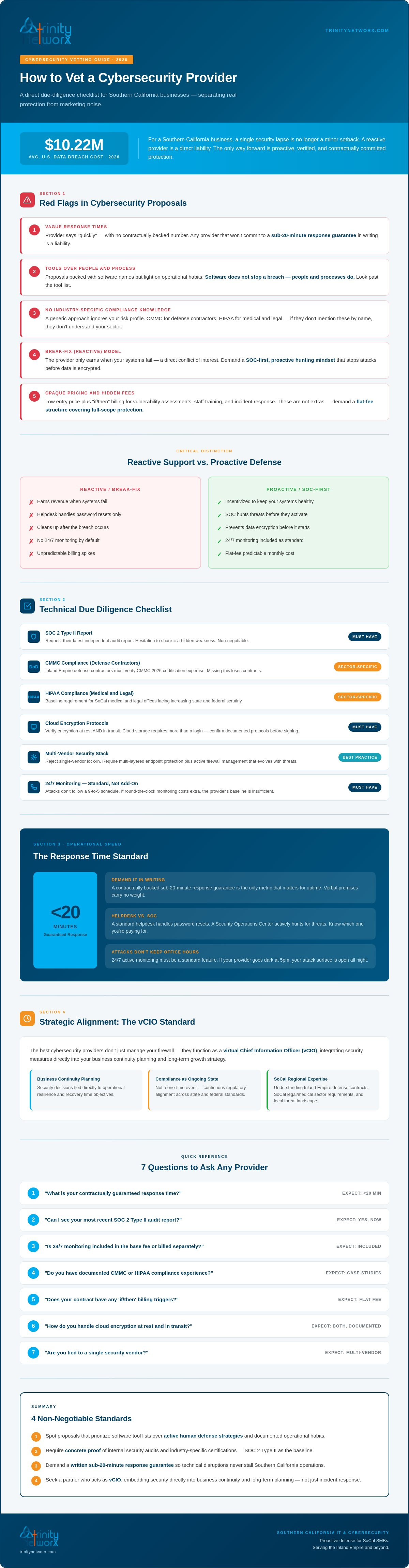
Stop viewing security as a technical line item. It is a strategic driver of business health and operational continuity. Many vendors treat security as a simple technical layer. This is a mistake. A partner must understand your specific industry, particularly if you operate in the manufacturing or supply chain sectors. When learning how to vet a cybersecurity provider, you must evaluate their ability to look beyond the next firewall update. Demand a technology roadmap that spans the next three to five years. This prevents your organization from falling into the trap of reactive spending. It helps you scale without technical friction.
A true partner functions as a member of your executive team. Utilizing virtual CIO services ensures your IT budget remains predictable and aligned with your growth targets. Strategic planning identifies aging hardware before it fails. It eliminates the chaos of emergency hardware refreshes that drain capital. This proactive approach turns your technology from a cost center into a competitive advantage. You gain momentum instead of technical debt.
Backups are useless if they don't work. Having a safety net isn't enough; you must know that the net will hold. Effective business data backup requires more than just automated scripts. Ask your potential provider how often they perform full data recovery drills. If they don't test their restoration process quarterly, your continuity plan is just a theory. Knowing how to vet a cybersecurity provider means verifying that they can restore your entire operation in hours, not days. This level of preparedness is the difference between a minor incident and a permanent shutdown. Your business deserves a partner that values stability as much as you do. Contact our team to discuss a roadmap that secures your future.
By: Lance Reichenberger, Ph.D.
Contact: contact us | Share: [Facebook] [LinkedIn] [Twitter]
Security isn't a technical accessory; it is a core business function. You've seen the red flags and you know the importance of SOC 2 reports and CMMC readiness. Now, you must act. A provider that won't commit to a response time in writing is a threat to your uptime. Don't settle for a vendor that hides behind software names or vague promises. Real protection requires a partner with documented habits and a fierce commitment to your operational continuity. Choose a team that understands the high stakes of the Southern California market.
Understanding how to vet a cybersecurity provider changes your business trajectory. It moves you from a defensive crouch to a position of strength. We offer 24/7 helpdesk support and a firm under 20 minute response time guarantee. Our team has provided local expertise since 2001. We don't just fix problems; we drive progress. Contact Lance Reichenberger, Ph.D. and the team at Trinity Networx, LLC to audit your current security posture. Let's secure your future today.
By: Lance Reichenberger, Ph.D.
Contact: contact us | Share: [Facebook] [LinkedIn] [Twitter]
SOC 2 Type II is the most critical certification to verify. It proves an independent auditor examined the provider's security controls over a period of months. This is far superior to a one time snapshot. It confirms the firm maintains high standards for data protection and operational reliability every day. If they don't have this, they aren't serious about their own security.
Assessments should happen continuously using automated tools. Waiting for a quarterly report is a mistake in 2026. Attackers move in seconds. Your provider needs to scan for vulnerabilities daily to catch new exploits before they are used against you. Real time visibility is the only way to stay ahead of modern threats.
Many firms provide both Managed IT and Cybersecurity Solutions to eliminate gaps between support and security. This integration allows the team to spot anomalies during routine maintenance. It ensures your helpdesk isn't accidentally opening doors for attackers while trying to fix a technical issue. Unified support creates a stronger defense for your entire organization.
A response time of under 20 minutes is the necessary standard for any technical emergency. Every minute of downtime during a breach increases the risk of total data loss. If a provider cannot guarantee this speed in their contract, they are not prepared for the pace of current cyberattacks. Speed is your best defense against ransomware.
A proactive partner provides a vCIO roadmap that looks years into the future. They don't just wait for your call. They use automated status monitoring to identify hardware failures or security gaps before you even notice a problem. This evidence based approach is essential when you decide how to vet a cybersecurity provider. If they can't show you a proactive maintenance schedule, they are just reacting to chaos.

Article by
Lance Reichenberger, Ph.D.., J.D. (Candidate)
Dr. Lance Reichenberger is the founder of Trinity Networx, a Southern California technology firm specializing in managed IT services, cybersecurity, network infrastructure, and business technology strategy. With nearly four decades of experience in the IT industry, he works with businesses to improve operational efficiency, strengthen security, and align technology with long-term growth objectives.
Lance focuses on proactive IT management, enterprise wireless infrastructure, cybersecurity integration, and scalable technology solutions for growing organizations throughout Southern California.
The content published on this website is provided for general informational and educational purposes only. Articles may be created, edited, or enhanced with the assistance of artificial intelligence and automation tools under the direction and review of Trinity Networx. While every effort is made to ensure accuracy and relevance, the information provided should not be considered professional, legal, financial, cybersecurity, or technical advice specific to your organization. Businesses should consult directly with a qualified professional regarding their unique environment, compliance requirements, and operational needs. Trinity Networx makes no warranties regarding completeness, reliability, or applicability of the information contained within these articles.
Schedule a brief conversation with Trinity Networx to discuss your business technology needs.
Get a practical roadmap built around your business, your users, your systems, and the technology issues that need attention first.
Put the right technology, support, security, and infrastructure in place so your business can grow, adapt, and move forward with confidence.