3281 E. Guasti Rd, STE 700, Ontario, CA 91761
1712 9th Ave SW, Watertown, SD 57201

By Lance Reichenberger, Ph.D.
Contact Trinity Networx, LLC: contact us | Share: [LinkedIn] [Facebook] [X]
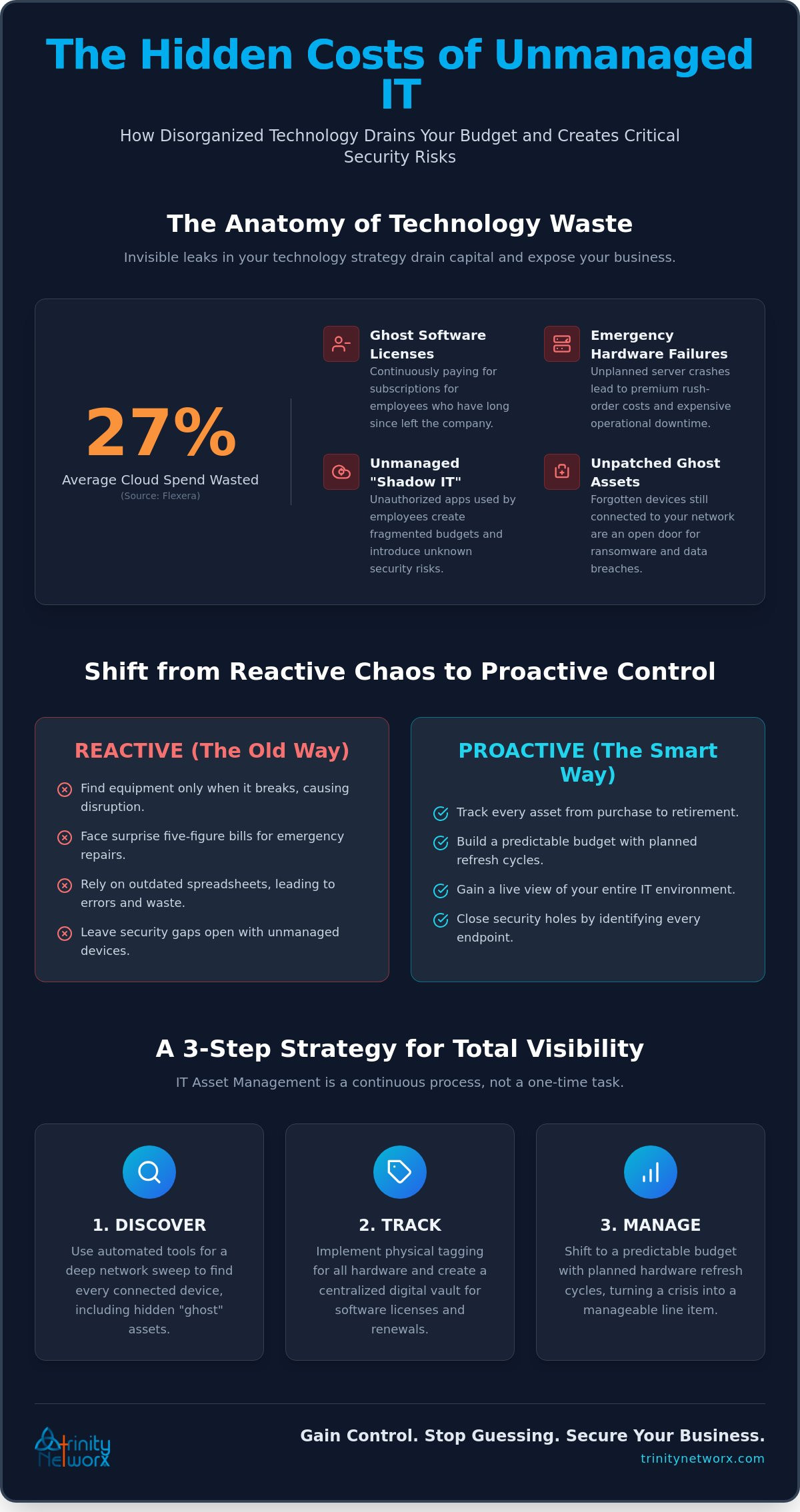
How much capital did you waste this morning? Most owners ignore the ghost technology haunting their monthly balance sheets. You're likely funding software licenses for people who haven't worked for you in months. Hardware disappears during staff turnover. Servers fail without warning, triggering emergency bills that wreck your quarterly projections. Research from Flexera indicates that organizations waste an average of 27% of their cloud budget. This isn't just a clerical oversight; it's a failure of visibility. Proactive IT asset management for small business turns this chaos into a strategic advantage. It stops the bleeding and secures your perimeter.
I know the frustration of opening a surprise five figure bill for a hardware refresh that should've been planned years ago. You want a clear inventory and a budget that stays where you put it. I'll show you how to build a tracking strategy that actually works. We'll move past reactive fixes. This guide covers identifying every device on your network, predicting your future spend, and closing the security gaps that hidden assets create. Let's build a more stable foundation for your growth.
• Stop reacting to broken gear; track every piece of hardware and software from purchase to retirement.
• Identify and cancel ghost licenses for departed staff to stop immediate cash leaks.
• Execute IT asset management for small business using deep network discovery to find every hidden device.
• Shift the administrative tracking burden to partners. Focus on your growth instead.
• Build a predictable budget and eliminate surprise invoices for emergency server refreshes.
IT asset management for small business is not a static inventory list tucked away in a drawer. It is a relentless, continuous process of tracking hardware and software throughout its entire lifecycle. You need to know where your equipment is, who is using it, and when it will fail. A foundational look at What is IT Asset Management shows that this discipline bridges the gap between technical oversight and financial accountability. It turns technology from a mystery into a manageable line item. You gain control. You stop guessing.
Most organizations live in a reactive state. They find equipment only when it breaks. This is a liability. Knowing exactly what lives on your network at all times provides security. It prevents unauthorized devices from siphoning data. It ensures you aren't paying for licenses that no one uses. If you still rely on a manual spreadsheet, you're already behind. Static files can't keep up with the speed of a growing company. They lead to errors. They cause missed renewals. They waste capital. You need a live view of your environment to stay competitive.
Your technology footprint consists of both physical and intangible assets. Hardware includes the tangible tools your team touches every day. Think of servers, workstations, laptops, and mobile devices. These require maintenance and eventual replacement. Software resources are different. They include SaaS subscriptions, local applications, and cloud instances. These assets are often harder to track because they don't sit on a desk. Our IT management services integrate both into a single dashboard. We monitor the health of your physical gear while managing the costs of your digital subscriptions. This visibility is the only way to maintain a lean, efficient operation. Stop the leaks before they sink your budget.
Invisible leaks drain your revenue every month. If you haven't audited your user seats lately, you're likely paying for software licenses assigned to people who left your company a year ago. It's a common oversight. SaaS sprawl makes it worse. Employees frequently sign up for unauthorized apps to solve immediate problems without telling IT. This shadow IT creates a fragmented budget and a massive security hole. Implementing a proactive tracking system ensures every dollar spent on software provides actual value.
Hardware is your next financial hurdle. Without a structured refresh cycle, you face surprise server failures that demand immediate capital. These emergency replacements often cost significantly more due to rush shipping and unplanned labor. You lose money on the hardware and the downtime. Our approach to IT optimization identifies these aging components before they crash. We help you plan for expenses years in advance. It turns a crisis into a predictable line item.
Ghost assets are the silent killers of your network security. These are old laptops, printers, or tablets that are no longer tracked but remain connected to your Wi-Fi. Because no one manages them, they don't receive critical security patches. An unpatched device is a wide-open door for ransomware. It only takes one forgotten workstation in a storage closet to compromise your entire database.
Effective IT asset management for small business requires finding every single endpoint. You cannot protect what you cannot see. We use managed cybersecurity services to hunt for these hidden threats. Visibility is your first line of defense. If you're tired of financial surprises and hidden risks, it's time to talk to a strategic partner who watches your back.
Execution begins with a deep network sweep. You cannot manage what you haven't found. We use automated discovery tools to identify every IP address and connected device. This initial audit uncovers the "ghosts" mentioned earlier. It provides a baseline for your entire strategy. Following this, we move to physical tagging. Every laptop and server gets a unique identifier. This physical link ensures that when a staff member leaves, the equipment returns to your inventory. It prevents hardware loss during turnover. It keeps your assets where they belong.
Software requires a different approach. We centralize every license key and renewal date in a single vault. You will never again pay a late fee or miss a critical update. This centralization allows you to see exactly how many seats you own versus how many you actually use. It stops the waste. Finally, we establish a formal procurement process. No one should buy a new app or laptop without it passing through the tracking system first. This gatekeeping prevents shadow IT from creeping back into your environment. Following the guidelines for IT Asset Management (ITAM) ensures your business remains compliant and secure against modern threats. It is about professional assurance.
Technology has a birth and a death. Effective IT asset management for small business tracks the asset from the moment of purchase to the second it is destroyed. Secure disposal is not optional. You must wipe all data to prevent breaches and meet compliance standards. Simply throwing away an old hard drive is a liability. We integrate this into your broader IT infrastructure planning to ensure you always have the right tools for the job. We manage the transitions. Do not leave your network to chance. You can contact us for a discovery session to see exactly where your current system is failing.
By Lance Reichenberger, Ph.D.
Contact Trinity Networx, LLC: contact us | Share: [LinkedIn] [Facebook] [X]
You didn't start your company to track laptop serial numbers. Most owners lack the hours required for diligent oversight. Buying a software license is simple; managing the lifecycle of every device is a burden that distracts from your core mission. Trinity Networx, LLC steps in as your strategic partner. We provide the tools and the expert labor to run them. We don't just report on your environment. We own the results.
Our team guarantees a response time of under 20 minutes for any technical hurdle. This speed ensures your inventory data is always live and accurate. If a device fails or a new hire starts, we move immediately. This level of proactive support is why firms rely on our managed IT services in Ontario CA. We bridge the gap between high-level budgeting and daily operations. IT asset management for small business is about more than just data entry. It's about professional assurance.
We understand the specific pressures of the Inland Empire and the greater SoCal region. Manufacturing plants need uptime on the floor. Legal firms require airtight compliance and data destruction. Generic, faceless vendors can't offer the site-specific insight we provide. We visit your office. We see your hardware. We know your team.
Effective IT asset management for small business requires a local touch. You need a partner who understands the local regulatory environment and the fast pace of Southern California commerce. Lance Reichenberger and the Trinity Networx, LLC team are ready to secure your assets and stabilize your budget. Stop managing spreadsheets. Start growing your business. Reach out today to speak with our experts.
By Lance Reichenberger, Ph.D.
Contact Trinity Networx, LLC: contact us | Share: [LinkedIn] [Facebook] [X]
Stop letting invisible assets dictate your financial future. You've moved beyond the theory of tracking and the risks of shadow IT. It's time to execute. A disciplined approach to IT asset management for small business ensures your growth isn't hampered by technical debt or security oversights. Trinity Networx, LLC has provided this level of assertive reliability since 2001.
We back our expertise with a 20 minute response time guarantee and 24/7 proactive monitoring. We manage the complexity while you focus on your Southern California operation. Ready to stabilize your budget and secure every endpoint? Contact Trinity Networx, LLC for a Proactive IT Strategy. Your technology should be a driver of progress, not a source of anxiety. Let's build that momentum.
By Lance Reichenberger, Ph.D.
Contact Trinity Networx: contact us | Share: [LinkedIn] [Facebook] [X]
Yes. A team of ten often manages thirty or more endpoints and dozens of cloud accounts. If you lose track of just one laptop during an employee exit, you face a potential data breach. Managing these assets ensures you recover hardware and revoke digital access the moment a staff member leaves the company.
Insurance carriers now demand a complete hardware and software inventory as a condition for coverage. They need to see that you know exactly what is on your network before they will assess your risk. If you cannot provide a verified list of devices, your application might be rejected or your premiums will skyrocket. It demonstrates professional oversight.
You can start there, but it will fail as you grow. Spreadsheets are static documents that become obsolete the second you save the file. They rely on manual entry and are prone to human error. Effective IT asset management for small business uses automated tools to track live changes on your network. This creates a reliable record that never goes out of date.
Data destruction is a mandatory final step for compliance. We don't just delete folders. We perform certified disk wiping or physical shredding of the media to ensure no proprietary information remains. This protects your liability and keeps your sensitive client data from falling into the wrong hands after the hardware leaves your office.
You should aim for a full reconciliation every quarter. While our systems monitor your network every minute of the day, a quarterly physical check verifies that your equipment matches your digital records. This cadence catches ghost assets and ensures your hardware refresh plan stays on schedule. It prevents financial surprises and keeps your budget predictable.

Article by
Lance Reichenberger, Ph.D.., J.D. (Candidate)
Dr. Lance Reichenberger is the founder of Trinity Networx, a Southern California technology firm specializing in managed IT services, cybersecurity, network infrastructure, and business technology strategy. With nearly four decades of experience in the IT industry, he works with businesses to improve operational efficiency, strengthen security, and align technology with long-term growth objectives.
Lance focuses on proactive IT management, enterprise wireless infrastructure, cybersecurity integration, and scalable technology solutions for growing organizations throughout Southern California.
The content published on this website is provided for general informational and educational purposes only. Articles may be created, edited, or enhanced with the assistance of artificial intelligence and automation tools under the direction and review of Trinity Networx. While every effort is made to ensure accuracy and relevance, the information provided should not be considered professional, legal, financial, cybersecurity, or technical advice specific to your organization. Businesses should consult directly with a qualified professional regarding their unique environment, compliance requirements, and operational needs. Trinity Networx makes no warranties regarding completeness, reliability, or applicability of the information contained within these articles.
Schedule a brief conversation with Trinity Networx to discuss your business technology needs.
Get a practical roadmap built around your business, your users, your systems, and the technology issues that need attention first.
Put the right technology, support, security, and infrastructure in place so your business can grow, adapt, and move forward with confidence.