3281 E. Guasti Rd, STE 700, Ontario, CA 91761
1712 9th Ave SW, Watertown, SD 57201

By Lance Reichenberger, Ph.D.
California regulators won't pause their enforcement calendars because your internal team feels overwhelmed by shifting mandates. Most Southern California executives currently confuse general labor law updates with the technical data privacy requirements looming on the horizon. This confusion creates a dangerous gap in your defense. You need a specific IT compliance checklist for California businesses 2026 that moves beyond vague policy language into hard technical requirements. Ignoring these shifts isn't an option; it's an invitation for a regulatory audit.
You likely feel the weight of the California Privacy Protection Agency (CPPA) and its increasing appetite for aggressive enforcement actions. It's difficult to audit complex cloud environments without specialized eyes. I'll provide a direct technical audit to verify your systems meet 2026 mandates without the typical guesswork. We will cover the specific network configurations and data handling protocols required to keep your operations secure. This guide breaks down the technical must-haves to reduce your risk of litigation and protect your business's future.
• Map consumer data with automated discovery to stay ahead of expanded CPPA definitions. Knowing where information lives is the first step toward safety.
• Deploy phishing resistant multi-factor authentication. This direct action satisfies strict legal mandates for reasonable security across all business applications.
• Follow this IT compliance checklist for California businesses 2026. It allows you to identify vulnerabilities in your cloud and on-premise infrastructure before they trigger an audit.
• Retire legacy hardware that lacks security patches. Aging equipment acts as a regulatory target and a liability for your Southern California operations.
• Detect compliance failures early. Proactive monitoring ensures your technical health supports business continuity and reduces the risk of sudden litigation.
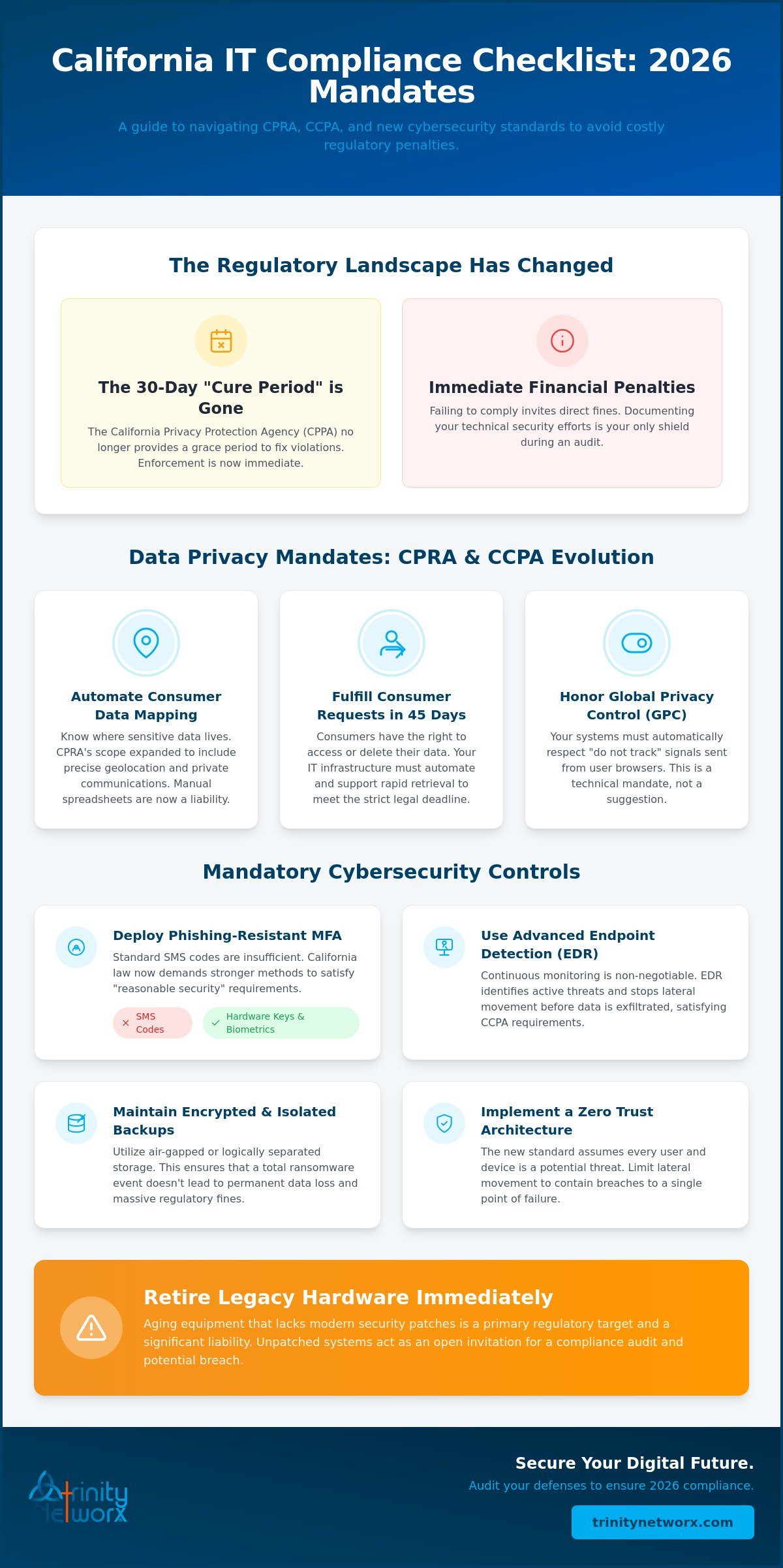
California's regulatory environment has moved past simple warnings. The California Privacy Rights Act (CPRA) expanded the scope of what businesses must protect. It's no longer just about credit card numbers. Sensitive personal information now includes precise geolocation and private communications. If you don't know exactly where this data sits on your servers, you're already behind. This is a primary entry on your IT compliance checklist for California businesses 2026.
Lance Reichenberger, Ph.D. notes that manual data tracking is now a liability. Relying on spreadsheets to track consumer data leads to errors. It leads to missed deadlines. Modern requirements demand automated discovery tools. These tools map data across your network in real time. You must also verify that Global Privacy Control (GPC) signals are active on your site. If a browser sends a "do not track" signal, your system must respect it immediately. It's a technical mandate, not a suggestion.
Consumers have a legal right to access or delete their data. You have exactly 45 days to comply. This window closes fast. Your IT infrastructure must support rapid retrieval. If data is scattered across unorganized cloud storage, you won't meet the deadline. Automation handles these requests without taxing your staff. It provides the speed necessary to maintain legal standing.
The "cure period" is a relic of the past. Earlier, the state gave you 30 days to fix a violation. That safety net is gone. The California Privacy Protection Agency now issues immediate financial penalties. Documenting your technical efforts is your only shield. You must prove you've taken every reasonable step to secure data. This documentation shows good faith during an audit. It's about operational survival. Maintaining an updated IT compliance checklist for California businesses 2026 is the only way to stay ahead of these aggressive new rules.
California law now demands "reasonable security" for all entities handling resident data. This isn't a vague suggestion anymore. In 2026, regulators look for specific technical controls during audits. A mandatory item on your IT compliance checklist for California businesses 2026 is phishing-resistant multi-factor authentication (MFA). Standard SMS codes don't provide enough protection. You need hardware keys or biometric verification across every business application to prevent credential theft. This is the baseline for operational survival.
Deploying advanced endpoint detection and response (EDR) is also non-negotiable. It provides the continuous monitoring required by the California Consumer Privacy Act (CCPA). EDR identifies active threats and stops lateral movement before data is exfiltrated. Beyond detection, you must maintain encrypted backups that are logically or physically isolated from your main network. Air-gapped storage ensures that even a total ransomware event doesn't lead to permanent data loss or massive regulatory fines. You must also conduct rigorous technical audits on every third party vendor to manage supply chain risks.
Zero trust architecture is the new standard for Southern California businesses. It assumes every user and device is a potential threat. By limiting lateral movement, you contain breaches to a single point of failure. You can't manage this level of scrutiny alone. Our managed cybersecurity services provide the constant vigilance needed to catch compliance drifts instantly. If you're unsure about your current perimeter, talk to an expert to audit your defenses.
Annual training sessions are a waste of time. They don't change behavior. Implement monthly security awareness simulations instead. These short, frequent tests keep security top of mind for your staff. You must track participation rates as part of your legal compliance documentation. This data proves your organization maintains a culture of vigilance when the state requests proof of your security efforts.
By Lance Reichenberger, Ph.D.
Vulnerability assessments aren't optional. You must scan every cloud and on-premise asset before the 2026 deadline hits. These scans identify weak points in your encryption and access controls. The IT compliance checklist for California businesses 2026 requires more than a simple checkbox; it demands proof of regular testing. Legacy hardware acts as an open door for attackers. If your servers or switches no longer receive security patches, retire them immediately. Keeping end-of-life equipment is a direct violation of the reasonable security clause.
Formalizing an incident response plan ensures you meet the strict breach notification timelines mandated by state law. You can't afford to guess when a crisis occurs. Your team needs a playbook that dictates exactly who to call and what systems to isolate. Follow the FTC Cybersecurity Guidance for Small Business to align with federal standards that often mirror California's expectations. Adopt active IT management to maintain a continuous compliance posture.
California is cracking down on automated decision-making. You must audit how your business uses AI to process resident data. Every automated process needs a clear opt-out mechanism for consumers to comply with state mandates. Documenting these technical workflows protects your firm during a state inquiry. It's about maintaining control over how data flows through your digital ecosystem.
Test your recovery time objective to ensure it aligns with your actual operational needs. Downtime is more than an inconvenience; it's a compliance failure. Review our guide on business data backup for 2026 technical standards. To begin your technical shift, contact Trinity Networx, LLC at contact us for a professional audit.
Contact Trinity Networx, LLC at contact us to discuss your 2026 roadmap. Share this roadmap on social media: [Facebook] [LinkedIn] [Twitter]
By Lance Reichenberger, Ph.D.
Compliance isn't a static goal. It's a continuous state of operational readiness. Proactive monitoring identifies technical drifts before they escalate into legal disasters. You need a partner. Someone who watches your network every hour of every day. Integrating IT optimization ensures your security protocols don't cripple your speed. This balance is a critical part of your IT compliance checklist for California businesses 2026. Security must drive your business forward. It shouldn't hold it back.
Accessing a 24/7 helpdesk ensures that technical roadblocks disappear immediately. Your team shouldn't wait for a callback while a potential vulnerability sits open. Working with a Southern California expert provides a distinct advantage. Local regulatory nuances matter. We understand the specific enforcement priorities of the CPPA and how they impact businesses in our region. We replace anxiety with assertive reliability. We keep you moving.
Stop viewing IT as a cost center. It is a documented asset that helps you win bigger contracts. Many enterprise clients now require proof of security before signing any agreement. If your business handles government data, achieving CMMC compliance is mandatory for future growth. We help you turn your technical posture into a competitive edge. You gain the momentum needed to outpace competitors. Most are still stuck in a reactive cycle. Don't be one of them.
The 2026 deadline is closer than it appears on the calendar. Scheduling a professional assessment is the only way to find your high risk gaps before a regulator does. We provide a direct technical roadmap to bring your systems into alignment. This is the final step in your IT compliance checklist for California businesses 2026. Contact our team at contact us to begin your technical shift. Don't let compliance fines destroy your operational capital. Secure your future today.
Contact us at contact us to discuss your compliance needs. Share this roadmap on social media: [Facebook] [LinkedIn] [Twitter]
By Lance Reichenberger, Ph.D.
Waiting for a regulatory notice is a failed strategy. You've seen the shift. California mandates now require technical accountability that goes beyond simple paperwork. You must move. Active network defense is the only way forward. This IT compliance checklist for California businesses 2026 serves as your baseline for survival. Successful leaders replace aging hardware. They automate data discovery now. They don't wait for a crisis to prove their security posture is sufficient.
Don't let technical debt become a legal liability. Under the leadership of Lance Reichenberger, Ph.D., Trinity Networx, LLC provides the assertive reliability your business deserves. We provide proactive 24/7 monitoring and a 20 minute response time guarantee to keep your systems stable. Stop reacting to every new headline. Contact Lance Reichenberger, Ph.D. at Trinity Networx, LLC to secure your 2026 compliance today. Your business has the strength to thrive in this new era. Professional assurance starts here.
Contact us at contact us. Share this roadmap: [Facebook] [LinkedIn] [Twitter]
By Lance Reichenberger, Ph.D.
CCPA applies to your business if you meet specific revenue or data thresholds. You're covered if you have over $25 million in gross annual revenue or handle the personal information of 100,000 or more California residents. Don't assume your size protects you. Many firms fall under the mandate because they share data with larger partners. It's a technical reality you must verify before 2026 to avoid sudden enforcement actions.
Penalties for non-compliance are steep and immediate. The California Privacy Protection Agency (CPPA) can issue fines of up to $2,500 for unintentional violations. Intentional violations cost up to $7,500 per incident. These costs multiply quickly across thousands of consumer records. There is no longer a 30 day cure period to fix mistakes. Your operational capital is at risk if your technical defenses fail an audit.
Conduct a technical IT audit at least once every twelve months to maintain your standing. Significant network changes or new cloud integrations require immediate re-assessment. Regular testing is a core part of your IT compliance checklist for California businesses 2026. It identifies security drifts before they become legal liabilities. Continuous monitoring provides even better protection by catching vulnerabilities as they appear.
"Reasonable security" means implementing industry-standard technical controls to protect personal data. This includes phishing resistant multi-factor authentication and advanced endpoint detection. You must also use encryption for data at rest and in transit. Regulators look for active monitoring and documented incident response plans. If you lack these specific technical layers, your security isn't considered reasonable under the law.
Managed IT services align your infrastructure with both CMMC and CCPA standards through overlapping technical controls. Many requirements for defense contracts mirror California's privacy mandates. This includes strict access logs and air-gapped backups. We help you build a unified defense that satisfies multiple regulatory bodies at once. It's a strategic way to maintain your IT compliance checklist for California businesses 2026 while pursuing government contracts.
Contact us at contact us. Share this guide: [Facebook] [LinkedIn] [Twitter]

Article by
Lance Reichenberger, Ph.D.., J.D. (Candidate)
Dr. Lance Reichenberger is the founder of Trinity Networx, a Southern California technology firm specializing in managed IT services, cybersecurity, network infrastructure, and business technology strategy. With nearly four decades of experience in the IT industry, he works with businesses to improve operational efficiency, strengthen security, and align technology with long-term growth objectives.
Lance focuses on proactive IT management, enterprise wireless infrastructure, cybersecurity integration, and scalable technology solutions for growing organizations throughout Southern California.
The content published on this website is provided for general informational and educational purposes only. Articles may be created, edited, or enhanced with the assistance of artificial intelligence and automation tools under the direction and review of Trinity Networx. While every effort is made to ensure accuracy and relevance, the information provided should not be considered professional, legal, financial, cybersecurity, or technical advice specific to your organization. Businesses should consult directly with a qualified professional regarding their unique environment, compliance requirements, and operational needs. Trinity Networx makes no warranties regarding completeness, reliability, or applicability of the information contained within these articles.
Schedule a brief conversation with Trinity Networx to discuss your business technology needs.
Get a practical roadmap built around your business, your users, your systems, and the technology issues that need attention first.
Put the right technology, support, security, and infrastructure in place so your business can grow, adapt, and move forward with confidence.