3281 E. Guasti Rd, STE 700, Ontario, CA 91761
1712 9th Ave SW, Watertown, SD 57201
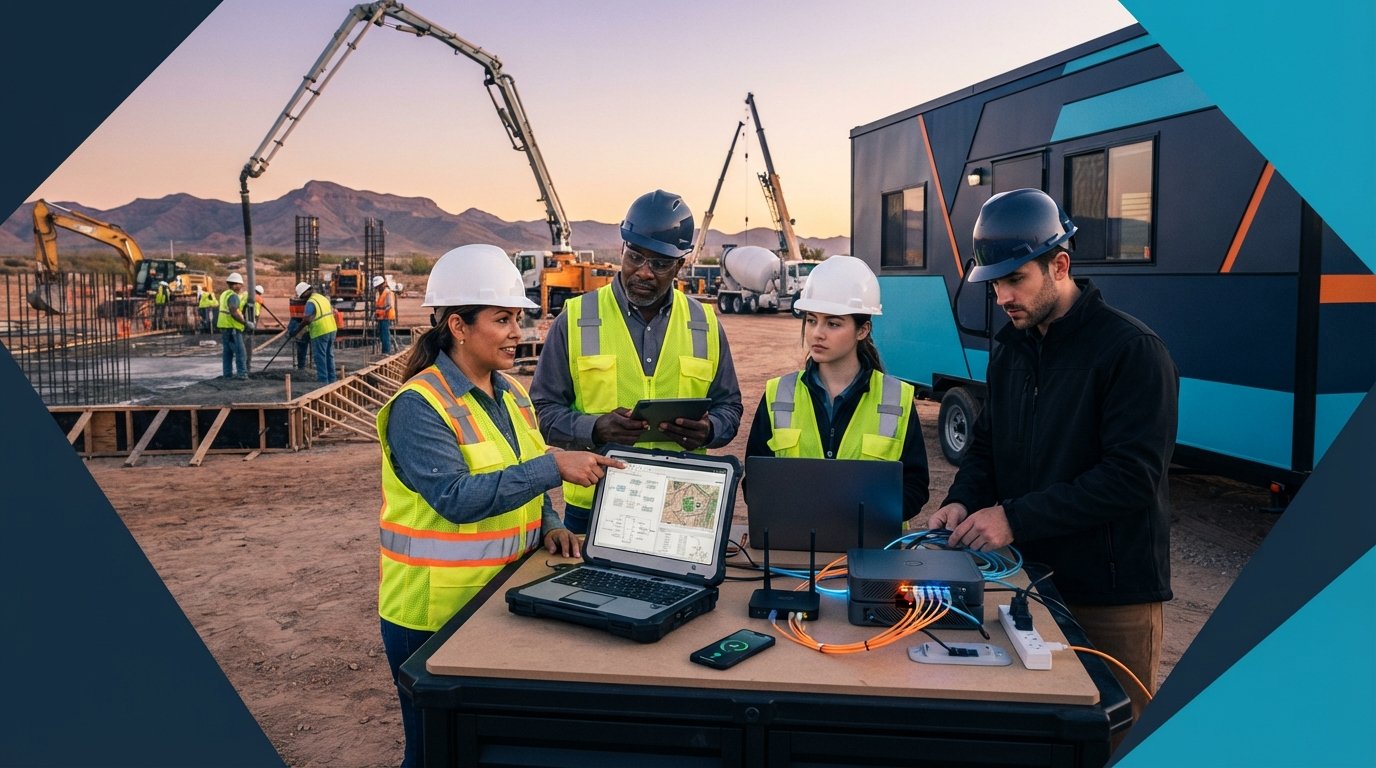
A concrete pour is scheduled for sunrise, yet your jobsite superintendent cannot load revised structural drawings because the field trailer network dropped. Generic help desks leave your crews stuck in queue for hours, waiting on remote operators who have never heard of Procore. Commercial builders need IT support that feels like an in-house team without the burden of full-time executive payroll.
Every lost hour in the dirt compounds labor costs and threatens hard completion deadlines. You shouldn't have to tolerate unpredictable hourly repair bills or technicians who don't understand jobsite realities. This guide reveals how growing contractors secure dedicated, field-ready technical management to protect project profit margins and eliminate operational downtime. We break down the exact operational model required to maintain rapid, local technical support across every active build.
• Identify why generic, outsourced call centers stall active jobsites and fail to resolve urgent field software errors.
• Discover how IT support that feels like an in-house team gives superintendents direct phone access to technicians who understand specialized construction workflows.
• Replace volatile hourly tech invoices with flat monthly pricing models that protect project profit margins from unplanned downtime.
• Uncover practical steps to audit field network infrastructure and lock down binding response commitments that safeguard active builds.
Commercial construction runs on strict milestones, tight trades, and heavy coordination. When field equipment fails, generic IT providers treat the issue like an office email glitch. They assign a ticket number, push the request into a shared queue, and ask a jobsite superintendent to wait. That model breaks down immediately on active jobsites. Subcontractors stand idle, inspections stall, and project managers lose valuable hours negotiating with offshore call center agents reading rigid scripts. Outsourced providers focused on corporate cubicles do not comprehend the physical realities of dirt, concrete, and fast turnaround schedules.
True operational alignment demands specialized construction technical expertise. Field crews cannot afford to explain what Procore, Autodesk Construction Cloud, or large-format plan tables are to an overseas help desk. They need direct access to engineers who grasp the exact applications driving your daily operations.
Remote ticket queues trigger expensive ripple effects across active projects. Commercial builds suffer when technology failures go unaddressed:
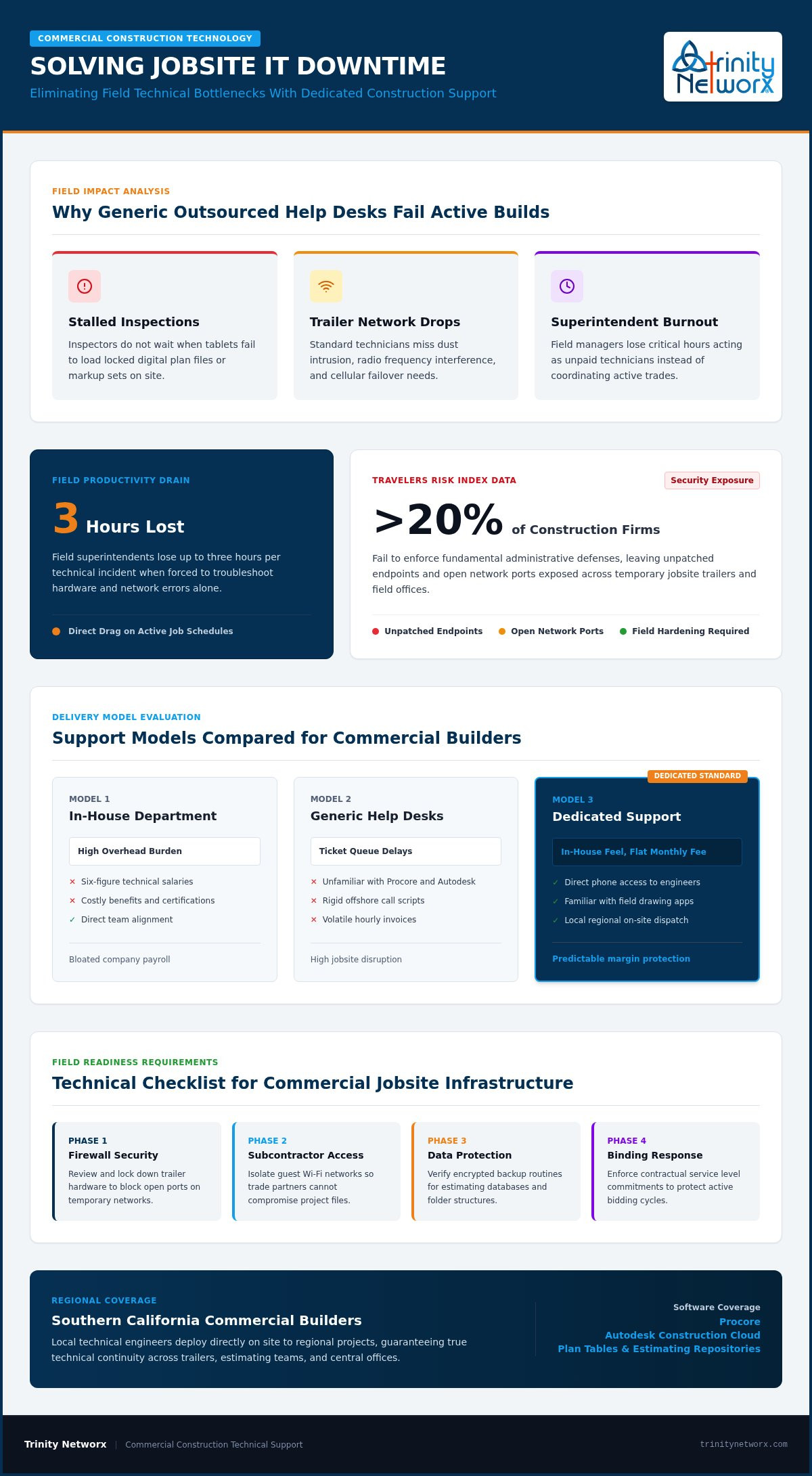
Inspectors won't wait while a superintendent troubleshoots locked digital plan files on a rugged tablet.
Generic technicians treat mobile trailers like permanent corporate buildings, missing the radio frequency interference, dust intrusion, and cellular failover needs unique to field offices.
Field leaders lose up to three hours per incident acting as amateur technicians instead of managing trades and jobsite safety.
Securing genuine IT support that feels like an in-house team removes these operational bottlenecks. Local, dedicated engineers answer direct calls, eliminate call queues, and resolve technical issues before daily field schedules slip.
Hiring an entire internal department brings massive overhead: six-figure salaries, benefits, and ongoing certifications. Yet, settling for disconnected third parties leaves project managers stranded. The middle ground is IT support that feels like an in-house team: an exclusive group of local, fully accountable engineers who operate as an embedded arm of your business. When superintendents call, they talk directly to experienced personnel who know them by name and immediately grasp their field environment.
No tier-one scripts. No endless diagnostic runarounds. Field personnel get immediate, decisive answers because these engineers already know your project folder structures, licensing limits, and estimation databases. Predictable, flat monthly agreements give commercial builders enterprise-grade technical leadership without bloated payroll.
True operational alignment connects the trailer directly to headquarters. Proactive monitoring flags hardware issues and network drops before trades step foot on site. You can review specialized commercial construction IT services to align central estimators, project executives, and active field teams on a single unified technical foundation.
When trailer routers fail or rugged tablets refuse to sync drawing markups, local technicians step in swiftly to eliminate the disruption. If your current IT setup leaves jobsite crews struggling alone, speak with our technical team to secure dependable, field-ready support across your regional operations.
Transitioning to reliable IT operations requires a methodical rollout rather than a hurried software switch. Before changing providers, commercial contractors must execute a rigorous audit of their field devices, active trailers, and project estimating repositories. According to Travelers Risk Index data, over 20 percent of construction firms fail to enforce fundamental administrative defenses, leaving unpatched endpoints and open network ports exposed across temporary jobsite setups.
Your technical partner must review local firewalls, isolate guest subcontractor access, and verify encrypted backup routines for all estimating data. Binding service level agreements are essential. Demand guaranteed response windows to protect active bidding schedules from unbudgeted network failures. For commercial builders in Southern California, having local engineers who can deploy on-site to regional projects guarantees true technical continuity.
Unpredictable hourly IT invoices quietly drain job margins. Shifting to an all-inclusive, flat monthly arrangement caps operational spending while providing continuous maintenance across every active jobsite.
If you already employ an internal technical director, consider exploring co-managed IT support. This structure relieves single technicians from exhausting tier-one maintenance tickets while reinforcing your operations with specialized field engineering. Delivering IT support that feels like an in-house team means your superintendents receive immediate assistance without bureaucratic delays.
Take control of your jobsite technology before your next ground-breaking. Contact Trinity Networx today to schedule a comprehensive construction network review and safeguard your field operations.
Unplanned downtime has no place on an active commercial build. Your field superintendents deserve immediate communication with engineers who understand trade schedules, cellular trailer limitations, and blueprint software. Partnering with Trinity Networx gives your firm IT support that feels like an in-house team without the heavy overhead of an internal tech department.
We back your operations with 100 percent in-house US technicians and zero overseas outsourcing. Recognized by CIO Review as a top promising IT services provider, our engineers deliver rapid server virtualization in 30 to 40 minutes to keep your bidding files and jobsite records protected. You don't have to accept slow ticket queues that eat into hard-earned margins.
Schedule a consultation with our construction technology team today to lock down reliable field support for every active build.
Dedicated external providers function as direct business partners rather than faceless ticketing queues. Instead of routing your field superintendents to overseas call centers, a dedicated partner supplies direct phone access to local technicians who understand jobsite workflows. You receive true IT support that feels like an in-house team, backed by guaranteed response times and technicians who already know your personnel and network layout.
Yes, experienced providers configure and maintain job trailer connectivity across California, Nevada, Arizona, and Utah. Support includes setting up ruggedized network gear, cellular data failover, and isolated Wi-Fi for visiting trade partners. Dedicated technicians handle remote mobile troubleshooting over the air while remaining available to deploy directly to regional jobsites when hardware failures disrupt active builds.
Specialized technicians support core commercial build applications, including Procore, Autodesk Construction Cloud, Bluebeam Revu, and heavy accounting systems like Sage 300 CRE. Rather than deflecting software issues back to software vendors, a specialized partner acts as an active liaison. They troubleshoot licensing sync errors, project database access problems, and digital blueprint viewing delays directly with field staff.
Flat monthly agreements replace unpredictable, billable hourly repair rates with stable technology overhead. Delivering IT support that feels like an in-house team under a fixed agreement encourages proactive maintenance rather than reactive emergency billings. This predictable structure protects project margins from surprise expenses, stabilizes annual cash flow, and eliminates disputes over billable hours spent fixing jobsite hardware.

Article by
Lance Reichenberger, Ph.D.., J.D. (Candidate)
Dr. Lance Reichenberger is the founder of Trinity Networx, a Southern California technology firm specializing in managed IT services, cybersecurity, network infrastructure, and business technology strategy. With nearly four decades of experience in the IT industry, he works with businesses to improve operational efficiency, strengthen security, and align technology with long-term growth objectives.
Lance focuses on proactive IT management, enterprise wireless infrastructure, cybersecurity integration, and scalable technology solutions for growing organizations throughout Southern California.
The content published on this website is provided for general informational and educational purposes only. Articles may be created, edited, or enhanced with the assistance of artificial intelligence and automation tools under the direction and review of Trinity Networx. While every effort is made to ensure accuracy and relevance, the information provided should not be considered professional, legal, financial, cybersecurity, or technical advice specific to your organization. Businesses should consult directly with a qualified professional regarding their unique environment, compliance requirements, and operational needs. Trinity Networx makes no warranties regarding completeness, reliability, or applicability of the information contained within these articles.
Schedule a brief conversation with Trinity Networx to discuss your business technology needs.
Get a practical roadmap built around your business, your users, your systems, and the technology issues that need attention first.
Put the right technology, support, security, and infrastructure in place so your business can grow, adapt, and move forward with confidence.